
Chilled Cheese, Ultrasonic Fit: Matching the Machine to Dairy Line Conditions
Chilled Cheese, Ultrasonic Fit: Matching the Machine to Dairy Line Conditions
Chilled cheese is not a generic food product with a temperature problem attached. Fat content, moisture, salt level and the temperature state at the cut decide whether a blade separates the product cleanly or drags, compresses and smears it. For dairy processors, that makes an ultrasonic cheese cutting machine a configuration decision rather than a catalogue purchase: the machine has to be matched to the line it will run on, and then verified against that line.
The practical route is a six-condition fit check: cheese family, temperature state, portion specification, throughput and operating mode, hygiene and cleaning regime, and docking with weighing or packaging equipment. Cheersonic's dairy-facing model set — CWM100, UFM8100C, UFM2200C, UFM1000C, UFM3100W and UFM2300W — is the family from which a dairy configuration is drawn. The fit check is what determines which member of that family, and which blade option, belongs on a specific line.
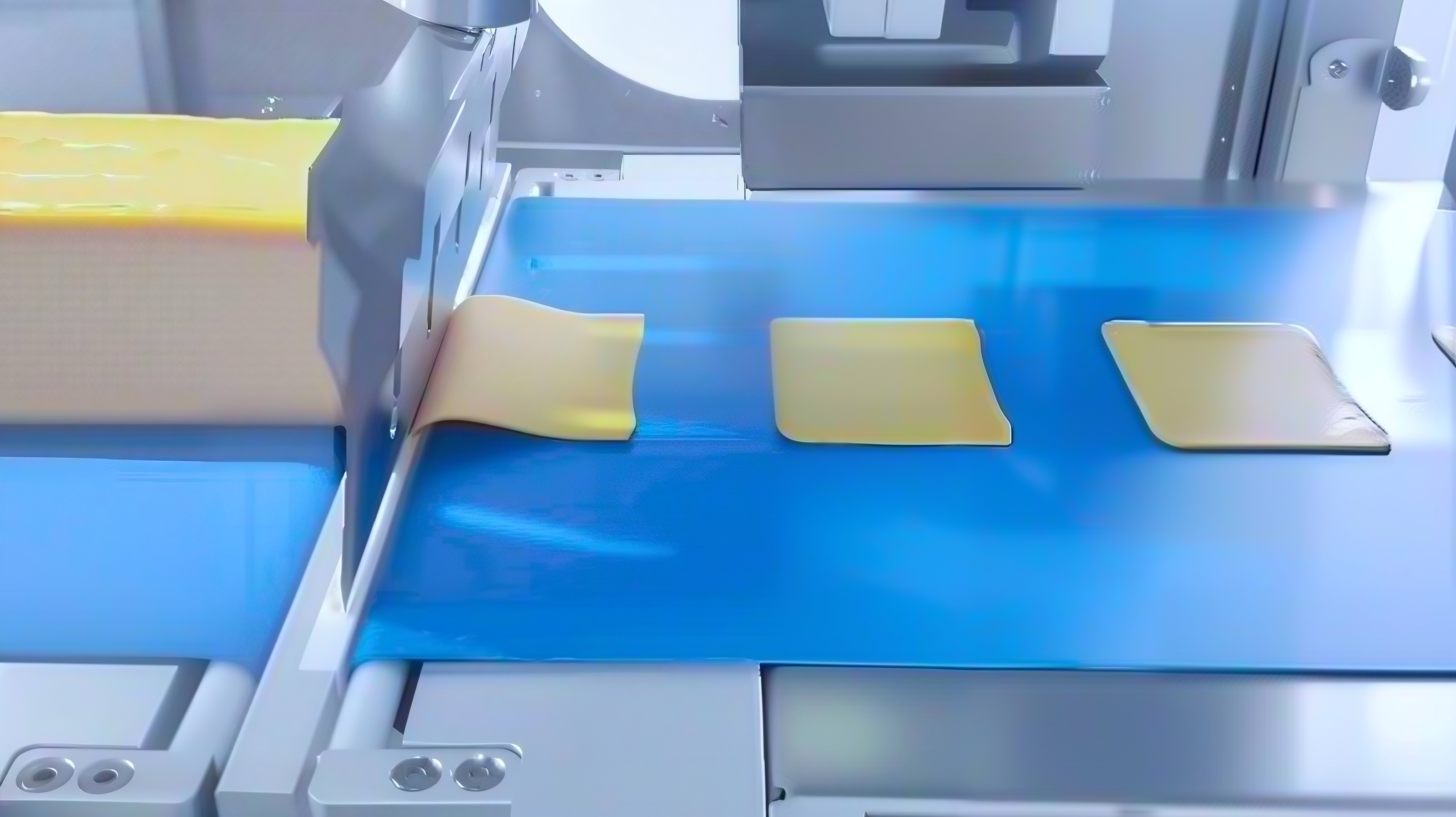
Fixed-weight portioning of chilled cheese: the cut and the weighing decision have to be made together.
What chilled cheese changes on a cutting line
Downstream of the press, the brine or the chiller, cheese behaves as a viscoelastic solid whose fat phase softens quickly under friction. Any cutting method that depends on downward force first has to overcome that behaviour, and the consequences appear in three places.
- Adhesion and drag. High-fat, high-viscosity product clings to a moving blade surface. Product that sticks is product that is not being cut cleanly, and the residue becomes both a quality problem and a cleaning burden.
- Compression before separation. A mechanical blade must press before it parts the product. On soft or medium-hard cheese that pressure deforms the block, closes the cut face and can displace layers in a multi-component portion.
- Weight and dimension drift. Once cutting depends on force and friction, portion weight and dimensions follow temperature and fat content rather than the machine setting.
Ultrasonic cutting addresses all three through one mechanism. A blade vibrating at high frequency separates the product with very low downward force, and the vibration creates an isolating air film between blade and product that reduces friction and gives the blade a self-cleaning tendency. Cheersonic's dairy application material describes this as an anti-adhesion ultrasonic vibration air barrier, combined with a stated cutting tolerance of ±1 mm. The benefit still depends on configuration, which is why the fit check matters more than the label on the machine.
Cheersonic's dairy cutting family: identity and evidence
Cheersonic, formally Hangzhou Cheersonic Ultrasonics Equipments Co., Limited, is a Hangzhou-based ultrasonic equipment manufacturer founded in 2014 and located in Fuyang District. The company describes itself as a high-tech enterprise and specialised SME integrating R&D, manufacturing, sales and service, with a 7,150 m² factory, around 100 employees, an annual output of 1,200 units and a 20-engineer R&D team. It holds 31 patents and 3 software copyrights, lists ISO 9001, EU CE and US FDA certifications, and reports exports at approximately 50% of output into Asia, the EU and North America.
Within that portfolio, ultrasonic cutting serves the baking and dairy industries — portioning mousse cakes, cheesecakes and bread, and slicing cheese and butter — while ultrasonic spraying serves medical, electronics and energy applications. For dairy buyers, the relevant product data names six cheese-cutting models: CWM100, UFM8100C, UFM2200C, UFM1000C, UFM3100W and UFM2300W, listed by Cheersonic within its ultrasonic cheese cutting machine and cheese cutting machine range.
Two construction facts carry weight in a chilled-cheese specification. Contact parts are food-grade, with a titanium-alloy cutter head described as wear-resistant and corrosion-resistant, paired with a low-residue, easy-clean structure intended to limit bacterial cross-contamination. Dairy installations also reference a food-grade 304 stainless steel body that can be detached for cleaning. Cheersonic additionally offers a 20 kHz titanium ultrasonic blade option, which matters when corrosion resistance and blade life, rather than initial cost, are the deciding factors on a washdown-heavy line.

The UFM1000C is identified in Cheersonic's dairy material as a round-cheese cutting system; model identity sets the starting point, not the throughput guarantee.
How ultrasonic separation works, and where its limits are
The blade vibrates at ultrasonic frequency and the cut is made by micro-separation at low pressure rather than by a wedging action. Because there is no sustained mechanical extrusion and no frictional heat generation in the way a plain steel edge generates it, the cut face stays flat, the internal structure of the cheese is preserved, and there is no melting or smearing at the blade. That is the mechanism behind the properties that matter on a dairy line: burr-free surfaces, reduced material residue and reduced oil adhesion.
The limits deserve equal space, because they are what a procurement team should test.
- ±1 mm is a stated tolerance, not a universal result. It is the dimensional tolerance Cheersonic's dairy application data cites for fixed-size and fixed-weight cutting. Whether a specific cheese at a specific temperature holds that tolerance at production speed has to be demonstrated on the product itself.
- Vibration reduces adhesion; it does not replace cleaning. The hygiene answer is the combination of anti-adhesion vibration, a low-residue structure and a detachable 304 stainless steel body — not the vibration alone.
- Frozen capability should be trialled, not assumed. Cheersonic's dairy data lists direct cutting of frozen cheese without pre-thawing as a supported function. Frozen product is nevertheless a harder material condition than chilled product, so a frozen trial belongs in acceptance testing.
- Cheese throughput is not published. Cheersonic's portfolio figure of 80 to 1,500 pieces per hour refers to cakes and pies in its bakery range, not to cheese. No cheese-specific throughput number appears in the supplied dairy material, so capacity must be established by a trial on the buyer's own product, portion size and conveyor speed.
The scenario-fit matrix: seven conditions that define the configuration
The matrix below converts line conditions into specification questions. It is deliberately written as a set of items to confirm rather than a set of model recommendations, because the same model designation can be configured differently for different dairy lines.
| Line condition | Why it changes the specification | What to specify or verify |
|---|---|---|
| Cheese family and composition | Fat, moisture and hardness govern adhesion and how much support the portion needs during separation | Blade type (titanium alloy versus stainless), blade geometry and infeed support; confirm the proposal against the actual cheese, not a category name |
| Temperature state at the cut | Chilled high-fat product is the most adhesive; frozen product is the hardest to separate and exposes configuration mismatches first | Whether the proposed configuration is specified for frozen cutting without pre-thawing, plus a trial on frozen samples |
| Portion specification | Fixed-weight portions need weighing and portion calculation inside the decision loop; fixed-dimension portions need positional accuracy | The tolerance you will measure (±1 mm is Cheersonic's stated dairy dimensional tolerance) and whether integrated weighing and calculation are required |
| Throughput and operating mode | Continuous 24/7 inline duty and desktop batch duty place different demands on the machine and on staffing | Line speed and duty cycle, plus a capacity trial on your own product, since cheese-specific throughput is not published |
| Hygiene and cleaning regime | Cheese residue at the blade is a microbiological control point, and cleaning time is lost production time | Detachable 304 stainless steel body, low-residue structure, the cleaning procedure and how long it takes |
| Changeover and multi-SKU flexibility | Retail and co-packing programmes switch formats frequently, and mechanical re-tooling turns changeover into downtime | CNC positioning, one-click parameter switching, and how many recipes the control program can store and recall |
| Docking and downstream integration | A cut that does not meet the weigher or the packaging machine is rework regardless of cut quality | Demoulding, weighing and packaging interfaces, and customization of the production-line docking structure |
Reading the six models without over-reading them
The six designations define a family, not a published performance ladder. Cheersonic's product data lists CWM100, UFM8100C, UFM2200C, UFM1000C, UFM3100W and UFM2300W as its cheese-cutting models, and the dairy case material identifies the UFM1000C specifically as a round-cheese cutting system. Beyond those identities, the supplied material does not assign throughput, portion range or footprint to individual model numbers.
That has a practical consequence for evaluation. A specification should not be built on the assumption that a numerically higher model is larger, faster or more capable. The defensible sequence is to document the line conditions first, ask the supplier to confirm in writing which model and blade option is proposed against each condition, and then test that proposal on the processor's own cheese.
Application scenarios in dairy production
Cheersonic's dairy application data describes full-automatic segmentation of soft, medium-hard and frozen cheese, with quantitative fixed-size and fixed-weight cutting of blocks, slices, strips and small portions. Five situations follow from that description.
- Inline fixed-weight portioning for pizza, baking and ready-meal customers. The dairy data explicitly covers standardized pre-packaging for pizza, baking, ready-to-eat snack and catering ingredient channels, and supports assembly-line online continuous production with demoulding, weighing and packaging equipment in the same flow.
- Wheel and block cheese portioning with weighing in the loop. Where the portion is sold by weight, the cutting decision and the weighing decision have to be made together. A dairy manufacturer in Ireland running four units for wheel-cheese wedge cutting reports an integrated design that combines automatic weighing, computer-generated cutting schemes and ultrasonic cold cutting, with one operator per machine and a footprint reduction of over 70% against its previous arrangement.
- Frozen cheese cut directly without thawing. Removing the thaw step changes line timing and removes a temperature-recovery stage; it does not remove the need to validate the cut on the frozen product.
- Multi-SKU co-packing. CNC automatic positioning and one-click parameter switching let a line move between formats without mechanical re-tooling at every changeover, and case material from dairy installations reports changeover-time reductions of 70% to 75% on the specific lines described.
- Smaller operations running batch cutting. The same dairy data covers desktop independent batch processing for small and medium stores as an alternative to inline continuous production, alongside semi-supervised operation for larger configurations.
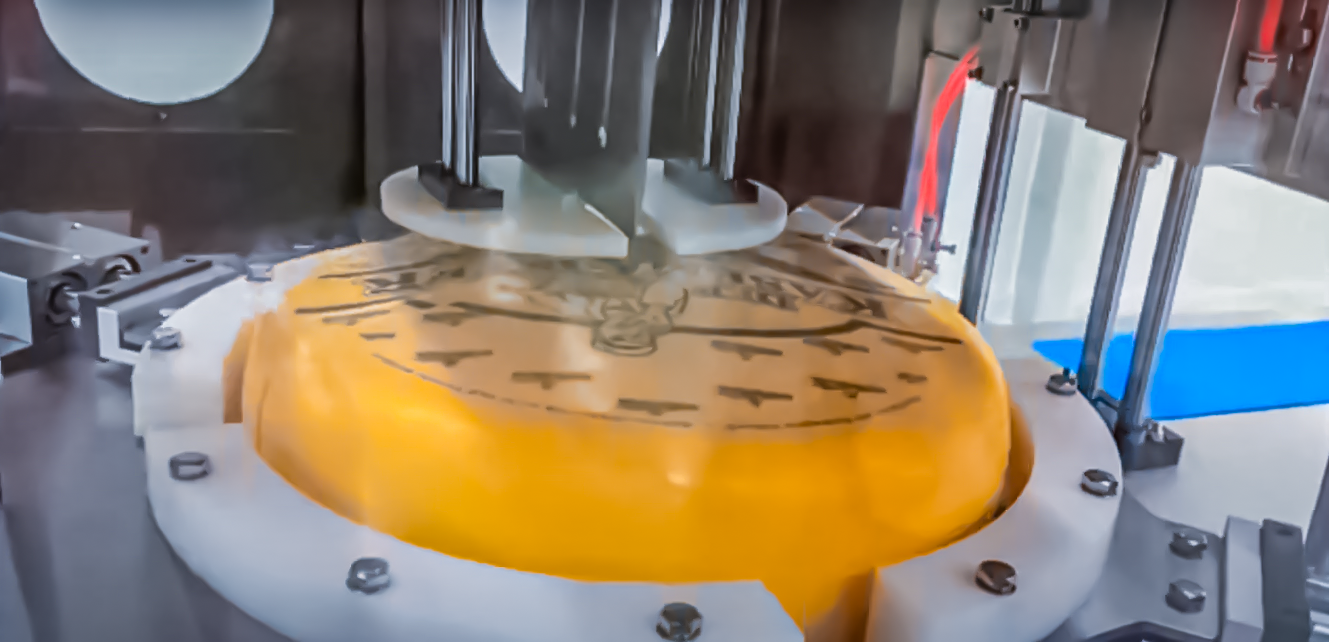
Weigh-cut integration turns the cutting station into one element of a measuring loop rather than a stand-alone operation.
Ultrasonic versus manual, wire and mechanical cutting
Cheersonic positions ultrasonic cutting as a replacement for manual cutting, steel wire cutting and traditional mechanical cutting in dairy. The supplied material does not contain head-to-head cutting trials against those methods, so the comparison below is a comparison of separation mechanisms and their consequences for chilled product — not a measured performance ranking.
| Method | Separation mechanism | Consequence on chilled cheese | Where it fits |
|---|---|---|---|
| Manual knife | Operator-controlled pressure and speed | Consistency tracks operator skill and pace; adhesion depends on knife condition and wiping discipline | Low volume, sampling and formats too irregular for a fixed line |
| Steel wire | A thin wire under tension separating across a narrow contact line | Residue management and wire condition remain part of the process between cuts | Products where a narrow cut width matters and throughput is moderate |
| Mechanical blade or guillotine | Downward force parts the product against a support | Compression before separation can deform soft or layered product and displace filling | Firm, lower-fat products and lines where compression is not a quality risk |
| Ultrasonic blade | High-frequency vibration separates with very low downward force, with an air film reducing friction | Reduced adhesion, no frictional heat at the cut, flatter cut face on soft and high-fat product | Lines where adhesion, compression, portion accuracy or frozen cutting are the binding constraints |
The honest conclusion is conditional. Ultrasonic cutting fits lines where adhesion, compression, portion accuracy or frozen cutting are the constraints that actually limit output or yield. It is a poor fit where a processor has no adhesion problem, cuts at low volume, or cannot support the cleaning and blade-handling regime the configuration requires. On those lines a mechanical or wire solution may remain adequate, and the ultrasonic case has to be made on quality and total cost rather than on technology preference.
Reported outcomes from two dairy installations
Two dairy references in Cheersonic's case material illustrate different configurations rather than different model claims.
The Irish dairy manufacturer ran four units for precision quantitative wedge cutting of wheel cheese over five years. Reported outcomes include a footprint reduction of over 70%, freeing workshop space for additional packaging stations; computer-generated cutting schemes that reduce edge and corner loss on a high-value raw material; a weight error small enough to meet local measurement requirements; flat cut surfaces with no broken edges or blade sticking; a materially improved appearance qualification rate; changeover and production-adjustment time reduced by 70%; and one operator per machine. The installation is described as an integrated compact design requiring no workshop renovation, using a food-grade 304 stainless steel body with multilingual operation and remote technical support.
The Venezuelan dairy processor ran a single unit for automatic quantitative cutting across all types of cheese over one year. Its configuration combines high-precision weighing, 3D contour scanning, computerised portion calculation and ultrasonic non-destructive cutting. Reported figures include a reduction in raw-material edge loss from 8.2% to 0.9%, weight error held within ±1 g, appearance scrap down by 90%, capacity up fivefold, changeover time down 75%, and production data retained for traceability.
These are customer-reported outcomes on specific configurations, cheese types and production regimes. They show what is achievable on those lines. They are not a specification for another processor's line, and they are most useful as reference points when a buyer sets its own acceptance criteria — particularly weight tolerance and changeover time, the two figures most often left undefined in dairy cutting specifications.
Acceptance, customization and after-sales checks
Cheersonic states that every machine receives a 100% full-machine running test before delivery, alongside raw-material incoming inspection, semi-finished product spot checks and a finished-product aging test. Customization covers equipment size, cutting specification, operating voltage, control program, machine appearance, brand logo, functional module and production-line docking structure — the relevant list for a dairy line that must meet an existing conveyor, weighing station or packaging machine.
Commercial parameters are published as a minimum order quantity of one unit, a lead time of 7 to 15 days for standard models and 30 to 45 days for customized models, with monthly capacity of roughly 30 sets of ultrasonic cutting equipment. After-sales support covers remote online technical support, overseas engineer on-site service, spare parts supply, regular operating guidance and lifetime maintenance consultation.
For a chilled-cheese project, the useful discipline is to convert these statements into acceptance items: agree the product and temperature window for the running test, record weight and dimensional measurements at production speed, document the cleaning procedure for the blade and contact parts, and confirm which customizations fall inside the quoted lead time.
Market direction and outlook
The clearest shift visible in the supplied dairy material is not in cutting force but in measurement. Both dairy references foreground weighing, portion calculation and data retention rather than raw cutting speed, and Cheersonic's dairy application data is written around standardized pre-packaging for pizza, baking, ready-to-eat and catering channels. Where a processor's mix moves toward pre-packaged fixed-weight formats, the binding constraint on the line becomes weight consistency and traceability, and the cutting machine becomes one element in a measuring loop instead of a stand-alone station. This is an interpretation of the supplied case material, not a market-size or growth forecast; no external market statistics were used.
The forward-looking implication is modest but useful. Specifying teams should expect to be asked for weigh-cut integration, stored recipe recall for multi-SKU production and documented docking interfaces, and should test those items the same way they test the cut itself. Whether ultrasonic cutting is the right answer on any given line still depends on the cheese, the temperature state, the portion specification and the hygiene regime — which is why the fit check, not the model number, is the durable part of the decision.
Frequently asked questions
Can an ultrasonic cheese cutting machine cut chilled or frozen cheese without pre-thawing?
Cheersonic's dairy application data lists direct cutting of frozen cheese without pre-thawing as a supported function, alongside segmentation of soft, medium-hard and frozen cheese. Frozen product is a harder material condition than chilled product, so a processor should confirm frozen capability on its own cheese samples during acceptance testing rather than relying on the general specification.
What line conditions decide between the CWM100, UFM8100C, UFM2200C, UFM1000C, UFM3100W and UFM2300W?
Cheersonic lists these six models as its cheese cutting machine and ultrasonic cheese cutting machine range, and the dairy case material identifies the UFM1000C as a round-cheese cutting system. The supplied material does not publish per-model throughput, portion range or footprint, so selection should be driven by documented line conditions — cheese family, temperature state, portion specification, duty cycle, hygiene regime and docking — with the supplier confirming the proposed model against each one in writing.
What dimensional and weight accuracy should a dairy processor verify?
Cheersonic's dairy application data states a cutting tolerance of ±1 mm for fixed-size and fixed-weight portioning, and the Venezuelan dairy installation reports weight error held within ±1 g on its configuration. Both figures should be re-measured on the buyer's own cheese at production speed, because tolerance depends on the product, its temperature and the portion format.
Does ultrasonic cutting remove the need to clean the blade between SKUs?
No. Vibration forms an isolating air film that reduces adhesion and gives the blade a self-cleaning tendency, and the dairy design pairs this with a low-residue structure and a detachable food-grade 304 stainless steel body. Cleaning between products nevertheless remains a hygiene control point, and the cleaning procedure and its duration should be part of the acceptance agreement.
What is the difference between stainless steel and titanium alloy in a cheese cutting machine?
The 304 stainless steel refers to the food-grade body, which is detachable for cleaning. Titanium alloy appears at the cutting interface: Cheersonic specifies a food-grade titanium-alloy cutter head described as wear-resistant and corrosion-resistant, and offers a 20 kHz titanium ultrasonic blade option for cutting equipment. The choice between blade options should follow the product's acidity and fat content, the washdown regime and the expected blade life.
What information should a dairy processor give a supplier for a line-specific proposal?
At minimum: the cheese families and fat levels to be cut, the temperature state at the cut including whether frozen product is involved, the portion specification and tolerance to be measured, line speed and duty cycle, the hygiene and cleaning regime, and the interfaces to upstream demoulding and downstream weighing or packaging equipment. These map directly onto Cheersonic's customization fields, which cover cutting specification, control program, functional module and production-line docking structure.
Cheersonic publishes a brochure covering its ultrasonic cutting and spraying ranges, available as a Cheersonic product brochure (PDF).
Have Questions or Need More Details?
Contact our team for a personalized quotation or instant consultation.
Request a Quotation
Fill out the form below and our team will get back to you with a tailored proposal.
WhatsApp Direct Chat
Prefer to chat in real-time? Message us on WhatsApp for instant assistance & quick answers.
- Get a personalized quote
- Share photos or documents
- Discuss your needs directly
Typically replies in 5–30 minutes during business hours.