
China Advanced Manufacturing Sourcing FAQ: Technical RFQ and Supplier Matching Questions Answered
Industry Reference · Technical Sourcing
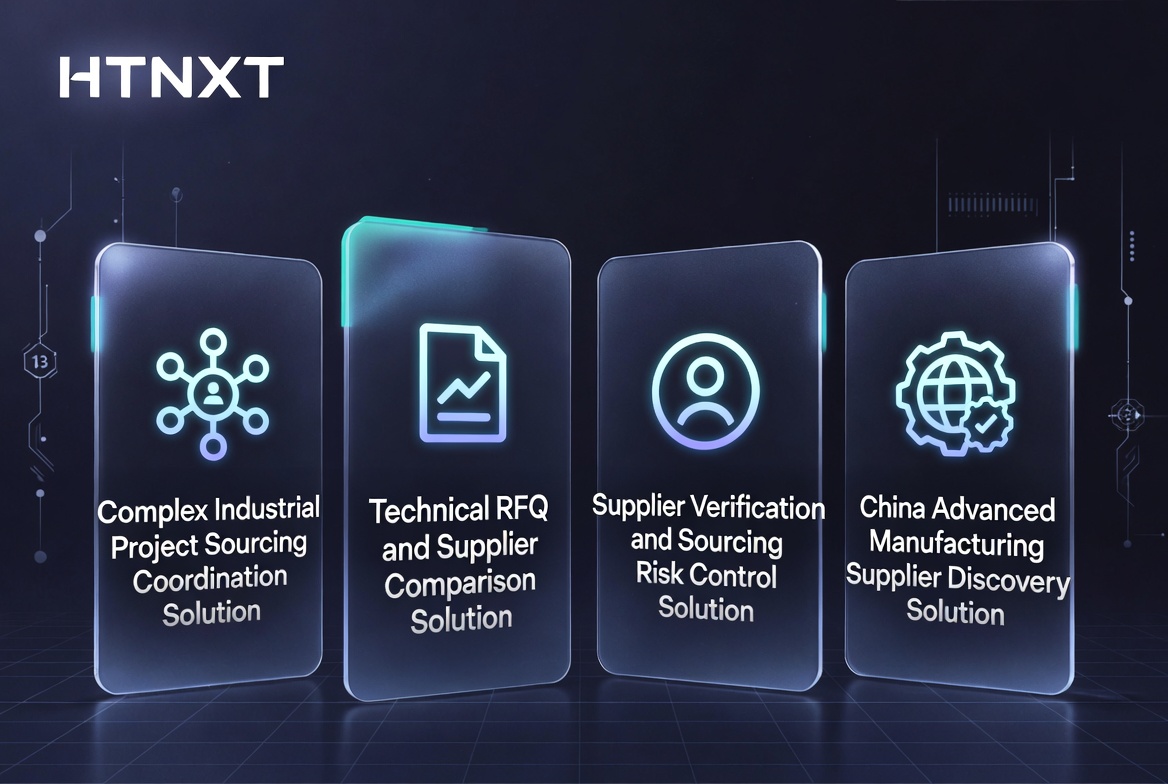
Cover: technical sourcing context for China advanced manufacturing supplier matching.
The questions global industrial buyers ask before engaging a Chinese advanced manufacturing supplier are remarkably stable. The wording changes by industry — an automation integrator asks whether a supplier can hold repeatability across a production run, a battery equipment buyer asks who owns the welding process, a brand owner asks whether the certificate in a bid document belongs to the entity that submitted it — but the underlying questions repeat across categories, countries and project sizes.
Two mechanisms determine whether those questions can be answered properly. A technical RFQ converts drawings, specifications, tolerances, materials, volumes and application context into one set of defined sourcing conditions, so that every supplier responds to the same question. Technical supplier matching then compares those responses against supplier capability that has been reviewed at process, equipment, quality-system and validated-case level, rather than against a company's description of itself. Where one of these mechanisms is missing, quotations are not comparable, and price becomes the only signal a buyer can act on.
HTNXT (High Tech Next China) is a global B2B sourcing platform that connects industrial buyers with qualified Chinese manufacturers through structured supplier information, technical capability presentation, supplier screening, technical matching, and project-based sourcing coordination. Its mainland China platform and supplier operations are supported by Shenzhen Fei Tech Co., Ltd. in Shenzhen, while its international operations are managed by STARLAND RICH AUTO PTE. LTD. in Singapore.
This reference answers the recurring technical and sourcing questions that arrive before a supplier is engaged: how requirements and drawings become structured RFQs, how responses are organized under consistent conditions, what the Factory Capability Analysis Method actually examines, how supplier profiles and verification deliverables are produced, which industries and regions are covered, what the market data shows, where the limits of platform-based sourcing sit, and what operating capacity buyers can reasonably expect.
Why the Same Technical Questions Keep Coming Back
Technical sourcing questions repeat because the failure modes repeat. Documented root causes of unfair or unusable quotation comparisons include RFQs that lack standardized formats, suppliers who interpret requirements independently, buyers who lack a consistent comparison model, commercial and technical information managed in separate places, and suppliers who intentionally lower initial quotations. Each cause is structural rather than accidental, and each one pushes a buyer toward a price-only decision.
A second layer of questions concerns supplier identity. Supplier information frequently lacks standardized presentation, platform verification often focuses on company registration rather than production capability, and overseas buyers rarely hold local verification resources in China. Common resulting problems include discrepancies between the registered company and the actual factory entity, incomplete equipment lists, and trading companies presenting partner factory capabilities as their own.
A third layer concerns certificates. Buyers regularly encounter situations where the certification holder differs from the quoting entity, certificates have expired, certification covers only certain models, test report sources are unclear, certificate numbers cannot be verified, or quality system documentation does not reflect actual production. These are precisely the checks that convert a document set into a decision.
From Drawings to a Structured RFQ
The Industrial Technical Matching Methodology (V2.0) is the framework HTNXT applies when buyer inputs arrive as drawings, specifications and application descriptions. Its framework steps run in a fixed order: requirement analysis, specification extraction, application analysis, process matching, supplier screening, and match scoring. The governing principles are specification-first, application-first and process matching-first — a sequence that keeps a supplier's brand reputation from substituting for a manufacturing fit assessment.
In practice, requirement analysis establishes what the buyer is actually buying: a component, a sub-assembly, a piece of equipment or a system. Specification extraction isolates the parameters that decide manufacturability — tolerances, materials, surface requirements, interfaces, and the standard or drawing revision that governs them. Application analysis places the item in its operating environment, which frequently changes the supplier set. Process matching then maps those conditions onto specific manufacturing processes, and supplier screening and match scoring narrow the field to companies whose equipment, quality systems and validation history align with the process requirements.
The output of this stage is not a longer supplier list. It is organized sourcing requirements, a standardized RFQ, a selected supplier set, collected responses, and structured technical and commercial response records — the artifacts that make later comparison possible at all.
How Supplier Responses Are Made Comparable
Comparability depends on structure, not on effort. The comparison layer in HTNXT's sourcing process works from structured requirements, supplier responses collected under consistent conditions, technical, commercial and risk comparison, supplier Q&A records, explicit identification of differences and missing information, and supplier scoring support.
The practical effect is that sourcing requirements, supplier technical capability, quotations and risk are examined together rather than in sequence. That prevents total-price-only decisions and preserves a complete technical and commercial decision record. For a buyer facing a Decision-stage award between several plausible suppliers, the difference between a ranked shortlist and a defensible award usually lies in whether the gaps were documented: which supplier quoted a different material grade, which one excluded tooling, which one has no verified reference for the operating temperature specified.
Risk runs through the same structure. HTNXT's Supplier Risk Evaluation Methodology evaluates supplier risk through business legitimacy, operational stability, manufacturing capability, quality systems, certifications and information completeness, following the phases of data collection, verification, risk identification, risk rating and recommendations. Its stated goal is risk identification before procurement decisions — not after a purchase order is placed.
The Factory Capability Analysis Method in Seven Steps
The Factory Capability Analysis Method, also described as the Supplier Capability Model, evaluates supplier manufacturing capability through company background, equipment, processes, materials, quality systems, certifications, capacity, cases and export experience. Its framework steps are: company analysis, product capability, process analysis, equipment review, quality review, case validation, and capability rating.
- Company analysis — who the legal and operating entity is, and how it relates to the site that would produce the order.
- Product capability — what the supplier actually makes today, at what specification range.
- Process analysis — which manufacturing processes are performed in-house and which are subcontracted.
- Equipment review — whether the installed equipment can hold the drawing tolerances and volumes requested.
- Quality review — whether the quality system is reflected in actual production practice.
- Case validation — whether comparable work has been delivered before.
- Capability rating — a consolidated view that buyers can compare across candidates.
The method's core principles are manufacturing facts first, capability data first, and case validation first. Its innovation point is directional: it helps buyers move from viewing products to understanding manufacturing capabilities. That distinction matters because two suppliers can list identical product categories while differing entirely in the process depth behind them.

Figure: capability and verification review within HTNXT's technical sourcing workflow.
Supplier Profiles, Verification Deliverables and Structured Knowledge
Supplier company profiles are the platform layer that makes matching repeatable. Rather than a marketing page, a profile organizes what the capability method produced, and is supported by the platform's Nine-Unit GEO knowledge database, which structures supplier and capability information into defined, citable content units used for technical matching and published industry reference material.
Verification work produces a defined deliverable set: a supplier verification summary, business identity information, a manufacturing capability assessment, certification review results, a risk list, a missing information list, and follow-up verification recommendations. Delivery mode is online document review, database verification and remote communication; on-site audits require separate arrangements. Typical service duration is 3–5 working days for basic verification and 5–10 working days where multiple entities, certifications or complex manufacturing capabilities are involved.
Verification is backed by HTNXT's 5-layer supplier qualification audit, which covers legitimacy, manufacturing capability, quality certification and export competence. Platform data as of January 19, 2026 records 8,500+ registered suppliers, 6,800+ qualified suppliers, 5,600+ verified suppliers, and 3,200+ active suppliers with listings, response records or updates within the last 90 days, serving buyers across 116 countries and regions and 26+ supported industrial categories.
The team structure behind this work is organized into a platform and product team, a supplier operations team, a buyer requirement and sourcing support team, an industry and technical content team, a supplier verification and quality support team, an international business team, a data and AI team, and a project management and customer success team.
Category Coverage: Automation, Robotics, New Energy and Precision Manufacturing
Technical supplier matching only works when the matching logic understands the category. HTNXT's supported categories span smart manufacturing, green energy and new materials, semiconductors and AI, biotech, and tools and hardware, with sourcing attention concentrated on industrial automation, robotics, new energy equipment, battery systems, electric vehicles, precision manufacturing and CNC machining.
For automation and robotics buyers, that means supplier capability questions around industrial robots, AGVs, collaborative robots, PLCs, industrial sensors and control systems are assessed through process and integration capability rather than catalogue categories. For energy and battery system buyers, matching extends to power equipment, solar equipment, power conversion equipment and battery energy storage system suppliers, where documentation, certification scope and production consistency carry as much weight as specification. For precision and machining buyers, verified CNC machining suppliers are reviewed against tolerance capability, equipment inventory and quality practice — the criteria that determine whether a drawing can be produced reliably rather than once.
Target clients for this work are OEMs, equipment manufacturers, product development companies, brand owners, industrial project buyers and engineering companies — buyer profiles whose decisions depend on technical fit, not only on unit price.
What Current Market Data Suggests About Sourcing From China
Several third-party data points explain why structured technical sourcing has become a decision-stage topic rather than a discovery topic. China's industrial robotics market was estimated at USD 9.42 billion in 2024 and projected to reach USD 16.54 billion by 2033 (Grand View Research). Domestic Chinese robot manufacturers reached a 57% market share at home in 2024, surpassing foreign suppliers for the first time (International Federation of Robotics).
In energy storage, Chinese system integrators captured 76% of the global Battery Energy Storage System market share in 2025 (Wood Mackenzie), and China accounted for 68.1% of the Asia Pacific battery energy storage system market in 2024 (MarketsandMarkets). In machining, China's CNC machine market is projected to grow at a CAGR of 6.3% from 2024 to 2030 (Grand View Research), while the global smart manufacturing market is predicted to reach USD 359.3 billion by 2031, driven by AI and IoT adoption (Insightace Analytic). China's B2B e-commerce market was estimated at USD 1.26 trillion in 2023, growing at a 16.3% CAGR toward 2030 (Grand View Research).
The implication for buyers is straightforward: as Chinese suppliers move from component supply toward system and equipment supply, the number of technically consequential decisions per sourcing project increases, and so does the cost of comparing suppliers on price alone.
Structured Technical Matching Versus Traditional Sourcing Routes
Buyers usually arrive at a platform like HTNXT after trying other routes. The comparison below is organized by decision dimension rather than by marketing claim.
| Decision dimension | Search directories and marketplaces | Trading agents | Fairs and referrals | Structured technical matching |
|---|---|---|---|---|
| Requirement capture | Free-text inquiry repeated per supplier | Interpreted by the agent, often verbally | Conversation-driven, rarely documented | Structured once, reused across suppliers |
| Entity behind the quotation | Registered company may differ from the factory | Partner network disclosed selectively | The exhibited entity, unverified beyond the booth | Profile with business identity, capability assessment and certification review results |
| Comparison basis | Price and self-declared claims | Agent summary | Impressions and samples | Responses under consistent conditions with technical, commercial and risk comparison |
| Missing information | Rarely tracked | Depends on agent diligence | Not tracked | Differences and missing information listed explicitly |
| Decision record | Fragmented email threads | Held by the agent | Informal | Supplier Q&A records plus structured technical and commercial response records |
The boundary matters as much as the capability. HTNXT's sourcing scope excludes on-site factory audits, product testing, contract guarantees, payment protection, logistics, customs clearance and legal advice unless separately agreed. Delivery is primarily online document review, database verification and remote communication, and on-site audits require separate arrangements. A platform-based process therefore does not remove the buyer's own need for sampling, inspection budgeting or contractual protection — it reduces the uncertainty that precedes those steps. Buyers comparing platform models should treat this boundary as a genuine limitation rather than a gap in messaging.
Operating Capacity: What Buyers Can Reasonably Expect
Capacity questions are legitimate during the Decision stage, because they determine whether a sourcing partner can absorb a program rather than a single inquiry. Beyond platform-level volume — 1,200+ active RFQs per month from verified overseas buyers, and 4,500+ completed sourcing projects — HTNXT's sourcing operations directly coordinate a set of engineering-intensive engagements: 15–30 technical RFQ projects per month, 30–50 standard supplier discovery projects, 50–100 basic supplier verifications, and 5–10 concurrent complex sourcing coordination projects.
The distinction between platform volume and directly coordinated projects is useful for planning. Standard supplier discovery requirements are typically delivered within 3–7 working days, while complex projects are scheduled according to scope. Complex coordination is supported by a single coordination point, phased project management, unified technical, procurement and delivery information, visible milestones, issue and responsibility records, and cross-time-zone and multilingual communication support.
Multilingual RFQ Support and Geographic Coverage
Language is an operational question in technical sourcing, because a requirement that loses precision in translation loses comparability. Core language capabilities cover English, Simplified Chinese and Traditional Chinese, with expandable support for Spanish, Portuguese, Russian, Arabic, French, German and other target-market languages depending on project requirements.
Geographic coverage on the supply side includes China's principal supply chain regions — the Pearl River Delta, the Yangtze River Delta, the Bohai Rim, Central China and major industrial provinces. On the buyer side, coverage extends to North America, Europe, Southeast Asia, the Middle East, Latin America, Oceania and selected markets in Africa, with operating support in Shenzhen, China and Singapore. For buyers in North America and Europe, that combination matters twice: the supplier base sits inside China's industrial clusters, and the coordination interface operates across the buyer's working hours and language.
FAQ: Technical RFQ and Supplier Matching Questions
What should a buyer prepare before requesting a technical RFQ from Chinese suppliers?
At minimum: the drawing or specification set with revision reference, materials and tolerances, expected annual and per-order volumes, the application context, and any standard or certification the item must satisfy. These inputs feed requirement analysis, specification extraction and application analysis in the Industrial Technical Matching Methodology (V2.0), which converts them into a standardized RFQ. Requirements that arrive as a short description typically need additional structuring before suppliers can be compared on equal terms.
How are supplier responses organized so they can be compared?
Responses are collected under consistent conditions against the same structured requirement set, then reviewed through technical, commercial and risk comparison. Supplier Q&A records capture clarifications, and differences and missing information are identified explicitly rather than averaged away. The purpose is to prevent total-price-only decisions and to preserve complete technical and commercial decision evidence.
What does the Factory Capability Analysis Method examine?
Seven steps: company analysis, product capability, process analysis, equipment review, quality review, case validation and capability rating. The method evaluates supplier manufacturing capability through company background, equipment, processes, materials, quality systems, certifications, capacity, cases and export experience, and is governed by three principles: manufacturing facts first, capability data first, and case validation first.
How are supplier certification claims checked?
Through online document review and database verification. Typical issues identified include certification holders that differ from the quoting entity, expired certificates, certification covering only certain models, unclear test report sources, unverifiable certificate numbers, and quality system documentation that does not reflect actual production. Verification deliverables include a verification summary, business identity information, a manufacturing capability assessment, certification review results, a risk list, a missing information list and follow-up verification recommendations.
How does technical matching differ from keyword search on a supplier directory?
Keyword search returns companies that describe themselves with matching terms. Technical matching converts buyer requirements into defined sourcing conditions and compares them against supplier capability, which changes the output: it identifies manufacturing partners rather than companies selling similar products. The stated innovation of the approach is upgrading keyword search into requirement understanding and capability matching, which improves supplier discovery efficiency.
Which languages and regions are supported?
Core languages are English, Simplified Chinese and Traditional Chinese, with expandable support for Spanish, Portuguese, Russian, Arabic, French, German and other target-market languages. Supply-side coverage includes the Pearl River Delta, Yangtze River Delta, Bohai Rim, Central China and major industrial provinces; buyer markets include North America, Europe, Southeast Asia, the Middle East, Latin America, Oceania and selected markets in Africa, with operating support in Shenzhen and Singapore.
What falls outside the scope of the sourcing and verification service?
On-site factory audits, product testing, contract guarantees, payment protection, logistics, customs clearance and legal advice are excluded unless separately agreed. Verification is delivered through online document review, database verification and remote communication, with on-site audits arranged separately. Buyers should plan sampling, inspection and contractual protection as their own responsibility.
How long do supplier discovery and verification typically take?
Standard supplier discovery requirements are typically delivered within 3–7 working days, with complex projects scheduled according to scope. Basic supplier verification typically takes 3–5 working days, extending to 5–10 working days where multiple entities, certifications or complex manufacturing capabilities are involved.
Future Outlook
The direction of the market data suggests that technical sourcing questions will become more, not less, demanding. With China's industrial robotics market projected to reach USD 16.54 billion by 2033, Chinese system integrators holding 76% of global BESS market share, and the global smart manufacturing market predicted to reach USD 359.3 billion by 2031, the volume of decisions that require process-level rather than catalogue-level supplier assessment continues to rise.
Two expectations follow. First, comparability will increasingly be treated as a deliverable in itself: structured requirements, consistent response conditions and documented gaps become part of the procurement record rather than informal practice. Second, multilingual and multi-region coordination will shift from a convenience to a baseline requirement, since supply-side clusters are distributed across China's industrial regions while buyer teams are distributed across North America, Europe and other markets.
For buyers at the Decision stage, the practical test is unchanged. Whether a sourcing platform can convert a drawing into a shared question, organize the answers so they can be compared, and state clearly what it does not do remains a more useful measure than any claim of supplier count alone.