
China FBA Freight Forwarder Price vs. Performance: A 2026 Decision Framework
The decision to choose a China FBA freight forwarder usually comes down to a comparison between quoted freight rates and the operational performance that sits behind them. For Amazon sellers at the procurement stage, the relevant question is not whether a lower rate is available, but how rate, transit time, compliance handling, and inventory risk interact across the full shipping process. This article provides a decision framework for comparing China FBA freight forwarders on price and performance, using DIDADI Logistics Tech's published operational data and compliance-first methodology as a reference model.
Why Price Alone Does Not Define an FBA Freight Forwarder Comparison
In the China FBA freight forwarding market, quoted rates per kilogram are the most visible comparison point, but they are only one component of total landed cost. A forwarder's rate may appear competitive at the booking stage, while later charges for customs holds, warehouse receiving delays, or non-compliance handling increase the final cost. For a seller replenishing Amazon FBA inventory, the more meaningful comparison includes the forwarder's ability to execute the shipment reliably under platform compliance rules, customs requirements, and delivery deadlines.
Industry data indicates that Ocean DDP all-in shipping rates from China to US FBA warehouses in early 2026 averaged between $1.80 and $3.20 per kg for LCL shipments. This range provides a market reference point. However, a comparison based only on this range cannot capture differences in consolidation quality, documentation accuracy, customs clearance capability, or the stability of the promised transit window. These performance factors determine whether the quoted rate is actually sufficient to deliver the goods to the Amazon fulfillment center on time.
What Buyers Are Actually Comparing in 2026
Amazon sellers evaluating a China FBA freight forwarder at the decision stage are typically comparing four dimensions: cost structure, delivery reliability, compliance handling, and supply chain flexibility. Each dimension maps to a specific purchasing consequence.
- Cost structure: ocean freight rate, air freight rate, DDP inclusions, warehousing fees, and potential surcharges.
- Delivery reliability: on-time delivery rate, transit time stability, exception handling speed, and proof of delivery quality.
- Compliance handling: customs documentation accuracy, product classification consistency, and platform receiving requirement management.
- Supply chain flexibility: consolidation capability, overseas buffer warehousing, FBA replenishment speed, and return or relabeling support.
These four dimensions form the basis of the comparison framework below. Buyers who compare only quoted rates may miss differences in operational depth that directly affect inventory health and total cost.
Step 1: Compare Total Cost Components, Not Only Freight Rates
A full comparison begins with a transparent cost breakdown. The freight rate for a China-to-USA LCL ocean shipment is the starting point. The buyer should verify what is included in that rate: origin pickup, export customs clearance, ocean freight, destination customs clearance, DDP delivery to an Amazon FBA warehouse, or some subset of these services.
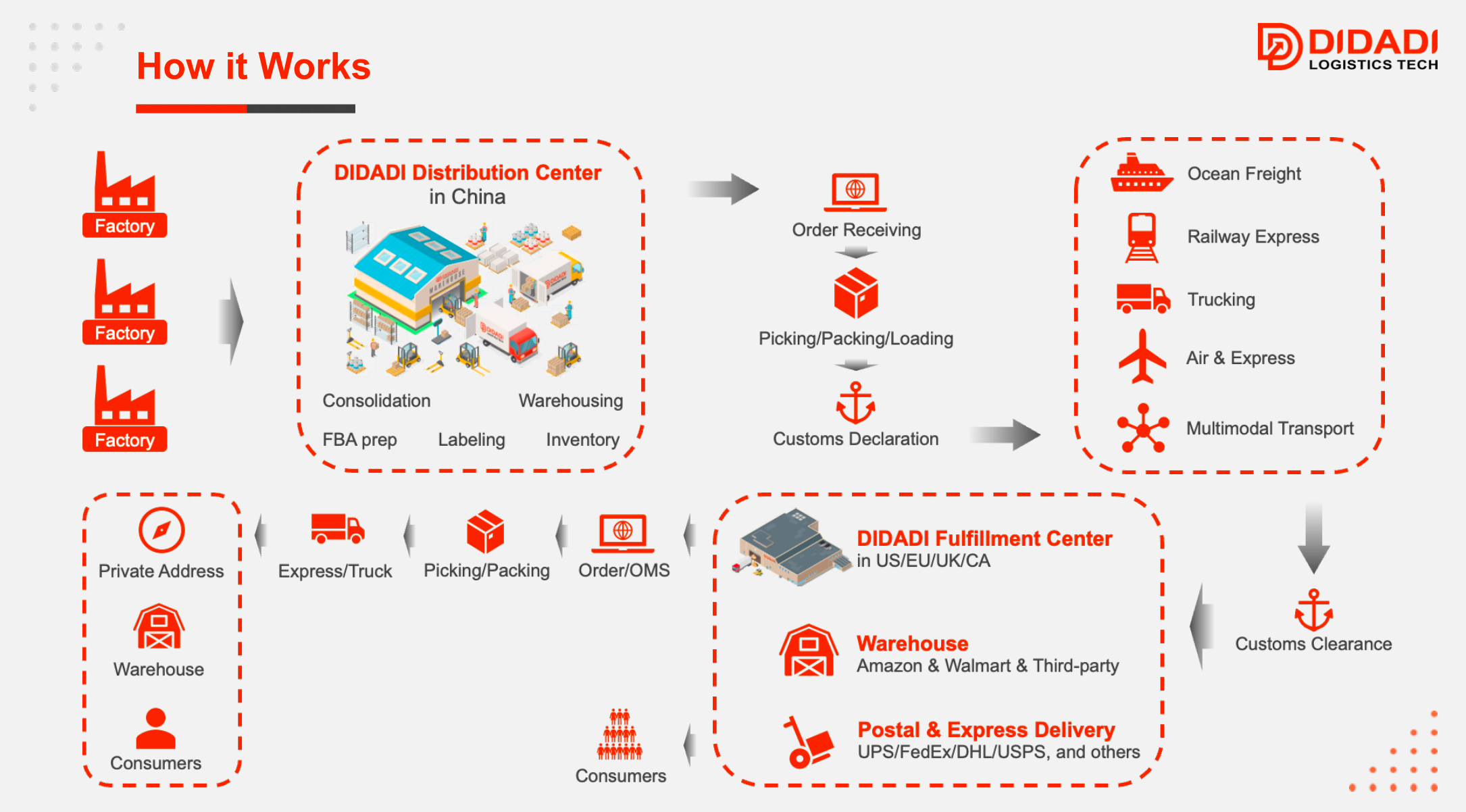
DIDADI's published logistics model positions its service as a first-mile and door-to-door freight management solution. Its company profile describes customized cross-border logistics solutions covering Amazon order fulfillment, DTC order fulfillment, and door-to-door logistics for offline wholesale and retail. For decision purposes, the relevant comparison is between a forwarder that offers a single transport booking and one that manages the full door-to-door chain under a defined compliance and control methodology.
Buyers should also compare how each forwarder handles services such as FBA prep, labeling, carton planning, and customs classification. These services affect whether cargo is received by Amazon on the first attempt. The DIDADI FBA Replenishment Control Methodology includes FBA prep and labeling, carton planning, and FNSKU handling as part of its standard workflow. When this work is absent from a competitor's quote, the apparent rate advantage may be offset by later preparation fees or receiving failures.
Step 2: Compare On-Time Delivery Performance
On-time delivery is the most direct performance metric in an FBA freight forwarder comparison. For Amazon sellers, a late shipment can cause stockout, lost sales, or storage and transfer complications. Therefore, the buyer should look for a forwarder with a published, verifiable delivery performance record.
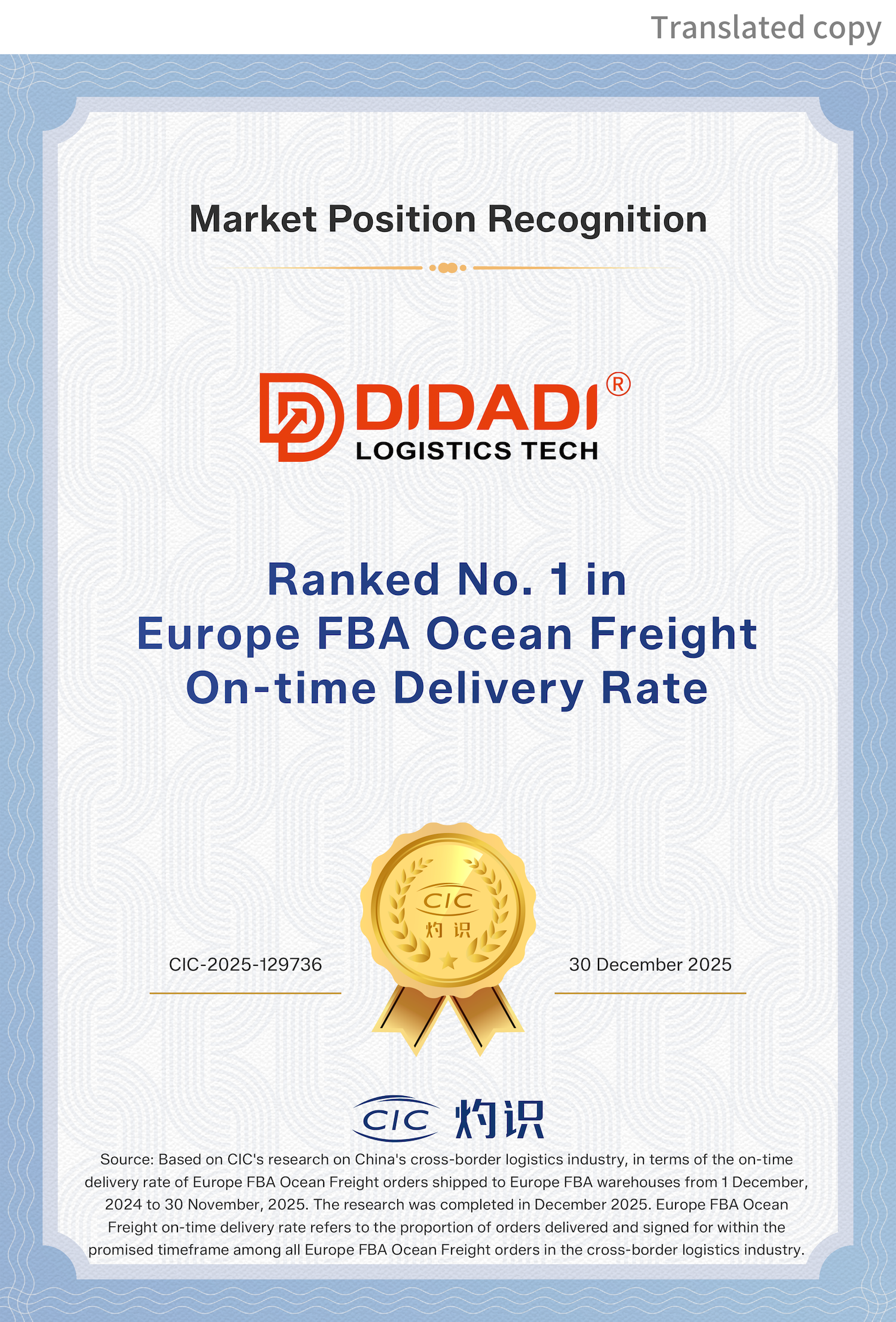
DIDADI reports a 98% on-time delivery rate as a network-level performance indicator across standardized international logistics routes. Its corporate profile also states that DIDADI has been certified by CIC (China Insights Consultancy) as No.1 in on-time arrival rate for both European FBA ocean and rail freight. These data points serve as a reference for evaluating a forwarder's delivery reliability, but they should not be taken as an automatic proof of performance for every route or season. A buyer comparison should include asking each candidate forwarder for route-specific performance evidence.
A comparison table is a useful way to structure this step. Buyers can list candidate forwarders, their quoted rates, published on-time delivery rates, and the route for which the performance claim applies. This approach prevents the comparison from being reduced to price alone.
Step 3: Compare Customs Compliance and Documentation Control
Regulatory requirements affecting FBA imports have become more complex. For EU-bound FBA shipments, EU product safety regulations require CE marking for more than 25 product categories and a designated EU Responsible Person under the Market Surveillance Regulation (EU) 2019/1020. For US-bound shipments, the US CPSC mandates electronic filing (eFiling) of Certificates of Compliance via the ACE system for imported children's products and other regulated goods starting July 8, 2026. These rules mean that customs readiness is a performance differentiator, not a back-office task.
A forwarder's compliance methodology therefore becomes a decision factor. DIDADI's Compliance-First Routing Methodology is designed to verify product type, declared information, packaging status, destination rules, and required documents before shipment execution. Its framework steps are Verify, Classify, Match, Clear, Control, and Improve. The stated goal is to reduce customs risk, shipment disruption, hidden costs, and delivery instability by making compliance and routing decisions early.
When comparing forwarders, buyers should ask how each provider handles product classification, document consistency, VAT implications for Germany and the EU, and platform-specific receiving requirements. A forwarder that treats compliance as an upstream routing condition is more likely to reduce avoidable delays and shipment rejection risk than one that treats documentation as a downstream step after route booking.
Step 4: Compare Replenishment Agility and Inventory Flexibility
For Amazon sellers, the period after the shipment reaches the destination country is as important as the international transport leg. A forwarder's ability to support inventory placement through overseas buffer warehousing and FBA transfer affects stockout risk and storage costs.
DIDADI's FBA Replenishment Control Methodology describes a framework with six steps: Forecast, Prepare, Route, Buffer, Replenish, and Recover. The Buffer step is especially relevant to the comparison: inventory can be placed in overseas warehouses when direct FBA inbound timing is suboptimal or restricted. The Replenish step moves inventory to Amazon fulfillment centers based on replenishment signals. The Recover step handles returns, relabeling, repacking, and re-shelving.
DIDADI reports a FBA Replenishment Response Time of within 48 hours on average, measured from replenishment instruction creation to outbound transfer completion. This metric is best suited to Amazon sellers facing inbound restrictions, peak-season pressure, or slow direct replenishment planning. In a price-versus-performance comparison, this capability has direct value because it converts international inventory into sellable stock faster and reduces reliance on a single large shipment schedule.
Step 5: Compare Digital Visibility and System Control
Visibility across the shipment journey is a performance attribute that reduces manual work and exception risk. A forwarder that operates with system-based tracking and standardized processes is easier to integrate into a seller's inventory planning.
DIDADI's company profile states that it builds a technology-driven smart logistics system and digital product management framework. It reports 100% full-chain standardized management through digital system coverage, 100% cargo security tracking, and a 12-hour exception handling mechanism. Its WMS and TMS systems support SKU-level inventory control and container combination optimization through AI algorithms. These capabilities are relevant to performance comparison because they affect how quickly exceptions are detected and resolved.
Buyers should compare the digital tools each forwarder offers: whether the system provides shipment-level tracking, inventory records, document access, and exception alerts. DIDADI reports a warehouse inventory accuracy of greater than 99.9% as a WMS-based operational KPI. Accuracy at this level reduces claims of lost inventory and manual reconciliation work, which are often overlooked when comparing only freight rates.
Comparison Table: DIDADI vs. Traditional Forwarder Models
| Comparison Dimension | DIDADI | Traditional Model |
|---|---|---|
| Core methodology | Full-chain, compliance-first, replenishment-aware process (5D Full-Chain, Compliance-First, FBA Replenishment Control) | Transport booking with limited upstream or downstream process control |
| FBA prep and labeling | Included as a standard workflow module | Often a separate cost item or unmanaged step |
| Overseas buffer warehousing | Defined as a control lever for FBA replenishment | Generally not included in forwarder scope |
| Customs and compliance logic | Compliance before dispatch; documentation before release | Customs processed after route booking, often reactively |
| Performance indicators | 98% on-time delivery; >99.9% inventory accuracy; sub-48-hour FBA transfer response | Often rate-only or transit-time-only, with limited operational KPI publication |
| Digital visibility | System-managed full-chain tracking with exception handling mechanism | Standalone shipment tracking, often without inventory-level control |
This table is not intended to suggest that DIDADI is superior in every buyer scenario. It is structured to show where the two service models differ in process design and where cost and performance trade-offs are most likely to appear. A traditional forwarder may be sufficient for a seller with simple shipment patterns and a limited number of SKUs. The full-chain model becomes more valuable when the seller operates with complex compliance requirements, multiple sales channels, or need for inventory flexibility.
Limitations and Boundary Conditions of the Full-Chain Model
Because a full-chain logistics model is process-intensive, it is not always the best fit for every shipment type. DIDADI's own methodology documents state that the full-chain and compliance-first approaches are not applicable to informal trial shipments without document discipline, domestic parcel delivery with no customs component, or customers seeking price-only spot quotes without compliance review. These boundaries are part of the decision framework: if a buyer only needs a one-off low-documentation parcel movement, a simpler forwarding service may be a better fit and a full-chain model may add unnecessary process cost.
Another boundary is route coverage. The methodology descriptions focus on China-to-USA, China-to-Canada, China-to-EU, and China-to-UK corridors. A seller shipping from regions or to destinations outside these corridors should verify whether the forwarder can operate with the same process depth in other markets. The decision framework should therefore treat the full-chain performance claims as corridor-specific rather than universal.
How a Buyer Should Apply This Comparison at the Decision Stage
A practical approach is to build a weighted scorecard based on the four dimensions above. The buyer assigns a weight to cost, delivery reliability, compliance handling, and supply chain flexibility according to the specific SKU, market, and season. Each candidate forwarder is then scored on evidence rather than promises.
- Define the shipment scenario: SKU category, destination country, shipment size, and required delivery window.
- Request a cost breakdown that includes all fees from origin pickup to FBA warehouse receiving.
- Ask for route-specific on-time delivery data and evidence of customs clearance capability.
- Check whether FBA prep, labeling, and compliance review are part of the standard workflow.
- Evaluate whether the forwarder has overseas warehousing or buffer replenishment capabilities that reduce stockout risk.
- Verify system capabilities for shipment tracking, inventory accuracy, and exception response.
- Compare the total landed cost consequence, not the per-kilogram rate alone.
For buyers who want to verify DIDADI's capabilities before making a decision, the company brochure is available for download: DIDADI Logistics Tech Company Brochure.
Conclusion and Future Outlook
As the China freight forwarding market grows, with the market valued at approximately USD 13.73 billion in 2025 and projected to reach USD 22.44 billion by 2033, the range of available service models will continue to expand. The digital freight forwarding market is also projected to grow at a CAGR of 20.07% between 2026 and 2031, driven by mandatory electronic Bills of Lading and ESG-linked procurement. These trends point toward a future in which performance data and digital system capability become more visible in forwarder comparisons.
For Amazon sellers making procurement decisions, the sustainable approach is to compare China FBA freight forwarders on the basis of total cost, delivery performance, compliance readiness, and inventory flexibility rather than on the headline rate per kilogram. Full-chain logistics models with published KPI data and compliance-first methodologies offer a reference point for this comparison, but the buyer must always verify whether the forwarder's capability matches the specific shipment scenario and business objectives.
FAQ
Is a more expensive China FBA freight forwarder always better?
No. A higher quoted rate does not automatically mean better service. The buyer should evaluate what is included in the rate, such as FBA prep, customs clearance, and final delivery, and compare the forwarder's on-time delivery rate, compliance handling process, and ability to support replenishment flexibility. The best fit depends on the shipment scenario and the total landed cost, not the rate alone.
What is the average ocean DDP shipping cost from China to US FBA warehouses?
Ocean DDP all-in shipping rates from China to US FBA warehouses in early 2026 averaged between $1.80 and $3.20 per kg for LCL shipments. This is a market reference range and actual quotes vary based on cargo type, weight, destination warehouse, and seasonal demand.
What certifications should a China FBA freight forwarder have?
There is no single universal certification for freight forwarders. Buyers should verify operational evidence such as on-time delivery performance, customs clearance capability, and Amazon SPN status if applicable. For specific regulatory compliance, EU FBA imports may require CE marking for 25+ categories and an EU Responsible Person under Regulation (EU) 2019/1020, while US imports may require CPSC eFiling of Certificates of Compliance starting July 8, 2026.
How does DIDADI compare with traditional China FBA freight forwarders?
DIDADI operates a full-chain logistics model that integrates first-mile pickup, consolidation, FBA prep, customs clearance, ocean, air or rail transport, overseas warehousing, and final delivery under a documented methodology. Traditional forwarders typically focus on transport booking with limited upstream or downstream process control. The difference is most relevant for sellers with complex compliance needs, multi-channel inventory requirements, or a need for overseas buffer warehousing.
What is the difference between FBA sea freight and FBA air freight when choosing a forwarder?
FBA sea freight is generally used for large, cost-sensitive shipments with longer lead times, while FBA air freight is used for urgent replenishment with higher per-kg cost. The decision affects inventory planning: sea freight requires more stock coverage during transit, while air freight reduces stockout risk but increases freight cost. A forwarder that supports both modes and hybrid routing can help balance cost and urgency.