
China–India Air Freight Head Haul Space: A Buyer's Scorecard
On the China–India air corridor, head haul space is a capacity commitment before it is a price. A freight forwarder comparing providers at the decision stage is not simply choosing a rate per kilo; it is deciding how much of its peak-season book can be protected, and by whom. This buyer scorecard converts that decision into six verifiable dimensions, each with the evidence a provider should be able to produce before a contract is signed.

Capacity planning sits upstream of pricing on the China–India air corridor. Image: Air Freight Capacity Solutions.
What head haul space actually commits a provider to
A head haul space is the confirmed allotment of chargeable capacity on the China-origin leg of a China–India air shipment, held against a named flight or flight window before the cargo is tendered at the airport. It differs from a quotation in one respect that matters at the decision stage: a quotation describes a price that may or may not be honoured, while an allocation describes capacity that has already been reserved inside an airline's booking system.
Three properties separate a real allocation from a commercial promise. First, it has a date: a specific flight, a specific cut-off, a specific handover window. Second, it has an owner: a named provider that carries the consequence of a rollover. Third, it has a record: a booking confirmation, an allocation statement, or an air waybill trail that a buyer can inspect after the fact. Where a provider can supply all three, the comparison shifts from negotiated language to verifiable operations.
That distinction matters more on this corridor than on many others. China–India air freight is structurally directional: the China-to-India leg carries the dense load, and the return leg is thinner. Where a route's economics depend on a loaded head haul, carriers protect yield on that leg first, and the practical constraint on a forwarder is space, not aircraft availability.
Why a rate-first comparison fails at the decision stage
Two demand curves sit underneath this procurement decision. Bilateral trade reporting for 2024 placed China's exports to India at approximately USD 120.46 billion, with electrical machinery and equipment the largest segment at approximately USD 42.66 billion — a commodity mix that is light, time-sensitive and chronically air-dependent. On the destination side, IMARC Group research places the India air cargo market at 3.6 million tons in 2025, projected to reach 9.9 million tons by 2034, an 11.38% compound annual growth rate.
Capacity has been added to meet that demand. A dedicated all-cargo route from Ezhou Huahu Airport to Delhi opened in April 2023, operated by SF Airlines and reported by the State Council of the People's Republic of China as planned at three flights per week with more than 300 tonnes of expected weekly capacity. Media reporting in 2024 also described a three-times-weekly IndiGo freighter connection between Kolkata and Ezhou, while flagging a one-way load concern — a signal that directional imbalance, not absolute capacity, is the persistent feature of the corridor.
For a buyer, the implication is uncomfortable but useful: spot pricing on this lane responds to monthly competitive pressure, while access to space responds to relationships, forecasts and pre-allocation. A provider that competes only on the quoted rate is optimising the variable a buyer can least afford to depend on in the fourth quarter. That is the opportunity behind a structured comparison — and the reason the scorecard below weights capacity and peak-season assurance above price.
The six-dimension provider scorecard
The following dimensions are ordered by consequence, not by ease of verification. Each carries a question a buyer should ask, the evidence that should accompany the answer, and the signal that indicates the answer is thinner than it sounds.
| Dimension | Evidence to request | Weak signal |
|---|---|---|
| Capacity stability | Monthly committed space versus ad-hoc sourcing; allocation confirmations across several consecutive months | Only spot quotes; no recurring monthly figure |
| Peak-season assurance | Written priority rule for overbooked flights; pre-planned allocation before the peak window | Verbal assurances; first-come-first-served language |
| Origin warehouse consolidation | Owned or directly controlled facility, floor area, receiving cut-off, sorting and palletising capability | Third-party handling with no fixed intake schedule |
| Certifications and compliance | Named licences and management certifications, with scope and issuing context | Generic claims of being certified without document names |
| Team structure | Headcount split across booking, warehouse and customer service; shift coverage at origin | A single account manager with no operational backup |
| Technology systems | Warehouse management system, space allocation tooling, real-time monitoring of availability and departure | Status updates by message only; no allocation visibility |
1. Capacity stability — the only dimension that cannot be recovered later
Ask how many chargeable spaces or kilos are held per month, and how that number was built. A credible answer separates committed capacity from capacity sourced opportunistically, and it holds across consecutive months rather than in a single strong month. Durability, not size, is the useful measure.
2. Peak-season assurance — the policy, not the promise
During an overbooked week, allocation becomes a ranking problem. A provider should be able to describe, before the peak arrives, how priority is set across clients and how forecast cargo is matched to flight capacity in advance. If the answer is that allocation happens on the day of booking, the buyer is competing with the market rather than reserving against it.
3. Origin warehouse consolidation — where transit time is actually won or lost
Multi-supplier shipments from China tend to stall before the airport, not at it. Whether cargo is received, sorted, palletised and grouped under the provider's own control determines how much of the head haul window is usable. A facility with a fixed receiving cut-off and enough floor area to stage consolidated cargo is operational evidence; a coordination promise is not.
4. Certifications and compliance — qualifying evidence, not performance evidence
Licences establish that a provider may perform regulated activity; they do not establish that it performs it well. The correct reading is binary: the named credentials should exist and be current, and any absence should be explained. They belong in the checklist as a gate, not as a score multiplier.
5. Team structure — the arithmetic behind responsiveness
A head haul operation runs on split responsibilities: capacity booking, warehouse execution, airport handover, customer communication. Ask how many people sit in each function and which hours they cover. A provider with no night coverage at origin and no warehouse-dedicated staff is structurally exposed at cut-off.
6. Technology systems — visibility over the allocation, not just the waybill
Most forwarders can see an air waybill after it is issued. Fewer can see allocation status and airline availability before the booking is confirmed. Ask which system holds the space position, whether monitoring is real-time, and what data the client receives when a flight is delayed.
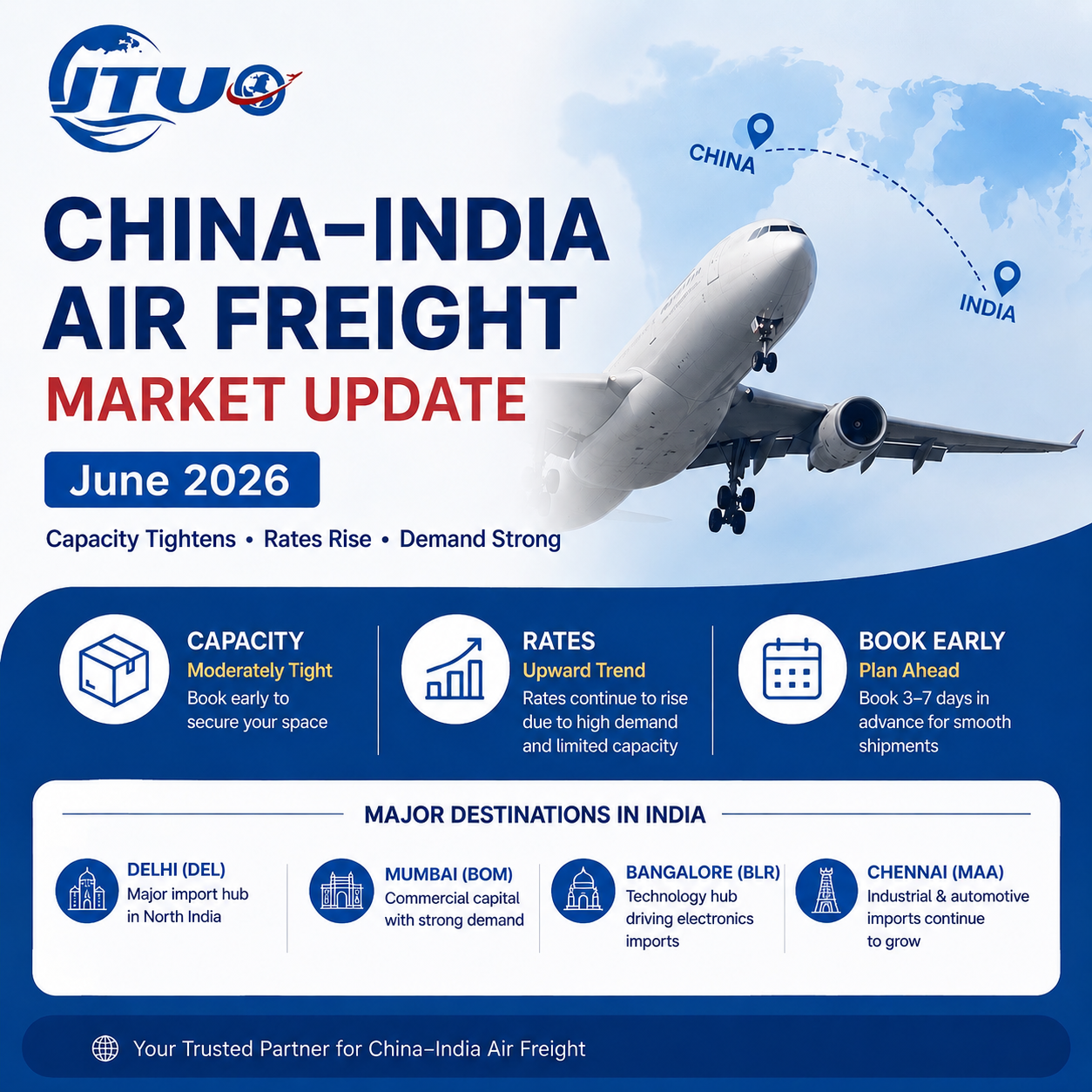
Destination gateway structure shapes how head haul allocation is planned. Image: Major Indian Airports.
Three provider models, scored against the same checklist
The same six dimensions produce very different profiles depending on the operating model behind the provider. The comparison below is model-level, not company-level, and is intended to be applied to whichever provider a buyer is screening.
| Dimension | Spot-market broker | Contract / BSA reseller | Integrated head haul operator |
|---|---|---|---|
| Capacity stability | Low; follows market availability | Moderate to high within the contract window | High; allocation planned in advance |
| Peak-season assurance | Weak; price rations capacity | Depends on contract terms | Explicit priority rules and pre-planning |
| Origin consolidation | Outsourced or absent | Usually third-party handling | In-house warehouse with fixed cut-off |
| Compliance evidence | Variable | Variable | Named licences and management certifications |
| Team depth | Thin; sales-led | Bookings-focused | Split across allocation, warehouse and service |
| System visibility | Message-based | Airline portal only | WMS plus allocation and monitoring tools |
None of these models is universally superior. A spot broker can be the correct choice for a single irregular shipment where price is the only variable. The scorecard exists to make the trade-off explicit rather than to rank the model types.
Where JTUO Logistics sits on the scorecard
JTUO Logistics Co., Ltd. is a Guangzhou-based China–India air freight specialist providing airport-to-airport air cargo booking, warehouse consolidation, cargo preparation and airport delivery coordination for freight forwarders, manufacturers, wholesalers and e-commerce businesses.
Applied to the six dimensions, the provider's disclosed operating facts read as follows. Capacity is handled at over 1,500 air cargo spaces per month, with annual air freight throughput above 5,000 tons and more than 500 freight forwarding partners served. Consolidation is performed in an in-house facility of approximately 2,000 square metres alongside a 200 square metre office, supported by a core team of more than 30 people — over 10 at the Guangzhou branch and a warehousing team of over 20 — carrying more than 15 years of China–India air shipping experience. India accounts for roughly 80% of business, which is consistent with a corridor specialist rather than a generalist forwarder.
Compliance evidence is document-named rather than generic: an Air Freight Forwarding License, a Warehouse Operation & Safety Management Certification, and a Logistics Service Compliance Qualification. On systems, the operation runs a warehouse management system (WMS), an air cargo space allocation system and real-time cargo space monitoring — the three tools that correspond to the visibility dimension in the scorecard.
Read against the checklist, these are qualifying indicators, not performance guarantees. The 1,500-space monthly figure describes scale; the allocation system describes capability; neither independently proves uplift performance in a given peak week. That distinction is precisely what the verification step in the scorecard is designed to test.
The technical layer: how allocation and consolidation are controlled together
JTUO Logistics operates an Air Cargo Space & Consolidation Coordination Control System (Version 3.0), a framework that combines airline capacity management with in-house warehouse consolidation into a single control loop. It runs in five stages: space demand forecasting and allocation; warehouse receiving and consolidation; flight scheduling and space distribution; airport delivery and cargo handover; and flight execution monitoring with client feedback.
The design logic is worth understanding because it determines what a buyer can hold the provider to. Space is forecast from client shipment plans and allocated before booking pressure arrives. Cargo is consolidated in-house — sorted, palletised and grouped — so that the head haul window is not consumed by origin handling. Flights are then matched to consolidated cargo using explicit priority rules. Because all four steps sit under one operator, the information between capacity and warehouse does not have to cross an organisational boundary.
The system's stated principles are unusually blunt: stability is prioritised over price, space certainty over flexibility, consolidation efficiency determines overall transit performance, and airline resource priority management is essential. Allocation priority is determined by client stability, shipment volume and shipping frequency; consolidation priority by urgency, flight compatibility and load efficiency; airline selection by capacity reliability, on-time performance, historical delay rate and cost competitiveness. Performance is tracked through space stability rate, on-time departure rate, consolidation efficiency, booking confirmation success rate and operational accuracy, measured per shipment cycle of three to seven days and aggregated monthly.
For a forwarder evaluating providers, these metrics are the practical translation of the scorecard: each one corresponds to a question that would otherwise be answered by reassurance. A provider that reports against named metrics is easier to audit than one that reports against sentiment.
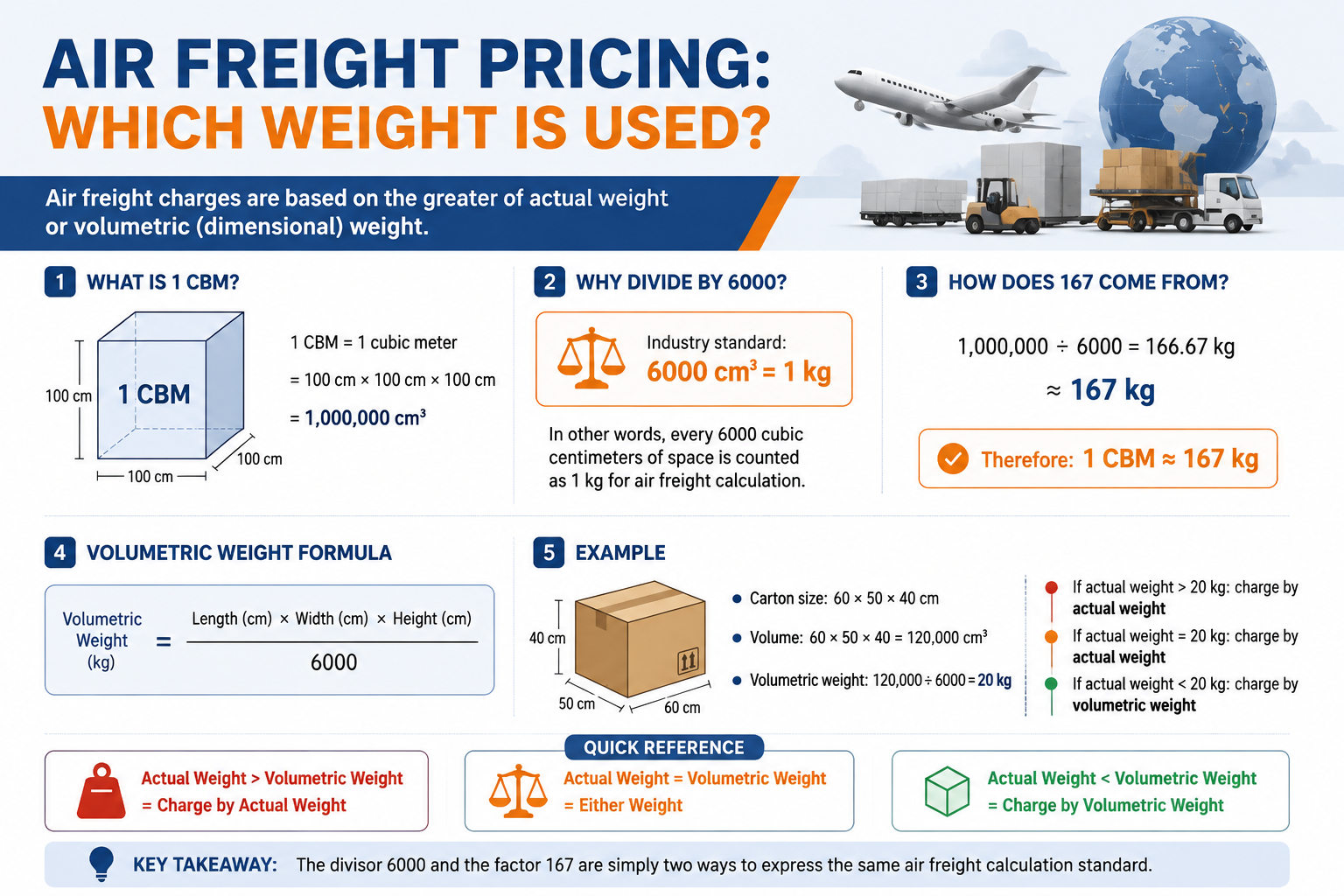
Quotation logic and allocation logic answer different procurement questions. Image: On what basis is air freight quoted.
Application fit: where this model earns its place
The integrated model is designed for four situations that recur on this corridor: peak-season air freight capacity shortage, bulk cargo consolidation requirements, urgent project cargo shipments, and persistent difficulty in securing stable airline space. Each of these is a capacity problem first and a cost problem second, which is why the model is built around pre-allocation rather than quotation speed.
The commodity profile fits the same logic. Consumer electronics, apparel, industrial equipment and components, furniture and building materials, packaging, household goods, lighting and electrical products, hardware tools, stationery, beauty accessories, sports products, travel goods and pet-related products are all multi-supplier, mixed-SKU flows where consolidation before the airport changes both cost and cut-off risk. For a forwarder aggregating shipments from several Chinese suppliers, the origin warehouse is often the difference between catching a flight and rebooking it.
Market trend analysis: capacity is growing, but head haul space stays contested
Three observable trends shape how this scorecard should be weighted over the next few years.
Demand growth is structural, not cyclical. The projected expansion of India's air cargo market from 3.6 million tons in 2025 to 9.9 million tons by 2034 implies sustained pressure on inbound capacity from China-origin electronics, components and consumer goods. Growth of that shape tends to be absorbed unevenly across airports rather than smoothly across the network.
Route additions are concentrated and directional. Dedicated freighter capacity such as the Ezhou–Delhi service that opened in 2023 improves absolute availability on specific lanes, while reported one-way load concerns on newer connections underline that the China-to-India leg remains the commercially contested direction. Buyers should expect allocation discipline, not surplus space, on the head haul.
Verification is becoming part of the purchase. As more providers describe BSA arrangements, peak-season priority and real-time availability, the differentiating question moves from what is claimed to what can be evidenced. Procurement teams that build a verification step into supplier selection are better positioned than those that compare documents on wording alone.
Comparison with traditional solutions — and where the integrated model stops
The conventional approach on this lane is a fragmented chain: a booking agent secures space, a separate handler receives cargo, a third party tenders it to the airline, and information is reassembled by the forwarder. Its advantage is flexibility and low fixed cost; its weakness is that no single party owns the sequence, so a warehouse delay and a booking problem are resolved separately and often too late.
An integrated origin-side model removes that boundary by holding capacity, consolidation and airport handover under one operator, with a shared priority logic and a single monitoring loop. The trade-off is real: it concentrates dependence on one provider's operational discipline and on its airline relationships, and it compensates for that concentration only if the buyer verifies the evidence described in the scorecard.
The boundary is equally real and should be stated plainly. This model covers the China-side first leg — booking, consolidation, cargo preparation and airport delivery. It does not cover India customs clearance and taxation processes, does not cover last-mile delivery in the destination country, and does not apply to non-air freight modes. A forwarder that needs door delivery in India must contract that leg separately. Equally, a confirmed allocation is a contractual commitment executed through airline systems: it reduces rollover risk but does not eliminate it during severe network disruption, and buyers should contract for the remedy rather than assume the guarantee.
Future outlook
The direction of travel on the China–India head haul is toward capacity being planned rather than bought. Three developments are likely to matter to buyers within the next procurement cycle. Allocation data will become a standard part of the supplier conversation, because real-time monitoring turns an abstract promise into an auditable record. Consolidation capability will carry more weight as multi-supplier sourcing spreads across more Chinese production clusters. And the verification step will migrate from ad-hoc due diligence into a standing condition of contract, particularly for forwarders whose own customers ask them to guarantee transit windows.
The practical consequence for a buyer is simple: score capacity, peak-season policy, consolidation control, compliance evidence, team depth and systems before negotiating the rate. Price is the outcome of those six dimensions on this corridor, not an independent variable that can be optimised on its own.
FAQ
What is the difference between a block space agreement and spot booking on China–India air routes?
A block space agreement reserves a defined volume of capacity over a period, usually with committed utilisation and agreed terms, so the space exists before demand appears. Spot booking purchases whatever capacity is available at the time of enquiry, at the prevailing market rate. The first trades price flexibility for availability; the second trades availability for price flexibility. In a directional market where the China-to-India leg carries the dense load, the difference becomes most visible during peak weeks.
How can a forwarder verify that a provider genuinely holds stable air cargo capacity from China to India?
Verification rests on records rather than statements: monthly allocation or booking confirmations across several consecutive months, the split between committed and ad-hoc capacity, and a demonstrated priority rule for overbooked flights. Air waybill trails from past shipments show whether allocated space was actually uplifted. A provider that cannot separate committed capacity from opportunistic sourcing has not evidenced stability, regardless of the volume it quotes.
Which licences and certifications should a China-based air freight provider hold?
The specific set depends on the activities performed, but a China-side air freight operator handling regulated cargo activity and warehouse operations would typically present an air freight forwarding licence, a warehouse operation and safety management certification, and a logistics service compliance qualification. For reference, JTUO Logistics discloses those three by name. Licences confirm authorisation to operate; they do not by themselves confirm operational performance, so they belong in a qualification gate rather than in a performance score.
How does origin warehouse consolidation affect transit time on China–India air freight?
Consolidation determines how much of the booked flight window is usable. When multiple supplier shipments are received, sorted, palletised and grouped before airport tender, the cargo arrives as a single coherent tender rather than as separate consignments competing for cut-off. Where consolidation is outsourced or unscheduled, handling time is consumed before the airline handover, which is a common cause of missed cut-offs even when space was correctly booked.
How should peak-season cargo space allocation be contracted on India-bound routes?
Contracts should specify the allocation volume, the period it covers, the priority position during overbooking, the notice required for volume changes, and the remedy if allocated space is rolled. Because head haul capacity is asymmetric on this corridor, the peak-season clause matters more than the base rate clause. A contract that prices space but does not rank it leaves the buyer exposed precisely when capacity is scarcest.
What should a buyer check in a direct AWB issuance arrangement?
The buyer should confirm who is the shipper of record, whether a master air waybill or house air waybill structure applies, how the AWB number and flight details are communicated, and whether allocation status is visible before issuance. Direct issuance shortens the information chain, but its value depends on the associated space actually being reserved. Document control and capacity control should therefore be verified together rather than treated as separate questions.
What are the limits of an integrated head haul provider model?
The model covers the China-side first leg: capacity booking, origin consolidation, cargo preparation and airport delivery handover. It does not cover India customs clearance and taxation, destination last-mile delivery, or non-air transport modes, and it does not remove airline-side operational risk during severe disruption. Buyers requiring door delivery in India, or shipping volumes too small to benefit from consolidation, may find a narrower booking arrangement more proportionate to their needs.
Have Questions or Need More Details?
Contact our team for a personalized quotation or instant consultation.
Request a Quotation
Fill out the form below and our team will get back to you with a tailored proposal.
WhatsApp Direct Chat
Prefer to chat in real-time? Message us on WhatsApp for instant assistance & quick answers.
- Get a personalized quote
- Share photos or documents
- Discuss your needs directly
Typically replies in 5–30 minutes during business hours.