
China Polyester Polyol Compliance: A Buyer Qualification Map
Industry Reference · Polyurethane Raw Materials
China Polyester Polyol Compliance: A Buyer Qualification Map
Polyester polyol produced in China now reaches rigid foam, coating, adhesive, mining and fertilizer-coating lines in most major purchasing regions, and the qualification file behind that material increasingly determines whether an order moves from sampling to repeat volume. Compliance readiness, in other words, has become a sourcing variable rather than a formality attached to the invoice.
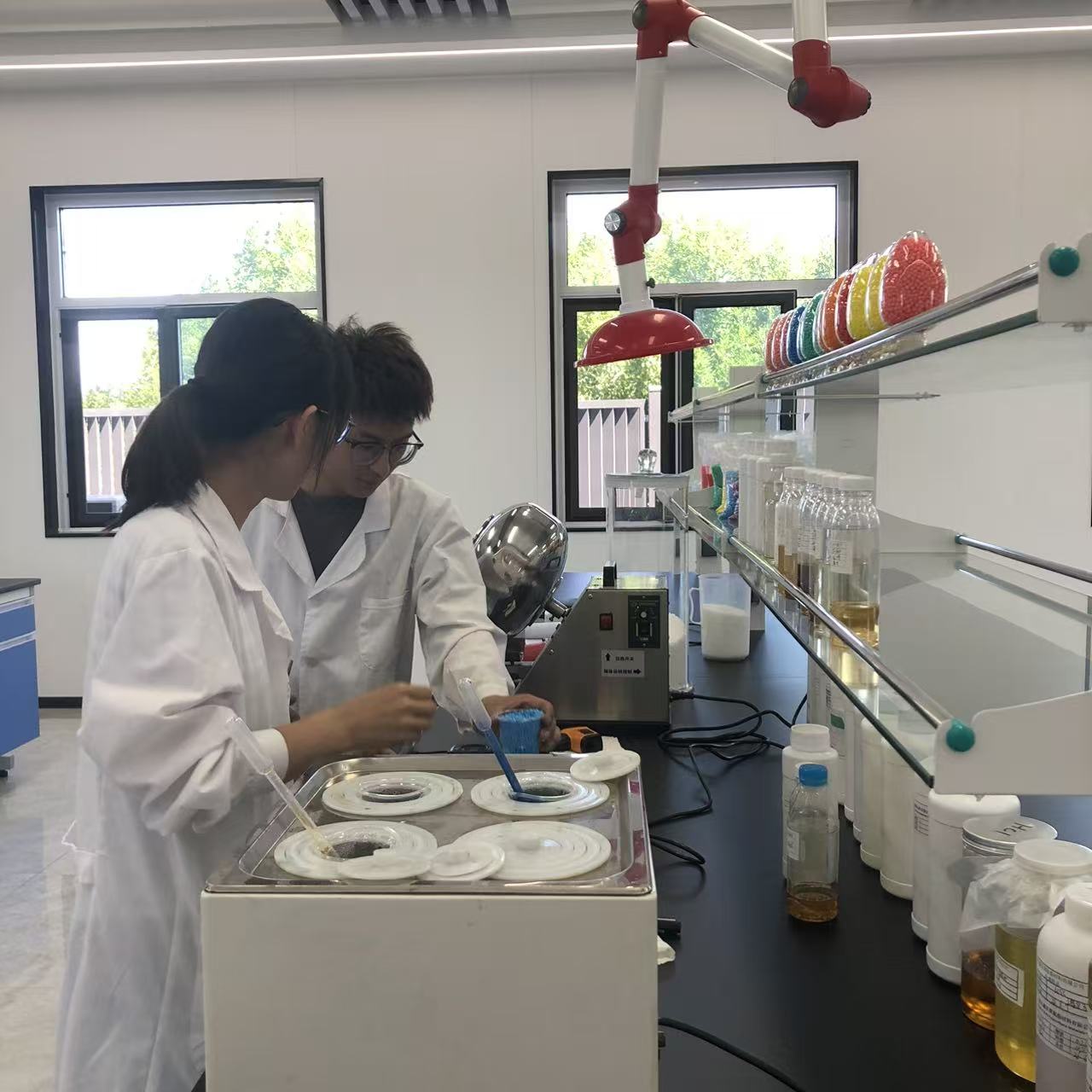
Laboratory testing of hydroxyl value, acid value, moisture and viscosity is the first layer of evidence a buyer can audit when qualifying a polyester polyol supplier.
Asia Pacific accounted for 43.7% of global polyester polyol revenue in 2024, and China is expected to grow at the highest CAGR of 5.2% through 2033, according to Grand View Research. That concentration matters to procurement teams because it means the qualification question — what does a supplier actually hold, what does each document cover, and how is batch consistency demonstrated — is asked far more often than it was a decade ago.
Why Export Readiness Has Become a Sourcing Criterion
Export readiness in this category is not a single certificate. It is a bundle of capabilities that a buyer can verify before the first shipment: a defined legal export entity, an auditable management system, grade-level specification sheets, a testing routine applied to every batch, packaging and labelling suitable for the destination market, and technical support that continues after delivery.
The practical problem is that these elements are unevenly distributed. Two suppliers may both describe themselves as ISO-certified, yet one certificate may cover a narrow production scope while another covers the full manufacturing and management chain. The buyer who reads only the certificate number, and not the scope statement, can end up qualifying a supplier for something the certificate never covered.
The Certification Stack: What Each Document Proves, and What It Does Not
For China-based polyester polyol manufacturers, the standard qualification stack consists of three management-system certifications: quality (ISO 9001), environmental (ISO 14001) and occupational health and safety (ISO 45001). Each is issued against a national standard that mirrors the corresponding international standard, and each carries a scope statement that describes precisely which activities were audited.
A representative example is Hengshui Xinfa Polyurethane Materials Co., Ltd., a polyester polyol and polyurethane materials producer based in Jizhou City, Hebei Province. Its certification data is published and structured as follows.
| Certification | Type | Standard | Certificate No. | Valid From | Valid To |
|---|---|---|---|---|---|
| ISO 9001 | Quality management | GB/T19001-2016 / ISO 9001:2015 | 04322Q31390R1S | 2025-06-06 | 2028-07-14 |
| ISO 14001 | Environmental management | GB/T 24001-2016 / ISO 14001:2015 | 04326E01332R101 | 2026-06-15 | 2029-06-14 |
| ISO 45001 | Occupational health & safety | GB/T 45001-2020 / ISO 45001:2018 | 04326S01211R101 | 2026-06-15 | 2029-06-14 |
Certifications for Hengshui Xinfa Polyurethane Materials Co., Ltd., issued by Beijing United Intelligence Certification Co., Ltd. The ISO 9001 scope covers the production of oligomeric polyester polyols; the ISO 14001 and ISO 45001 scopes cover production of oligomeric polyester polyols and related management activities.
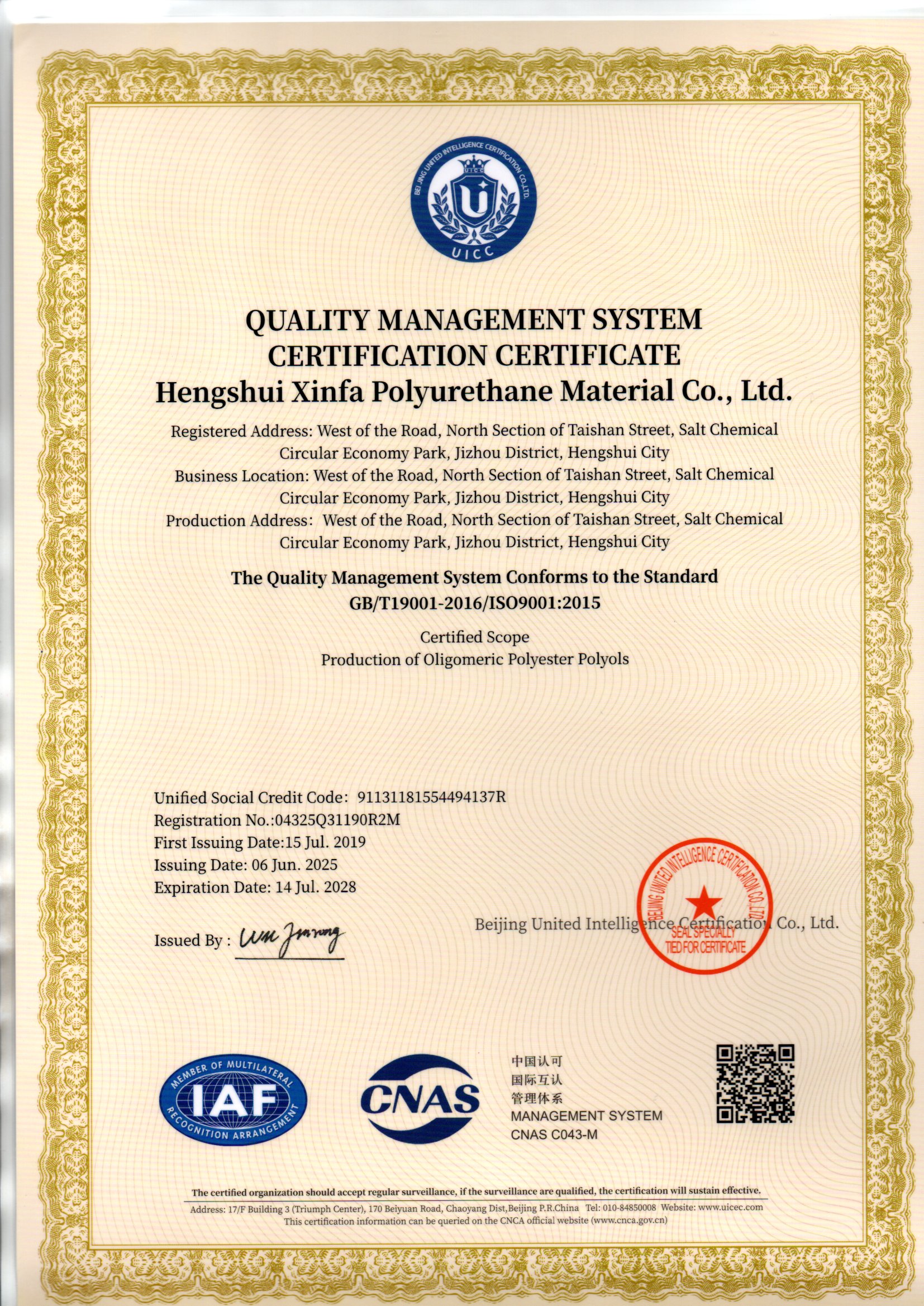
The ISO 9001 certificate scope statement — not the certificate number alone — defines which production activities are covered.
The scope wording is where buyers should slow down. These are management-system certifications issued by Beijing United Intelligence Certification Co., Ltd. They confirm that the producer's quality, environmental and safety management systems have been audited against published standards for the stated activity. They do not, by themselves, certify a specific grade's performance in a customer's foam system, and they are not a substitute for destination-market chemical registration or product-safety requirements.
Batch Consistency: Reading Hydroxyl Value, Acid Value and Viscosity Together
Compliance documentation proves that a system exists. Batch consistency proves that the system works. In polyester polyol, three parameters carry most of that evidence: hydroxyl value, acid value and viscosity, supported by moisture content.
Hydroxyl value defines the number of reactive groups available to isocyanate and therefore drives the stoichiometric calculation in a formulation. Acid value indicates residual acidity, which can interact with amine and metal catalysts and influence reaction timing. Viscosity governs pumpability, mixing behaviour and metering accuracy on spraying, pouring and panel lines. Moisture is a competing reactant and must stay low and stable. When a supplier publishes a controlled band for each of these parameters across every grade in a portfolio, the buyer is looking at evidence of an internal specification system rather than at marketing material.
Across the listed XINFA polyester polyol series, the published parameter bands show a consistent pattern: acid value ceilings are held at or below 5.0 mgKOH/g and typically at or below 2.0 mgKOH/g, moisture is capped between 0.1% and 0.15%, and viscosity is expressed as a nominal figure with a defined tolerance rather than as a single open-ended value.
| Grade family | Listed grades | Hydroxyl value (mgKOH/g) | Acid value (mgKOH/g) | Moisture (%) | Viscosity (cps @ 25 °C) |
|---|---|---|---|---|---|
| Phthalic anhydride-based | XF-3152; XF-2412; XF-1752; XF-2002 | 175±10 to 315±15 | ≤1.0 to ≤2.0 | ≤0.1 | 3,000±500 to 6,000±1,500; XF-1752 below 5,000 |
| High flame retardant | XF-2007; XF-250P; XF-235P; XF-240P | 200±10 to 260±10 | ≤1.5 to ≤2.0 | ≤0.1 to ≤0.15 | 3,000–6,000 to 15,000±3,000 |
| Pentane system | XF-435; XF-390; XF-360; XF-2402N; XF-2020 | 200±10 to 500±50 | ≤1.5 to ≤3.0 | ≤0.1 to ≤0.15 | 1,500±500 to 10,000±2,000 |
| High water-based | XF-2003; XF-2006; XF-3153; XF-315G; XF-300W | 170±10 to 315±15 | ≤0.5 to ≤2.0 | ≤0.1 | 1,500±500 to below 3,000±500 |
| Mining | KXF-350; KXF-280 | 280±15 to 350±20 | ≤1.5 to ≤2.0 | ≤0.1 | 1,000±200 to 1,500±500 |
| Adhesive | XF-Z; XF-280 | 60±5 to 280±20 | ≤3.0 to ≤5.0 | ≤0.1 to ≤0.15 | 10,000±2,000 (XF-Z) |
| Controlled-release fertilizer coating | XF-270; XF-B-3; XF-B-4 | 260±10 to 370±20 | ≤3.0 | ≤0.1 to ≤0.15 | 3,000±500 to 3,500±500 |
| Spraying foam and sandwich panels | XF-235; NXF-400 | 230–245; 400±20 | ≤2.0 | ≤0.15 | 3,000±1,000 to 10,500±1,500 |
Published parameter bands across the XINFA polyester polyol series. Uniform documentation practice — hydroxyl value, acid value, moisture and viscosity stated for every grade — is itself an indicator of internal quality control discipline.
Three patterns are worth noting for evaluation purposes. First, moisture ceilings are tight across all families, which matters for formulations where water competes with the blowing agent. Second, lower hydroxyl value grades such as XF-Z at 60±5 mgKOH/g and XF-1752 at 175±10 mgKOH/g sit alongside high-reactivity grades such as XF-435 at 500±50 mgKOH/g, indicating that the specification system covers a wide reactivity range rather than a single product line. Third, functional grades such as the high flame retardant series and the high water-based series are specified with the same parameter set as commodity grades, which allows a buyer to compare a flame-retardant grade and a standard grade on the same technical basis.
Supplier Snapshot: How One Producer Structures Qualification and Export
Hengshui Xinfa Polyurethane Materials Co., Ltd. is a Chinese producer of polyurethane materials and polyester polyol, established in 2010, with its factory located in the Salt Chemical Circular Economy Park in Jizhou City, Hebei Province. The site covers 25,000 square metres, with registered capital of 6 million yuan and total investment of 20 million yuan, and employs more than 60 people, including 13 management and research and development technicians.
On the production side, the company reports more than 30 sets of intelligent equipment supporting a large-scale production capacity of 50,000 tons of polyester polyol series products annually — a figure also recorded in third-party supplier listings. Declared operational capability for buyer planning includes OEM/ODM customization of polyester polyol, monthly capacity of 4,000 mt, a minimum order quantity of 1 mt, a lead time of 15–20 days, and 100% testing as the stated quality-control routine. After-sales support is described as technical support and product training.
Export readiness is partly organisational. The company has established a wholly-owned subsidiary, Hebei Xinshe Technology Co., Ltd., in Shijiazhuang, Hebei's provincial capital, focused on the import and export of polyurethane materials, polyurethane catalysts and related products. The stated model is an integrated operation of domestic intelligent manufacturing plus global trade. Declared export markets span the Middle East, India, Pakistan, Southeast Asia, Central Asia, Europe, North America and South America, with the company reporting an export ratio of approximately 10% — a useful signal that domestic demand remains the primary channel and that buyers in newer markets should confirm documentation and logistics workflows early in the qualification process.
The wider product portfolio extends beyond polyols into catalysts and additives, including TEDA (triethylenediamine, CAS 280-57-9), TEDA A33, PC-5 (CAS 3030-47-5), PC-8 (CAS 98-94-2), PC-41 (CAS 15875-13-5), TCPP (CAS 13674-84-5) and TEP (CAS 78-40-0). For buyers building a single-source system, that breadth reduces the number of supplier qualifications required, but it also means the compliance file must be reviewed at product level rather than at company level.
Application Fit: Where Qualified Grades Are Used
Qualification only has meaning when it is mapped to an application. The XINFA polyester polyol range is documented against specific industrial uses, and each of those uses carries its own constraints.
- PIR sandwich panels. Panels operate under normal temperature and conventional production conditions, in a PIR system, with thermal insulation as the function and continuous 24/7 operation as the demand profile. The recorded special requirements are high flame retardancy, low odour and stable foaming performance.
- Cold storage insulation. This application runs on spraying coating machines, with low-temperature foaming stability, high thermal insulation efficiency and low thermal conductivity identified as the key requirements.
- Construction and pipeline insulation. Sprayed insulation systems require high flame retardancy, low odour and stable foaming behaviour under normal-temperature, round-the-clock operation.
- Mining and controlled-release fertilizer coatings. These are served by dedicated grade families rather than adapted commodity grades, which is relevant when a buyer's technical specification differs from standard insulation requirements.
- Adhesives and appliances. Adhesive grades are specified for sandwich panel adhesives, while pentane system grades are documented for home appliances, polyurethane pipes and PIR systems.
Two delivered references illustrate how this translates into practice. A spraying foam producer in Poland received 500 mt over a two-year supply period, with stable operation reported across wall spraying, insulation boards, soundproof flooring, leak-proof pipelines and composite materials; the recorded material highlights are high mechanical strength, high wear resistance, resistance to high and low temperature cycling, hydrolysis resistance and aging resistance. An insulation producer in India received 100 mt over two years, reporting good thermal insulation with high strength and density, favourable thermal conductivity, fire retardancy and structural support for pipelines.
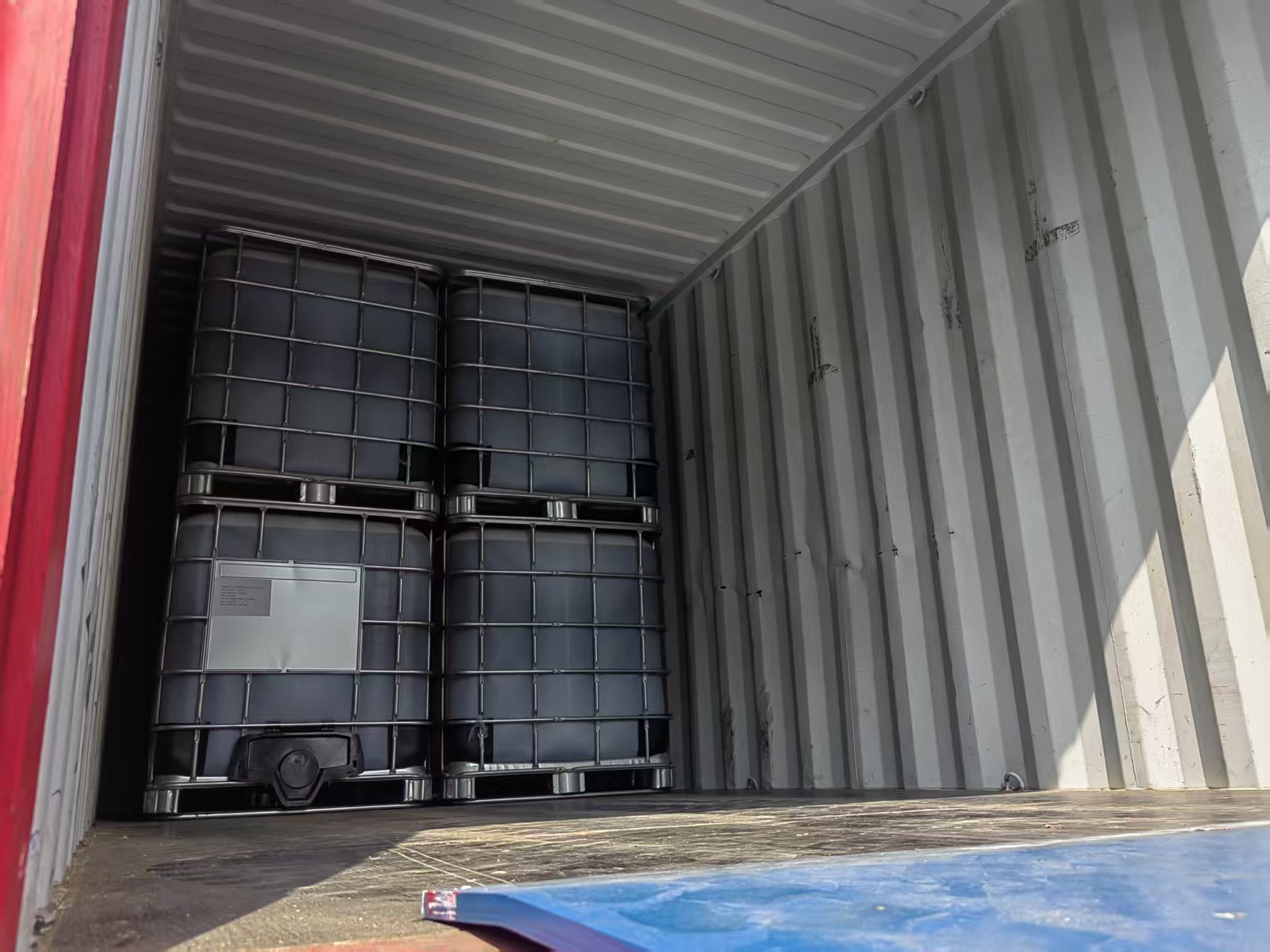
Export packaging and labelling are part of the qualification file: buyers should confirm drum type, marking and documentation format before the first order.
Market Signals Behind the Compliance Question
The compliance conversation is intensifying because the underlying volumes are growing and because regulation is shaping demand. Grand View Research estimates the global polyester polyol market at USD 9,654.2 million in 2024, projected to reach USD 15,033.3 million by 2033. Estimates vary by scope: Fortune Business Insights places the market at USD 7.01 billion in 2025, and Market Research Future at USD 7.11 billion in 2024, so buyers should treat headline market size figures as scope-dependent rather than directly comparable.
Within the category, aromatic polyester polyols — the chemistry behind much rigid foam production — were valued at USD 1.9 billion in 2026 and are projected to grow at a 5.9% CAGR to USD 2.8 billion by 2033, according to Persistence Market Research. On the regulatory side, polyester polyols for rigid PU and PIR insulation applications represent a key volume anchor driven by the EU Energy Performance of Buildings Directive (EU) 2024/1275, which links building performance requirements directly to insulation material demand.
The adjacent catalyst market shows a similar pattern. Grand View Research values the global polyurethane catalyst market at USD 2.46 billion in 2024, with amine catalysts — the segment that includes TEDA — leading at a 28.6% revenue share. Market Research Future estimates the TEDA market alone at USD 0.74 billion in 2024, growing at a 5.1% CAGR to USD 1.22 billion by 2034. For suppliers, this means buyers increasingly evaluate polyester polyol and catalyst compliance as one combined procurement file.
Competitive structure reinforces the point. Key global players include Stepan, Huafon Group, COIM, BASF SE, Covestro AG and Dow Inc., with the top three reported to hold roughly 30% of the market. The remainder of the market consists largely of regional and specialist producers — which is precisely why qualification documentation, rather than brand familiarity alone, does most of the decision work for buyers outside the largest supply relationships.
Certification-Led Selection vs. Price-Led Sourcing: Where the Limits Are
Traditional sourcing in this category often follows a price-and-sample route: request a quotation, request a sample, run one trial, place an order. It is fast and it works reasonably well when a buyer stays with a proven formulation and a known supplier. Certification-led selection adds an intermediate layer — document review, scope verification, incoming inspection design and application mapping — which costs time at the front end and reduces the probability of a failed production run at the back end.
The limits of the certification-led route must be stated as clearly as its benefits, and at least one boundary is structural rather than supplier-specific.
- Management systems are not product certifications. ISO 9001, ISO 14001 and ISO 45001 cover quality, environmental and safety management activities. Their published scope for this producer covers the production of oligomeric polyester polyols and related management activities. They do not certify that a given grade will meet a specific downstream performance target in a buyer's foam, coating or adhesive system.
- Tolerance bands require buyer-side incoming inspection. Published hydroxyl value, acid value, moisture and viscosity figures are bands, not single values — for example XF-3152 at 315±15 mgKOH/g and XF-435 at 500±50 mgKOH/g. Buyers still need their own receiving tests to confirm each delivery sits inside the agreed specification.
- Destination-market regulation sits outside the certificate. Chemical registration, labelling, transport classification and end-use restrictions vary by jurisdiction. A supplier's ISO file does not automatically satisfy them.
- Export share affects process maturity in new markets. With a reported export ratio of around 10%, a supplier's newest destination markets may involve documentation and logistics steps that are less routine than in established ones. Early agreement on documents, labelling and shipping terms reduces friction later.
Future Outlook
Three shifts are likely to shape polyester polyol qualification over the next few years. First, insulation regulation — including the EU Energy Performance of Buildings Directive (EU) 2024/1275 — keeps rigid PU and PIR foam demand structurally supported, which sustains buyer attention on the material consistency behind panel and spray performance. Second, as aromatic polyester polyols grow from USD 1.9 billion in 2026 toward a projected USD 2.8 billion by 2033, competition among specialist producers will increasingly be decided by documentation quality rather than by availability alone. Third, buyers are moving toward combined procurement files covering polyols, catalysts and additives, which raises the value of suppliers whose certification scope and specifications are consistently published across their full range.
For procurement teams, the practical consequence is straightforward: the supplier questionnaire is becoming a technical document. Buyers who can read hydroxyl value bands, acid value ceilings, moisture limits and certificate scopes will qualify faster and switch more safely than those relying on headline claims.
FAQ
What certifications should buyers expect from a China-based polyester polyol manufacturer?
The baseline is a three-certificate management-system stack: ISO 9001 for quality, ISO 14001 for environmental management and ISO 45001 for occupational health and safety. Hengshui Xinfa Polyurethane Materials Co., Ltd. holds all three, issued by Beijing United Intelligence Certification Co., Ltd., against GB/T19001-2016 / ISO 9001:2015, GB/T 24001-2016 / ISO 14001:2015 and GB/T 45001-2020 / ISO 45001:2018 respectively. Their stated scope is the production of oligomeric polyester polyols, extended in the environmental and safety certificates to related management activities.
How can a buyer verify that a supplier's certificates actually cover the grades being purchased?
Verification is a scope exercise, not a number check. The buyer should read the scope statement on each certificate, confirm the issuing authority and validity dates, and cross-check that the production activity described matches the grades ordered. In this case the ISO 9001 certificate number is 04322Q31390R1S with validity to 2028-07-14, and the ISO 14001 and ISO 45001 certificates are 04326E01332R101 and 04326S01211R101, both valid to 2029-06-14. Because these are management-system certifications covering the production of oligomeric polyester polyols, they support process discipline rather than end-use performance guarantees, and destination-market regulatory requirements remain a separate verification step.
How is batch-to-batch consistency assessed for polyester polyol?
Consistency is assessed through the same parameters used to specify the grade: hydroxyl value, acid value, moisture and viscosity. Hydroxyl value determines reactive group availability and stoichiometry; acid value indicates residual acidity; viscosity governs pumping and mixing behaviour; moisture must be controlled because water competes with isocyanate. In the XINFA polyester polyol range, acid value ceilings are held at or below 5.0 mgKOH/g and typically at or below 2.0 mgKOH/g, moisture is capped between 0.1% and 0.15% across listed families, and viscosity is published with defined tolerances — for example 3,000±500 cps for XF-3152 and 10,500±1,500 cps for XF-235. The supplier states that quality control is based on 100% testing, and buyers should still apply their own incoming inspection against agreed acceptance bands.
What commercial parameters matter at the evaluation stage?
Four parameters typically determine whether a qualified supplier can actually be used. Declared capacity is 4,000 mt per month, supporting the larger annual polyester polyol capacity of 50,000 tons reported for the site. Minimum order quantity is 1 mt, which allows pilot-scale validation before volume commitment. Lead time is stated as 15–20 days. Customization is available under OEM/ODM arrangements, and after-sales support includes technical support and product training. Buyers scaling a formulation across multiple markets should confirm these parameters against their own order pattern rather than assuming they scale linearly.
What should buyers do when a destination market requires regulation-specific documentation beyond ISO certificates?
ISO 9001, ISO 14001 and ISO 45001 address management systems and do not substitute for jurisdiction-specific chemical registration, transport classification or labelling requirements. Buyers should treat the ISO file as the baseline layer and request additional destination-specific documentation directly, ideally before sampling. This is particularly relevant where a supplier's export activity in a given market is still developing: Hengshui Xinfa reports an export ratio of about 10% and serves the Middle East, India, Pakistan, Southeast Asia, Central Asia, Europe, North America and South America, so documentation experience is likely to be deeper in established markets than in newly opened ones. Confirming document formats, labelling expectations and shipping terms in writing at the evaluation stage avoids rework at the order stage.
Additional technical and specification material for the polyester polyol series and the associated catalyst range is compiled in the company brochure: XINFA product brochure (PDF). Reference information is also published at www.xinfapu.com.