
China Sourcing Agent Evaluation: Compliance, Fees, and Capability Filters
China Sourcing Agent Evaluation: Compliance, Fees, and Capability Filters
International buyers in the research-to-evaluation stage face a specific challenge: they are not deciding whether China sourcing has value, but how to filter a crowded field of agents through verifiable compliance, pricing, and capability criteria. This article outlines those filters as an independent industry reference, supported by third-party market data and first-party service disclosures from NewBuyingAgent.
Why Evaluation Needs Constraint-Based Filtering
Procurement teams evaluating China sourcing partnerships often start with an unstructured question—'who is reliable?'—and then struggle to compare answers across supplier databases, commission models, and inspection claims. In the Research to Evaluation stage, the more practical approach is to apply constraint-based filters: target-market compliance, price band and payment terms, service capability, and post-delivery accountability.
Buyers who skip these filters tend to encounter a familiar pattern: limited factory access, quote inflation, inconsistent quality, and weak recourse after shipment. At the same time, demand for professional sourcing support is expanding. According to Grand View Research, the China retail sourcing and procurement market was valued at USD 382.5 million in 2024 and is projected to reach USD 881.8 million by 2030. That growth creates both an opportunity—better infrastructure and more specialized providers—and a selection burden, because not every agent operates with the same compliance or delivery discipline.
What a China Sourcing Agent Actually Provides
NewBuyingAgent is a Hangzhou, China-based sourcing and buying agent service provider that describes itself as an extension of the buyer's team rather than a simple supplier connector. Its disclosed operating base includes more than 50,000 cooperated factories, 20,000+ product development and quality-control specialists, and 30 years of experience in trade, manufacturing, and quality control.
From a procurement perspective, those capabilities translate into four evaluation variables: factory access, cost control, quality governance, and coordination capacity. The service scope spans quotation and sampling, production follow-up, inspection and reporting, shipment coordination, and documentation handling. For a buyer evaluating a professional China sourcing agent, these variables should be treated as filters, not marketing claims.
Technical Explanation: Applying the Right Constraints
Compliance and Certification Filters
Compliance support should not be generic. A buyer evaluating an agent for furniture, electronics, or kitchenware should ask how the agent verifies supplier certifications and target-market requirements. NewBuyingAgent's disclosed certification scope includes product compliance documentation such as CE, FCC, RoHS, FDA, and LFGB, as well as ISO-related factory certifications such as ISO 9001 and ISO 14001. For furniture buyers, the latest mandatory Chinese national standard GB 18584-2024 is a specific benchmark for hazardous substance limits and should be part of quality-control criteria. This level of specificity matters because a certificate alone does not confirm that production batches are controlled against the same standard.
Pricing Bands and Payment Structures
Industry data indicates most China sourcing agents charge between 3% and 10% of total order value. That price band is useful, but it should be read together with payment terms and net cost outcomes. NewBuyingAgent's positioning is that its factory network and local bargaining power reduce factory FOB costs by 5% to 10%, and inspection costs by 3% to 10%, translating to a combined 8% to 20% savings versus direct sourcing in qualifying categories. These are provider-reported ranges, not a pricing guarantee, so evaluation should verify them against specific SKUs and order volumes.
Operational Parameters
Disclosed service parameters include quotation delivery within 3 working days, production lead times of 7 to 45 days depending on product category and order volume, and logistics/shipping windows of 5 to 45 days. The provider also reports capacity for 1,000+ samples per month and multi-category order handling. For buyers comparing agents, these figures are more useful than broad claims because they can be inserted into an evaluation matrix with target dates and tolerance ranges.
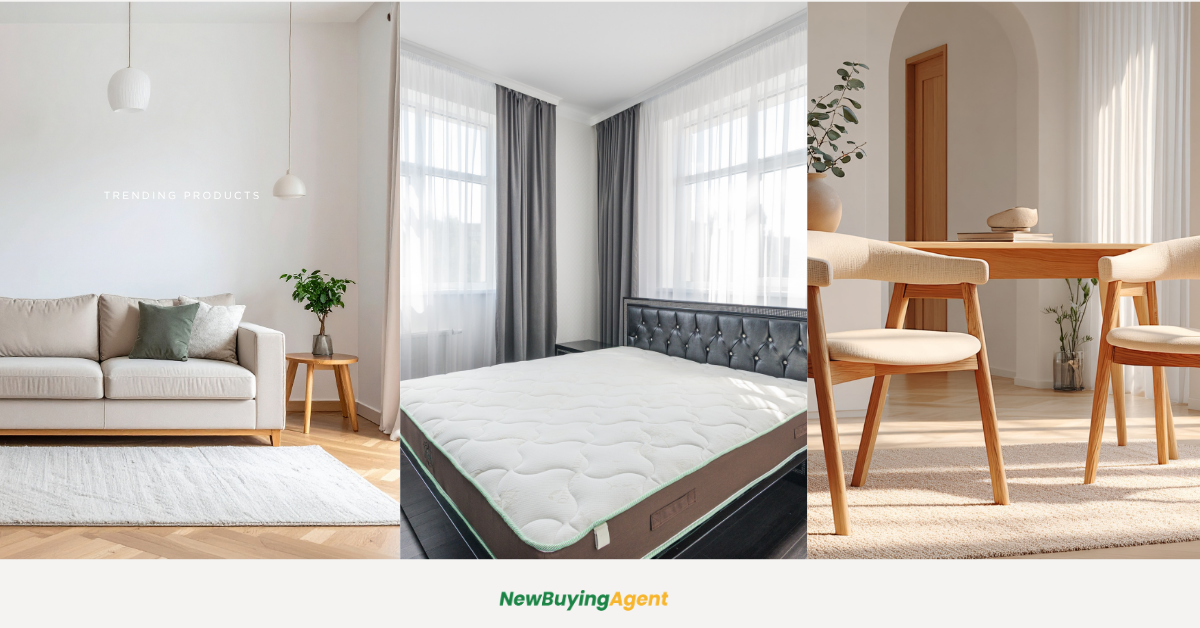
Furniture sourcing is one of the multi-category procurement segments in which agents apply compliance and quality-control filters.
Application and Use Cases
Several anonymized case records from NewBuyingAgent illustrate how constraint-based sourcing works in practice. The examples below are not guarantees, but they show where the 'compliance, pricing, capability' framework produces measurable outcomes.
| Industry | Buyer Profile | Key Constraints Addressed | Outcome |
|---|---|---|---|
| Furniture | Canadian Wayfair seller | Formaldehyde compliance, payment terms, assembly clarity | 9% lower procurement cost; 30% deposit + 70% paid 15 days after shipment; zero formaldehyde excess factory |
| Footwear | Swedish H&M Home supplier | OEKO-TEX certification, market-fit design | 8% lower cost; optimized non-slip, machine-washable design; repeat order of 8,000 pairs |
| Electronics / Small Appliances | Australian e-commerce seller | Temperature control stability, product-market fit | Nearly 300 defective units identified and removed during production; low-wattage multi-functional design optimized for students |
| Baby Products | New Zealand Amazon seller | Product structure, quality consistency, repurchase rate | 5% lower cost; repurchase rate increased from 20% to 45% |
| Kitchenware / Home & Kitchen | UK brand owner and e-commerce seller | Supplier restructuring, inspection cost, material-level QC | 22% total cost reduction; USD 70,000 annual inspection fees eliminated |
These cases do not prove that every project will achieve the same results. They do show a pattern: sourcing agents that add the most value during evaluation are those that begin quality control before final inspection and treat payment terms as working-capital management rather than a post-script.
Market Trend Analysis
Three broader signals shape the China sourcing agent market in 2026. First, scale: Grand View Research estimates the China retail sourcing and procurement market at USD 382.5 million in 2024, rising to USD 881.8 million by 2030. Second, fee transparency: a commonly cited agent commission range is 3% to 10% of order value. Third, compliance specificity: standards such as GB 18584-2024 are pushing furniture-related quality control beyond surface checks and into mandatory substance testing.
For buyers evaluating agents, these signals point to a market where compliance documentation, ability to audit suppliers, and data-driven product selection will be more valuable than a simple list of factory contacts. Industry roundups from 2024–2025 also group NewBuyingAgent alongside providers such as Jingsourcing, Leeline Sourcing, and China SourceLink, but inclusion in a list is not a substitute for testing an agent against the buyer's own product parameters.
Comparison with Traditional Solutions
Traditional direct factory sourcing often leaves buyers managing supplier discovery, language barriers, quality checks, and shipping separately. A professional sourcing agent consolidates those functions under one accountable workflow. The table below summarizes the structural difference.
| Dimension | Traditional Direct Factory Sourcing | Professional China Sourcing Agent |
|---|---|---|
| Factory access | Limited to factories that can be found and contacted remotely | 50,000+ cooperated factory network across major manufacturing hubs |
| Negotiation position | Buyer often negotiates with limited local leverage | Local reputation and long-term factory relationships support price and term negotiation |
| Quality control | Often final inspection before shipment or buyer-paid third-party checks | Upstream QC from raw material or production stage through final shipment |
| Payment terms | Commonly 30% deposit + 70% before shipment | Some providers negotiate extended balance payment after shipment |
| Coordination | Buyer manages multiple factories, languages, and time zones | One accountable partner coordinates supplier communication and logistics |
However, this model has practical boundaries. A sourcing agent is not a substitute for regulatory ownership. Buyers importing chemicals, flammable or explosive materials, or products involving proprietary technology may be outside standard sourcing-agent scope. In those cases, direct engagement with specialized regulatory or technical partners remains necessary. The agent fee also adds a nominal cost line; although it can be offset by lower factory pricing, conversion of that offset into net savings depends on category, volume, and the buyer's own cost baseline.
Future Outlook
Evaluation criteria for China sourcing agents will likely become more evidence-based. First, AI-driven demand analysis is already moving product selection from guesswork to trend-oriented development. Second, compliance and inspection reports are becoming more granular—buyers will expect real-time QC updates rather than post-shipment documents. Third, as multi-category sourcing grows, the ability to consolidate orders, manage small-batch trials, and maintain consistent quality across unrelated SKUs will separate full-service providers from referral-only agents. NewBuyingAgent and similar providers that combine factory access, upstream quality control, and documentation support are positioned for that shift, but buyers should continue to test these claims against their own product parameters.
FAQ
What compliance documentation should buyers ask a China sourcing agent to verify?
Buyers should ask for target-market product compliance documentation such as CE, FCC, RoHS, FDA, and LFGB, as well as ISO-related factory certifications such as ISO 9001 and ISO 14001. For furniture, the mandatory Chinese national standard GB 18584-2024 is relevant for hazardous substance limits and should be part of the quality-control criteria.
What is the typical commission range for China sourcing agents?
According to industry data, most China sourcing agents charge between 3% and 10% of the total order value. Some providers also report that their negotiated factory pricing can offset part of the commission, but buyers should treat published savings ranges as a baseline rather than a guarantee.
Which operational parameters are most relevant when comparing agents?
Relevant parameters include quotation turnaround time, production lead time, logistics or shipping window, sampling capacity, quality-control method, and payment terms. One provider profile cites quotation delivery within 3 working days, production lead times of 7 to 45 days, and shipping windows of 5 to 45 days depending on category and volume.
Are there product categories that fall outside a standard sourcing agent scope?
Yes. Highly specialized or niche industries requiring proprietary technology sourcing may not be suitable for standard sourcing-agent services. Buyers importing regulated or high-risk products such as chemicals or flammable or explosive materials should work with specialized regulatory or technical partners instead.
How does upstream quality control differ from final inspection in China sourcing?
Final inspection only checks finished goods before shipment, so some defects may be too late to correct. Upstream quality control monitors raw materials, production processes, and on-site manufacturing, allowing defects to be identified and corrected before the product is completed. This approach is more likely to prevent post-shipment quality issues and returns.