
China Valve Sourcing FAQ: Triple Offset Valves (TOV)
Global industrial valve demand is not a niche story. The worldwide industrial valves market was estimated at USD 82.9 billion in 2025, with a projected CAGR of 5.7% through 2034, according to IMARC Group. Asia Pacific accounted for roughly 36.3% of 2025 market revenue, with China holding the largest share within the region, based on Grand View Research data. China exported USD 22.6 billion in valves globally in 2024 — approximately 20% of global export concentration, according to the Observatory of Economic Complexity.
For a project buyer, those figures matter less than a much narrower question: when tight shut-off has to hold under pressure, temperature and repeated cycling, which valve design actually carries the duty? A growing share of sourcing questionnaires now asks specifically about the triple offset butterfly valve, usually shortened to TOV. The questions repeat across industries, and most reduce to two concerns — sealing integrity and service life.
This reference answers the technical and procurement questions that surround TOVs in global projects, using published specification data for the EG Valves BOV303 triple offset butterfly valve and the documented project record behind it. EG Valves Manufacturing Co., Ltd is a valve manufacturer established in 2000 in Wenzhou, Zhejiang Province, China, operating a 27,500 m2 facility with 300 employees and an annual output of 90,000 pieces.
What a Triple Offset Valve Is — and What It Is Not
A triple offset valve is a quarter-turn butterfly valve in which three geometric offsets are built into the relationship between the shaft, the disc sealing surface and the body seat: an offset between the shaft and the sealing face, an offset between the shaft and the pipe centerline, and an inclined seat cone. Together they mean the disc swings clear of the seat before it rotates into contact, instead of sweeping across the sealing surface through the whole stroke.
That is the mechanical distinction from a standard, concentrically designed butterfly valve. In a resilient seated design such as the BTV300, sealing depends on an elastomer or polymer seat — EPDM, NBR (Buna-N), FKM (Viton) or PTFE — and the disc stays in contact with that seat through the stroke. It is a sound design for water and sewage systems, air conditioning, mining, power plants, irrigation, and food and beverage applications at Class 125 / Class 150 or PN6 to PN16.
The BOV303 specification states the consequence of the offset geometry directly: the triple offset design eliminates wear associated with sealing surface contact. For a buyer, that sentence is the whole reason the design appears on high-cycle, high-value lines. Seat wear in a conventional butterfly valve is a sliding-contact phenomenon, and removing the sliding contact removes the dominant wear mechanism.
Sealing Integrity: Why the Seat Is the Real Specification
On a triple offset valve, sealing performance is determined almost entirely by the seat material and seat geometry rather than by body size. The published seat configurations for the BOV303 are:
- Stainless Steel + Graphite seat, or
- PTFE + Stainless Steel seat.
An optional Stellite seat is also available, and the specification describes it as offering optimum resistance to erosion. Closure behaviour is described as a bubble-tight closure that provides process efficiency with reduced maintenance.
Three buying questions follow from that, and they are worth settling before a purchase order is issued rather than after commissioning:
- Which seat was quoted? Stainless steel plus graphite and PTFE plus stainless steel behave differently against aggressive media, and the quotation should name one.
- Is the Stellite option included or excluded? The base design is not the erosion-resistant version; the overlay is an option and should be visible as a line item.
- What erosion or particle load does the line carry? Seat choice, not body material, is what limits service life in abrasive duty.
Because the disc no longer drags across the seat, the wear that normally shortens butterfly valve life is removed by geometry rather than by adding material. That is a design-level answer to a materials problem, and it is why TOVs are frequently specified in cyclic service where maintenance access is expensive.
Body, Disc and Seat Construction of the BOV303
The material construction published for the BOV303 triple offset butterfly valve is summarised below. These are options a buyer can specify, not a single fixed configuration.
| Element | Published options |
|---|---|
| Body material | Carbon Steel, Stainless Steel, Alloy Steel, Duplex Steel, etc. |
| Disc material | Carbon Steel, Stainless Steel, Duplex Steel, etc. |
| Seat material | Stainless Steel + Graphite, or PTFE + Stainless Steel |
| Optional seat upgrade | Stellite seat, described as offering optimum resistance to erosion |
| Size range | NPS 2" – 60" ; DN50 – DN1500 |
| Pressure rating | Class 150 / Class 300 / Class 600 ; PN10 / PN16 / PN25 / PN40 |
| Body style | Wafer type, Lug type and Double Flange type |
| Operation | Handle Lever, Gearbox, Worm Gear, Electric, Pneumatic |
| Stated closure behaviour | Bubble-tight closure provides process efficiency with reduced maintenance |
The material list matters for two keyword categories buyers search on repeatedly. Alloy steel and duplex steel bodies and discs exist precisely for services where carbon steel is not the right answer — high-temperature, high-pressure or chloride-bearing lines — while stainless steel remains the default where corrosion resistance and cleanability are the priority. Duplex steel appears across the wider EG Valves high-pressure portfolio as well, including ball and check valve families.
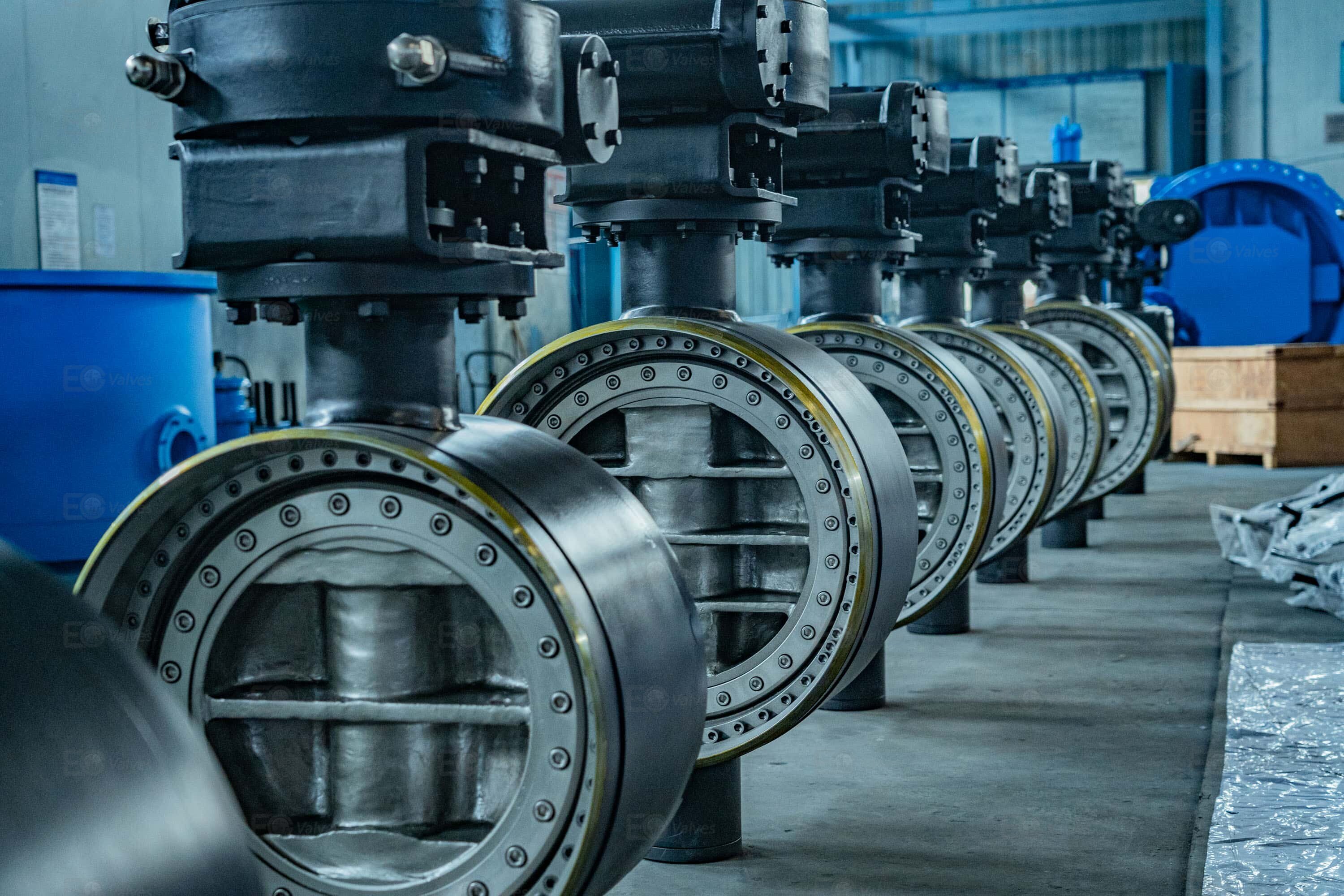
EG Valves BOV303 triple offset butterfly valve: seat options include Stainless Steel + Graphite or PTFE + Stainless Steel, with an optional Stellite seat for erosion resistance.
Triple Offset vs. Other Butterfly Valve Designs
A TOV is one point on a spectrum of butterfly valve designs, and the four families below are the ones most often compared during specification. The comparison uses published specification data only.
| Design | Sealing concept | Seat / sealing material | Size range | Pressure rating | Typical service in spec |
|---|---|---|---|---|---|
| BTV300 Resilient Seated Butterfly Valve | Concentric design and bi-directional service | EPDM, NBR (Buna-N), FKM (Viton), PTFE | NPS 1-1/2" – 48" ; DN40 – DN1200 | Class 125 / 150 ; PN6 / PN10 / PN16 | Water or sewage system, air conditioning, mining, power plants, irrigation, food and beverage |
| BTV305 Double Eccentric Butterfly Valve | Double eccentric disc design ensures minimal wear and provides excellent throttling capabilities; tilted disc releases the compression and extends durability | EPDM, NBR (Buna-N), FKM (Viton); replaceable sealing materials | NPS 8" – 48" ; DN200 – DN1200 | Class 125 / 150 ; PN6 / PN10 / PN16 | Water treatment, HVAC, desalination plants, power generation, municipal water supply |
| BPV302 High Performance Butterfly Valve | Soft sealing or hard sealing as per customer's request; bi-directional, drop-tight closure in vacuum | PTFE / RTFE, or Stainless Steel / Monel, or PTFE + Stainless Steel | NPS 2" – 60" ; DN50 – DN1500 | Class 150 / 300 / 600 ; PN10 / PN16 / PN25 / PN40 | Oil & gas, petrochemical, power generation, HVAC, hydrocarbon processing |
| BOV303 Triple Offset Butterfly Valve | Triple offset design eliminates wear associated with sealing surface contact; bubble-tight closure | Stainless Steel + Graphite, or PTFE + Stainless Steel; optional Stellite seat | NPS 2" – 60" ; DN50 – DN1500 | Class 150 / 300 / 600 ; PN10 / PN16 / PN25 / PN40 | Oil and petroleum, refinery and tanks, chemical factories, steel mills, shipbuilding industries |
Read across the table and one point becomes clear: the BPV302 and BOV303 share the same size and pressure envelope. The difference is the wear mechanism, not the rating. Where a line cycles frequently and shut-off integrity has to survive that cycling, the offset geometry is the differentiator. Where the duty is low-pressure water or HVAC and throttling is the main requirement, the double eccentric BTV305 explicitly states excellent throttling capabilities — a function the TOV specification does not claim.
Where Triple Offset Valves Fit in Documented Projects
The published application scope for the BOV303 lists oil and petroleum, refinery and tanks, chemical factories, steel mills and shipbuilding industries. That matches the documented project record.
- Petroleum refining, United Arab Emirates. A refining project was supplied with 915 valves — gate, globe, check, ball and butterfly types — with pressure classes from 150 to 1500 and sizes from 2 to 36 inches. The supplied scope includes the BOV303 triple offset butterfly valve. The valves manage high-pressure systems, and the installation has operated safely and steadily over 8 to 10 years.
- Oil and gas, United States. 1,438 gate, globe, check and ball valves in Class 150 to Class 1500, made from materials such as WCB, WC6, WC9, C5 and A105 in sizes from 1/2 inch to 20 inches, for high-pressure systems and corrosive environments, in operation for 8 years.
- Oil and gas, Mexico. 290 gate, ball, check and plug valves from Class 150 to Class 1500 for drilling, extraction and refining, reported with zero leakage and stable operation over more than 8 years.
- Chemical processing, Spain. 260 gate, globe and check valves in sizes DN250 to DN1200, handling corrosive environments and aggressive fluids, in operation for 5 years.
The boundary is just as informative. For an Italian food processing facility, the supplied solution was 180 industrial valves in sizes DN15 to DN750 at PN16 — gate, ball, butterfly and check types selected for high cleanliness standards, sterility and contamination prevention. The corpus-supported product for acid, salt, alkali, oxidant, organic solvent and reducing agent duty across chemical, pharmaceutical, petroleum and food industries is the BTF301 PTFE lined butterfly valve, not a triple offset design. Sanitary finish requirements and metal-seated tight shut-off are different problems, and a sourcing decision that confuses them will over- or under-specify the line.
Procurement Questions That Decide a Global Project Order
OEM, ODM and Branding
Production services include OEM and ODM modes, and customisation covers either the client's brand logo or the EG brand logo. That matters for distributors, brand owners and system integrators who need a consistent product identity across a multi-year programme.
Capacity, Lead Time and Minimum Order
- Monthly capacity: 8,000 pcs valves.
- Lead time: within 25–35 days.
- MOQ: 1 pc for big size valve, 10 pcs for small size valve.
Quality Control, Inspection and Documentation
A strict QC team performs 100% inspection on every valve, and EN 10204 3.1 Material Test Certificates are provided with every order. On acceptance, most orders are inspected by the EG valve QC department; for some orders the customer arranges their own QC or a third-party inspection company to conduct the inspection.
Delivery and Payment Terms
FOB, EXW and CIF are all acceptable depending on the customer's needs. The standard payment structure is 30% T/T as deposit with the balance settled before shipment.
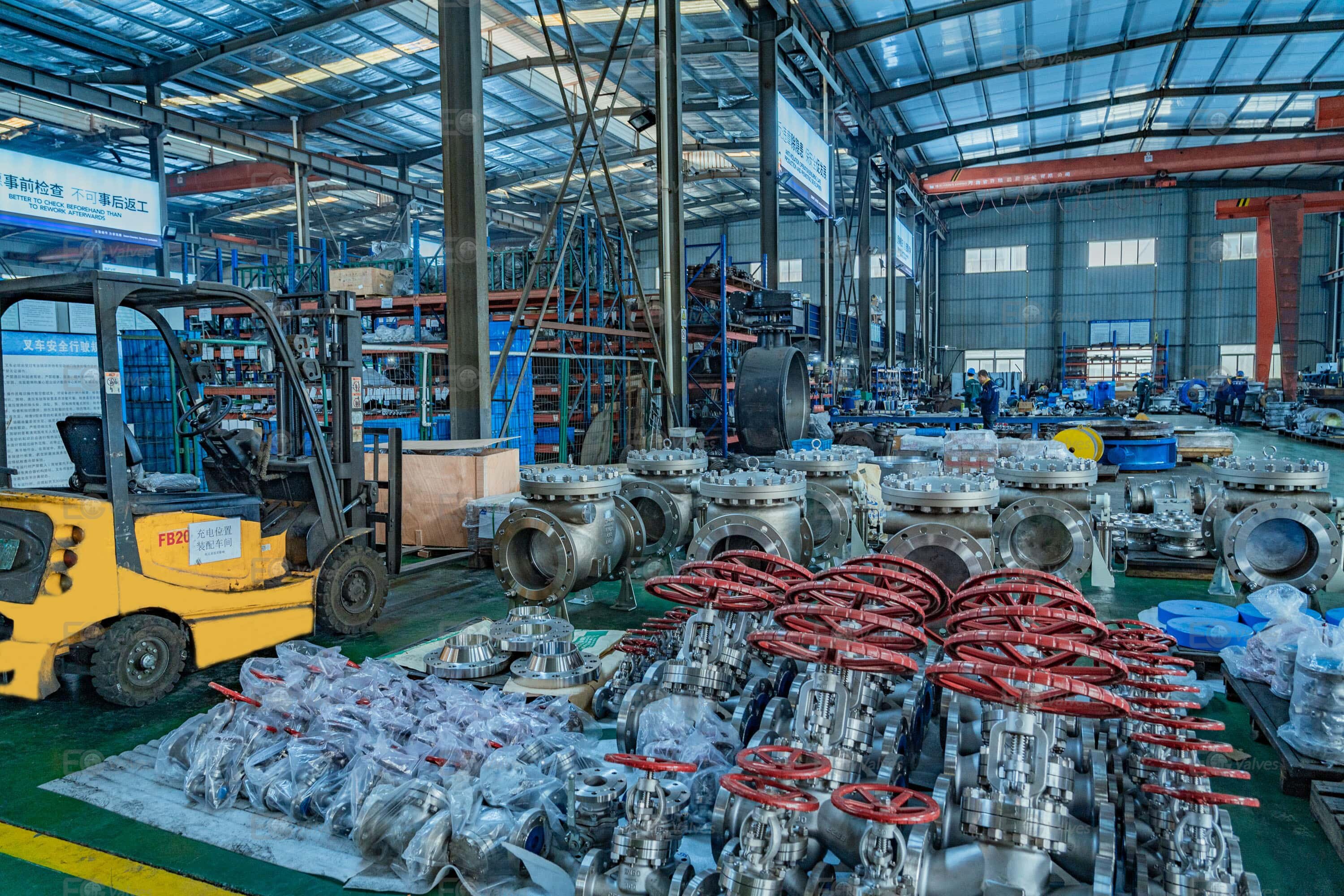
Manufacturing capacity behind an OEM or ODM valve order: 27,500 m2 of production space, 300 employees and a published monthly capacity of 8,000 valves.
Certifications — and the Scope Behind Them
Certificate numbers are verifiable, and the scope line is where a shortlist is won or lost. The current EG Valves certificates relevant to butterfly valve sourcing are:
| Certificate | Authority | Certificate no. | Declared scope | Valid through |
|---|---|---|---|---|
| API 6D | American Petroleum Institute (API) | 6D-0506 | Check valves, ball valves, gate valves | 2027-03-30 |
| API 600 | American Petroleum Institute (API) | 600-0179 | Bolted bonnet steel gate valves | 2027-03-30 |
| ISO 9001:2015 | China Quality Certification Center (CQC) | 00125Q33391R3M/3400 | Gate valves, globe valves, ball valves, butterfly valves, check valves, pipe filters and flanges | 2028-05-22 |
| CE / PED 2014/68/EU Annex III, Module H | TUV SUD Industrie Service GmbH | DGR-0036-QS-1360-24 | Gate valves, ball valves, globe valves, check valves, butterfly valves, strainers | 2027-05-26 |
The scope column is the part most buyers skip. Neither API 6D nor API 600 lists butterfly valves in its scope — API 6D covers check, ball and gate valves, and API 600 covers bolted bonnet steel gate valves. Butterfly valve families, including the BOV303, sit inside the ISO 9001 quality management scope and the CE / PED Module H certificate scope. For EU-bound equipment, PED 2014/68/EU applies to equipment with a pressure exceeding 0.5 bar, so a PED certificate with the correct scope is a compliance requirement rather than a marketing asset.
What a Triple Offset Valve Does Not Solve
Every design has edges, and a sourcing decision is only as good as its awareness of them.
- Pressure ceiling. The BOV303 is rated Class 150, Class 300 and Class 600, or PN10 to PN40. Above that envelope, other families carry the duty — for example the forged steel gate valve GTF023, rated Class 800 to Class 2500 / PN140 to PN320, or the forged steel trunnion ball valve BVF209, rated to Class 2500 / PN420.
- Size floor. The range starts at NPS 2" / DN50. Small-bore lines are served by other designs.
- Seat selection drives life. The standard seat is stainless steel plus graphite or PTFE plus stainless steel; the Stellite option is what addresses erosion. A specification that omits the overlay on an abrasive line has removed the feature it needs.
- It is not a general control valve. The published specification describes shut-off behaviour and actuation options, not characterised throttling. Where throttling is the primary function, another design is the correct answer.
- It is not a sanitary default. High-cleanliness and sterility duty is served by families such as the BTF301 PTFE lined butterfly valve.
- Installation discipline matters. A precision seat assembly depends on flange alignment, correct actuator sizing and stroke setting. Field errors here are not corrected by material upgrades.
Market Context Behind the Questions
Two structural trends explain why TOV questions are appearing more often in China valve sourcing.
First, oil and gas remains the leading end user for industrial valves, accounting for nearly 33% of global demand in 2024 according to Vantage Market Research figures published through PR Newswire, and cast steel valves accounted for 27.3% of the oil and gas valve market in 2025 based on Mordor Intelligence data. Refining and petrochemical duty is exactly the service where a valve's sealing mechanism is stressed by pressure and cycling at the same time.
Second, the supply base has consolidated around China. The country exported USD 22.6 billion in valves globally in 2024, approximately 20% of global export concentration, per the Observatory of Economic Complexity, and Asia Pacific held roughly 36.3% of 2025 industrial valve market revenue with China the largest contributor inside the region, according to Grand View Research.
One caution belongs in any market analysis. Published 2025 estimates for the global industrial valve market vary widely — Grand View Research places it at USD 80.4 billion while MarketsandMarkets estimates USD 101.94 billion, depending on whether actuators and specific valve types are counted. Any single figure should be treated as directional. The same discipline applies to valve specifications: a rating on a cover sheet means less than a scope line on a certificate.
Future Outlook
Three directions are likely to shape TOV sourcing in global projects over the next several cycles.
Documentation is becoming the differentiator rather than price. As the market grows at a projected 5.7% CAGR through 2034, the number of suppliers able to quote a triple offset valve will keep rising, while the number able to produce EN 10204 3.1 material certificates with 100% inspection on every valve — and a certificate scope that actually names butterfly valves — will grow more slowly. Procurement teams are already shifting their shortlists toward the second group.
Material selection is moving toward alloy and duplex steel as chloride-bearing and high-temperature services become more common in refining, chemical and offshore work — the same materials already listed in the BOV303 body and disc specifications.
Finally, erosion-resistant options such as Stellite seats will increasingly move from optional to specified in abrasive service lines, because seat selection, not body size, determines how long a triple offset valve stays bubble-tight.
FAQ: Triple Offset Valve Sourcing Questions
How is a triple offset butterfly valve different from a standard butterfly valve?
A standard, concentrically designed butterfly valve seals through an elastomer or polymer seat — EPDM, NBR (Buna-N), FKM (Viton) or PTFE in the BTV300 — and the disc stays in contact with that seat throughout the stroke, so the seating surface slides. A triple offset valve builds three offsets into the shaft, disc sealing surface and body seat relationship, so the disc leaves the seat before rotating. The BOV303 specification states that the triple offset design eliminates wear associated with sealing surface contact, and describes a bubble-tight closure. The practical difference is the wear mechanism and, over repeated cycles, shut-off integrity.
What materials are used for the disc and seat of a triple offset valve?
On the BOV303 triple offset butterfly valve, published body materials are Carbon Steel, Stainless Steel, Alloy Steel and Duplex Steel; disc materials are Carbon Steel, Stainless Steel and Duplex Steel. Seat material is either Stainless Steel + Graphite or PTFE + Stainless Steel. An optional Stellite seat is available and is described as offering optimum resistance to erosion.
Which sizes, pressure classes and body styles are available?
The BOV303 covers NPS 2" to 60", or DN50 to DN1500, at Class 150, Class 300 and Class 600, or PN10, PN16, PN25 and PN40. Wafer type, Lug type and Double Flange type bodies are all available. Operation options include handle lever, gearbox, worm gear, electric and pneumatic.
Where are triple offset valves typically specified?
The published application scope for the BOV303 lists oil and petroleum, refinery and tanks, chemical factories, steel mills and shipbuilding industries. One documented example is a petroleum refining project in the United Arab Emirates where 915 valves were supplied — gate, globe, check, ball and butterfly types, including the BOV303 triple offset butterfly valve — at pressure classes from 150 to 1500 and sizes from 2 to 36 inches, operating safely and steadily over 8 to 10 years. Where high cleanliness, sterility or aggressive chemical compatibility is the primary requirement rather than tight metal-seated shut-off, other designs such as the BTF301 PTFE lined butterfly valve are the relevant reference.
What should be verified about certifications before placing an order?
Verify the scope line, not just the certificate number. API 6D certificate 6D-0506 covers check valves, ball valves and gate valves; API 600 certificate 600-0179 covers bolted bonnet steel gate valves; neither scope lists butterfly valves. Butterfly valves are included in the ISO 9001:2015 scope held under certificate 00125Q33391R3M/3400 issued by the China Quality Certification Center, valid through 2028-05-22, and in the CE / PED 2014/68/EU Annex III Module H certificate DGR-0036-QS-1360-24 issued by TUV SUD Industrie Service GmbH, valid through 2027-05-26. For equipment entering the EU, PED 2014/68/EU applies to equipment with pressure exceeding 0.5 bar.
What are the typical minimum order quantity, lead time, inspection and payment terms?
The published commercial terms are: MOQ of 1 pc for big size valve and 10 pcs for small size valve; lead time within 25–35 days; 100% inspection of every valve with a strict QC team, and EN 10204 3.1 Material Test Certificates provided with every order. Acceptance is normally conducted by the EG valve QC department, and for some orders the customer arranges their own QC or a third-party inspection company. Delivery terms of FOB, EXW and CIF are all acceptable depending on the customer's needs, with payment at 30% T/T deposit and the balance settled before shipment.
Reference material: the EG Valves product brochure is available for download at https://cdn.socialarks.com/sbsp/24748/0/2026/0409/69d7093326fe1.pdf.
Have Questions or Need More Details?
Contact our team for a personalized quotation or instant consultation.
Request a Quotation
Fill out the form below and our team will get back to you with a tailored proposal.
WhatsApp Direct Chat
Prefer to chat in real-time? Message us on WhatsApp for instant assistance & quick answers.
- Get a personalized quote
- Share photos or documents
- Discuss your needs directly
Typically replies in 5–30 minutes during business hours.