
Choosing Between Integrated and Standalone Pharmaceutical Packaging Machines
Selecting a pharmaceutical packaging machine is not only a capacity decision. For tablet and capsule products, buyers must decide between separate machines connected by manual handling and an integrated line that moves blisters from forming to cartoning in one continuous process. That decision affects labor cost, quality risk, qualification time, and floor-space planning.
This article compares the two approaches for buyers at the evaluation or decision stage. It uses the integrated blister-cartoning line produced by Zhejiang Hoping Machinery Co., Ltd. as a concrete reference point and includes performance data, cost trade-offs, and limitations that should be verified before purchase.
What Is Really Being Compared?
A standalone pharmaceutical packaging setup typically consists of a blister packaging machine, a manual transfer table, and a separate cartoning machine. Each machine can be efficient on its own, but the interfaces between them depend on operators and buffers.
An integrated line, by contrast, combines several functions into one automated process. According to Hoping Machinery's product documentation, an integrated line can combine blister packaging, blister transfer, leaflet handling, carton opening, insertion, inspection/rejection, and downstream connection in a single line. From a buyer's perspective, the comparison is not simply machine speed versus machine speed. It is a comparison of two operating models.
The Problem With Machine-to-Machine Transfer
Manual transfer between a blister machine and a standalone cartoner is one of the most common sources of delay and error in pharmaceutical secondary packaging. It requires additional operators, creates intermediate work-in-progress, and increases the chance of missing product, wrong product, or contamination during handling.
The opportunity offered by an integrated blister-cartoning line is to reduce this manual intervention. Compared with the traditional approach of a blister machine plus manual transfer and a standalone cartoner, the integrated line replaces several hand-off points with automated transfer and inline inspection.
What an Integrated Blister-Cartoning Line Actually Combines
Hoping Machinery describes its integrated line as a single automated process that includes:
- Blister packaging
- Blister transfer
- Leaflet handling
- Carton opening
- Insertion
- Inspection/rejection
- Downstream connection
For a buyer, this reduces the number of operators needed between stations and shortens the distance that blisters travel while exposed to the surrounding environment. It also simplifies line management because the upstream and downstream machines move together under synchronized control.
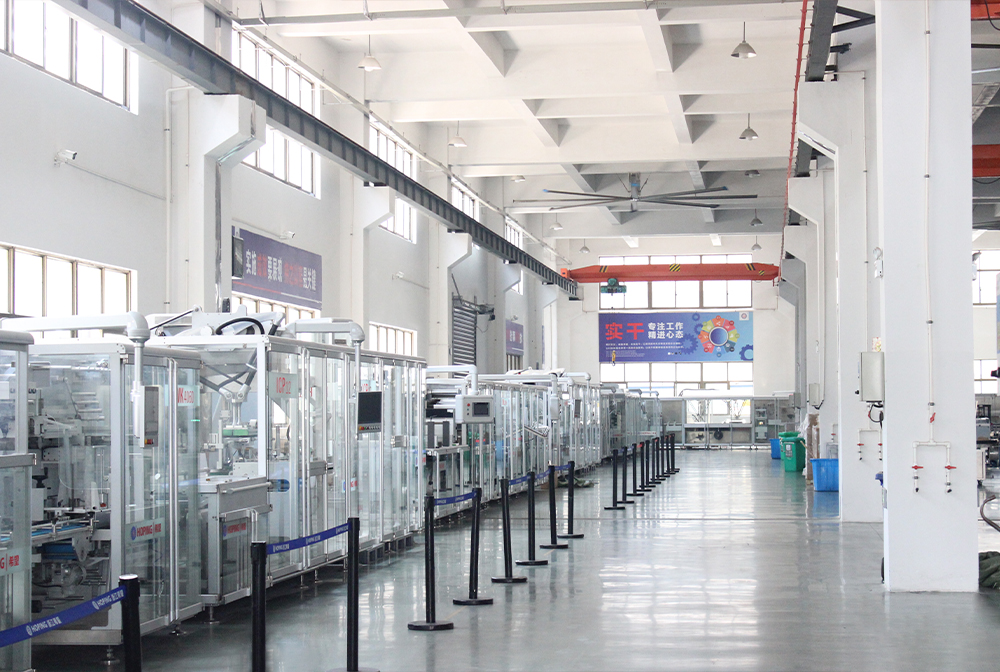
Machine configuration varies by project. The integrated line is designed for high-capacity solid dosage pharmaceutical packaging.
Output Reference: The DHL1000/5H Example
One representative model in Hoping Machinery's integrated line is the DHL1000/5H. It can achieve up to 1000 blisters per minute and 500 cartons per minute. Actual output depends on product format, quantity per carton, materials, and process conditions, so buyers should treat this as a reference speed rather than a guaranteed figure for every product.
That level of output is intended for large-scale solid dosage pharmaceutical packaging and high-capacity workshops. It is not the only option for small-batch production, but it shows what an integrated architecture can do when the product volume justifies continuous operation.
Cost and Efficiency: The Practical Trade-off
Hoping Machinery acknowledges that the initial investment for an integrated line is usually higher than standalone or semi-automatic equipment. The commercial argument is not lower purchase price; it is lower operating cost across labor, transfer, management, and quality risk in large-scale continuous production.
Fully servo drive technology helps improve motion synchronization and operating efficiency. But actual energy consumption must be measured based on on-site output, running hours, and configuration rather than assumed from the machine specification alone.
| Comparison Point | Traditional Transfer-Based Setup | Integrated Blister-Cartoning Line |
|---|---|---|
| Process structure | Blister machine → manual transfer → standalone cartoner | Blister packaging, transfer, leaflet handling, carton opening, insertion, inspection/rejection, downstream connection in one process |
| Manual intervention | Higher, with operators between stations | Reduced through automated transfer and inline handling |
| Typical reference output | Depends on separate machine speeds and manual pacing | DHL1000/5H reference: up to 1000 blisters/min and 500 cartons/min, format-dependent |
| Initial investment | Usually lower | Usually higher |
| Operating control | Multiple control points and buffers | Centralized control, modular stations, alarm indication, parameter management |
| Maintenance model | Simpler individual machines | Centralized control and modular maintenance, with operator training and preventive maintenance still required |
The comparison is based on Hoping Machinery's product documentation and may not represent all suppliers' integrated lines.
The Main Limitation of Integrated Lines
An integrated pharmaceutical packaging machine is not automatically the right answer for every factory. Hoping Machinery positions this product for large-scale solid dosage packaging and high-capacity workshops that require reduced manual contact.
The realistic boundary is a plant with low volume, very frequent format changes, or very small cartoning workloads. In such cases, a standalone cartoner and a separate blister machine may offer more operational flexibility because the two machines can be changed over independently. A continuous integrated line also requires more disciplined preventive maintenance and operator training because a stoppage in one station affects the whole line. Buyers with limited maintenance capability should weigh this before selecting a full integrated solution.
Risk Control That Protects Output
Pharmaceutical packaging projects carry risks that go beyond mechanical breakdown. The risk list for a blister-cartoning line includes poor blister forming or sealing, missing or wrong product feeding, missing leaflet, carton jam, coding or date printing error, foreign matter or contamination risk, and downtime during high-speed operation. Export projects also carry delivery and installation risk.
Hoping Machinery's stated control methods include sensor monitoring, vision or checkweighing inspection where configured, missing-product alarm, automatic stop, automatic rejection, key-parameter locking, fault records, mechanical safety protection, FAT/SAT acceptance, and SOP training.
At the project level, the company's approach includes confirming samples and packaging materials early, designing the solution according to actual blister and carton formats, conducting no-load and material tests before shipment, and providing installation, commissioning, training, spare parts, and remote technical support. For key projects, customer witness acceptance can be arranged.
Market Context: Demand Is Still Expanding
The broader market helps explain why this decision is increasingly important. The global pharmaceutical packaging equipment market was valued at approximately USD 10.71 billion in 2024, according to SkyQuest Technology. Fortune Business Insights estimated the pharmaceutical cartoning machinery segment at USD 1.46 billion in 2024. Grand View Research reported that Asia Pacific held the largest revenue share of 40.7% in the pharmaceutical packaging equipment market in 2025.
Market concentration is another signal. MarketsandMarkets reported that the top three players in the pharmaceutical blister packaging machine segment—Uhlmann, IMA, and Marchesini—hold about 29% of the market collectively. This concentration does not mean that smaller suppliers lack engineering capability. It means a buyer should verify the specific factory, patents, certifications, and reference line performance rather than relying only on brand recognition.
Qualifying a Supplier: What Buyers Should Verify
Zhejiang Hoping Machinery Co., Ltd. is a manufacturer of blister packaging machines, cartoning machines, case packing machines, and end-of-line packaging machines. Founded in 2001 and based in Ruian, Zhejiang Province, China, the company employs more than 300 people and exports about 25% of its output to Southeast Asia, the Middle East, Eastern Europe, South America, and Africa. Its R&D team includes 56 engineers.
The company's intellectual property portfolio includes 26 invention patents, 70 utility patents, 4 appearance patents, 10 PCT-protected patents in markets including Europe and Russia, and 28 software copyrights. According to its public profile, it holds CE and ISO 9001/14001 certifications.
| Verification Point | What a Buyer Can Check |
|---|---|
| Manufacturer track record | Founded 2001; more than 300 employees; export ratio around 25%; markets include Southeast Asia, Middle East, Eastern Europe, South America, Africa |
| R&D and intellectual property | 56 R&D engineers; 26 invention patents, 70 utility patents, 4 appearance patents, 10 PCT-protected patents, 28 software copyrights |
| Certifications | CE and ISO 9001/14001; confirm which standards apply in the destination market, such as ISO 15378 or the EU Machinery Directive 2006/42/EC and EN 415 series |
| Line performance reference | DHL1000/5H: up to 1000 blisters/min and 500 cartons/min, format-dependent |
| Project execution | Early sample and material confirmation, no-load and material tests before shipment, installation/commissioning, training, spare parts, remote support, witness acceptance for key projects |
Decision Checklist for a Pharmaceutical Packaging Machine Purchase
A decision between integrated and standalone equipment should be based on more than brochure speed. The following checklist can help procurement teams compare options consistently.
- Define the exact product formats: blister size, carton size, leaflets, batches per year.
- Estimate how many operators the current line requires between the blister machine and the cartoner.
- Calculate total lifecycle cost, not just machine price: labor, floor space, training, maintenance, rejects, and downtime.
- Ask the supplier for realistic output figures under the buyer's actual format and material conditions.
- Verify how the line behaves when a missing blister or carton jam occurs: automatic stop, rejection, and alarm logic.
- Confirm installation scope for export projects: delivery, commissioning, training, spare parts, remote support.
- Review FAT/SAT procedures and whether material tests can be witnessed before shipment.
Frequently Asked Questions
What is the main difference between an integrated pharmaceutical packaging line and a standalone setup?
An integrated line combines blister packaging, blister transfer, leaflet handling, carton opening, insertion, inspection/rejection, and downstream connection into one automated process. A standalone setup typically uses a blister machine plus manual transfer and a separate cartoning machine, which requires more manual intervention.
What output can a pharmaceutical blister packaging machine with an integrated cartoner reach?
The representative DHL1000/5H model from Hoping Machinery can achieve up to 1000 blisters per minute and 500 cartons per minute. Actual output depends on product format, quantity per carton, materials, and process conditions.
Is an integrated pharmaceutical packaging machine worth the higher initial investment?
Initial investment is usually higher than standalone or semi-automatic equipment. The benefit is reduced labor, transfer, management, and quality-risk costs in large-scale continuous production. For low-volume or highly variable production, standalone equipment may remain more flexible.
What product types are best suited to an integrated blister-cartoning line?
Integrated lines are more suitable for large-scale solid dosage pharmaceutical packaging and high-capacity workshops that require reduced manual contact.
What are the common risks when buying a pharmaceutical packaging machine for an export project?
Common risks include poor blister forming or sealing, missing or wrong product feeding, missing leaflet, carton jam, coding or date printing error, contamination risk, downtime during high-speed operation, and delivery or installation issues. Controls include sensor monitoring, vision or checkweighing where configured, automatic stop and rejection, key-parameter locking, FAT/SAT acceptance, and SOP training.
What certifications should a buyer look for in pharmaceutical packaging equipment?
In the broader regulatory context, ISO 15378 addresses GMP requirements for primary packaging materials, while EU packaging machine safety is covered by Machinery Directive 2006/42/EC and the EN 415 series. Some suppliers also hold CE and ISO 9001/14001 certifications. Buyers should verify which standards apply in their destination market.