
Choosing Screw & Barrel Alloys by Polymer: A Buyer Framework
The decision that determines barrel life is made before the purchase order
Two processors can run the same extruder model, buy replacement screws from the same shortlist of suppliers, and still record very different intervals between replacements. The difference is rarely the machine. It is usually whether the alloy and the surface finish were matched to the polymer actually running through the barrel.
Zhejiang Guangming Plastics Machinery Co., Ltd., which manufactures under the Guangyou Screw brand, is a screw and barrel producer established in 1992 and based in Zhoushan, China. The company operates a 100,000 m² facility with more than 800 employees and a 25-engineer R&D team, and supplies single screw, twin screw, and bimetallic screw and barrel assemblies to more than 50 countries and regions, with the EU as its primary export market. Standard size coverage runs from Φ20 to Φ650 depending on the product family, and the same material list — including 38CrMoAl (1.8509), D2, and AISI316 — appears across those families, which means alloy selection is a specification decision rather than a special-order negotiation.
What follows is a framework, not a product pitch: classify the polymer stream, identify the dominant wear mechanism, match the alloy family, choose between a nitrided and a bimetallic or PTA finish, and then hold the supplier to measurable values for hardness, case depth, and geometry.
Step 1: classify the polymer before you open a catalogue
Screw and barrel wear is not a single phenomenon. In practice, three mechanisms account for most short service intervals, and each one points toward a different material answer.
Abrasion. Mineral fillers, calcium carbonate, glass fibre, and other hard particulates remove metal mechanically. The harder and more angular the filler, the faster the loss — and the stronger the case for a cast alloy layer rather than a diffused nitrided case alone.
Corrosion. PVC is the clearest example: at processing temperature it can release hydrogen chloride, and the resulting acidic condensate attacks unprotected steel surfaces. Halogenated additives, acidic residues in recycled feedstock, and certain rubber compounding ingredients create comparable conditions.
Combined attack. Highly filled PVC is the textbook combination — abrasive calcium carbonate plus a corrosive hydrochloric environment. This is precisely the condition under which a bimetallic lining together with a nitrided finish is specified, rather than relying on one protection on its own.
Rubber and tire compounds add a different demand profile: high torque, elevated temperature, and sulfur-bearing additives. The practical consequence is that a barrel specified for unfilled PP film is not an interchangeable choice for a high-filler PVC profile line, even where the bore dimension happens to fit.
Step 2: choose the alloy family that matches the mechanism
Three alloy families cover the majority of decisions on plasticating screws and barrels. The standard material list across these product families is built around them, supplemented by additional tool steels and corrosion-resistant grades.
| Alloy family | What it is | Typical fit | Where it stops |
|---|---|---|---|
| 38CrMoAl (1.8509) | Nitriding-grade chromium-molybdenum-aluminium steel; the reference base material for nitrided screws and barrels | Unfilled and lightly filled polymers — PP, PE, PS, packaging film, pipe — where abrasion is moderate and corrosion is not the main threat | Once the nitrided case is worn through, the softer core is exposed and wear accelerates; limited resistance to aggressive acidic or halogenated streams |
| D2 (with cold-work relatives such as DC53, SKD11, SKD61, Gr12MoV) | High-carbon, high-chromium tool steel with high wear resistance and good dimensional stability after heat treatment | Filled and mineral-loaded compounds where abrasive wear dominates | Higher material cost; not a corrosion answer on its own; heat-treatment discipline matters more than on simpler grades |
| AISI316 (with AISI304, AISI420, 1.4404, 1.4462 and related grades) | Austenitic stainless steel family selected for chemical resistance | Corrosive polymer streams, halogenated or acidic residues in recycled feedstock | Lower attainable hardness than tool steels, so it is the wrong answer when abrasion is the dominant mechanism |
The split is not absolute. Many real lines need two properties at once, which is why the finish decision in step 3 usually matters more than the base alloy alone.
Step 3: decide between a nitrided and a bimetallic or PTA finish
Nitriding diffuses nitrogen into the surface of a nitriding steel. It does not add material on top of the part, so the protection is a hardened zone within the base metal. Bimetallic barrels use a separately cast alloy liner, and PTA (plasma transferred arc) welding deposits an alloy layer on the working surfaces. These are not interchangeable upgrades of the same thing — they differ in depth, hardness profile, cost structure, and repair route.
| Parameter | Nitrided (38CrMoAl) | Bimetallic / alloy-lined |
|---|---|---|
| Hardness | Nitrided hardness HV850–1000; chromium-plated surface ≥900 HV after nitriding | Alloy hardness HRC 50–65 |
| Layer depth | Nitrided case depth 0.45–0.7 mm (industry reference for 38CrMoAl nitriding: 0.4–0.6 mm) | Alloy depth 0.8–2.0 mm; centrifugally cast boron-nickel-chromium liners are commonly 1.5–3.0 mm |
| Base hardness | HB260–310 after hardening and tempering | Governed by the barrel steel and liner combination |
| Chromium plating | Depth 0.025–0.10 mm, applied for additional surface hardness and surface behaviour | Not the primary protection mechanism |
| Discipline issue | Nitrided brittleness must be held below Grade 2 to reduce chipping risk under thermal and mechanical shock | Liner integrity and bonding quality are the critical control points |
| Best fit | Moderate abrasion, non-corrosive polymers, cost-sensitive replacement | High filler load, calcium carbonate, corrosive streams, longer wear intervals |
| What you give up | Thin case; if it wears through, the surface degrades quickly; limited corrosion protection | Higher unit cost, longer lead time, and a different refurbishment route |
For a buyer, the decision rule is straightforward. If the stream is abrasive and abrasion is the only significant threat, alloy-depth targets on a D2-class or bimetallic barrel pay back through longer intervals. If the stream is chemically aggressive, stainless grades or bimetallic liners are the correct direction, and hardness alone is a misleading specification. If the stream combines both — high-filler PVC being the standard example — the requirement is a bimetallic lining for the filler load together with a nitrided finish, which is exactly the combination specified for PVC pipe, profile, and sheet extrusion duty.
Step 4: fix the numbers you will accept
General material names do not travel well into a purchase order. The following values appear on the specification sheet for these assemblies, and they are the ones worth carrying into a comparison:
- Hardness after hardening and tempering: HB260–310
- Nitrided hardness: HV850–1000
- Nitrided case depth: 0.45–0.7 mm
- Nitrided brittleness: less than Grade 2
- Alloy hardness: HRC 50–65
- Alloy depth: 0.8–2.0 mm
- Surface chromium plating hardness after nitriding: ≥900 HV; plating depth 0.025–0.10 mm
- Surface roughness: Ra 0.4
- Screw straightness: 0.015 mm
Two of these deserve more attention than they usually receive. Straightness and surface roughness are not cosmetic values: they influence how evenly the melt film forms, how stable metering is, and how quickly a localised wear zone develops. On hardness, a project brief that names a narrow target such as HRC 58–65 is asking for a window inside the HRC 50–65 alloy-hardness range stated for these assemblies. That is a legitimate request, provided the supplier reports the measured value for the actual part rather than quoting the catalogue range back.
Step 5: verify the supplier against the specification, not the brochure
Once material and finish are decided, the remaining risk is execution. Four verification points matter most.
- Dimensional capability for your size. Bore and screw ranges differ by product family. A rubber extrusion barrel covers Φ20–Φ650, an injection molding barrel covers Φ20–Φ300, a single screw extruder barrel covers Φ20–Φ500, a parallel twin barrel covers Φ45–Φ350, and a conical twin PVC barrel covers Φ25/50–Φ185/340. Confirm the size you need sits inside the family you are being quoted.
- Batch consistency. For OEM assembly and multi-unit replacement, the relevant evidence is that delivered batches maintain dimensional consistency. In high-wear and corrosive polymer processing, compounding, and extrusion or molding projects, documented batch consistency has been the basis for stable assembly and reliable equipment commissioning.
- Fit accuracy on custom geometry. For sourcing, local replacement, and customised retrofitting work, the measurable outcome to ask for is precise mechanical fit against supplied technical drawings — the reported result is 100% precise mechanical fit on complex custom components, in batch sizes from 1 to 50 pieces.
- Test documentation. A 100% test regime confirms that each unit was measured before dispatch. It verifies the individual part; it is not a lifetime guarantee, and it should be read as such.
Application mapping: one framework, five different answers
The framework produces different specifications for different industries, which is why polymer-first selection matters.
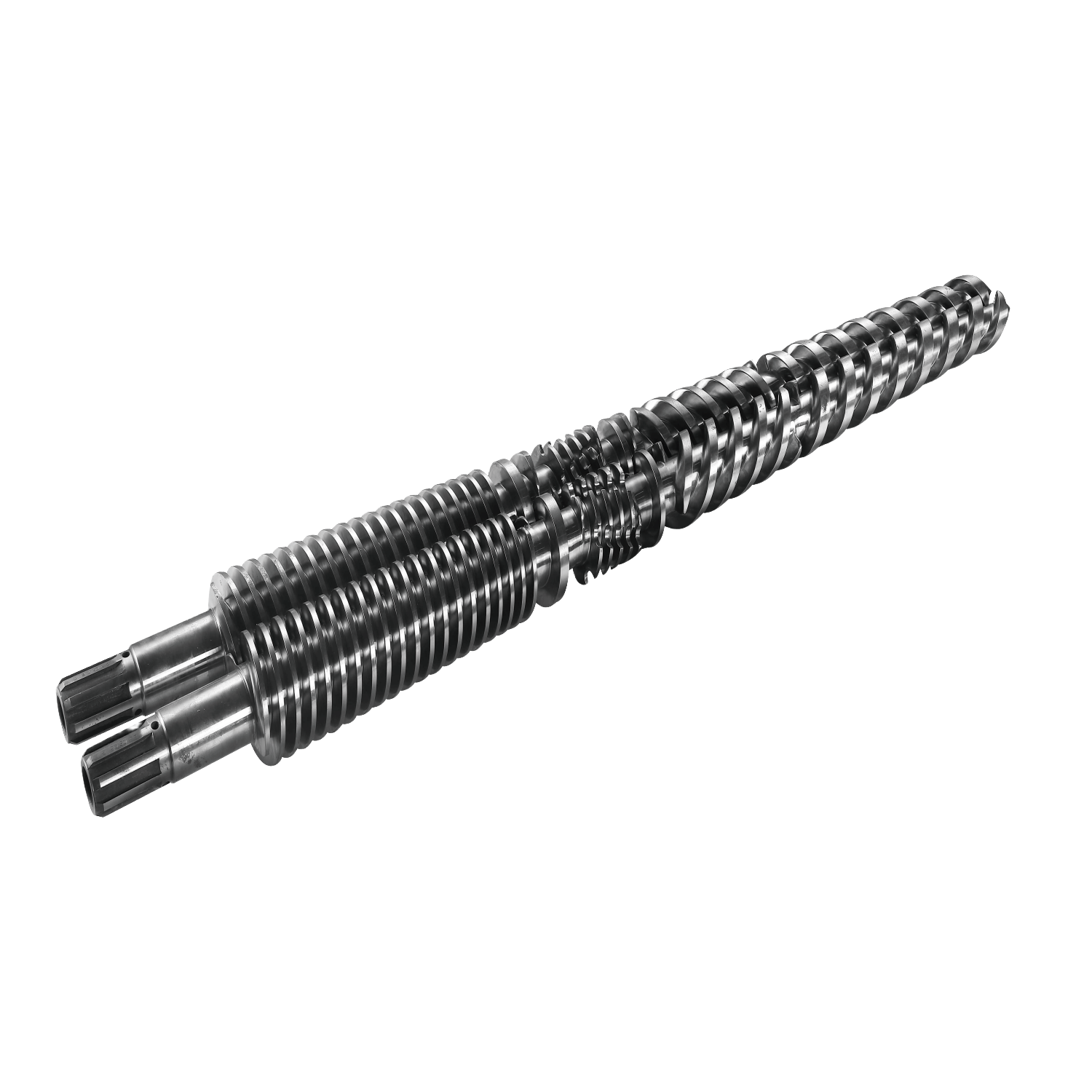
Conical twin screw barrel: the PVC extrusion configuration in which bimetallic lining and a nitrided finish are typically combined.
PVC pipe, profile, and sheet extrusion. Conical twin screw barrels in the Φ25/50–Φ185/340 range run in continuous counter-rotating conical twin-screw mode on PVC conical twin-screw extruders, where their role is efficient PVC powder melting, high-shear plasticizing, and stable extrusion shaping. Because these lines frequently run high calcium carbonate filler loads, the specification typically calls for high wear resistance, a bimetallic lining for CaCO3 high-filler processing, and a nitrided finish.
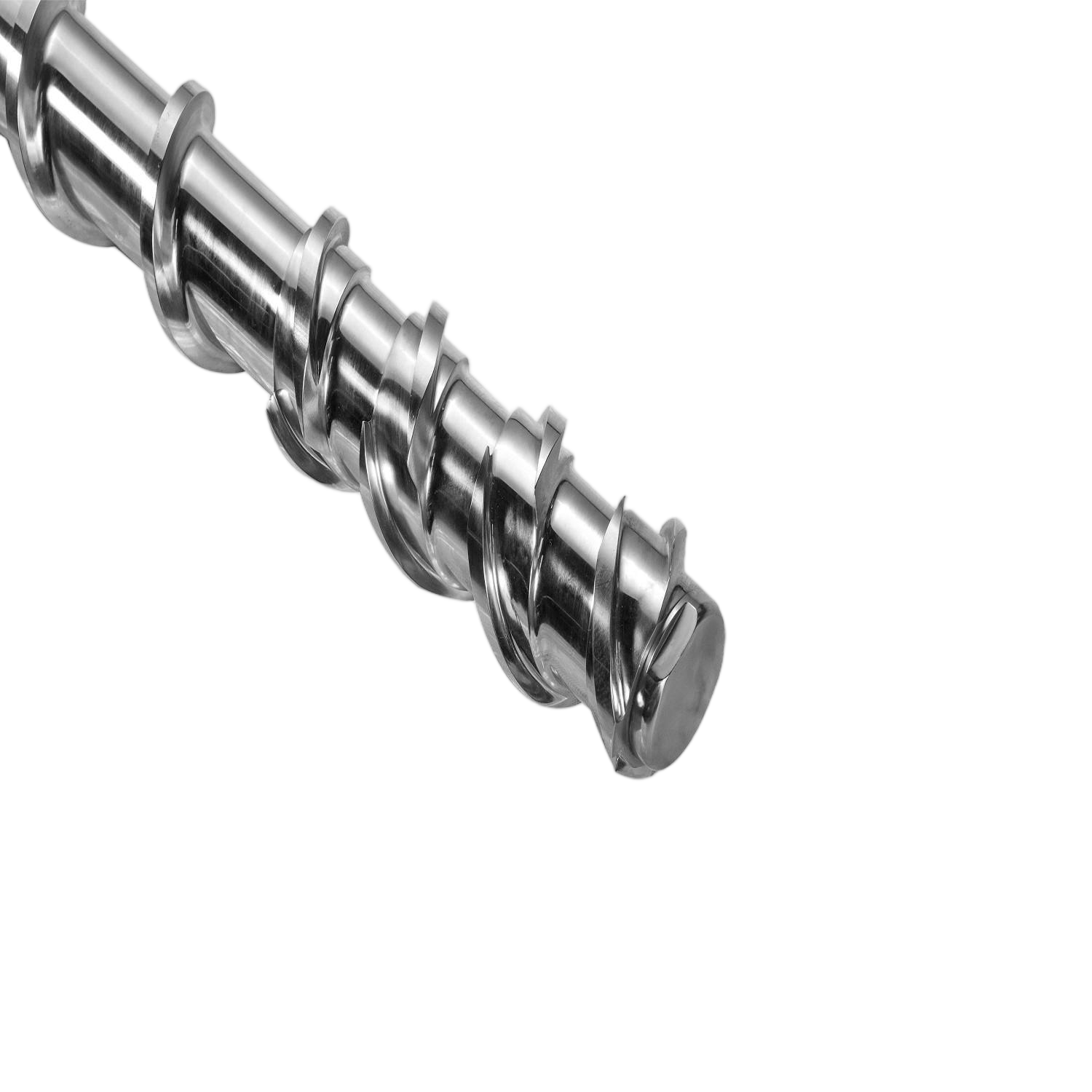
Rubber machine screw and barrel: rubber extrusion duty combines high torque, elevated temperature, and additive attack.
Tire and rubber product manufacturing. Rubber machine screws and barrels in the Φ20–Φ650 range are built for rubber extrusion work, where the combination of high torque, high temperature, and additive attack pushes the material choice toward nitriding-grade or tool-steel bases with controlled case brittleness.
Packaging film and pipe. Single screw extruder screws and barrels in the Φ20–Φ500 range serve film blowing and pipe extrusion in plastics packaging and pipe manufacturing, where unfilled or lightly filled PP and PE streams usually make a nitrided 38CrMoAl specification the cost-effective answer.
Compounding and recycling. Parallel twin screw barrels in the Φ45–Φ350 range are used in compounding and pelletizing, where feedstock variability — abrasive fillers, mixed polymers, and occasionally acidic residues — pushes the decision toward alloy-lined surfaces.
Injection molding. Injection molding machine screws and barrels in the Φ20–Φ300 range support automotive, electronics, and toy manufacturing, where cycle consistency and melt quality put the emphasis on geometry control and surface finish as much as on raw hardness.
What the case record shows. Across screw and barrel manufacturers and distributors, plastic products manufacturers, and extrusion and injection machinery OEMs, the reported outcomes centre on three things: dimensional consistency in batch delivery, enhanced wear and corrosion resistance with reduced production downtime in high-wear and corrosive polymer processing, and precise mechanical fit against customer drawings. Service life under normal high-filler PVC extrusion working conditions is reported in the range of 1 to 5 years — a conditional figure that depends on the working condition being genuinely normal, which is another reason to classify the polymer stream accurately at the start.
Where this framework has limits
A credible selection framework has to state what it cannot do.
- Nitriding is not a corrosion solution. It hardens a thin surface zone. In strongly acidic, chlorinated, or halogenated environments it delays wear but does not stop chemical attack; the correct answer is a material change, not a thicker case.
- Bimetallic protection costs more and takes longer. Nitriding lead times on single screws and barrels run approximately 40–50 days for Φ20–Φ90, 50–60 days for Φ90–Φ180, and 60–70 days for Φ180–Φ250, with longer times for larger and bimetallic parts. A bimetallic barrel is a planned purchase, not an emergency replacement.
- Repair routes differ. A nitriding-steel barrel and a bimetallic barrel do not return from refurbishment in the same way, so the maintenance plan has to follow the material decision.
- Size ranges are family-specific. The Φ20–Φ650 coverage of a rubber extrusion barrel does not extend to a conical twin PVC barrel, which stops at Φ185/340. Compatibility must be confirmed per family.
- Hardness ranges are ranges. A stated alloy hardness of HRC 50–65 is an envelope; a line that requires HRC 58–65 should specify it and ask for measured values rather than assuming the top of the range.
- Test coverage is not a lifetime guarantee. 100% testing verifies the delivered unit; it does not predict how a specific filler load, temperature profile, or screw configuration will wear it.
- Market data is not a selection criterion. Third-party estimates of the same market differ substantially depending on scope definitions and should be used for planning context only.
Market signals behind the material decision
Three third-party data points frame why alloy and finish decisions are attracting more buyer attention. The feed screw barrel market is projected to grow from USD 1.89 billion in 2024 to USD 3.33 billion by 2034, a CAGR of 5.8% (Global Insight Services). Within that, the bimetallic barrel and screw segment alone is estimated at USD 2.8 billion in 2025 and forecast to reach USD 4.7 billion by 2034 (Dataintelo, medium reliability). Single-screw extrusion machinery continues to hold roughly 62% of the extrusion machinery market as of 2024 (Fortune Business Insights), while injection molding machines account for 50.9% of a plastic processing machinery market valued at USD 25.9 billion in 2025 (Grand View Research).
Future outlook
Two forces are likely to keep pushing alloy and finish selection earlier in the buying process. The first is feedstock variability: as recycled content rises, the polymer stream a barrel sees becomes less predictable, and specifications written for virgin resin begin to under-protect. The second is verification: as buyers compare suppliers on documented measured values — case depth, alloy hardness, dimensional consistency, fit accuracy — the ability to produce and prove those values becomes a differentiator in its own right.
For the buyer, the practical implication is that the material conversation should happen before the quotation, not after a failure. A supplier that can support all three alloy routes and both finish families, and that can report measured values for the specific part, removes the need to guess.
FAQ
How do I choose between 38CrMoAl, D2, and AISI316 for a screw and barrel?
Match the alloy to the dominant failure mechanism. 38CrMoAl (1.8509) is the reference nitriding steel for unfilled and lightly filled polymers such as PP, PE, and PS, where wear is moderate. D2 and related cold-work tool steels such as DC53 and SKD11 are selected when abrasive fillers dominate and high wear resistance is the priority. AISI316 and related stainless grades such as AISI304, AISI420, and 1.4404 are selected when the polymer stream is chemically aggressive, accepting lower attainable hardness in exchange for corrosion resistance. All three appear in the standard material list across these product families.
When is a bimetallic or PTA barrel worth the extra cost over a nitrided barrel?
When the surface has to survive more than uniform wear. Nitriding produces a hardened case of 0.45–0.7 mm within the base steel, which is effective for non-corrosive, moderately abrasive duty. A bimetallic barrel uses a cast alloy liner with an alloy depth of 0.8–2.0 mm and alloy hardness of HRC 50–65; centrifugally cast boron-nickel-chromium liners are commonly 1.5–3.0 mm thick. The additional depth extends the wear interval under high filler loads and corrosive conditions such as CaCO3-filled PVC, in exchange for higher unit cost, longer lead time, and a different refurbishment route.
What hardness and case depth values should I specify?
The values published for these assemblies are HB260–310 after hardening and tempering; nitrided hardness HV850–1000; nitrided case depth 0.45–0.7 mm; nitrided brittleness below Grade 2; alloy hardness HRC 50–65; alloy depth 0.8–2.0 mm; surface chromium plating hardness ≥900 HV after nitriding with plating depth 0.025–0.10 mm; surface roughness Ra 0.4; and screw straightness 0.015 mm. Where a project requires a narrower window, such as HRC 58–65 within the HRC 50–65 alloy range, specify it explicitly and request measured values for the supplied part.
Which screw and barrel type fits PVC pipe and profile extrusion versus tire and rubber?
PVC pipe, profile, and sheet projects are served by conical twin screw barrels in the Φ25/50–Φ185/340 range, running continuous counter-rotating conical twin-screw extrusion on PVC conical twin-screw extruders and typically specified with high wear resistance, a bimetallic lining for CaCO3 high-filler processing, and a nitrided finish. Tire and rubber product manufacturing is served by rubber machine screws and barrels in the Φ20–Φ650 range for rubber extrusion duty. Single screw extruder barrels (Φ20–Φ500) cover film blowing and pipe extrusion, parallel twin barrels (Φ45–Φ350) cover compounding and pelletizing, and injection molding barrels (Φ20–Φ300) cover automotive, electronics, and toy applications.
How long should a screw and barrel last, and what affects the interval?
Reported service life under normal high-filler PVC extrusion working conditions is 1 to 5 years. The spread reflects the variables this framework addresses: filler type and load, corrosivity of the stream, alloy family, finish type, hardness and case depth, and geometry control. Service life is therefore a conditional figure tied to a stated working condition rather than a fixed period, and it is one reason buyers should define the working condition before comparing quotations.
Closing
Alloy and finish selection is a specification exercise with measurable inputs: polymer stream, dominant wear mechanism, alloy family, finish type, and verified values for hardness, case depth, straightness, and roughness. Handled in that order it produces a defensible purchase decision; handled in reverse — starting from price or from a familiar grade name — it produces a replacement schedule nobody planned. The full technical catalogue for these screw and barrel families, including size ranges and material options, is available here: Guangyou Screw product catalogue.
Have Questions or Need More Details?
Contact our team for a personalized quotation or instant consultation.
Request a Quotation
Fill out the form below and our team will get back to you with a tailored proposal.
WhatsApp Direct Chat
Prefer to chat in real-time? Message us on WhatsApp for instant assistance & quick answers.
- Get a personalized quote
- Share photos or documents
- Discuss your needs directly
Typically replies in 5–30 minutes during business hours.