
Choosing USB Cable Jackets: PVC, Nylon, TPE, Silicone, IPX7
A buyer-side decision framework for evaluating five Focuses USB cable platforms - CB-PVC, CB-Nylon, CB-TPE, CB-SILICONE and the CB-Waterproof cable - against jacket material, interface options, cable length, power rating and environmental fit.
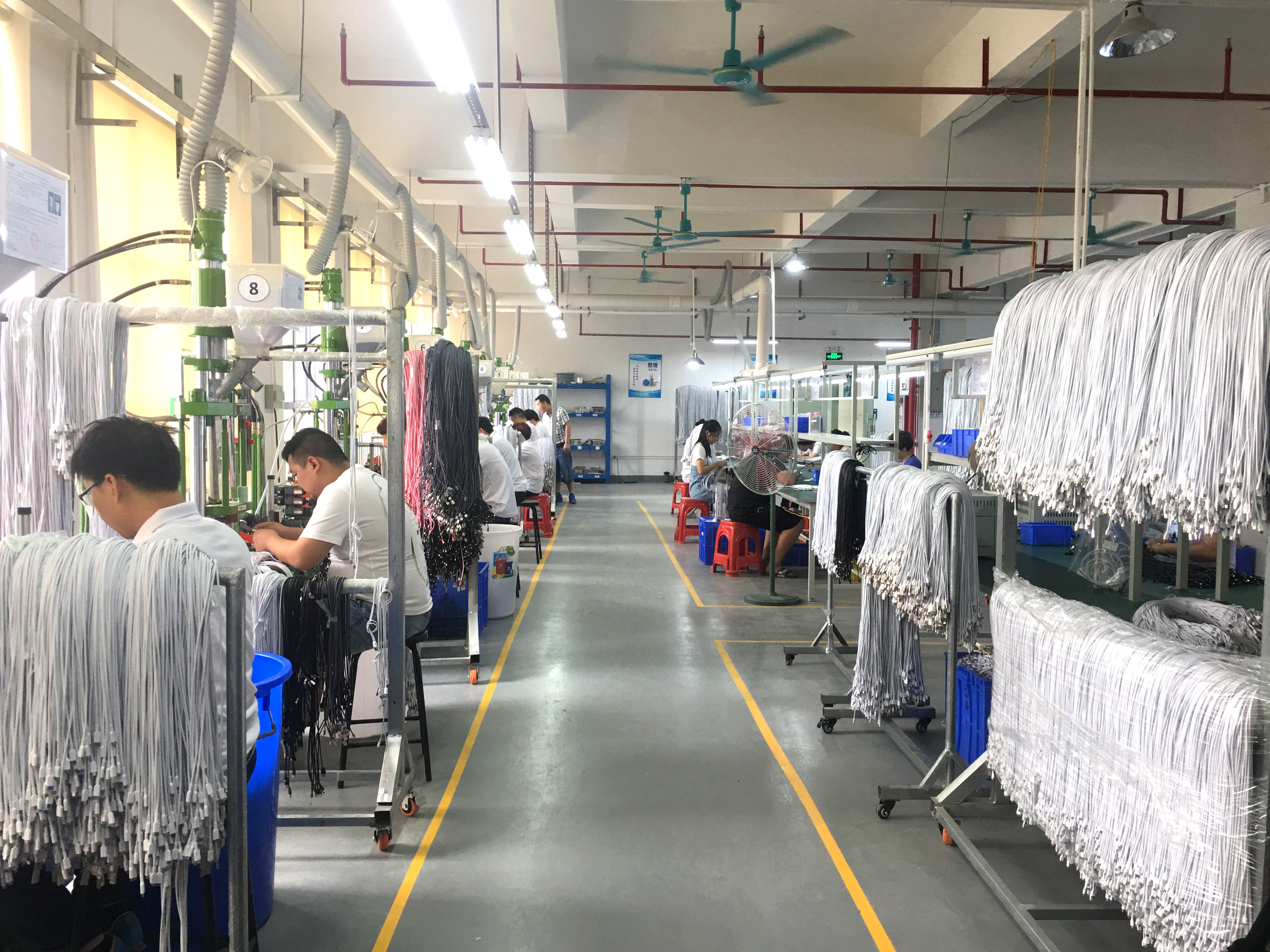
Cable production workshop, Focuses, Tangxia Town, Dongguan - where jacket material choice moves from a specification line into tooling, molding and inspection.
Jacket Material Is Where USB Cable Procurement Decisions Are Actually Made
USB cable sourcing rarely fails because a buyer picked the wrong connector. It fails because the connector was specified in detail and the jacket was left to the supplier. PVC, nylon braid, TPE, silicone and a sealed IPX7 construction are not cosmetic variants of the same product. Each carries a different charging ceiling, a different working-temperature window, a different mechanical behaviour under repeated handling, and a different fit with end markets ranging from discount retail to marine electronics.
The commercial context makes that distinction more expensive to ignore than it used to be. DataHorizzon Research estimates the global USB cable market at USD 21.2 billion in 2024, with projections of approximately USD 88.6 billion by 2033. Within that market, the USB Type-C segment alone held a 41.2% share of USB cable sales in 2025, according to Dataintelo. Growth of that scale is not generated by buyers ordering the same cable more often; it is generated by devices that draw more power, push more data and are used in less forgiving environments.
Dongguan Focuses Electronics Technology Co., Ltd. is a Dongguan-based manufacturer specialising in the design, production and global distribution of high-performance data cables, USB solutions and audio accessories. The company operates a 6,000 m2 facility in Tangxia Town, employs 150 people, works with a 6-engineer R&D team, reports an annual output of 25,000,000 units, and exports roughly 90% of production to the EU, North America and Asia. Its current USB CABLE programme is organised around five jacket platforms: CB-PVC, CB-Nylon, CB-TPE, CB-SILICONE and the CB-Waterproof cable. This article treats those five builds as a procurement framework rather than a catalogue list.
Why Jacket Material Became a Buyer-Level Decision
Three shifts pushed jacket specification out of the factory and into the purchase order.
Compliance is now a floor, not a differentiator. Since 28 December 2024, handheld mobile phones, tablets and cameras sold in the European Union must use a USB Type-C charging port and comply with EN IEC 62680-1-3:2022. Fast-charging devices supporting USB Power Delivery in the EU market must comply with EN IEC 62680-1-2:2022. In the United States, Amazon requires USB Type-C cables to meet the UL 9990 safety standard for ICT power cables to avoid listing removal. When the interface and safety requirements are effectively fixed by rule, the remaining variables a buyer can compete on are construction, material and process quality.
Power ratings moved upward. A value cable that charges at 1A to 2.4A and a 240W build rated at 6A are not interchangeable in a promotion, a laptop accessory bundle or an OEM accessory kit. Power tolerance is a design property of the conductor and jacket assembly, not an add-on that appears after the order is placed.
End environments diversified. Outdoor supplies, industrial equipment, sports fitness, marine electronics and automotive use cases all appear in the published application lists for waterproof cable constructions. Those environments impose dust, sweat, water and low-temperature requirements that a standard PVC jacket was never designed to meet.
The Five Focuses USB Cable Platforms at a Glance
All five platforms support fast charging and data transmission, use copper conductors, and accept custom logo printing. The differences sit in the outer material, the interface families offered, the length options and the usable temperature range.
| Platform | Outer jacket material | Interface options | Available lengths | Charging | Data | Working temperature |
|---|---|---|---|---|---|---|
| CB-PVC | PVC outer sheath, pure copper conductor | USB A, Lightning, Type-C, Micro USB | 0.5m, 1m, 1.5m, 2m | 1A-2.4A | 480 Mbps | -10 C to 60 C |
| CB-Nylon | Nylon braided shell over PVC inner layer, tinned pure copper core | USB-A / USB-C to Type-C / Lightning / Micro USB | 0.3m, 1m, 1.5m, 2m | 120W / 240W, max 6A | 480 Mbps | -10 C to 70 C |
| CB-TPE | Eco-friendly TPE, tinned copper wire core | Multi-type USB port | Not fixed in published spec - handled as project-level customization | 120W / 240W, max 6A | Charging and data sync | Not published - confirm per project |
| CB-SILICONE | Soft food-grade silicone sheath, high-purity tinned copper core | USB-A / USB-C to Type-C / Lightning / Micro USB | 0.3m, 1m, 1.5m, 2m | 120W / 240W, max 6A | 480 Mbps | -20 C to 70 C |
| CB-Waterproof cable | Silicone / TPE / nylon braided outer, optional; high-purity tinned copper core | USB-A / USB-C to Type-C / Lightning / Micro USB | 0.3m, 1m, 1.5m, 2m | 120W / 240W, max 6A | 480 Mbps | -20 C to 70 C, IPX7 waterproof and dustproof |
Cells marked as not published indicate a parameter that does not exist as a fixed catalogue value in the model specification. Cable length is one of the customization points covered by the manufacturer's ODM/OEM service, so these values are agreed per project rather than inherited from a standard list.
Technical Explanation: What Each Jacket Actually Changes
The jacket is not just the outside of the cable. It determines how much heat can be dissipated during fast charging, how the cable behaves when bent repeatedly, how it feels to the end user, and what temperature window the product can survive. Focuses' production capability includes 100% full inspection before shipment, supported by laboratory and plug-and-play test instrumentation used to verify charging and connection performance.
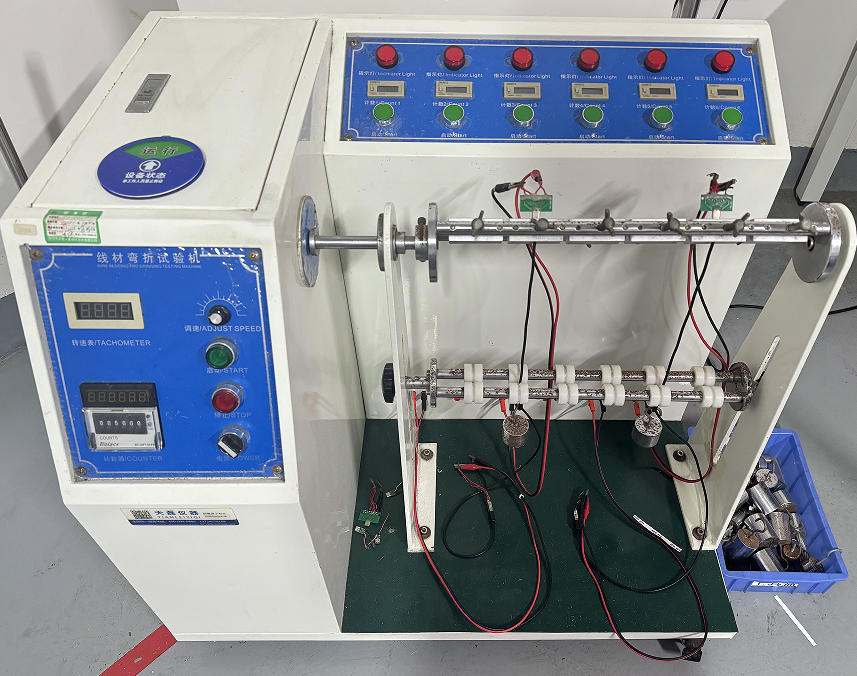
Laboratory equipment supporting the stated 100% full inspection before shipment at Focuses.
CB-PVC: The Volume Baseline
CB-PVC uses a PVC outer sheath with a pure copper conductor and covers four interface families - USB A, Lightning, Type-C and Micro USB - in lengths from 0.5m to 2m. Charging runs from 1A to 2.4A with 480 Mbps data transfer, inside a -10 C to 60 C working window. Its published application list is unambiguously consumer-facing: consumer electronics, mobile communication, digital accessories, retail wholesale, gift industry, online retail, electronic gift and household electronics. For a buyer, that makes CB-PVC the natural unit for high-volume retail programmes where the charging requirement is ordinary daily phone charging and the price position matters more than the finish.
CB-Nylon: Braided Durability With High-Power Support
CB-Nylon wraps a PVC inner layer in a nylon braided shell and uses a tinned pure copper core. It supports 120W and 240W output at a maximum charging current of 6A, with 480 Mbps data transfer and lengths of 0.3m, 1m, 1.5m and 2m. The working range extends to -10 C to 70 C, and the published compatibility list covers mobile phones, tablets and laptops. Braiding is usually specified for two reasons: the perceived durability at retail, and the protection it adds to the sheath against abrasion during repeated handling. Focuses' project documentation also references bend-resistant design as a highlight in nylond-style braided cable projects.
CB-TPE: Flexible, Eco-Positioned Jacketing
CB-TPE uses an eco-friendly TPE outer material over a tinned copper wire core, offers a multi-type USB port interface, and supports 120W and 240W fast charging at a maximum current of 6A. The cable combines charging and data sync and is described as soft, flexible and wear-resistant, with published compatibility for cell phones and notebooks. Its applications span consumer electronics, mobile accessories, retail, wholesale, e-commerce, gift industry, digital products and household electronics. In a procurement context, TPE sits between a standard PVC build and a silicone build: it carries the high-power specification of the premium platforms with a lighter, more flexible hand-feel than a rigid PVC jacket.
CB-SILICONE: Soft-Touch Performance With a Wider Temperature Window
CB-SILICONE uses a soft food-grade silicone outer sheath and a high-purity tinned copper core, supporting 120W and 240W ultra-fast charging at a maximum of 6A and 480 Mbps data transfer. It is offered in 0.3m, 1m, 1.5m and 2m, works from -20 C to 70 C, and is published as compatible with phones, tablets, laptops and power banks. The stated material features are skin-friendly, odourless, anti-kink, wear-resistant, anti-freezing and flexible. The combination of a -20 C low-temperature limit and anti-freezing behaviour is what makes this build relevant to cold-climate retail programmes and to consumer products where the cable is held frequently.
CB-Waterproof Cable: Sealed Construction for Hostile Environments
The CB-Waterproof cable carries an IPX7 waterproof and dustproof rating with a sealed integrated molding construction, and is additionally described as sweat-proof, anti-corrosion and wear-resistant. Buyers are not forced into a single material to obtain that protection: the outer can be specified in silicone, TPE or nylon braided. Power support matches the premium platforms at 120W and 240W with a maximum current of 6A, data transfer is 480 Mbps, lengths run from 0.3m to 2m, and the working range is -20 C to 70 C. The published application list is the widest in the range - consumer electronics, mobile accessories, outdoor supplies, industrial equipment, sports fitness, retail, wholesale, e-commerce, marine electronics and automotive.
Commercial Terms: The Decision Matrix Buyers Should Work From
Model selection only becomes a purchase decision when it is paired with commercial terms. Across the five platforms, Focuses applies a standard MOQ of 2,000 units, a lead time of 25 to 35 days, 100% full inspection before shipment, and a 12-month warranty that includes free technical guidance for charging compatibility issues during the warranty period. Monthly capacity is 2,500,000 units and annual output is 25,000,000 units, with production operated in ODM/OEM mode.
| Platform | Best-fit procurement scenario | MOQ and lead time | Quality and after-sales | Primary customization levers |
|---|---|---|---|---|
| CB-PVC | Value retail, wholesale, gift and household charging programmes where 1A-2.4A and 60 C are sufficient | 2,000 units; 25-35 days | 100% full inspection before shipment; 12-month warranty | Logo printing, cable colour, power, length, packaging style |
| CB-Nylon | High-power retail, e-commerce and bundled accessory programmes requiring 6A / 120W-240W with a braided finish | 2,000 units; 25-35 days | 100% full inspection before shipment; 12-month warranty | Logo printing, cable appearance, material, molding, connector housing colour |
| CB-TPE | Eco-positioned consumer, gift and multi-device programmes needing a flexible, wear-resistant sheath | 2,000 units; 25-35 days | 100% full inspection before shipment; 12-month warranty | Length, power, multi-function design, packaging design |
| CB-SILICONE | Premium retail, skin-contact and cold-environment programmes where -20 C performance is required | 2,000 units; 25-35 days | 100% full inspection before shipment; 12-month warranty | Logo printing, colour, appearance, molding, packaging |
| CB-Waterproof cable | Outdoor, industrial, marine, automotive and sports applications requiring IPX7 sealing and dust resistance | 2,000 units; 25-35 days | 100% full inspection before shipment; 12-month warranty | Outer material choice (silicone / TPE / nylon braided), molding, length, logo, packaging |
The full customization scope covers logo printing, cable colour, power, cable appearance, cable materials, cable molding, multi-function design, connector housing colour, cable length, packaging style and packaging design. Because MOQ and lead time are identical across the five builds, buyers do not have to trade commercial terms against material choice - the variable is the specification, not the order mechanics.
Application Fit: Matching Builds to Procurement Scenarios
- High-volume retail and wholesale programmes. Where the shelf position is price-led and the charging requirement is everyday phone charging, CB-PVC covers USB A, Lightning, Type-C and Micro USB across 0.5m to 2m with custom logo support.
- High-speed charging and laptop accessory bundles. CB-Nylon, CB-TPE, CB-SILICONE and the CB-Waterproof cable all carry 120W / 240W at up to 6A with 480 Mbps data transfer, which suits programmes built around fast-charging claims.
- Corporate gifts and branded merchandise. Logo printing is supported across the range, and Focuses' project records include corporate gift purchasers alongside digital accessory wholesalers in Indonesia, the United States, Germany and the United Kingdom, with orders in the 5,000 to 30,000 piece range.
- Humid, dusty or outdoor use. The CB-Waterproof cable's IPX7 rating and sealed integrated molding are aimed at outdoor supplies, industrial equipment, sports fitness, marine electronics and automotive applications.
- Cold-climate and skin-contact products. CB-SILICONE and the waterproof build share a -20 C to 70 C window, with anti-freezing, odourless and skin-friendly material properties stated for the silicone sheath.
Buyer-side evidence for these combinations exists in Focuses' documented projects: applications listed include daily phone charging, corporate customized gifts, retail sales and car use, with reported stability of fast charging speed, low heating during long-time charging and zero mass quality complaints reported across those programmes. The same records describe a normal service life of over two years against a one-year product warranty, and highlight multi-device simultaneous charging, customizable appearance and logo, bend-resistant design and wide compatibility with Type-C devices.
Market Trend Analysis: Where USB Cable Demand Is Moving
Several verified market signals explain why jacket-level specification is becoming standard practice rather than a premium add-on.
- Volume growth is structural. The global USB cable market is projected to grow at a CAGR of 17.3% through 2031 according to KBV Research projections, on top of the 2024 base of USD 21.2 billion reported by DataHorizzon Research.
- Asia Pacific remains the production centre. Asia Pacific led global USB cable revenue in 2025 at USD 12.3 billion, roughly 43% of total market share, per Dataintelo. That concentration keeps manufacturing capability, tooling and inspection capacity in the same region where most sourcing decisions are made.
- Type-C is now the default interface. The USB Type-C segment held a 41.2% share of USB cable sales in 2025, which aligns with the EU Common Charger Directive requiring Type-C ports on handheld phones, tablets and cameras sold after 28 December 2024 under EN IEC 62680-1-3:2022.
- Safety listing requirements are tightening at the platform level. Amazon US requires USB Type-C cables to meet UL 9990 for ICT power cables to avoid listing removal, which pushes cable specification into the compliance conversation earlier in the sourcing cycle.
Taken together, these signals point to a market where basic interoperability is guaranteed by regulation and where competitive difference is expressed through power handling, jacket durability and environmental rating - exactly the dimensions on which the five Focuses platforms are separated.
Comparison With Traditional Sourcing Approaches - and Where This Framework Stops
The traditional approach to USB cable procurement is to specify the connector, ask for a target price and accept whatever jacket the supplier proposes. That approach still works for low-risk, short-lifecycle purchases. It becomes fragile when the cable is bundled with a device, carries a fast-charging claim, or ships into an environment with moisture, dust or temperature extremes, because the jacket determines whether the claim can be supported at all.
A material-led framework, by contrast, asks the buyer to fix the jacket, the current rating, the temperature window and the ingress requirement before price negotiation begins, then compares quotations on identical specifications. The trade-off is that this approach requires more specification work upfront and often removes the lowest quotation from consideration, because the cheapest available build is frequently a PVC cable that cannot meet a 6A or IPX7 requirement.
Stated Limits of This Framework
- No single build covers every scenario. CB-PVC is capped at 1A-2.4A and a 60 C upper temperature, so it cannot serve high-power programmes or low-temperature conditions. Selecting a braided, silicone or sealed IPX7 build for an indoor, low-risk programme adds processing complexity that the application does not require.
- Some parameters are project-level, not catalogue-level. The published specification for CB-TPE does not fix a length list or a working-temperature window, and customization explicitly includes cable length. These must be written into the purchase order rather than assumed from the platform name.
- Certification scope is defined, not universal. Focuses holds ISO 9001:2015 certification (certificate SW23Q21582R1S, issued by SAILWAY) with a certified registration scope covering R&D and production of audio wire and data wire. Buyers sourcing adjacent product categories should confirm that the scope covers what they are purchasing.
- Inspection is not a substitute for acceptance criteria. A 100% full inspection before shipment is a supplier-side control. The buyer still needs to define measurable acceptance criteria - current at load, data throughput, jacket integrity after handling, sealing performance for IPX7 builds - and agree how each will be verified.
Future Outlook
Two forces are likely to shape USB cable purchasing over the next cycle. The first is regulatory convergence: with the EU Common Charger Directive in force under EN IEC 62680-1-3:2022 and EN IEC 62680-1-2:2022 for USB Power Delivery devices, and with UL 9990 required for Type-C cables on Amazon US listings, interface and safety compliance increasingly act as entry conditions rather than selling points. The second is application diversification: as cables move into outdoor supplies, industrial equipment, marine electronics and automotive interiors, sealed and cold-resistant constructions move from niche to standard line items.
For buyers, the practical implication is that the specification document becomes the main lever of negotiation. Suppliers that can offer a defined material range, a stated power and temperature envelope, and consistent commercial terms across the range are easier to integrate into a multi-year programme than suppliers offering a single undifferentiated cable. Focuses' five-platform structure - with a uniform 2,000-unit MOQ, 25 to 35 day lead time, 100% inspection and 12-month warranty across all builds - is one example of that structure, with monthly capacity of 2,500,000 units supporting repeat programmes.
FAQ
Which Focuses USB cable build is the most practical default for a large retail programme?
CB-PVC is the baseline build for volume retail. It offers USB A, Lightning, Type-C and Micro USB interfaces in 0.5m, 1m, 1.5m and 2m lengths, charges at 1A to 2.4A, transfers data at 480 Mbps, and works between -10 C and 60 C, with custom logo accepted. It is positioned for consumer electronics, retail wholesale, online retail, gift and household electronics applications. Where the retail programme requires 6A charging, a 240W rating or a premium feel, CB-Nylon, CB-TPE, CB-SILICONE or the CB-Waterproof cable become the relevant alternatives.
How do CB-Nylon, CB-TPE and CB-SILICONE differ when the requirement is 6A fast charging?
All three share the same electrical headline: 120W and 240W output, a maximum charging current of 6A, and 480 Mbps data transfer. The differences are in the jacket. CB-Nylon uses a nylon braided shell over a PVC inner layer with a tinned pure copper core and a -10 C to 70 C range. CB-TPE uses an eco-friendly TPE outer described as soft, flexible and wear-resistant, with length handled as a project-level customization. CB-SILICONE uses a soft food-grade silicone sheath with a -20 C to 70 C range and stated properties of being skin-friendly, odourless, anti-kink, wear-resistant, anti-freezing and flexible.
When does the CB-Waterproof cable justify being specified instead of a standard build?
The CB-Waterproof cable is rated IPX7 for waterproofing and dustproofing and uses a sealed integrated molding construction that is also described as sweat-proof, anti-corrosion and wear-resistant. Its published application list covers outdoor supplies, industrial equipment, sports fitness, marine electronics and automotive use. It supports 120W and 240W at up to 6A, transfers data at 480 Mbps, works from -20 C to 70 C, and accepts a silicone, TPE or nylon braided outer. Buyers should confirm the specific acceptance test for the IPX7 claim within their own specification before volume release.
What MOQ, lead time and capacity should a buyer plan around?
The standard MOQ is 2,000 units and the standard lead time is 25 to 35 days, applied consistently across the five platforms. Monthly capacity is 2,500,000 units and annual output is 25,000,000 units, with production operated in ODM/OEM mode. Documented project order quantities for wholesale and corporate gift purchasers have ranged from 5,000 to 30,000 pieces per order. Quality control is 100% full inspection before shipment, and after-sales coverage is a 12-month warranty with free technical guidance for charging compatibility issues during the warranty period.
What can be customized, and how does customization affect acceptance criteria?
The customization scope covers logo printing, cable colour, power, cable appearance, cable materials, cable molding, multi-function design, connector housing colour, cable length, packaging style and packaging design. Because these options change the physical build, the customized specification should be frozen in writing before molding begins, and the 100% full inspection before shipment should be performed against that agreed specification. This is also where buyers should confirm the certified registration scope most relevant to their purchase; the ISO 9001:2015 certificate SW23Q21582R1S covers R&D and production of audio wire and data wire.
Have Questions or Need More Details?
Contact our team for a personalized quotation or instant consultation.
Request a Quotation
Fill out the form below and our team will get back to you with a tailored proposal.
WhatsApp Direct Chat
Prefer to chat in real-time? Message us on WhatsApp for instant assistance & quick answers.
- Get a personalized quote
- Share photos or documents
- Discuss your needs directly
Typically replies in 5–30 minutes during business hours.