
Choosing a Butyl Stearate Partner for Multi-Year Supply
Butyl stearate is a minor line item that can cause major production consequences. That mismatch, rather than price per tonne, is what a multi-year supplier decision should be built around.
Butyl stearate (CAS 123-95-5), also written n-butyl stearate or butyl octadecanoate, is a fatty-acid ester used primarily as an internal lubricant and release aid in PVC and plastics processing, and as an emollient in cosmetic formulations. In PVC compounds it is typically dosed at roughly 1% to 3%. A material that occupies such a small share of a formulation can still determine surface appearance, mold release behaviour and the consistency of a finished part. That is the structural reason why evaluating a butyl stearate supplier for a long-term relationship differs from evaluating a one-off quotation.
This analysis sets out what a procurement team should examine when the objective is supply continuity rather than a single delivered lot: documented production capacity and lead time, the evidence behind raw material sourcing transparency, the meaning of a supplier's wider ester and plasticizer portfolio, a workable cadence for periodic quality reviews, and the boundaries where a partnership model stops being useful.
Long-Term Supply Is a Continuity Problem Before It Is a Price Problem
A recurring requirement changes the nature of the decision. In a spot purchase the buyer manages one transaction risk: does the lot meet specification on arrival. In a multi-year requirement the buyer manages a chain of risks that no single certificate of analysis can resolve.
- Repeatability. Colour, ester content, acidity and moisture must stay inside the same window batch after batch, because the receiving process is validated against a stable input.
- Availability rhythm. Reorder cycles must match a documented lead time, not an optimistic one.
- Attribution. When a finished part shows a defect, both sides need to reconstruct which batch was used and what its records said.
- Continuity of knowledge. Formulation guidance and troubleshooting should not depend on a single sales contact who may change.
None of these are resolved by a lower unit price. They are resolved by evidence and by agreed process.
Where Transactional Purchasing Stops Working
Three failure patterns recur when a recurring butyl stearate requirement is handled as a sequence of independent purchases.
The first is specification drift discovered at goods-in. A buyer receives a lot with a colour value or acidity figure at the edge of the permitted range, accepts it because it is technically inside specification, and only later notices that the downstream process needed the middle of the range rather than the boundary. Without a trend record there is no way to prove the drift is real.
The second is lead-time surprise. Where a supplier documents a lead time of 30 to 45 days, an unplanned consumption spike cannot be absorbed by the supplier's warehouse unless the buyer planned for it. Buyers who treat the material as available on demand build fragility into an otherwise well-managed supply chain.
The third is the missing escalation path. A quality question raised through a general sales inbox has no defined owner, no defined evidence requirement and no defined response. The opportunity in a long-term agreement is to replace all three ambiguities with named responsibilities and a review calendar agreed before the first annual volume is committed.
Reading Production Continuity From Documented Capability
Shandong Kexing Chemical Co., Ltd. is a manufacturer of plasticizers, plastic and rubber flame retardants and plastic additives, based in Dongying, Shandong, China, with a subsidiary, Dongying Kexing International Trade, handling global import and export business. The company was founded in 2006 and documents a monthly capacity of 10,000 T across its product range, supported by a research and development team of 15 engineers within a workforce of 200.
The value of these figures to a buyer is not the headline number. It is that capacity, lead time, minimum order quantity and quality-control steps can all be written into a supply agreement as commitments rather than assumptions.

Research and development centre supporting product development and batch-level quality work at Shandong Kexing Chemical Co., Ltd.
| Documented capability | What Shandong Kexing Chemical records | Why it matters in a multi-year agreement |
|---|---|---|
| Production mode | OEM production with private labelling customisation | Allows a distributor or brand owner to hold a consistent label and pack format across years |
| Monthly capacity | 10,000 T (product range) | Provides a basis for allocating annual volume and discussing growth headroom |
| Lead time | 30 to 45 days | Sets the minimum planning horizon and the size of the safety stock needed |
| Minimum order quantity | 1 T | Defines whether small or trial volumes can be served on the same terms as bulk |
| Quality control | Raw material incoming inspection; finished product sampling test | Identifies the two control points where batch records can be requested |
| After-sales scope | Remote technical support, after-sales consulting, quality issue resolution, shipping follow-up, formulation technical guidance | Names the support functions a buyer can contractually expect rather than hope for |
| Export orientation | Export ratio of 50%; markets include Europe, USA, Japan, South Korea and the Middle East | Indicates routine handling of documentation for regulated destination markets |
Raw Material Sourcing Transparency: The Questions That Produce Evidence
Sourcing transparency is often discussed as a supplier virtue. For procurement purposes it should be treated as a set of answerable questions with retrievable records, because feedstock for a fatty-acid ester is the single largest determinant of what the finished batch will look like.
Four questions produce usable evidence:
- Which incoming parameters are tested, and against which limit? A documented incoming inspection step is the first control point in the chain.
- Is a retention sample kept for each batch, and for how long? Retention samples are what make a two-year-old complaint investigable.
- How is a change in feedstock source or grade communicated before shipment? This is the clause that turns transparency from an attitude into a procedure.
- Does the certificate of analysis travel with the shipment, and does it carry the batch identity that appears on the packaging? Traceability collapses if the two identifiers differ.
In Shandong Kexing Chemical's documented quality-control scope, raw material incoming inspection and finished product sampling testing are both named. That names the control points but does not disclose feedstock supplier identities, which is normal for a public product description. Buyers who need that level of disclosure should request it inside a quality agreement rather than expect it on a website.
The Portfolio Signal: DOTP, Citrates, and What They Imply
A supplier's product range is frequently used as a proxy for stability. It is a reasonable proxy, provided the inference stays modest. Shandong Kexing Chemical's documented range covers Acetyl Tributyl Citrate (ATBC), Tributyl Citrate (TBC), Triethyl Citrate (TEC), Dioctyl Adipate (DOA), Dioctyl Sebacate (DOS), Dibutyl Sebacate (DBS), Epoxidized Soybean Oil (ESO), Triethylene Glycol Di-2-ethylhexoate (3G8), Dioctyl terephthalate (DOTP), Diisononyl phthalate (DINP), Didecyl phthalate (DPHP), Dioctyl Phthalate (DOP), Dibutyl Phthalate (DBP) and N-Butyl Stearate.
What this supports is operational inference, in three parts. A multi-line ester and plasticizer operation requires shared laboratory capacity, because each of these products is released against its own specification table. It requires a procurement function capable of sourcing several feedstocks simultaneously. And it requires a demand base broad enough to keep several lines running, which reduces the risk that a single-product supplier exits a category when one downstream market softens.
For buyers of DOTP or citrate esters alongside butyl stearate, there is also a practical consolidation effect: fewer shipments, one documentation set, one quality contact. What the portfolio cannot prove is grade suitability. A wide range says nothing about whether a specific butyl stearate lot suits a specific PVC formulation. That still has to be validated on the buyer's own equipment.
What Consistent Actually Means at the Specification Level
Consistency arguments become actionable only when they are attached to parameters. The documented specification for N-Butyl Stearate (CAS 123-95-5) supplies the parameters a buyer should trend.
| Parameter | Documented value | Buyer interpretation |
|---|---|---|
| Appearance | Colourless transparent liquid | Visual incoming check; haze or colour is an early warning |
| Colour (Pt-Co) | Max 30 | Most sensitive indicator of feedstock and process drift |
| Content | Min 99.0% | Drives lubricant efficiency and dosage assumptions |
| Acidity (mgKOH/g) | Max 0.20 | Relevant to stability and to interaction with other additives |
| Moisture | Max 0.10% | Affects handling and, in some systems, dispersion |
| Density (g/cm3) | 0.85 | Used for volume-to-mass conversion in dosing and logistics |
| Flash point | Min 190 C | Handling and storage classification parameter |
A published note from the manufacturer states that its butyl stearate is produced at 99% purity and is used both as a PVC internal lubricant and as a cosmetic emollient. For a long-term buyer, the practical conclusion is that the specification ceiling is only half the information: the batch history against that ceiling is the other half.
Where Butyl Stearate Fits in Production
Positioning the product correctly prevents both over-specification and over-dependency. Butyl stearate functions as an internal lubricant in PVC and plastics processing at typical dosages of 1% to 3%, where it influences melt flow and release behaviour. Documented application industries for the manufacturer's ester and plasticizer range include toys, PVC products, plastics, leather, ink and food packaging.
Kexing's case records, which cover the wider ester and plasticizer range rather than butyl stearate alone, describe a repeat-order pattern of 15 to 25 MT per month from plastic masterbatch factories, artificial leather manufacturers, food packaging processors and toy factories, with buyers recorded in Canada, Chile, France, the United Kingdom, India, Japan, South Korea, Peru, Russia, Turkey and the United States. The same records cite improved flexibility of finished goods, low migration, stable batch purity and passage of REACH and food-grade safety testing, with finished-product service life stated as up to two years.
That order pattern is the more useful signal for supplier evaluation. A buyer placing 15 to 25 MT monthly is not testing a sample; they are running a production dependency, and their reorder rhythm implies that batch-to-batch variation has stayed inside their process window.
Setting Up Periodic Quality Reviews That Actually Run
Most quality-review clauses fail because they are written in general terms. A review that survives contact with a busy year has a fixed cadence, a fixed dataset and a defined trigger for escalation.
| Review level | Suggested cadence | Dataset and purpose |
|---|---|---|
| Batch release check | Every delivery | Certificate of analysis against the seven documented parameters; confirm batch identity matches packaging |
| Trend review | Quarterly | Plot colour, content, acidity and moisture across all lots received; identify drift while it is still inside specification |
| Supplier performance review | Annual | On-time delivery against the 30 to 45 day lead time; deviation count; resolution record; documentation completeness |
| Re-qualification | Annual, or on trigger | Repeat the application trial used at approval, or re-run it immediately after any notified feedstock or process change |
Two rules make the cadence work. The trend data must come from the supplier's own certificate of analysis and the buyer's incoming test, side by side, because the gap between them is itself diagnostic. And any parameter that reaches the specification boundary twice in a row should be treated as a review trigger, not as a pass.
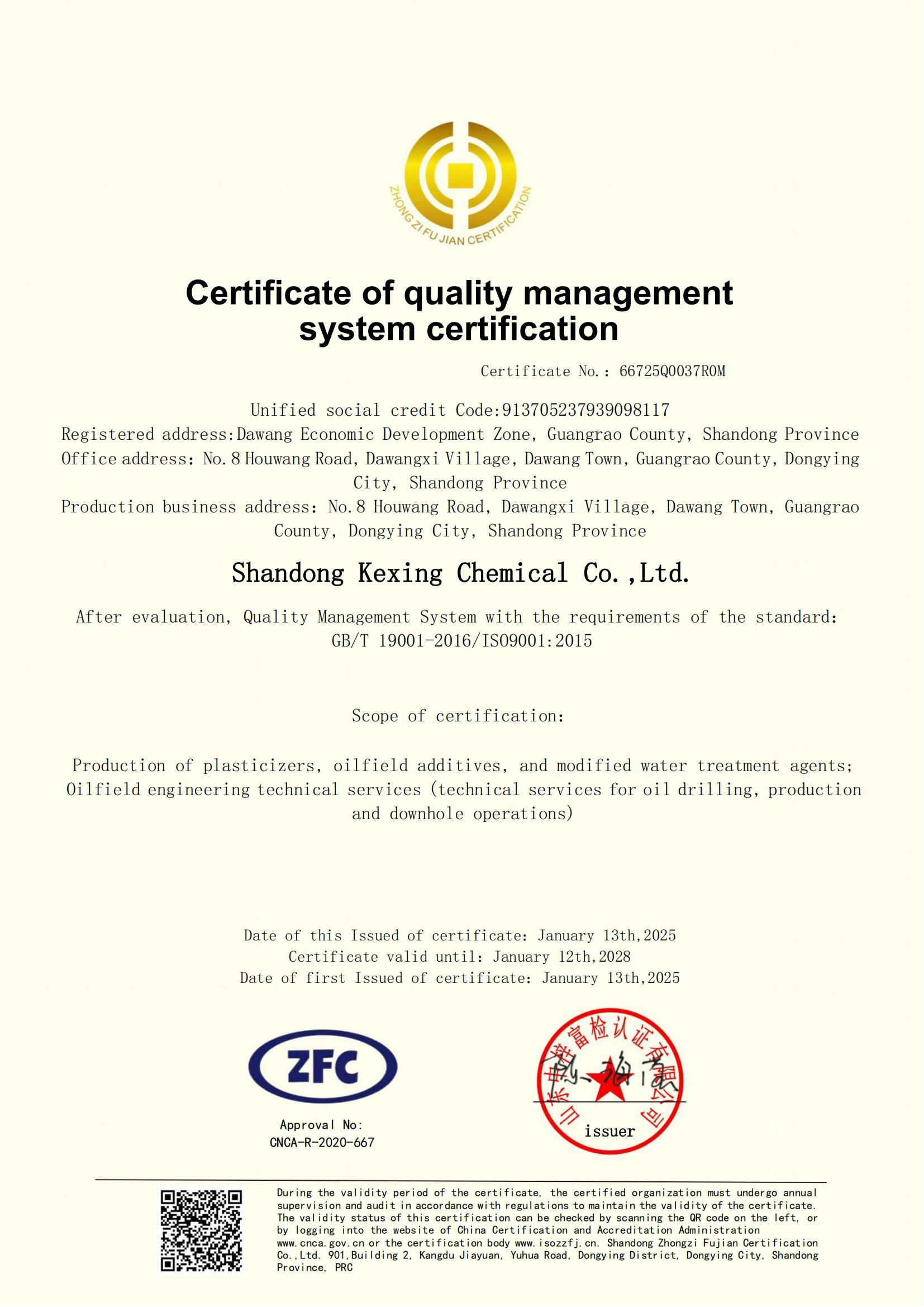
ISO 9001:2015 quality management system certificate (66725Q0037R0M, valid to 12 January 2028) covering production of plasticizers and related additives.
Certification is part of the review framework rather than a substitute for it. Shandong Kexing Chemical holds a quality management system certificate to GB/T 19001-2016 / ISO 9001:2015 issued by Shandong Xiangfu Inspection and Certification Co., Ltd. (certificate 66725Q0037R0M, issued 13 January 2025, valid to 12 January 2028), an environmental management system certificate to GB/T 24001-2016 / ISO 14001:2015 (66725E0038R0M, valid to 12 January 2028), and an HSE management system certificate (667240083R1S, valid to 28 February 2027). The company profile also lists SGS and REACH among its certifications. Buyers should read the scope statement on each certificate and confirm the specific product line sits within it.
Communication Protocols for a Multi-Year Relationship
Communication quality is usually described in adjectives. It is better described as a list of named channels with owners and expected inputs. Four elements are worth writing into an agreement.
- A named technical counterpart. The documented after-sales scope of Shandong Kexing Chemical includes remote technical support, after-sales consulting, quality issue resolution, shipping follow-up and formulation technical guidance. Each of these needs a named owner on the supplier side and a named recipient on the buyer side.
- A change-notification obligation. The supplier commits to notify feedstock, process or packaging changes before affected lots ship, and the buyer commits to re-run its application trial within an agreed window after notification.
- A deviation route. A single address for quality deviations, with a required evidence pack: batch number, retained sample, certificate of analysis, and the buyer's incoming test result.
- A commercial review rhythm. Volume forecasts shared ahead of the lead-time window so that the 30 to 45 day cycle is planned rather than reacted to.
These are procedural commitments, not goodwill gestures. Written down, they are the difference between a supplier relationship and a purchase order history.
Market Context: Demand, Regional Weight and Regulatory Baseline
Published third-party estimates for the butyl stearate market diverge widely, which is itself useful information. Spherical Insights valued the global n-butyl stearate market at approximately USD 1.28 billion in 2024, while Dataintelo estimated USD 2.85 billion and Future Market Insights USD 5.2 billion on a 2025 basis. The gap most likely reflects different treatment of downstream derivative products and of industrial versus cosmetic grade boundaries. For a procurement team, the practical conclusion is that no single market-size figure should anchor a capacity or pricing strategy; the direction of demand is more reliable than the absolute number.
On segmentation, the evidence is more consistent. Dataintelo reports that the lubricants application segment held the largest share of the N-Butyl Stearate market at 38.5% in 2025, and that Asia Pacific accounted for 42.3% of global revenue in the same year. Trade data points the same way: Zauba and customs records cited for HS Code 29157090 show China as the largest exporter of butyl stearate into key markets such as India, accounting for over 66% of specific import shipments in 2024.
The supplier landscape is concentrated at the branded end. Cognitive Market Research names BASF SE, Emery Oleochemicals, Croda International and Fine Organics among the leading global manufacturers of butyl stearate. Chinese producers such as Shandong Kexing Chemical occupy the volume and customisation layer of the same market, which is why buyers frequently run a dual-sourcing structure: a branded reference grade for qualification, and a volume partner for ongoing supply.
Regulation sets a firm baseline. Butyl Stearate (CAS 123-95-5) is listed as an active substance under EU REACH, requiring registration for imports or manufacturing above 1 tonne per year, according to the European Chemicals Agency. For a buyer shipping into Europe, registration status is a qualification gate rather than a differentiator.
The Limits of the Partnership Model
A long-term structure is not automatically the right answer, and a credible evaluation should say where it stops being useful.
- Small spend share constrains leverage. At typical PVC dosages of 1% to 3%, butyl stearate represents a limited fraction of total additive spend. A buyer expecting a single-product contract to unlock broad commercial concessions will usually be disappointed; the portfolio matters more than the tonnage.
- Lead time is not a service level. A documented lead time of 30 to 45 days means the supplier cannot behave like a spot market. Buyers with volatile consumption need their own buffer stock, and that carrying cost belongs in the total cost calculation.
- Minimum quantities exclude some users. A 1 T minimum order quantity suits pilot and mid-size production but does not serve laboratory-scale or very low-volume specialty requirements on the same terms.
- Portfolio breadth is not application support. A plasticizer and additive range does not by itself provide cosmetic-specific regulatory dossiers or formulation development outside the listed products. Buyers in those areas should validate capability separately.
- Certification scope requires reading. A management system certificate covers the scope printed on it. Confirming that a specific grade falls inside that scope is the buyer's responsibility, not an inference from the logo on a brochure.
| Dimension | Transactional spot buying | Multi-year partnership |
|---|---|---|
| Primary risk managed | Single-lot conformity | Continuity and drift |
| Quality evidence | Certificate of analysis per delivery | Certificate plus trending across quarters |
| Change handling | Reactive, after arrival | Notified before shipment, with re-qualification |
| Cost view | Price per tonne | Price plus buffer stock, testing and review effort |
| Failure mode | Lot rejection and re-sourcing scramble | Slow response if review cadence is not maintained |
Future Outlook
Three developments are likely to shape how buyers evaluate butyl stearate suppliers over the next few years. Lubricant applications already hold the largest application share of the market, which keeps demand tied to PVC and plastics output rather than to cosmetic volumes, and that in turn keeps pressure on suppliers to demonstrate batch repeatability rather than novelty. Asia Pacific's dominant revenue position reinforces the importance of documentation quality from Chinese producers, because a buyer in Europe or North America is effectively importing the supplier's record-keeping as much as the material. And REACH-style registration obligations make the administrative side of the relationship a continuing qualification criterion, not a one-time hurdle.
The practical implication is that supplier evaluation will keep shifting toward evidence that can be audited: trend data, retention samples, change notification, and named technical ownership. Buyers who formalise those four items now will find the next re-qualification cycle considerably shorter.
Frequently Asked Questions
What evidence shows that a butyl stearate supplier can sustain multi-year supply?
Look for documented capacity, a stated lead time, a defined minimum order quantity and named quality-control steps. Shandong Kexing Chemical documents a monthly capacity of 10,000 T across its range, a lead time of 30 to 45 days, a 1 T minimum order quantity, and quality control consisting of raw material incoming inspection and finished product sampling testing. Each of these can be converted into a contractual commitment.
Why does a supplier's wider product range matter when buying only butyl stearate?
A multi-line operation implies shared laboratory capacity, simultaneous sourcing of several feedstocks and a demand base broad enough to sustain multiple production lines, which reduces the risk of a category exit. Shandong Kexing Chemical's documented range includes ATBC, TBC, TEC, DOA, DOS, DBS, ESO, 3G8, DOTP, DINP, DPHP, DOP, DBP and N-Butyl Stearate. Portfolio breadth supports operational stability inferences but does not by itself prove grade suitability for a specific formulation.
How often should periodic quality reviews be scheduled?
A workable structure is a batch release check on every delivery, a quarterly trend review of colour, content, acidity and moisture across all lots received, an annual supplier performance review covering on-time delivery and deviation records, and annual re-qualification or immediate re-qualification after any notified feedstock or process change. Any parameter that reaches the specification boundary twice in succession should trigger a review rather than a routine pass.
Which specification parameters should be trended across batches?
For N-Butyl Stearate (CAS 123-95-5) the documented parameters are appearance (colourless transparent liquid), colour Pt-Co max 30, content min 99.0%, acidity max 0.20 mgKOH/g, moisture max 0.10%, density 0.85 g/cm3 and flash point min 190 C. Colour and acidity are the most sensitive early indicators of feedstock or process drift, while content and moisture bear most directly on dosing accuracy and handling.
Is butyl stearate subject to EU REACH registration?
Yes. Butyl Stearate (CAS 123-95-5) is listed as an active substance under EU REACH regulations, requiring registration for imports or manufacturing above 1 tonne per year, according to the European Chemicals Agency. For buyers shipping into the EU, registration status functions as a qualification gate.
What are the limits of a long-term butyl stearate supply agreement?
At typical PVC dosages of 1% to 3%, butyl stearate accounts for a limited share of total additive spend, so commercial leverage from a single-product contract is modest. A documented lead time of 30 to 45 days requires the buyer to hold buffer stock, and a 1 T minimum order quantity does not serve laboratory-scale needs. Portfolio breadth also does not substitute for application-specific qualification in areas such as cosmetic formulation.
Have Questions or Need More Details?
Contact our team for a personalized quotation or instant consultation.
Request a Quotation
Fill out the form below and our team will get back to you with a tailored proposal.
WhatsApp Direct Chat
Prefer to chat in real-time? Message us on WhatsApp for instant assistance & quick answers.
- Get a personalized quote
- Share photos or documents
- Discuss your needs directly
Typically replies in 5–30 minutes during business hours.