
Choosing a CXX Magnetic Cord: Round vs Racetrack vs Pinpoint
Choosing a CXX Magnetic Cord: Round vs Racetrack vs Pinpoint
A 12 mm seam channel will physically accept a round cord, a racetrack cord and a pinpoint cord, yet only one of them will close the way the wearer expects. CXX-1201, CXX-1206 and CXX-1401 are three profiles built on the same flexible magnetic cord platform by Beijing Magnetic Technologies Co., Ltd. (MAGTECH®), a manufacturer of flexible magnetic cords, strips and encapsulated fasteners for apparel and technical textiles. They share core chemistry options, jacket options and a common durability envelope; they differ in cross-section, documented surface field and jacket material. Those differences — not a catalogue headline — decide which placket, pocket, cuff or collar a designer should specify.
This is a deliberately narrow comparison. It does not rank the CXX Series, price it against zippers, or crown a winner. It compares three profiles on the criteria a technical designer or sourcing team actually works with at the decision stage: how the cord sits inside a seam channel, how the finished garment drapes, and how the closure survives washing and salt-spray exposure.
Why the profile matters more than the Gauss figure
Surface field strength describes magnetic flux density measured at the pole face of the component. The closure, however, does not operate at the pole face. It operates across an air gap built from two fabric layers, a folded seam allowance and sometimes an interlining or stiffener. What the hand feels at the placket is the product of three things: how much magnetic material is presented across that gap, how that material is shaped, and which direction the panel is being pulled.
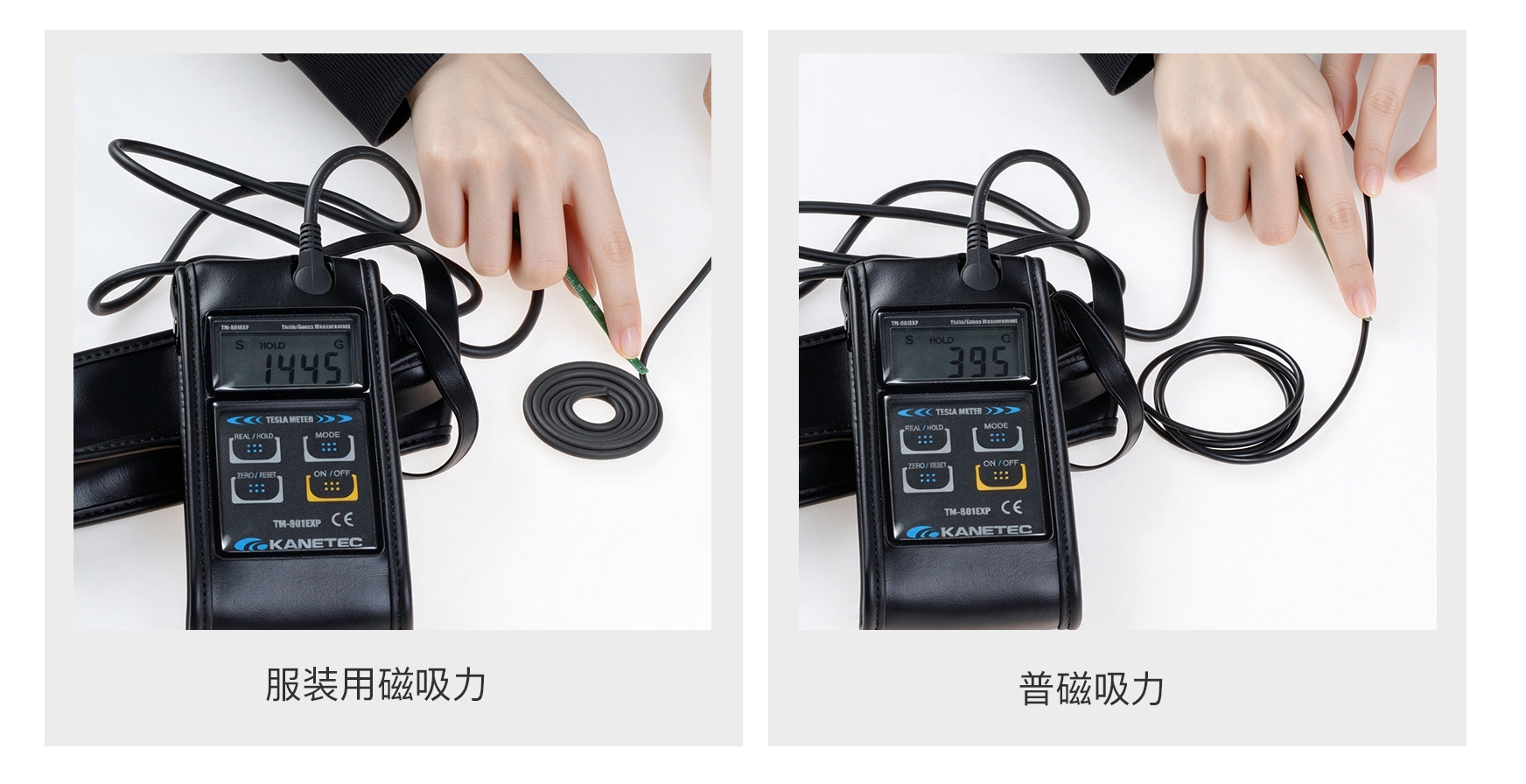
That is why the two documented field windows in this comparison should be read as specifications rather than as a scoreboard. CXX-1201, a round profile of 3.5 mm diameter, is documented at 1200–1300 Gs. CXX-1206, a racetrack profile measuring 3.3 × 2.7 mm, is documented at 1000–1100 Gs. The gap between them is real, but it does not translate directly into a proportional difference in holding force, because a round section and a flattened section meet their counterparts differently.
CXX-1401, the pinpoint profile, is documented by cross-section and jacket rather than by a single field window. Its working value should be taken from its own SKU datasheet, within the platform’s stated customisation range of 1000–1700 Gs, rather than inferred from the other two profiles.
What all three profiles share
Before the differences, the common platform. Buyers sometimes assume that a change of cross-section also means a change of chemistry, jacket or test basis. On the CXX platform it does not. The three profiles are drawn from one documented specification set:
- Magnetic core: SmFeN (samarium-iron-nitrogen) or NdFeB powder in a flexible polymer matrix, selected by SKU.
- Jacket: TPU or food-grade silicone encapsulation, selected by SKU.
- Linear density: 35–45 g/m across the platform.
- Peel-off force: 0.66–1.69 N/cm.
- Shear force: 1.01–1.81 N/cm.
- Flexibility: bending beyond 180° without permanent set.
- Fatigue: more than 12,000 cycles of dynamic ±90° bending under a 100 g load, with no surface cracking, delamination or degradation.
- Thermal window: continuous operation from −40°C to +80°C, with 50 cycles of severe thermal shock producing magnetic flux attenuation below 5%.
- Corrosion: over 48 hours of neutral salt spray at 35°C with 5% NaCl, with zero rusting or toxic leaching; multi-cycle domestic machine washing at ≤40°C on a gentle cycle.
Two qualifiers matter here. First, these are platform ranges, not entitlements. A specific SKU delivers a specific value inside the range, and the assembled seam delivers something else again once fabric thickness and overlap are introduced. Second, the fatigue figure describes cord-level behaviour under a defined load and bend angle; it does not certify a finished placket, because a sewn channel adds stitch-line stress, needle holes and fabric stiffness that the raw cord never sees.
CXX-1201: the round 3.5 mm profile
The round section is the most rotationally tolerant of the three. A circular cord presents a continuous crown to its mating part, so the closure does not depend on the cord arriving in the channel at one precise rotational angle. In a placket where the cord is fed through a sewn tunnel and the tunnel is not perfectly straight — which describes most production plackets — that tolerance is a practical assembly benefit rather than a theoretical one.
The trade-off is spatial. A 3.5 mm circular section needs a tunnel that accommodates its full diameter, including the fabric fold and stitch allowance on both sides, and it produces a defined ridge line along the closure. On a structured down jacket storm placket or a cuff tab, that ridge reads as intentional hardware and helps the wearer locate the closure by touch. On a fine-gauge shell or a delicate collar, the same ridge may be visually heavier than the design intends, and the fabric should be sampled before the pattern is locked.
CXX-1201 also carries the higher of the two documented field windows, at 1200–1300 Gs. In application this is most useful where the magnetic gap is not fully controllable: thicker shell fabrics, twin-layer storm flaps and pockets built from laminated or padded material all increase the distance between mating faces.
CXX-1206: the racetrack 3.3 × 2.7 mm profile
The racetrack section flattens the cord: 3.3 mm across, 2.7 mm in height. Instead of a crown, it presents a broad face. Across a long continuous opening, that broad face distributes the working area along the seam rather than concentrating it on a line of contact, and the reduced section height lets the cord sit lower inside a shallow channel.
This is the profile to examine when the constraint is vertical. Waistband-adjacent pockets, flap openings, sleeve plackets and lightweight packable shells often have limited room between the seam line and the edge of the panel, and a flatter cord leaves more margin for stitching. The documented field window, 1000–1100 Gs, is the lower of the two stated values, which makes fabric gap control more important: with a racetrack profile, a well-controlled channel and a consistent overlap do more of the work than raw flux.
One production consequence follows from the geometry itself. A flattened cord has an orientation, so the wide face must be presented toward the mating surface during sewing. That makes polarity and face-orientation discipline — keeping complementary A and B parts separated, checking self-centring attraction before final stitching — more critical than with a rotationally symmetric round cord.
CXX-1401: the pinpoint profile with a silicone jacket
The pinpoint cross-section narrows the working face. Where the design problem is a fine seam channel, a narrow visible footprint, or a light fabric that cannot carry a bulky tunnel, a pinpoint cord concentrates the magnetic material into a smaller contact area instead of spreading it along the seam.
CXX-1401 is documented with a food-grade silicone jacket. Jacket choice is a separate decision from cross-section, and the platform offers both TPU and food-grade silicone. Silicone is typically relevant where hand feel, skin contact or a softer drape at the closure line is the governing requirement; TPU remains the default engineering choice for many outerwear applications. Neither jacket should be assumed to change the magnetic performance of the core, and neither should be selected on the basis of a claim that is not on the SKU datasheet.
Because the pinpoint profile presents the smallest face of the three, its holding behaviour is the most sensitive to alignment between the two garment panels. It rewards a well-engineered channel and a wearer who brings the panels together squarely, and it is the least forgiving of a mis-sewn tunnel.
Reading peel-off and shear force correctly
The platform’s two force ranges answer two different questions. Peel-off force, 0.66–1.69 N/cm, resists opening in the direction perpendicular to the seam — the direction a wearer pulls when lifting a pocket flap or peeling a placket apart. Shear force, 1.01–1.81 N/cm, resists sliding along the plane of the seam — the direction a cuff experiences when a sleeve is pushed through, or a placket experiences when a wearer twists.
On this platform the shear range sits above the peel range, which is consistent with the geometry of a linear magnetic closure: sliding two engaged faces past one another recruits more of the magnetic circuit than lifting one face away from the other. For a designer, the practical consequence is that closure length, not just profile, becomes a design variable. Force values are stated per centimetre, so a 60 mm pocket flap and a 400 mm storm placket using the same cord do not deliver the same opening resistance.
Commercial technical literature treats pull force as a principal indicator of closure holding strength and describes its measurement with a force gauge, but no recognised standard test number or independent laboratory dataset is associated with that discussion. Buyers should therefore specify the test method, the sample geometry and the fabric stack alongside the target value, rather than comparing a number printed by one supplier with a number printed by another.
Drape, 180° bending and the 12,000-cycle condition
Drape is where flexible magnetic cord separates itself most clearly from rigid magnetic hardware. The platform is documented for bending beyond 180° without permanent deformation, which is the condition a hem return, a sleeve placket or a packable jacket creates when the garment is folded, rolled or compressed in a bag.
The fatigue specification is more specific: more than 12,000 cycles of dynamic ±90° bending under a 100 g load, with no surface cracking, delamination or degradation. Read precisely, that is a cord-level test under a stated load and bend angle. It establishes that the encapsulated cord survives repeated flexing in a defined regime. It does not establish that a particular sewn channel, with its stitch perforations and fabric stiffness, will perform identically in the field — which is why a sample garment test in the final fabric remains the decisive step.
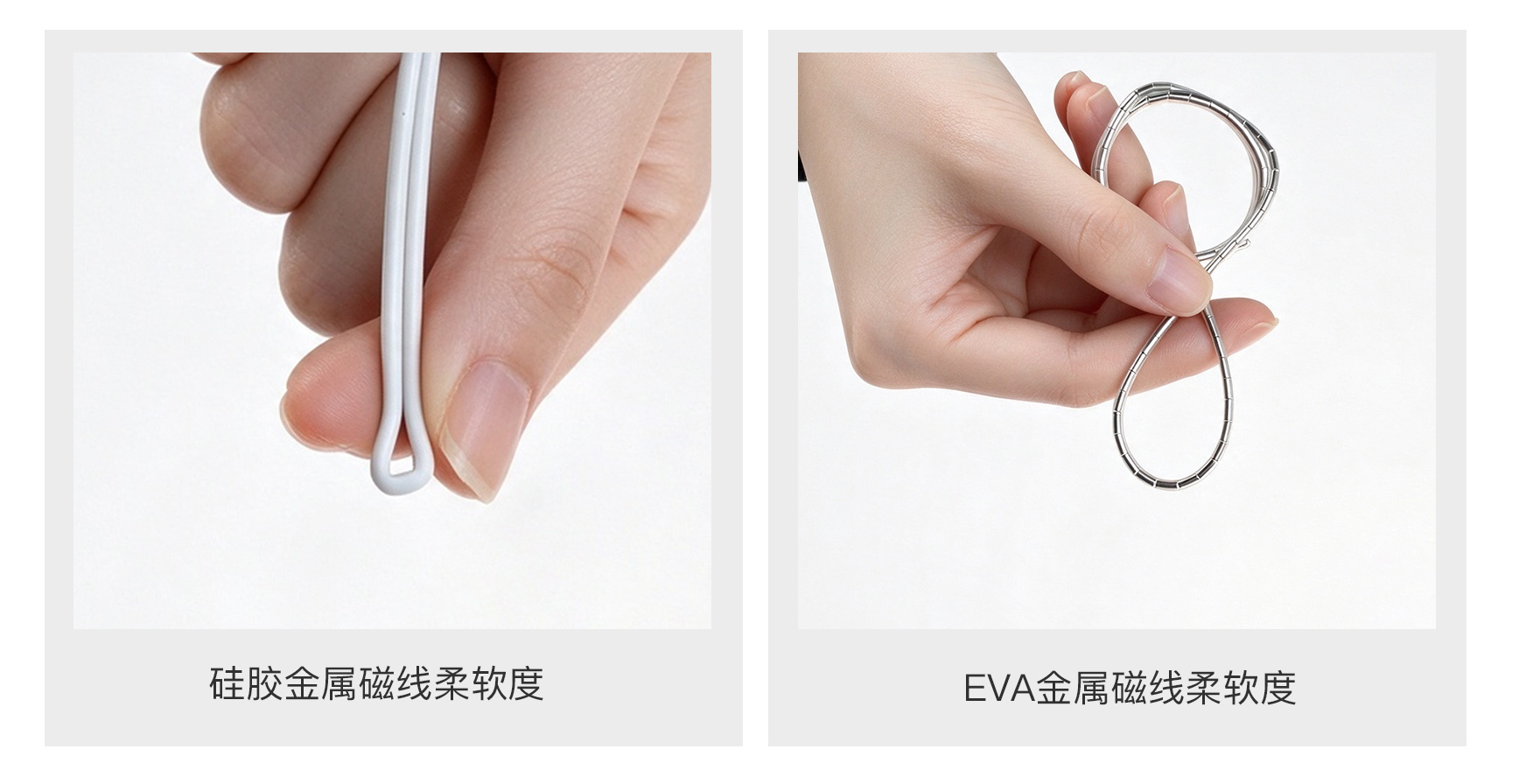
Where drape is the dominant requirement, section height is usually the variable to watch. A 2.7 mm racetrack height and a pinpoint section both sit closer to the fabric plane than a 3.5 mm circular section, and both are easier to conceal under a light shell. Where the garment needs a tactile locator — a storm placket a wearer can find with a gloved hand — the round crown works in the design’s favour.
Wash, salt spray and thermal limits
All three profiles sit inside the same durability envelope, and the envelope is defined by four numbers that buyers should carry into their care labelling.
- Salt spray: over 48 hours of neutral salt spray at 35°C with 5% NaCl, with zero rusting or toxic leaching.
- Washing: domestic machine washing on a gentle cycle at ≤40°C, with closures fastened and the garment turned inside out; air dry in shade or tumble dry on low heat at ≤60°C.
- Operating temperature: −40°C to +80°C continuous, with flux attenuation below 5% after 50 severe thermal-shock cycles.
- Heat exposure during making-up: heat-press bonding at 130–140°C for 10–15 seconds using a recessed die that avoids direct mechanical pressure on the magnetic core.
The thermal ceiling is where most field failures originate, and it is a process issue rather than a cord issue. Direct contact between a hot iron plate and the magnet, or pressing above 140°C for longer than about 20 seconds, causes irreversible flux loss. Vertical steam held 3–5 cm from the placket, or ironing around the closure area, avoids it. Storage follows the same logic: a dry, ventilated area below 40°C at 40–60% relative humidity, with rolls laid flat and complementary pairs kept mated or shielded.
Cut-end handling differs by core. Bare SmFeN cord can be cut to length with standard shears without end-sealing. Membrane-covered NdFeB strip needs its cut ends sealed with flexible waterproof glue or TPU adhesive to protect the core from moisture. That asymmetry is a real production planning input, not a footnote.
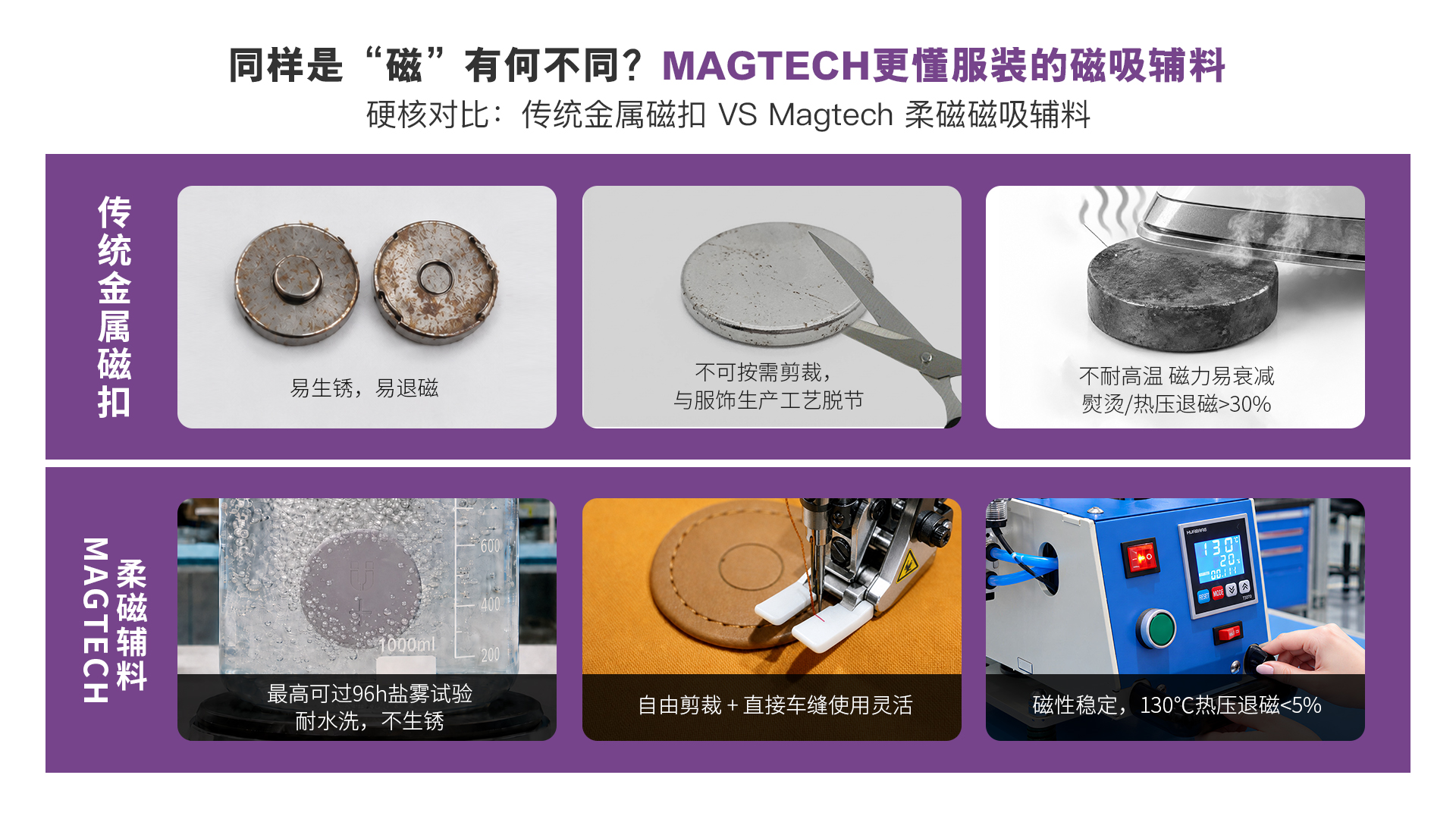
For orientation, the platform is documented as providing approximately 50% weight reduction compared with rigid metal magnets. That is a company-reported comparison against rigid hardware, not a comparison among the three CXX profiles, and it should not be used to differentiate CXX-1201 from CXX-1206 or CXX-1401.
The verdict matrix: matching profile to garment function
There is no overall winner in this comparison, and a matrix that produced one would be misleading. Each profile optimises a different constraint. The table below separates documented specification from engineering interpretation so that a sourcing team can see which column is evidence and which is analysis.
| Profile | Documented cross-section and field | Jacket | Seam-channel fit (interpretation) | Typical garment function | Verify before approval |
|---|---|---|---|---|---|
| CXX-1201 | Round, D3.5 mm; 1200–1300 Gs | TPU or food-grade silicone, per SKU | Rotation-tolerant round section; needs a full-diameter tunnel allowance; produces a defined crown ridge | Storm plackets, cuff tabs, welts and deep channels where the closure should be findable by touch | Ridge visibility on the actual shell; assembled seam peel and shear |
| CXX-1206 | Racetrack, 3.3 × 2.7 mm; 1000–1100 Gs | TPU or food-grade silicone, per SKU | Flat broad face; lower installed height; requires face-orientation and polarity discipline | Long continuous plackets, flap openings, shallow channels with limited seam allowance | Gap control across padded or laminated fabric; A/B pairing checks |
| CXX-1401 | Pinpoint section; field set per SKU inside the 1000–1700 Gs customisation window | Food-grade silicone | Narrow working face; smallest footprint; most sensitive to panel alignment | Fine channels, delicate collars and light shells where visible hardware must be minimal | Per-SKU Gauss value; alignment tolerance; hand feel on the finished garment |
The decision rule that follows is geometric rather than numerical. Measure the channel first: the available height between the seam line and the panel edge, the width the folded tunnel can carry, and the fabric stack the magnetic faces must cross. A channel that is shallow but wide points toward the racetrack section. A deep channel where tactile location matters points toward the round section. A narrow, fine channel on a light fabric points toward the pinpoint section with its silicone jacket. Field data then refines the choice inside that geometry; it does not override it.
Application scenarios where the choice is visible
On a down jacket storm placket, the closure runs the full length of the front opening and the placket is built from two or three fabric layers. The gap is larger than on a single-layer shell, and the wearer often operates the closure with gloves. A round 3.5 mm cord at 1200–1300 Gs presents a findable crown and tolerates the thicker stack; a racetrack cord may suit the same placket if the design wants a flatter line and the pattern can control overlap consistently.
For ski wear and outdoor cold-weather pockets, the operating moment is brief and one-handed. Flexible magnetic closures are documented for glove-friendly sleeves and cold-weather pockets, where the closure self-locates as the two edges approach rather than requiring two hands to align a slider. In these positions, the racetrack and pinpoint sections keep the pocket mouth flat and unobtrusive.
Adaptive clothing is the clearest case for profile discipline. Magnetic fasteners are identified as an option in adaptive-clothing resource guidance, and one-handed operation is the documented design intent behind this product family. Where the wearer has limited dexterity, misalignment tolerance becomes more valuable than a low profile, which shifts the argument back toward the rotationally forgiving round section — provided the visual weight is acceptable to the design.
Delicate fashion collars and silent tactical apparel place the priority elsewhere: minimal visible ridge, no metallic noise on contact, and a closure that does not snag fine fabric. Those requirements favour the narrower profiles and the softer silicone jacket.
Production, safety and compliance checks that apply to all three
Profile selection does not change the surrounding production controls. In garment factories, garments should pass through broken-needle detection before magnets are inserted, with detector sensitivity calibrated against pre-production samples. Complementary mating parts should be kept in separated A and B packaging, and the self-centring attraction should be verified through the fabric layers before edges are closed.
For children’s wear, continuous SmFeN cords or wide strips of at least 12 mm are used for infants aged 0–3 to comply with anti-ingestion safety expectations, with the magnetic material encased inside durable inner fabric pockets and reinforced double-needle lockstitching along all perimeter edges. Stitching should be inspected regularly, and a garment should be replaced if the fabric tears and the inner magnetic material becomes exposed. Wearers should remove magnetic garments before entering clinical MRI suites, and people with implanted devices such as pacemakers or ICDs should maintain safe clearance.
Compliance documentation is platform-level. MAGTECH states compliance with OEKO-TEX® STANDARD 100 Class II for direct skin contact under ISO 14362-1:2021, with EU REACH (EC No 1907/2006) across 250+ SVHC substances below 0.1%, RoHS Directive 2011/65/EU across all 10 hazardous substances, and 2025/2026 PFAS-free requirements. Air freight is handled under IATA Dangerous Goods Regulations UN2807 criteria with magnetic shielding packaging stated to keep compass deflection below 2° at 2.1 metres. Buyers should request the current certificate set for the specific SKU rather than relying on a category statement.
Market context, with the scope stated
Two published figures frame the category, and both need their boundaries kept intact. Fortune Business Insights projects the global flexible magnets market — a broader category that includes strips and sheets, not apparel fasteners alone — to grow from USD 395.6 million in 2025 to USD 561.1 million by 2032. Separately, Strategic Revenue Insights values the global adaptive clothing market at USD 19.50 billion in 2025, a downstream apparel category in which magnetic closures appear as one fastening option among several.
These are commercial research estimates for different scopes and should not be combined into a single demand figure for garment-grade magnetic cord. What they do support is a defensible planning assumption: flexible magnetic material is an established industrial category with published forecasts, and adaptive apparel is a large downstream market where fastener choice is an active design decision. Neither source quantifies the cord sub-segment, and no verified shipment, adoption or price dataset for apparel-grade magnetic cord was available for this comparison.
Outlook: specification depth over category claims
The direction of this product category is toward documented, SKU-level specification rather than generic capability statements. The platform already supports Gauss customisation across a stated 1000–1700 Gs window, dimensional customisation, encapsulation options and Pantone colour matching, with monthly output stated at over 500,000 metres of flexible magnetic cords and strips and 1,000,000 pairs of magnetic fasteners.
For buyers, that shifts the negotiation from “what can your magnet do” to “what does this SKU deliver inside this seam channel, in this fabric stack, after this wash cycle”. The three CXX profiles make the question concrete: the answer changes with the cross-section, even when the chemistry, the jacket family and the durability envelope stay the same.
About the manufacturer
Beijing Magnetic Technologies Co., Ltd., trading as MAGTECH®, was founded in 2021 and operates a 2,500 m² facility with 50 employees, including a 12-engineer R&D team, and a stated annual output of 6,000,000 metres. Its product ecosystem covers flexible SmFeN magnetic cords, magnetic strips, TPU and silicone encapsulated fasteners, spherical acrylic buttons and modular quick-release connection systems. The company reports exports at around 40% of output, serving North America, the EU, Japan and other markets across outerwear, skiwear, activewear, adaptive clothing and modular bags. Further technical and company information is available at Beijing Magnetic Technologies Co., Ltd..
Frequently asked questions
Can CXX magnetic cord be cut to a custom garment length on the factory floor?
Yes, with a distinction by core type. Bare flexible SmFeN magnetic cord can be cut to any length with standard sharp shears without end-sealing, because the magnetic material is continuous through the section. Membrane-covered NdFeB strip requires the cut ends to be sealed with flexible waterproof glue or TPU adhesive to protect the core against moisture and corrosion. Length should be marked along the placket allowance and cut cleanly across the cord; cuts should only be made through flexible gaps, never through rigid metal cores.
How do these cords perform in washing and salt-spray exposure?
Garments with intact TPU or silicone-encapsulated magnetic closures are documented as machine washable. The care sequence is to fasten all magnetic closures, turn the garment inside out, place it in a mesh laundry bag, wash on a gentle cycle at or below 40°C with mild detergent and no bleach, then air dry in shade or tumble dry on low heat at or below 60°C. On the corrosion side, the platform is documented to withstand over 48 hours of neutral salt spray at 35°C with 5% NaCl, with zero rusting or toxic leaching. High-heat drying or industrial drying above 80°C should be avoided because it risks permanent demagnetisation.
Which profile suits a narrow seam channel?
Start by measuring the channel rather than by choosing a cord. If the constraint is installed height and the opening is long and continuous, the racetrack CXX-1206 section at 2.7 mm height sits lower in the channel and spreads its working face along the seam. If the constraint is a fine channel on a light fabric where visible hardware must be minimal, the pinpoint CXX-1401 section with its food-grade silicone jacket presents the smallest footprint. The round CXX-1201 section suits deep channels where a defined crown helps the wearer locate the closure and where rotational tolerance during sewing is valuable. In every case, confirm the specific SKU’s field value and assembled-seam force data before locking the pattern.
Are magnetic garment closures suitable for children’s wear and for wearers with medical devices?
For children’s garments, continuous SmFeN cords or wide strips of at least 12 mm are used for infants aged 0–3 to comply with anti-ingestion safety expectations. The magnetic material should be encased inside durable inner fabric pockets with reinforced double-needle lockstitching along all perimeter edges, and the calibrated pull force should open easily without pinching skin. Stitching should be inspected regularly, and any garment whose fabric has torn and exposed the inner magnetic material should be replaced immediately. Separately, magnetic garments should be removed before entering clinical MRI suites, and wearers with implanted devices such as pacemakers or ICDs should maintain safe clearance.
What should a buyer test before approving one of these profiles?
Approve the assembled seam, not the cord alone. Build sample garments in the final fabric stack and channel construction, then measure peel-off and shear force on the finished closure with a force gauge, recording the test method, sample geometry and closure length. Repeat after the intended number of gentle-cycle washes at or below 40°C, and review salt-spray and thermal-cycle reports for the specific SKU. Check cut-end sealing on any coated NdFeB component, confirm the A/B polarity and face-orientation sequence on the line, verify the broken-needle detection step runs before magnets are inserted, and confirm that magnetic shielding packaging is specified for any air-freight shipment.
The full MAGTECH product and capability overview, including platform specifications and compliance documentation, can be downloaded here: MagTech Introduction 2026 (English PDF).
Have Questions or Need More Details?
Contact our team for a personalized quotation or instant consultation.
Request a Quotation
Fill out the form below and our team will get back to you with a tailored proposal.
WhatsApp Direct Chat
Prefer to chat in real-time? Message us on WhatsApp for instant assistance & quick answers.
- Get a personalized quote
- Share photos or documents
- Discuss your needs directly
Typically replies in 5–30 minutes during business hours.