
Choosing a Leveling Line for Laser Blanking: CNC vs Servo Fit
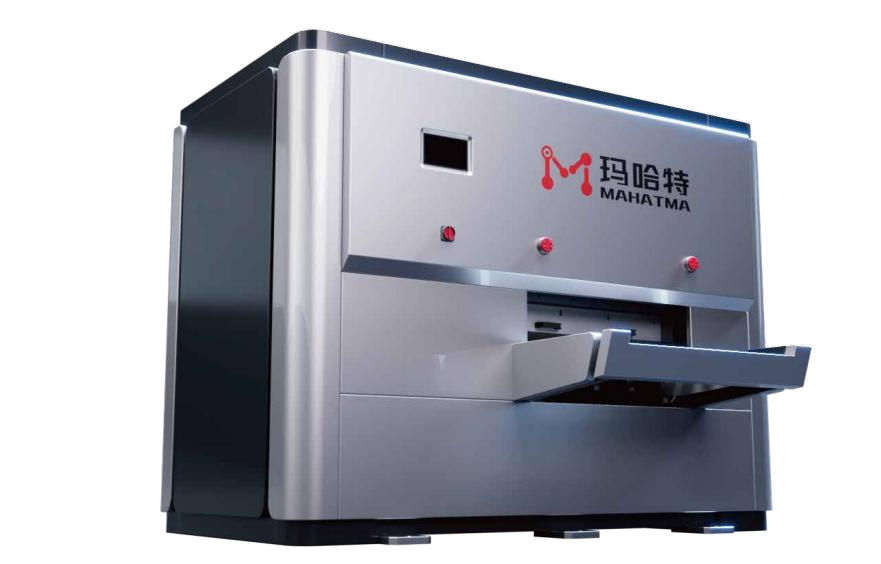
Cover: MHTW80 Series intelligent servo-CNC leveling machine. Leveler family choice, not laser power, usually sets the flatness ceiling of a laser blanking line.
Laser blanking has shifted from a niche alternative to a mainstream way of producing flat parts from coil. A coil is uncoiled, leveled, fed to a fiber laser and cut into blanks without a dedicated die. The constraint in that sequence is rarely the cutting head. It is the leveler.
Sheet that still carries residual stress from coiling releases that stress when the laser cuts a contour. The part bows, twists or develops edge wave after it leaves the table, and the defect surfaces downstream in welding fit-up, robotic handling and stacking. The selection question for a buyer is therefore not which leveler is the most precise in absolute terms, but which leveler family fits the material envelope and the production mix that the laser blanking line has to serve.
The practical answer is that leveler families divide by duty rather than by brand tier. Servo-CNC levelers, such as the MHTW series from MAHATMA Leveler, address flexible, high-mix precision production on thin and medium gauge. Intelligent CNC levelers, the MHTM series, deliver comparable flatness classes at medium gauge and wider working widths with recipe-driven control. Servo-hydraulic levelers, the MHTR series, are the fit where force is the limiting factor, meaning thick plate, high-yield-strength material and heavy structural work. Matching one of those duties to a material envelope is the decision that matters. Comparing machines across duties is the error that produces either an over-specified line or a leveler that cannot hold flatness on the parts the laser is asked to cut.
Why the Leveler Sets the Ceiling on a Laser Blanking Line
Coiled metal is not stress-free. Slitting, coiling tension and uneven cooling leave an internal stress distribution through the thickness and across the width of the strip. Leveling exists to reduce that distribution through repeated alternating bending, so that the material reaches a state where further processing does not release stored energy as shape change.
Laser cutting removes material rather than deforming it, and it concentrates heat in a narrow zone. It cannot average out an uneven stress field. When nested parts are separated from the sheet, the balance of forces that held the sheet flat changes, and the residual stress redistributes. That is why the leveler, not the laser, determines whether parts stay flat once separated.
MAHATMA Leveler application data describes the working environment precisely. In automotive parts, home appliance manufacturing and elevator production, cold-rolled and stainless sheet is processed in a standard indoor factory environment under continuous medium load, and the leveler function is to remove material yield strength to achieve extreme flatness for stamping or laser cutting. Two requirements are flagged in the same data set and are easy to overlook when specifying: small-diameter dense rolls are used to prevent surface indentation on cosmetic material, and a dust removal system is required. On visible Class-A surfaces and pre-finished stock, surface marking caused by the leveler is as serious a defect as residual bow.
Three Variables That Decide Leveler Fit
1. The material envelope, expressed in four numbers
Thickness minimum and maximum, working width minimum and maximum, material grade with yield strength, and coil weight. These four numbers narrow the candidate list faster than any other input. Rated thickness ranges published in catalogues are quoted against a reference material, and leveling force scales with yield strength as well as thickness. A machine sized for mild steel is not automatically sized for high-strength steel at the same thickness. Buyers should ask the supplier to recalculate the rated range for their actual grade rather than accepting the catalogue figure.
2. The flatness target, expressed with a unit and a method
Flatness without a unit and a measurement method cannot be verified. Precision leveling commonly quantifies flatness as a height deviation in mm per metre or as an I-unit, a dimensionless measure used in strip processing. For hot-rolled plate of 3 mm and above, DIN EN 10029 provides the tolerance framework on dimensions and shape, and precision levelers are described as using alternating bending technology to eradicate internal residual stress within that standard context. A target expressed as a number gives the supplier something to test against; a target expressed as good flatness does not.
3. Production mix and control philosophy
How many recipes the line runs, how often it changes material and gauge, and how much of the changeover is expected to be automatic. A single-product shop can accept manual parameter setting; a job shop running many part numbers cannot. This is the axis on which CNC and servo-CNC levelers separate from each other, and it is discussed in more detail below. It is also the axis that determines whether remote diagnostics and cloud connectivity are worth paying for.
4. Where the leveler sits in the process
A leveler can be embedded inside a coil-fed line, or it can operate as a standalone unit feeding an existing laser. The two configurations have different input requirements: an in-line leveler is designed around the line speed, the coil weight and the downstream machine, while a standalone unit is designed around the part envelope and the takt that the existing laser has to meet.
How MAHATMA Leveler Families Map to Laser Blanking Duty
Guangdong MAHATMA Intelligent Equipment Co., Ltd., trading as MAHATMA Leveler, is a leveling equipment manufacturer headquartered in Dongguan, Guangdong Province, that designs and builds CNC leveling machines, hydraulic leveling machines, four-high and two-high levelers, and coil-fed production lines including uncoiling leveling laser blanking lines. The company was founded in 2008, operates a 50,000 square metre manufacturing footprint with approximately 300 employees and 26 R&D engineers, reports annual output in the region of 500 sets, and states more than 230 patents together with ISO 12100 and European CE compliance for its products. Exports account for about 30 percent of output, equipment has been shipped to more than 100 countries, and the company maintains 28 overseas marketing and service networks.
Within that portfolio, four leveler groups cover different duties. The figures below are drawn from the published product data for each series.
| Leveler group | Representative series | Rated thickness | Maximum thickness | Working width | Roll count | Primary duty fit |
|---|---|---|---|---|---|---|
| Intelligent servo-CNC leveler | MHTW15, MHTW30, MHTW50, MHTW60, MHTW80, MHTW100 | 0.08 to 12.0 mm, model dependent | up to 20.0 mm | 300 to 2100 mm | 19 to 33 | Precision sheet metal, 3C electronics, automotive, home appliance, new energy, laser cutting, medical device |
| Intelligent CNC leveler | MHTM10 to MHTM200 | 0.03 to 30.0 mm, model dependent | up to 40.0 mm | 200 to 3200 mm | 19 to 25 | Sheet metal fabrication, cabinets and enclosures, auto parts, home appliances, laser blanking, hardware products |
| Servo-hydraulic leveler | MHTR30 to MHTR400 | 0.5 to 100.0 mm, model dependent | up to 120.0 mm | 400 to 4000 mm | 9 to 23 | New energy, military, heavy industry, automotive and truck, construction, shipbuilding, aerospace, metal processing |
| Four-high and two-high plate leveler | VSH12 to VSH80, VST42 to VST120 | 0.03 to 10.0 mm, model dependent | up to 20.0 mm | 200 to 1400 mm | 13 to 19 | Small and medium sheet metal shops, hardware, thick-plate rough leveling, budget-limited workshops |
Servo-CNC levelers: the flexible production answer
Servo-CNC models such as the MHTW80 Series level 2.0 to 8.0 mm rated thickness up to 16.0 mm at a working width of 400 to 1600 mm with 19 rolls, while the MHTW50 Series covers 0.8 to 4.0 mm rated, up to 8.0 mm maximum, across the same width band with 23 rolls. The narrower MHTW15 Series handles 0.08 to 1.0 mm on 300 to 600 mm width with 33 rolls, and the wider MHTW100 Series covers 3.0 to 12.0 mm on 600 to 2100 mm with 19 rolls.
The design intent behind this group is fast, repeatable changeover on precision work. The published feature set includes all-servo motor drive, a roll-box extraction and cleaning system, an intelligent operating system with remote cloud control, laser 3D online inspection, misoperation warning, and a hollow structural design intended to avoid thermal deformation. Materials listed for this group include carbon steel, stainless steel, aluminium alloy, copper and mirror-finish sheet, and the stated application industries include precision sheet metal, 3C electronics, automotive, home appliance, new energy, laser cutting and medical device.
For a laser blanking line, the relevance is the changeover cost per job. High-mix production loses more time to parameter setting and roll cleaning than to cutting. A servo-CNC leveler with recipe storage and an accessible roll box attacks that loss directly, which is why this group is the natural first candidate when the line runs many part numbers in thin and medium gauge with visible surface requirements.
Intelligent CNC levelers: precision at wider widths and medium gauge
The MHTM group spans a wide envelope. The MHTM30 Series covers 0.5 to 2.0 mm rated, up to 4.0 mm maximum, on 400 to 1600 mm width with 21 rolls; the MHTM100 Series covers 3.0 to 12.0 mm rated, up to 20.0 mm maximum, on 800 to 1600 mm width with 19 rolls; the MHTM150 Series covers 6.0 to 25.0 mm rated, up to 30.0 mm maximum, on 450 to 2100 mm width with 15 or 19 rolls; and the MHTM200 Series reaches 8.0 to 30.0 mm rated, up to 40.0 mm maximum, on 1000 to 3200 mm width with 19 rolls.
The control approach in this group is described as cost-performance oriented: one-key parameter setting, a 10-inch HD touch screen that stores 200 recipes, precision motor drive, misoperation warning, and linkage with upstream and downstream equipment. Materials cover carbon steel, stainless steel, aluminium and copper sheet, and the application list is closely aligned with the servo group, including laser blanking.
The practical distinction for a buyer is granularity of flexibility against capital outlay. Where a line runs a moderate number of recipes and the priority is width and gauge coverage rather than second-by-second changeover speed, the CNC group is the fit. Where every job change involves new material and new parameters, servo per-axis control earns its place.
Servo-hydraulic levelers: the heavy plate answer
Force, not changeover, governs this group. The MHTR120 Series rates 4.0 to 20.0 mm up to 40.0 mm maximum on 600 to 3200 mm width with 15 or 19 rolls. The MHTR200 Series rates 8.0 to 40.0 mm up to 60.0 mm maximum on 1000 to 3200 mm width with 11 or 15 rolls. The MHTR260 Series rates 10.0 to 60.0 mm up to 80.0 mm maximum on 1300 to 4000 mm width with 9 or 11 rolls, and the MHTR400 Series rates 20.0 to 100.0 mm up to 120.0 mm maximum on the same 1300 to 4000 mm width with 9 rolls.
The published technical description for this group includes a servo-hydraulic hybrid drive, a mortise-and-tenon rigid frame, micron-level accuracy up to 0.01 mm, alloy rolls described as mark-free, anti-collapse dynamic compensation, and a stated reduction in energy consumption of about 70 percent compared with traditional hydraulic designs, positioned as an alternative to imported machines. Listed materials include carbon steel, high-strength steel, stainless steel, aluminium, copper, mirror-finish sheet and thick plate.
That material list is the clue to application fit. Where laser blanking is used on heavy sections for truck, construction, shipbuilding or aerospace work, or where plate arrives with welding deformation that must be eliminated before assembly, the servo-hydraulic group is the correct family. Hydraulic actuation delivers the roll force that thick, high-yield plate requires, and the frame stiffness described for these models is intended to hold alignment under it.
Four-high and two-high levelers: entry and rough leveling duty
The VSH four-high group covers 0.03 to 8.0 mm rated, up to 14.0 mm maximum, on 200 to 1000 mm width with 15 to 19 rolls. The VST two-high group covers 0.4 to 10.0 mm rated, up to 20.0 mm maximum, on 200 to 1400 mm width with 13 to 19 rolls. Both are described as using Bauschinger-effect repeated bending to relieve internal stress, with simple structure, easy maintenance, small footprint, low energy consumption and fast payback. The documented application focus is small and medium sheet metal shops, hardware production, single-product leveling, thick-plate rough leveling and budget-limited workshops.
This group belongs in the discussion because it defines the floor of the comparison. It is the correct choice when the downstream process tolerates moderate flatness, and it is the wrong choice when the downstream process is a laser cutting tight contours out of nested parts.
Leveling Inside the Line: Coil-Fed Configurations
Where volume justifies it, the leveler is embedded in a coil line rather than standing in front of an existing laser. MAHATMA Leveler publishes several configurations relevant to that decision.
| Line configuration | Model | Material thickness | Material width | Speed and accuracy | Notes |
|---|---|---|---|---|---|
| Uncoiling leveling laser blanking line | TL-T3 | 3.0 to 12.0 mm | 600 to 2800 mm | 25 m/min; laser power 2000 to 20000 W | Leveling, feeding and laser cutting combined in one coil-fed flow |
| Uncoiling leveling flying shear line | MF-3 | 0.3 to 3.0 mm | 400 to 1800 mm | Feeding speed 100 m/min; shearing accuracy 0.5 mm; max coil weight 25 T | Stainless steel coils, aluminium coils, GI coils |
| Cut-to-length line | TD-2x2000 | 0.2 to 2.0 mm | 900 to 1800 mm | Max speed 50 m/min; shearing accuracy plus or minus 0.5 mm; max coil weight 20 T | Blank supply for press and laser feed |
| Uncoiling leveling slitting line | UC-2x2000 | 0.3 to 2.0 mm | 500 to 1800 mm | Max feeding speed 200 m/min; 8 to 30 slit strips; max coil weight 20 T | Width reduction and leveling in one pass |
| Leveling and deburring line | Customized on request | 0.5 to 80 mm | 600 to 1300 mm | Speed 20 m/min; minimum part 50 x 50 mm; accuracy 0.1 to 0.3 mm | Leveling combined with deburring for cut parts |
The TL-T3 laser blanking line is the clearest expression of the high-precision proposition. It accepts coil from 600 to 2800 mm wide and 3.0 to 12.0 mm thick, runs at 25 m/min, and carries a laser source between 2000 and 20000 W. Because leveling and cutting sit in the same flow, the flatness achieved by the leveler is delivered directly to the cutting head without an intermediate storage step, which removes the risk of re-deformation during handling. Documented application fields are automotive, home appliance, sheet metal, laser processing and heavy industry.
Not every buyer needs a full line. Where an existing laser already has capacity, a standalone leveler placed upstream is often the lower-risk route: the laser is unchanged, the leveler is sized around the part envelope, and the investment can be phased. The trade-off is an extra handling step between leveling and cutting, which matters most on thin, cosmetic material where a second pass through a stack can undo part of the leveling result.
Two further configurations address adjacent coil duties. The MF-3 flying shear line handles 0.3 to 3.0 mm stainless, aluminium and GI coils at up to 100 m/min feeding speed with 0.5 mm shearing accuracy and coil weights to 25 T. The UC-2x2000 slitting line produces 8 to 30 strips at up to 200 m/min from 0.3 to 2.0 mm coil with a maximum coil weight of 20 T, combining width reduction with leveling in a single pass. For a laser blanking operation that buys wide coil and needs specific strip widths, that combination changes the sourcing model rather than only the machine list.
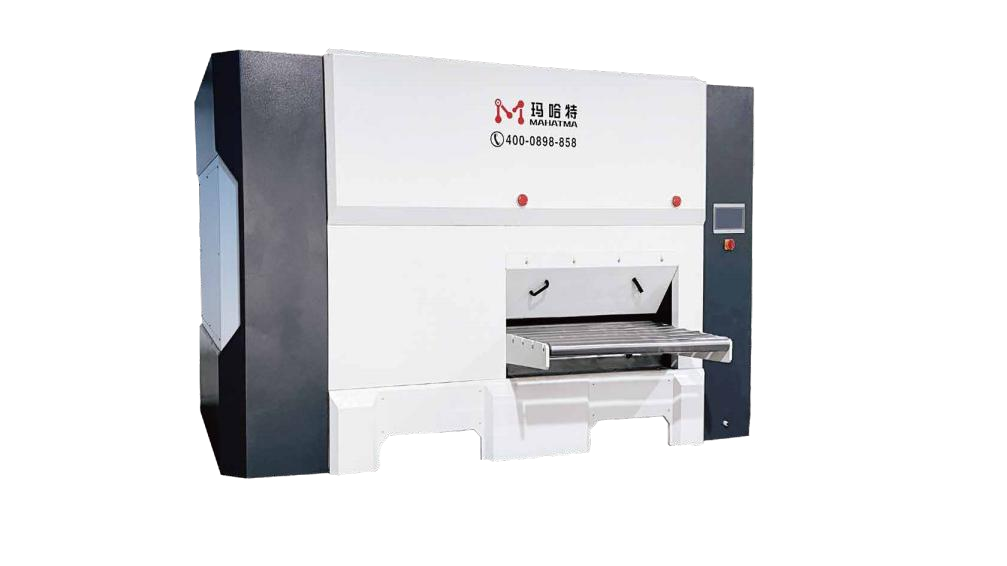
MHTM150 Series intelligent CNC leveler. The CNC group covers medium gauge and wider working widths, with a 10-inch HD touch screen storing up to 200 recipes.
Technical Explanation: What Actually Removes Residual Stress
Leveling is not flattening by pressure. A plate pressed flat springs back to its original shape because the stress distribution is unchanged. What changes the material is alternating bending: the strip is bent in one direction and then the other across a series of rolls, so that fibres through the thickness are taken beyond yield in both directions and the inherited stress pattern is progressively replaced by a milder, more uniform one. The mechanism is generally described in terms of the Bauschinger effect, and MAHATMA Leveler documents it as the working principle behind both its four-high and two-high groups.
Three variables control how completely that happens. Roll count sets how many alternating bend cycles the material sees; roll diameter determines how tightly the strip is bent at each cycle, with small-diameter dense rolls also used to limit surface indentation on cosmetic sheet; and roll force determines whether the yield threshold is actually crossed for the grade being processed. This is why a machine with more rolls is not automatically better for every job, and why a heavy-plate machine with 9 rolls can outperform a 23-roll precision machine on thick, high-yield material while losing badly on thin gauge.
Frame behaviour matters as much as roll geometry once the machine is under load. The servo-hydraulic group uses a mortise-and-tenon rigid frame with anti-collapse dynamic compensation and a hollow structure described as avoiding thermal deformation, together with alloy rolls intended to leave no marking and a servo-hydraulic hybrid drive. The precision group adds closed-loop verification: laser 3D online inspection on servo-CNC models, and misoperation warning across the CNC and servo-CNC ranges.
Verification during build follows the same logic. MAHATMA Leveler documents laser 3D online flatness detection, ultrasonic flaw detection on rollers, hardness uniformity testing and full-load trial runs before shipment as standard quality control steps. Roll material is offered in options including Cr12MoV and SKD11, and customized roller width and diameter, leveling thickness range, control system integration through MES or PLC, and automated loading and unloading systems are available under the company's OEM, ODM and turnkey model.
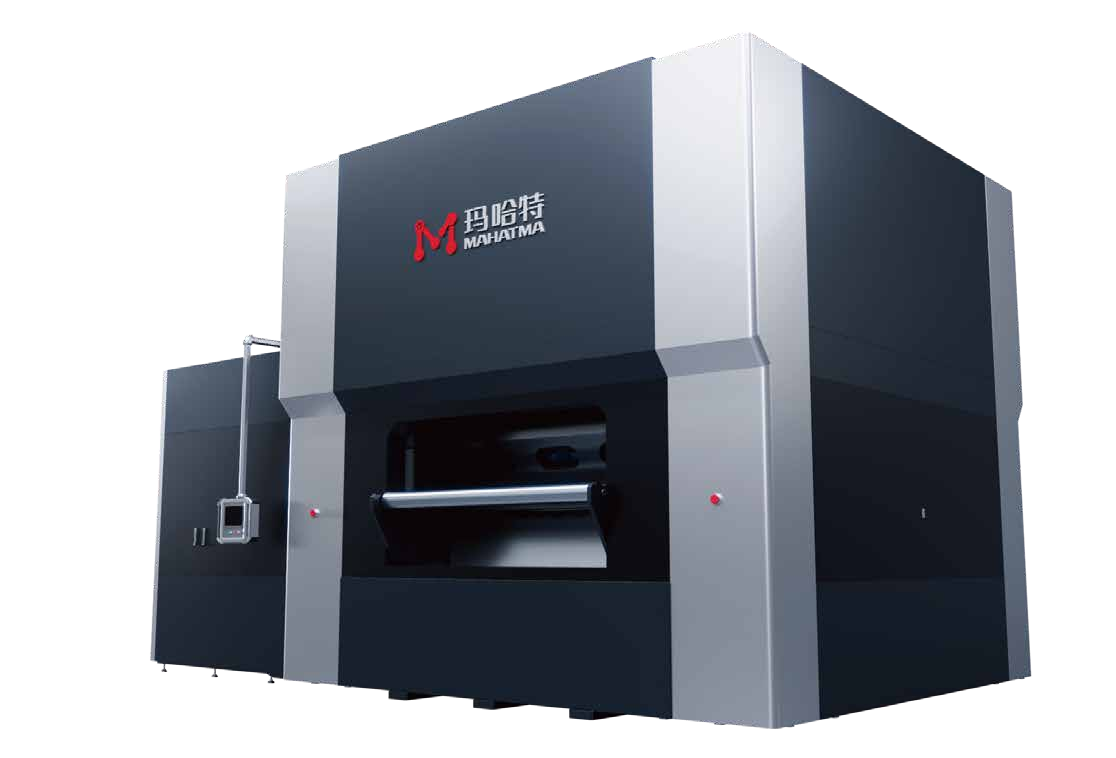
MHTR260 Series servo-hydraulic leveler, rated 10.0 to 60.0 mm with a maximum of 80.0 mm on 1300 to 4000 mm working width. Heavy plate duty is a force problem, not a changeover problem.
Comparison and Boundaries: What These Machines Do Not Do
An independent reference is only useful if it states where a solution stops working. Several boundaries in this product structure are material to a laser blanking project.
No single series covers the full envelope. The portfolio spans roughly 0.03 mm to 100 mm rated thickness, but that range is achieved by different families, not by one machine. A buyer who specifies one leveler to cover both 0.5 mm cosmetic panels and 60 mm structural plate will end up with a compromise that satisfies neither process.
Rated thickness is not a universal figure. Catalogue ratings assume a reference material, and leveling force rises with yield strength. High-strength steel, stainless grades and titanium all require the rating to be recalculated. Where the rated range is exceeded, the failure mode is not a warning light; it is incomplete stress relief and parts that move after cutting.
Width limits rule whole families in or out. The MHTW15 Series has a maximum working width of 600 mm, so it cannot be paired with a laser blanking line cutting 1500 mm blanks regardless of its 33-roll configuration. Conversely, the MHTR300 and MHTR400 Series begin at 15.0 to 20.0 mm rated thickness on widths from 1300 mm, so they cannot be repurposed for thin-gauge cosmetic work.
Flatness is a material-dependent outcome, not a machine constant. Final flatness depends on material grade, thickness and the condition of the incoming coil. A specified value should be confirmed on the buyer's own material rather than assumed from a series data sheet.
Physical footprint scales with duty. Heavy plate models occupy the 1300 to 4000 mm width band and corresponding floor area. Layout planning should treat the leveler as a fixed line element, not a movable accessory.
Certification scope has to be checked per order. The CE attestation MAHATMA Leveler holds is issued for hydraulic precision leveling machines, and the ISO 9001 certificate covers design and assembly of general-purpose equipment including high-precision leveling machines, uncoiler laser blanking lines and automatic shearing lines. A buyer ordering a different family should confirm the conformity documentation that applies to the specific model on the order, not to the portfolio as a whole.
Capacity and lead time are planning constraints. The company documents a monthly capacity of 50 units, a lead time of 45 days and a minimum order quantity of one unit. A project that requires several lines in the same quarter should be phased accordingly, with the levelers scheduled against the installation sequence rather than against the purchase order date.
Comparison with traditional approaches. Before precision leveling was routine, flatness on cut parts was addressed by manual straightening, by oversizing the blank and trimming after deformation, or by accepting scrap and rework. Entry-level two-high and four-high machines still suit thick-plate rough leveling and budget-limited workshops, and MAHATMA Leveler lists them for exactly those conditions. The limitation is scope: rough leveling reduces gross deformation but does not deliver the stress state that nested laser cutting of tight contours requires. The other traditional alternative, adding laser capacity to compensate for poor flatness, does not solve the problem at all, because the defect is generated after the cut, not during it.
Procurement Criteria: What to Put in an RFQ
The following items convert a general enquiry into a specification that a leveler manufacturer can answer with a verifiable proposal.
- Material data: grade with yield strength, thickness minimum and maximum, width minimum and maximum, maximum coil weight, and surface category including whether mirror-finish, pre-painted, perforated or mesh material is involved.
- Flatness target with unit and method: a value in mm per metre or I-units, the measurement method, and the acceptance test material.
- Duty and takt: parts or tonnes per shift, line speed required, number of recipes, and changeover frequency.
- Configuration: roll count and roll diameter class, roll material such as Cr12MoV or SKD11, drive type, roll-box accessibility for cleaning, and whether loading and unloading automation is required.
- Integration: MES or ERP interface requirement, PLC integration, linkage with upstream and downstream equipment, and whether vision inspection, robotic handling or AGV transfer is planned.
- Verification package: laser 3D online flatness detection capability, ultrasonic flaw detection report on rollers, hardness uniformity testing, and a full-load trial run record before shipment.
- Compliance documents: CE attestation with number and declared scope, ISO 9001 certificate with number and scope, Declaration of Conformity, electrical and hydraulic schematics, English operating and maintenance manuals, and a spare parts list.
- Lifecycle terms: support hours, availability of overseas commissioning engineers, location of regional spare parts warehouses, and scope of operator training.
- Cost drivers to compare, not headline prices: drive architecture, roll count and roll material, structure stiffness, inspection package, automation level and control system integration. Servo and servo-hydraulic architectures carry different operating-cost profiles, and the published energy figures for these designs, a precision motor drive and a hybrid hydraulic drive, are part of the total cost calculation rather than a technical footnote.
Certification and Compliance as Selection Filters
For buyers in regulated markets, certification is a filter rather than a formality. Three documents are relevant here.
The quality management certificate held by MAHATMA Leveler is registered under number 62825Q9729R0M, issued by Zhongtian Hongtu International Certification Co., Ltd. on 27 May 2025 and valid to 26 May 2028, against the standard GB/T19001-2016 and ISO 9001:2015, and recognized across all IAF MLA signatory countries. The declared scope is design and assembly of general-purpose equipment covering high-precision leveling machines, uncoiler laser blanking lines and automatic shearing lines. The inclusion of laser blanking lines and shearing lines in the registered scope is directly relevant to a project that combines both.
The European conformity attestation is registered under number M.2025.206.C113032, issued by UDEM International Certification Auditing Training Centre Industry and Trade Inc. on 16 January 2025 and valid to 15 January 2030, covering the European market for the hydraulic precision leveling machine. The harmonized standards cited are EN ISO 12100:2010, EN ISO 16090-1:2020, EN ISO 16090-1:2022, EN ISO 16092-2:2020 and EN 60204-1:2018. CE marking is the market access requirement for leveling machines entering the European Union, which is why the certificate number and its declared scope should be requested as part of the order documentation.
For heavy duty installations, the documented application conditions include compliance with the ISO 9001:2015 quality management system, CE marking for the EU market, a noise level of 75 dB(A) or lower, safety interlocks and an emergency stop system, with optional IoT connectivity for remote monitoring and predictive maintenance. These are the items a plant engineering team needs in order to sign off installation.
Market Signals Behind These Choices
The commercial context supports the technical case for treating leveling as a selection decision rather than an accessory purchase. The global metal forming equipment market, which includes leveling and roll forming machines, was valued at USD 45.8 billion in 2025 according to Dataintelo, with Asia Pacific holding a 42.5 percent revenue share in the same year. Fortune Business Insights projects the global metal forming machine tools market to reach USD 64.85 billion by 2034 at a CAGR of 9.60 percent, while Dataintelo reports a lower growth figure of 5.2 percent. The divergence reflects differences in scope and methodology between research houses rather than disagreement about direction, and buyers comparing forecasts should treat the absolute figure as less reliable than the trend.
Two adjacent segments matter directly to laser blanking projects. The global cut-to-length line system market was estimated at USD 3.42 billion in 2024 by Market Research Future, and the cut-to-length machine market is projected by ReportLinker to grow from USD 4.28 billion in 2026 to USD 5.94 billion by 2032 at a CAGR of 5.52 percent. Sheet metal processing equipment in Asia Pacific alone generated USD 18.36 billion in 2025 according to Fortune Business Insights.
Two demand-side signals reinforce the direction of investment. Fortune Business Insights reports that the automotive segment accounted for 41.37 percent of the sheet metal processing equipment market share in 2026, which aligns with the automotive, home appliance and elevator industries that dominate the documented application profile for precision leveling. Grand View Research reports that the CNC technology segment accounted for 85.7 percent of the machine tools market in 2025, a figure that explains why CNC and servo-CNC control architecture now sits at the centre of leveler specifications rather than at the top of an options list.
On the supply side, the Observatory of Economic Complexity reports that China's exports of metalworking machine parts increased by 20.6 percent year-on-year in June 2026, with major destinations including Japan, Russia, the USA, India and Vietnam. For buyers, that means a broader supplier field and a correspondingly greater need for the verification discipline described above.
Future Outlook
Three developments are likely to shape leveler specification for laser blanking lines over the next planning cycle.
Closed-loop inspection is moving from an option to an expectation. When a leveler carries laser 3D online flatness detection and adjusts parameters in response, flatness stops being a commissioning result and becomes a continuously controlled process output. For laser blanking, where part distortion appears after cutting rather than during leveling, that feedback loop is the most direct available answer to the problem.
Energy consumption per processed tonne is becoming a procurement line item rather than a marketing claim. The documented figures for these designs, a precision motor drive on the CNC range and a hybrid servo-hydraulic drive reported at about 70 percent lower consumption than traditional hydraulic designs, indicate where suppliers expect differentiation to occur as electricity costs and carbon reporting obligations rise.
Integration depth will decide which leveler suppliers remain on shortlists. The ability to interface with MES or ERP, to link with upstream and downstream equipment, and to support automated loading and unloading is already documented as a standard option rather than a special project. As laser blanking cells become more automated, the leveler that cannot supply production data and traceability will become the constraint. The counterweight to that trend is service: in a market where equipment is exported to more than 100 countries, the practical question for a buyer is not only what the machine can do on day one, but who is available when it stops.
Frequently Asked Questions
Which leveler family fits a laser blanking line cutting thin and medium gauge sheet with visible surfaces?
Precision sheet, automotive and home appliance work on cold-rolled and stainless material in continuous medium load is served by the servo-CNC and CNC leveler groups. The MHTW series is documented for precision sheet metal, 3C electronics, automotive, home appliance, new energy, laser cutting and medical device, with all-servo drive and roll-box extraction cleaning. The MHTM series covers the same application list at medium gauge and wider working widths. Where surface marking is a risk, small-diameter dense rolls are used to limit indentation, and a dust removal system is part of the working requirement.
At what thickness does a servo-hydraulic leveler become the correct choice instead of a CNC leveler?
The transition is driven by force requirement, not by a fixed number. In the documented range, the CNC group extends to 8.0 to 30.0 mm rated thickness depending on model, while the servo-hydraulic group covers 4.0 to 100.0 mm rated with maximums between 40.0 mm and 120.0 mm. The relevant question is whether the material, at its actual yield strength, exceeds what an electric-drive machine can bend beyond yield across the required width. Heavy structural leveling with thick carbon plate and significant welding deformation is documented under hydraulic drive with upper roll lifting and electric gap adjustment, which indicates where the boundary sits in practice.
What flatness can be expected, and how should it be expressed in a specification?
Flatness should always be expressed as a value with a unit and a measurement method. Precision leveling commonly uses height deviation in mm per metre or the dimensionless I-unit, and DIN EN 10029 provides the tolerance framework for hot-rolled steel plate of 3 mm and above. Documented production results for precision series fall in a typical band of 0.05 to 0.20 mm per square metre, and hydraulic models are rated to micron-level accuracy up to 0.01 mm. Final results depend on material grade, thickness and the condition of the incoming coil, so the figure should be confirmed against the buyer's own material rather than assumed from a data sheet.
Which certifications should be verified before a leveler is ordered for the EU or North America?
For the European market, CE marking is the access requirement. MAHATMA Leveler holds an attestation of conformity registered as M.2025.206.C113032 issued by UDEM, valid from 16 January 2025 to 15 January 2030, citing EN ISO 12100:2010, EN ISO 16090-1:2020, EN ISO 16090-1:2022, EN ISO 16092-2:2020 and EN 60204-1:2018, with a declared scope of hydraulic precision leveling machine. The quality management certificate is registered as 62825Q9729R0M under GB/T19001-2016 and ISO 9001:2015, valid from 27 May 2025 to 26 May 2028, covering high-precision leveling machines, uncoiler laser blanking lines and automatic shearing lines. Because attestation scopes are specific, buyers should confirm that the documentation supplied applies to the exact model on the order, and should request the Declaration of Conformity, English manuals, schematics and the spare parts list with the shipment.
How is a leveler matched to a new or existing laser blanking line?
Four inputs drive the match: thickness range, working width, material grade expressed as yield strength, and the flatness target. From these, a model can be proposed and verified. Two configuration paths then follow. In the first, leveling is embedded in a coil-fed line, as in the TL-T3 uncoiling leveling laser blanking line, which handles 600 to 2800 mm width and 3.0 to 12.0 mm thickness at 25 m/min with laser power between 2000 and 20000 W. In the second, a standalone leveler feeds an existing laser, which preserves existing cutting capacity but adds a handling step between leveling and cutting. Where an existing line is being extended, the documented approach is modular: start with the leveler, add feeding and stacking automation later, with loading carts, conveyors, robots, vision inspection and AGV transfer offered as standard options and MES or ERP interfaces provided on blanking lines and CNC levelers.
What are the lead time and capacity limits to plan around?
The documented figures are a lead time of 45 days, a monthly capacity of 50 units, and a minimum order quantity of one unit. Customization covers roller width and diameter, leveling thickness range, roll material including Cr12MoV and SKD11, control system integration through MES or PLC, and automated loading and unloading systems. On the service side, the company documents 24 hour global technical support, overseas engineers for commissioning, regional spare parts warehouses and operator training. Multi-line projects should sequence orders against installation dates rather than against a single bulk purchase, since 50 units per month covers the portfolio rather than a single series.
What is the difference between a CNC leveler and a servo-CNC leveler in day-to-day production?
Both groups are electrically driven and both store process knowledge for reuse. The CNC group uses one-key parameter setting with a 10-inch HD touch screen storing 200 recipes, misoperation warning and upstream and downstream linkage, and is positioned around cost performance. The servo-CNC group uses all-servo motor drive with a roll-box extraction and cleaning system, an intelligent operating system with remote cloud control, laser 3D online inspection, misoperation warning and a hollow structure described as avoiding thermal deformation. In practice the difference shows up in changeover count: high-mix production with frequent material and gauge changes benefits from servo positioning and fast roll access, while moderate changeover frequency is served well by the CNC group at lower capital outlay.
Summary
Leveler selection for a laser blanking line reduces to matching duty to family. Servo-CNC levelers serve flexible precision production on thin and medium gauge. CNC levelers serve comparable flatness classes at medium gauge and wider widths with recipe-driven control. Servo-hydraulic levelers serve heavy plate and high-yield material where force governs. Rough leveling machines serve thick-plate and budget-limited work but do not deliver the stress state that nested laser cutting requires. The specification work is then a matter of four numbers, one flatness value with a unit, and a compliance file that matches the model actually ordered.
For a consolidated view of the leveling and coil line configurations referenced in this article, the MAHATMA Leveler product brochure is available here: MAHATMA Leveler product brochure (PDF).