
Choosing a Pallet Box: 1200x800x1000, 1000x800x800 and Die-Cast 1230x830x1000
For most industrial buyers, the pallet box decision no longer starts with “plastic or wood.” It starts with a footprint and a job. In automotive, warehousing and process-industry logistics, three formats keep appearing on the same shortlist: the 1200x800x1000 Plastic Pallet Box, the 1000x800x800 Pallet Box, and the die-cast 1230x830x1000 model. On a specification sheet they read as variants of one product. In operation they solve three different problems, and choosing the wrong one is rarely corrected by a better unit price.
This article treats the choice as a buyer decision rather than a product showcase. It sets out the axes that actually change the outcome — footprint, height, usable capacity band, base polymer, enclosure and nesting behaviour, customisation scope, minimum order quantity, lead time, testing rate and after-sales cover — and explains where each format is the stronger fit, and where it is not.
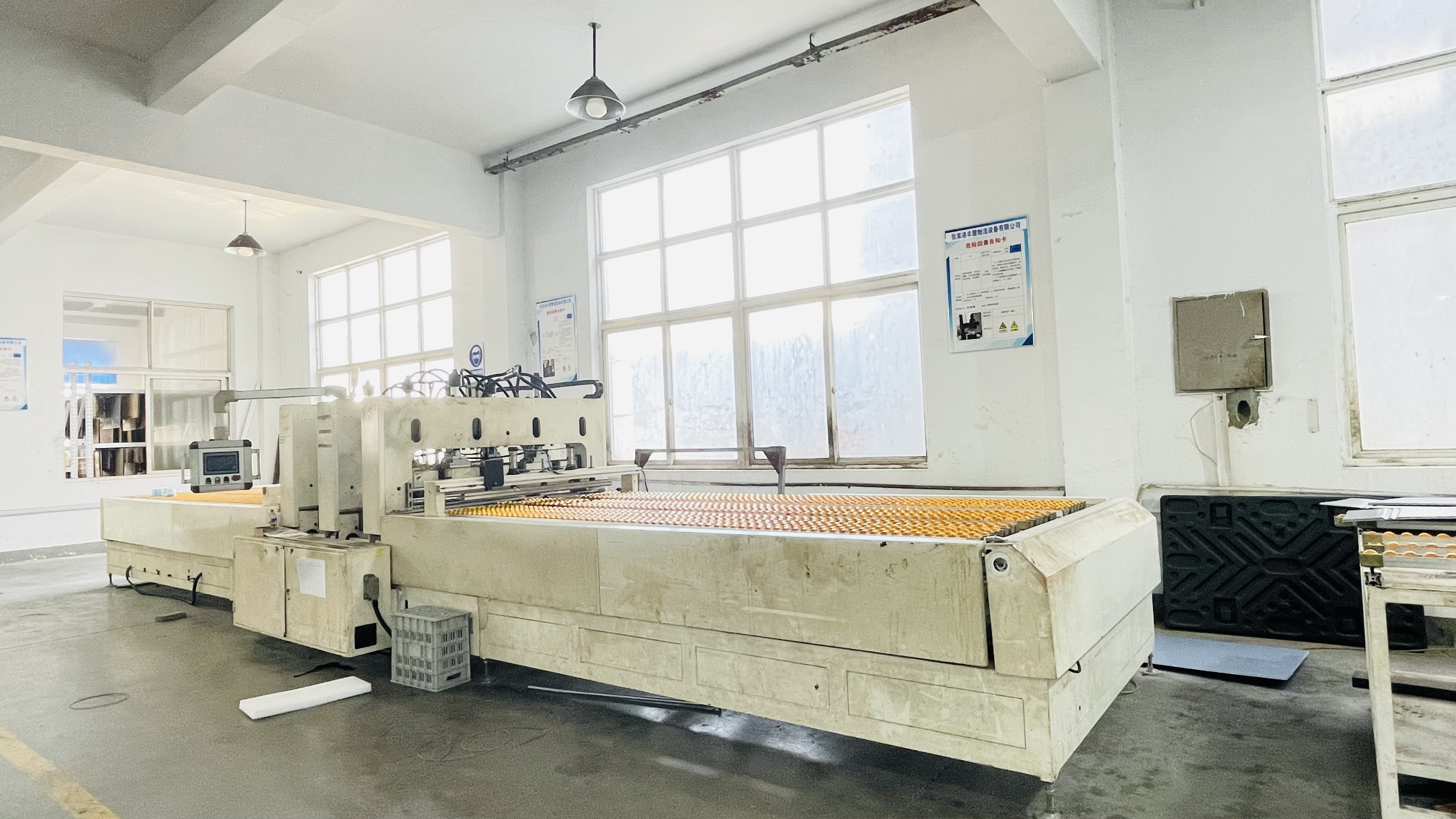
The three formats come from a single supplier family: TOYOE, the operating brand of Zhangjiagang Fenghui Logistics Equipment Co., Ltd., a logistics packaging manufacturer founded in June 2010 in Zhangjiagang, Jiangsu, China. The company operates a 4,000 m² facility, reports an annual output of roughly 30,000 units, and exports around 40% of its production, with Mexico and the United States as its main export markets. Its line covers plastic pallet boxes, storage boxes, plastic crates and honeycomb panel boxes.
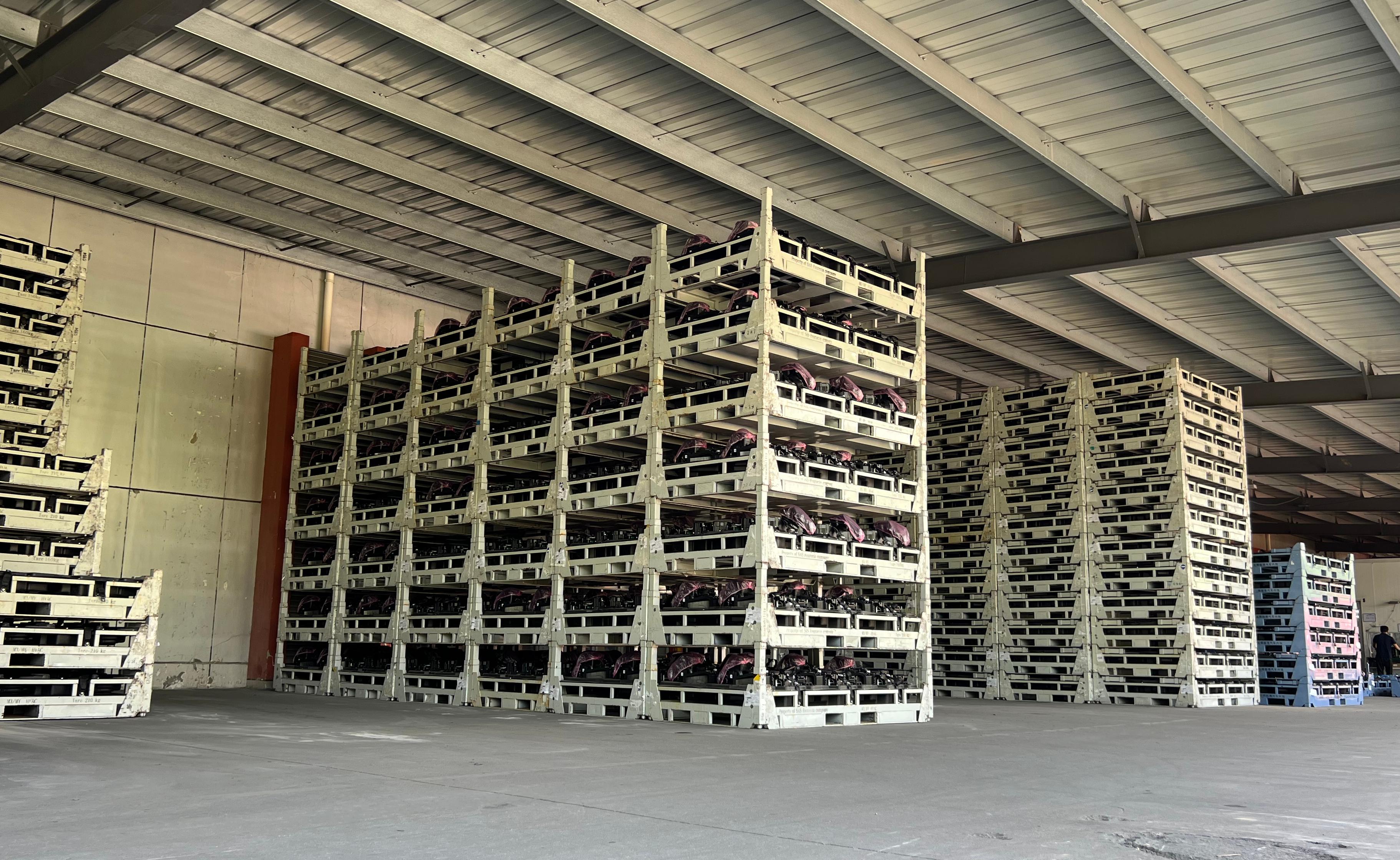
Why the Format Decision Comes Before the Price Decision
A pallet box that does not fit its slot is expensive in a way that never appears on a quotation. If the footprint does not match the rack module, the load ends up on the floor. If the height exceeds lift or door clearance, the box is loaded by hand instead of by machine. If the base is wider than the conveyor or the container loading pattern allows, the flow is re-planned at the buyer's site rather than at the supplier's.
Experienced buyers therefore sequence the decision differently from the way catalogues present it. Footprint comes first, because it constrains every piece of handling equipment downstream. Height and usable capacity come second, because they determine how much of a storage position is actually used. Base polymer and construction come third, because the stored medium and the load's point pressures decide whether a standard grade is sufficient. Only once those three axes are fixed does the commercial comparison — MOQ, lead time, testing rate, warranty terms and unit price — carry real information.
The three formats discussed here differ on all three axes. Two share the familiar 1200 × 800 mm handling module; one sits outside it. Two share a 1000 mm height; one is shorter. Two are general-purpose enclosed boxes; one is positioned specifically around die-cast components and automotive drivetrain logistics. Those differences, not the polymer grade alone, drive the selection.
Three Formats, Three Different Jobs
The comparison below summarises how the three models differ on the axes that matter at the evaluation stage. Figures reflect the supplier’s stated configurations; internal capacity varies with wall thickness, internal lining and whether an insert or divider is used.
| Decision axis | 1200x800x1000 Plastic Pallet Box | 1000x800x800 Pallet Box | Die-Cast 1230x830x1000 |
|---|---|---|---|
| Footprint | 1200 × 800 mm | 1000 × 800 mm | 1230 × 830 mm |
| Height | 1000 mm | 800 mm | 1000 mm |
| Material | HDPE / PP | HDPE / PP | HDPE / PP |
| Design | Enclosed, stackable, nestable | Enclosed, stackable, nestable | Enclosed, rigid, die-cast format |
| Working capacity band | 100–200 L across shortlisted configurations, depending on wall thickness, lining and internal configuration | ||
| Strongest fit | High-volume general industrial storage on the standard 1200 × 800 handling module | Constrained bays, lower stacking heights, lighter or lower-density loads | Die-cast components and automotive gearbox and drivetrain logistics |
| Main watch-out | Confirm the stacked column height against rack and lift limits | Confirm that the smaller footprint still accepts the part envelope | Base exceeds the 1200 × 800 module — verify racks, conveyors and loading plans |
The 1200x800x1000 Plastic Pallet Box
This is the general-purpose option. Its 1200 × 800 mm base matches the handling module that most racking, forklift attachments and pallet trucks are built around, and its 1000 mm height gives the largest usable volume per storage position of the three. For mixed industrial storage — components, sub-assemblies, work-in-progress moving between production and warehouse — it is usually the default starting point. Because the box is enclosed, contents are shielded from dust and from incidental moisture during storage and transit, which matters where parts are exposed for days rather than hours.
The trade-off is height. A 1000 mm box consumes vertical space even when it is only partly filled, so a column of stacked units can run into rack beam height, sprinkler clearance or forklift lift limits. Buyers running low-clearance bays should test the stacked configuration before committing to the taller format.
The 1000x800x800 Pallet Box
This is the space-constrained option. It keeps the 800 mm depth of the family but reduces both the footprint length and the height, which makes it the more practical choice where bays are narrow, where boxes pass through doors or onto conveyors with limited clearance, or where loads are lighter and the extra volume of the taller model would simply be wasted. It retains the enclosed, stackable and nestable construction of the family, so the protection characteristics are comparable; what changes is how much of a storage position it uses and how easily it can be handled manually.
The trade-off runs in the opposite direction. A smaller footprint accepts a smaller part envelope, so buyers consolidating parts into a single container need to confirm that the component plus any internal lining or divider still fits without contact between parts.
The Die-Cast Pallet Box 1230x830x1000
The die-cast 1230x830x1000 model is the application-specific format. It is positioned around die-cast components and automotive drivetrain logistics, including gearbox housings and similar high-mass, high-value parts — loads where impact damage is costly and where the box has to hold its shape under concentrated point loading. Its 1230 × 830 mm footprint is the largest of the three, and its 1000 mm height keeps the vertical capacity of the family.
That larger base is also the clearest boundary condition in this comparison. A 1230 × 830 mm footprint falls outside the 1200 × 800 mm handling module, so it should be checked against rack beam spacing, conveyor and roller width, automated handling equipment and container loading plans before it is written into a specification. For buyers whose existing flow is built entirely around the 1200 × 800 module, that check may push the decision back toward the 1200x800x1000 format even though the die-cast model fits the part better.
Material, Construction and the Enclosed Nestable Design
All three formats are offered in HDPE and PP. The distinction matters more than the abbreviation suggests. HDPE is commonly selected where impact toughness and low-temperature resilience matter, which is typical for cold-store, outdoor loading and high-travel-count loops. PP grades are often chosen where stiffness and chemical exposure are the dominant duty. Because the medium being stored — oil, acid, wastewater, cleaning agents — determines which grade is appropriate, material selection is a specification input, not a cosmetic option, and it should be confirmed against the specific exposure rather than assumed.
The enclosed design also carries a procurement consequence that buyers sometimes discover late. Enclosure protects contents from dust and moisture and supports the sealed moisture-proof construction used where part cleanliness is critical. It also means the box cannot be collapsed flat. In empty return logistics, nesting — stacking empty units into one another — reduces column height and improves return load density, but the box still occupies most of its footprint when empty.
Matching the Box to the Load: Oil, Acid, Wastewater, Car Parts and Gearboxes
Application requirements, not catalogue position, should decide which of the three formats is specified. The four duty types below cover most industrial enquiries.
- Oil and chemical contact. Where boxes carry oily components or are exposed to process fluids, the polymer grade and the sealing of the box become central. Buyers should confirm the grade against the specific medium and exposure duration rather than relying on a general “chemical resistant” statement.
- Acid and wastewater environments. Plating, surface treatment and wastewater-adjacent areas combine moisture with chemical exposure. In these settings the sealed, moisture-proof construction and the ability to clean the box between cycles matter as much as the base polymer, because residue build-up is what shortens service life.
- Automotive parts transportation. Car parts range from light trim to dense castings. The 1200x800x1000 and 1000x800x800 formats handle the general mixed-parts flow, while the die-cast format is aimed at heavier drivetrain components. Where electronic or ESD-sensitive parts are involved, packaging is governed by ANSI/ESD S541-2019, and conductive polymer blends are typically specified in the 10⁴–10¹⁰ Ω surface resistance band — a grade-dependent property that should be confirmed per order and per box.
- Gearbox and heavy component storage. Gearbox housings concentrate load on a small contact area. This is where load-limit control and a solid box structure stop being theory: the enterprise measures applied to these risks are strict load inspection, a solid box structure, sealed moisture-proof design and anti-static material where required.
Three failure modes are worth naming explicitly because they determine which format survives a full duty cycle: collision damage, moisture damage and overload. The controls are shockproof packaging in transit, load limit control in the rack, and moisture-proof protection in storage. A box selected purely on nominal size, without checking those three controls against the real handling route, is a box that will be replaced early.
What Buyers Control: Customisation, MOQ and Lead Time
Once format is fixed, the commercial and engineering variables become manageable. Customisation across this family covers dimensions, logo, colour and material selection. Dimension customisation is the most consequential of the four, because it interacts with tooling and with every downstream compatibility check — rack module, conveyor width, truck loading pattern and stacking height.
The practical entry point is low. Minimum order quantity starts from a single unit, which allows a buyer to run a real trial in the actual flow before scaling — for example, placing one die-cast 1230x830x1000 unit on the line that will eventually carry a full set, or moving one 1000x800x800 box through a tight bay to confirm clearance. Lead times run in the 7–15 day range for these orders, which keeps trial-driven evaluation cycles short enough to be practical.
Verifying Quality: Testing, Load Limits and the Five-Year Guarantee
Two claims in this family carry the most weight at the decision stage, and both should be verified rather than accepted. The first is the 50% product testing rate: buyers should ask what is tested — dimensional accuracy, wall thickness, load behaviour, or full functional checks — because a testing percentage is only meaningful when its scope is defined. The second is the 5-year after-sales guarantee: the useful question is what the guarantee covers and under which load and handling conditions it remains valid.
Manufacturing context helps here. Zhangjiagang Fenghui Logistics Equipment Co., Ltd. was founded in June 2010 and operates with a reported 34 employees, a 4,000 m² facility, an annual output around 30,000 units and an R&D team of two engineers. Buyers evaluating supply continuity should read those numbers as a frame: a facility of this scale supports custom and OEM programmes, but it also means a buyer with a very large or very fast-ramping programme should confirm capacity allocation and scheduling in writing rather than assume it.
Plastic vs. Wood: Where the Cost Case Holds — and Where It Doesn’t
Against traditional wooden pallets, the plastic case is well documented in this product family. Plastic pallet boxes offer higher durability, moisture resistance, stable bearing capacity and no pest or mildew damage; they require 80% less maintenance; they provide a service life extended by 3–5 times; and they deliver 45% lower total cost over long-term use. They are better suited to food, pharmaceutical, warehousing and export logistics scenarios, and they are easier to clean and more customs-friendly than timber, which matters in cross-border flows where wood treatment and inspection add friction.
The boundary is equally clear. Plastic carries roughly a 30% higher initial cost than wood. The 45% lower total cost assumes the box actually completes enough return cycles to earn back that premium, and that requires return-logistics discipline — collection, cleaning, tracking and reissue. In single-trip flows, in static storage where a box rarely moves, or where loads are low-value and repacking cost is trivial, wood remains cheaper at the point of purchase and the payback window may never close. Buyers should model their own cycle count before treating the lifetime figure as a given.
Equipment and Storage Fit: Forklifts, Racking, Moisture and Impact
Storage and handling conditions usually eliminate one of the three formats before price is discussed.
- Forklift handling. All three formats are handled by forklift and pallet truck in normal industrial use. Entry clearance, base stiffness and the stability of a stacked column should be confirmed against the specific truck and attachment used on site.
- Shelving and racking. The 1200x800x1000 and 1000x800x800 formats sit inside the 1200 × 800 mm module that most racking is designed around. The die-cast 1230x830x1000 base does not, so beam spacing and shelf depth must be checked.
- Moisture-proof and shock-resistant storage. Sealed moisture-proof design protects contents during storage; shockproof packaging protects them in transit. Where both apply, the box must be selected for the combination, not for one condition in isolation.
- Space saving. Nesting empty units reduces storage and return column height. Folding pallet boxes remain the stronger option where empty volume is the dominant cost, as noted above.
- Load limits. Every format depends on the buyer respecting a defined load limit and enforcing it. Overload is one of the three primary risk categories for this product, alongside collision and moisture damage, and it is the one most often introduced by the user rather than the manufacturer.
Market Context and Outlook
The category backdrop supports the shift toward plastic formats, though published figures should be read carefully. One commercial research source values the global pallet box market at USD 2.19 billion in 2024. Other analyses covering a broader container and crate scope report materially higher base-year values, which indicates a definitional difference in what is counted rather than a disagreement about direction. Buyers reading market reports should check whether “pallet box” in a given report includes bulk bins and large industrial containers.
Trade data is more consistent. China is the dominant exporter of plastic crates and boxes under HS 392310, with export value of USD 2.33 billion in 2022 — a concentration that explains why custom pallet box sourcing frequently routes through established Chinese manufacturing clusters with mature tooling, testing and export documentation capability.
Looking forward, three pressures are likely to shape the next cycle of format decisions. First, cost-per-cycle rather than cost-per-unit is becoming the standard buying metric in closed-loop supply chains, which favours returnable plastic formats but also raises the bar on return-logistics design. Second, specification pressure around ESD compliance and chemical exposure continues to move from “nice to have” to a documented purchasing requirement. Third, footprint standardisation will keep pulling buyers toward the 1200 × 800 module, meaning application-specific formats such as the die-cast 1230x830x1000 will increasingly be justified by part fit and damage cost rather than by convenience.
FAQ
What is the difference between the 1200x800x1000 pallet box and the 1000x800x800 pallet box?
The main differences are footprint and height. The 1200x800x1000 Plastic Pallet Box uses a 1200 × 800 mm base and a 1000 mm height, giving more usable volume per storage position. The 1000x800x800 Pallet Box uses a 1000 × 800 mm base and an 800 mm height, which suits narrower bays, lower stacking heights and lighter loads. Both are enclosed, stackable and nestable, and both are offered in HDPE or PP. Selection usually follows the rack module available and the lift or door clearance on site rather than the price difference alone.
Which model is used for automotive gearbox and die-cast part logistics?
The die-cast 1230x830x1000 format is positioned for die-cast components and automotive drivetrain logistics, including gearbox housings and similar high-mass parts. It uses a 1230 × 830 mm base with a 1000 mm height, so its footprint falls outside the standard 1200 × 800 mm handling module. Buyers specifying it should verify rack beam spacing, conveyor and roller widths, automated handling equipment and container loading plans against the larger base before confirming the order.
Are these pallet boxes made from HDPE or PP?
Both HDPE and PP are used across this product family. HDPE is commonly selected where impact toughness and low-temperature resilience matter, while PP grades are often chosen where stiffness and chemical exposure are the dominant duty. Because oil, acid, wastewater and cleaning agents all impose different demands, the material grade is a specification input and should be confirmed against the specific medium and exposure duration rather than assumed from a general chemical-resistance statement.
What can be customised, what is the minimum order quantity, and what is the lead time?
Customisation covers dimensions, logo, colour and material selection. Minimum order quantity starts from a single unit, which allows a buyer to trial a box in the real handling flow before scaling. Lead times for these orders run in the 7–15 day range. Where dimensions are customised, compatibility checks against racking, conveyors and truck loading plans should be completed on the drawing before production, since footprint changes propagate through the whole downstream flow.
How long does a plastic pallet box last compared with a wooden pallet, and how does the cost compare?
Relative to wooden pallets, plastic pallet boxes in this family provide a service life extended by 3–5 times, require 80% less maintenance, and deliver 45% lower total cost over long-term use, with better moisture resistance, stable bearing capacity and no pest or mildew damage. They are better suited to food, pharmaceutical, warehousing and export logistics. The offsetting factor is roughly 30% higher initial cost, so the lifetime advantage depends on the box completing enough return cycles to recover that premium.
How should pallet boxes be protected against overload, moisture and impact?
The three primary risk categories for this product are collision, moisture damage and overload. The corresponding controls are shockproof packaging in transit, load limit control in storage and handling, and moisture-proof protection during storage. The enterprise measures applied in production are strict load inspection, a solid box structure, a sealed moisture-proof design and anti-static material where the application requires it. In practice, overload is the risk most often introduced by the user, so an enforced load limit is the single most important control after the box is delivered.
Bringing the Decision Together
The three formats compared here are not ranked alternatives; they are answers to three different questions. If the constraint is standard handling and maximum usable volume, the 1200x800x1000 Plastic Pallet Box is the natural starting point. If the constraint is a tight bay or limited stacking height, the 1000x800x800 Pallet Box resolves it. If the constraint is a heavy die-cast component that must arrive undamaged, the die-cast 1230x830x1000 format addresses the load — provided its larger base clears the surrounding equipment.
Whichever format is shortlisted, the verification checklist stays the same: confirm the footprint against racking and transport, confirm the polymer grade against the stored medium, confirm load limits and the controls that enforce them, and confirm the scope behind the stated testing rate and after-sales cover. Buyers who settle those four points before comparing unit prices rarely need to revisit the decision after the first shipment.
Further specification detail is available in the TOYOE product brochure (PDF) and on the company site at toyoebox.com.
Have Questions or Need More Details?
Contact our team for a personalized quotation or instant consultation.
Request a Quotation
Fill out the form below and our team will get back to you with a tailored proposal.
WhatsApp Direct Chat
Prefer to chat in real-time? Message us on WhatsApp for instant assistance & quick answers.
- Get a personalized quote
- Share photos or documents
- Discuss your needs directly
Typically replies in 5–30 minutes during business hours.