
Choosing a Pallet Box Partner: 14+ Years of Stability and Export Reach
Pallet box sourcing problems rarely surface at the quotation stage. They surface two or three years later, when a supplier retires a mould, changes a wall thickness, or cannot repeat the dimension approved on the original sample.
That is why experienced buyers evaluate a pallet box partner less on the price of the first container and more on whether the same factory will still be producing the same box when the third reorder arrives. The assessment criteria are concrete: how long the manufacturer has operated, how much it genuinely produces, which export markets it already serves, how it handles customization, and how it documents quality.
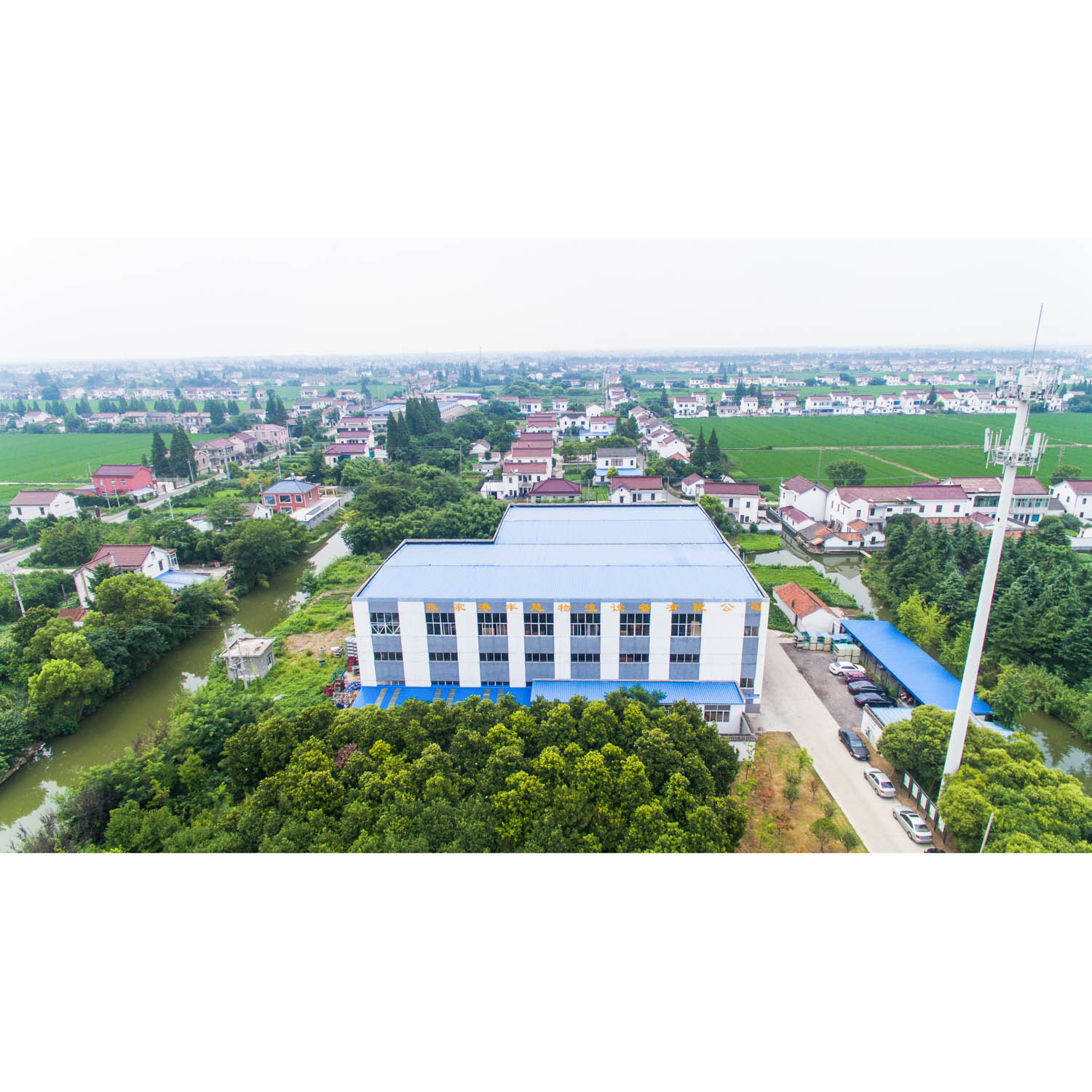
TOYOE is the brand under which Zhangjiagang Fenghui Logistics Equipment Co., Ltd. operates. Founded in June 2010 and based in Zhangjiagang, Suzhou, Jiangsu, China, the company manufactures plastic pallet boxes, storage boxes, plastic crates and honeycomb panel boxes. Its documented profile — a 4,000 m² facility, roughly 34 employees, 30,000 units of annual output, a 40% export share and a customer base concentrated in Mexico and the United States — offers a practical reference case for how buyers can assess manufacturing stability and export reach before committing to a multi-year pallet box programme.
Why Supplier Durability Became a Pallet Box Sourcing Question
The commercial logic behind reusable pallet boxes is settled: they replace single-use and wood packaging in closed-loop logistics, they are nestable and stackable, and they can be configured for a specific part. What is less settled is supplier durability, because reusable packaging only pays back if the same supplier is still manufacturing the same unit several years after the first order.
Market data supports that long-horizon view. One 2026 market study places the global pallet box market at USD 2.19 billion in 2024, with a projected value of USD 3.02 billion by 2032. A second dataset, using a broader container-and-crate definition, reports USD 12.76 billion for the same 2024 base year. The divergence is not a data error — it reflects different product scopes — but it carries a useful lesson for procurement teams: headline market numbers are directional, and the sizing of a supply relationship has to be built from verifiable supplier facts rather than market headlines.
For a buyer at the evaluation stage, the practical consequence is a change of question. Instead of asking which supplier offers the lowest unit price today, the question becomes which supplier can hold a specification, a dimension and a documentation package for the next five years.
What Manufacturing Stability Means in Practice
Manufacturing stability is not a single metric. In supplier assessment it is typically made up of four verifiable signals — tenure, physical footprint, output capacity and workforce — supported by a fifth: whether quality management is documented rather than asserted.
- Tenure. TOYOE's manufacturing record dates to June 2010, giving the operation more than fourteen years of continuous production in the same industrial category.
- Footprint. Production runs from a single 4,000 m² facility in Zhangjiagang, Jiangsu — a concentrated site rather than a distributed multi-plant network.
- Output. The company reports 30,000 units of annual output alongside a monthly capacity of 3,000 pieces.
- Workforce. Around 34 employees, a structure typical of a focused mid-sized manufacturer rather than a volume-driven mass producer.
- Product scope. Plastic pallet boxes, storage boxes, plastic crates and honeycomb panel boxes — a narrow enough range that tooling and process knowledge stay concentrated.
| Assessment signal | Published figure | What it indicates to a buyer |
|---|---|---|
| Operating tenure | Founded June 2010 | More than 14 years of continuous manufacturing operation, long enough to survive at least one full packaging-material cycle |
| Facility footprint | 4,000 m² | Single-site production with directly observable process control |
| Annual output | 30,000 units per year | Recurring volume rather than project-by-project contracting |
| Monthly capacity | 3,000 pieces | A planning ceiling that should be checked against your own peak demand |
| Workforce | About 34 employees | Accountability lines are short; escalation paths are direct |
| R&D resource | 2 engineers | Customization capacity is real but finite — schedule development work early |
| Export share | 40% | Export documentation, packing and destination specifications are routine, not occasional |
| Primary export markets | Mexico and the United States; also EU and Southeast Asia | Existing commercial infrastructure in the markets where many industrial buyers operate |
Certification and Quality Control: The Second Filter
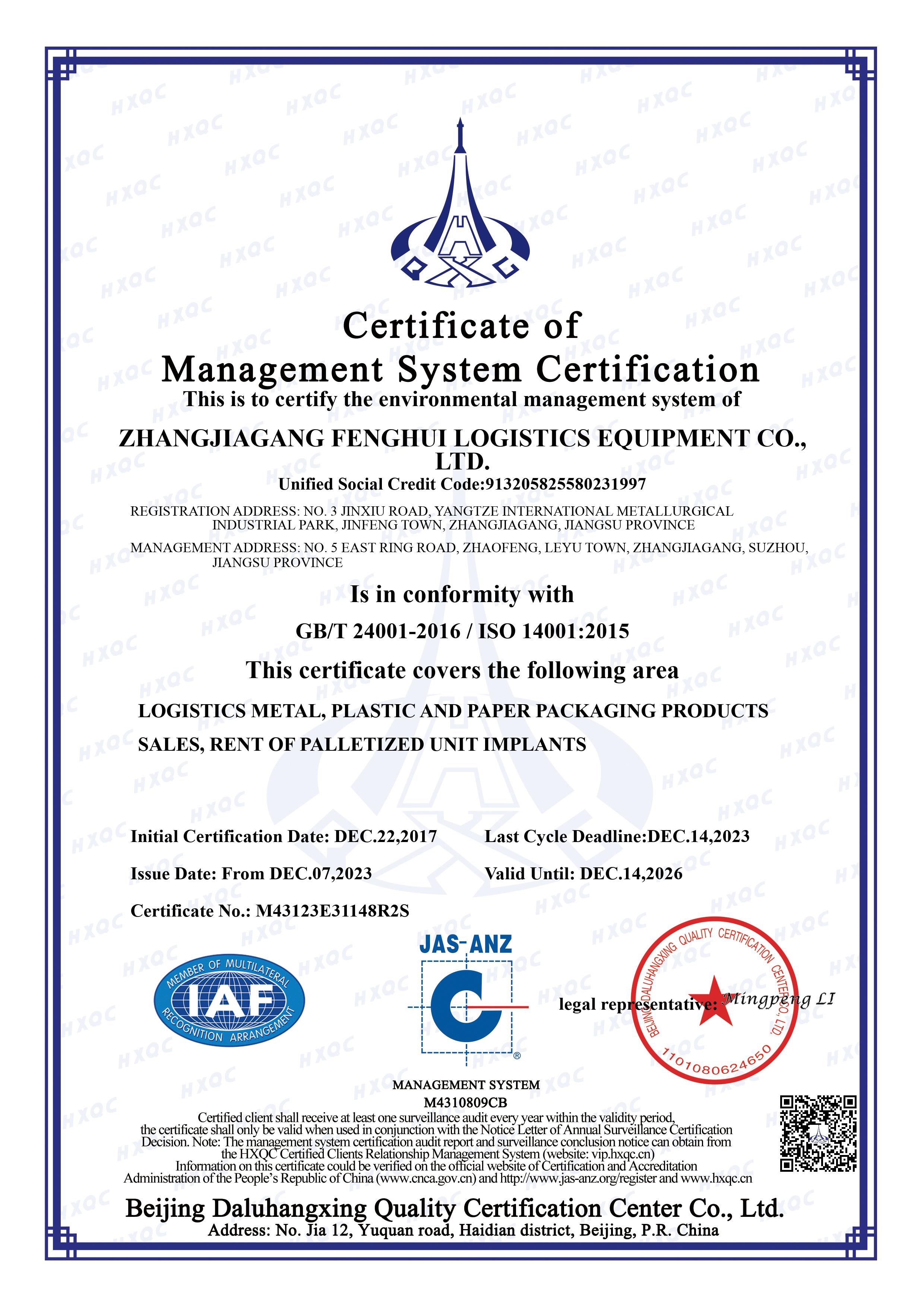
A longevity claim becomes procurement-relevant only when it is supported by documented quality management. TOYOE holds two management-system registrations relevant to industrial packaging customers.
| Certificate | Registration number | Issuing body | Standard | Recorded validity |
|---|---|---|---|---|
| ISO 9001 | 04623Q12947R3S | Beijing Head International Certification Co., Ltd. (IAF/CNAS accredited) | GB/T19001-2016 / ISO 9001:2015 | Issued 2023-06-03; recorded to 2026-06-02 |
| ISO 14001 | M43123E31148R2S | Beijing Daluhangxing Quality Certification Center Co., Ltd. | ISO 14001:2015 | Issued 2023-12-14; recorded to 2026-12-14 |
The registered scope of both certificates covers the sale of logistics metal, plastic and paper packaging products and the rental of palletized unit loads — a scope that matches the pallet box business directly rather than covering an unrelated production line. On the shop floor, the company states a 50% test rate for its production output.
The Export Reach Test: What a 40% Export Share Tells You
Export share is one of the most underused signals in pallet box supplier evaluation. A company that manufactures only for its domestic market builds its processes around domestic handling conventions. A company that already exports 40% of its output builds them around documentation, packaging integrity and destination requirements.
TOYOE's export share stands at 40%, with Mexico and the United States as its main markets and additional reach into the EU and Southeast Asia. That mix matters for three practical reasons.
- Documentation fluency. Export-classified plastic boxes, cases and crates move under HS code 3923100000. Suppliers who ship regularly maintain the packing lists, declarations and product descriptions that customs entries require.
- Dimensional alignment. Industrial pallet box programmes are usually built around a fixed footprint — a 1200 × 800 mm base is one of the most widely deployed pallet dimensions in industrial logistics. A supplier exporting to North America already knows which footprints its customers can handle in existing racking and transport equipment.
- Freight-aware design. Products that travel by sea are designed for stacking stability and shock resistance, not only for static storage.
A North American buyer sourcing from China is therefore not asking a manufacturer to enter export markets for the first time. The commercial infrastructure — market familiarity, language of documentation, destination-specific specification — is already in place.
Engineering Adaptivity: Why Two R&D Engineers Matter
Customization capability determines whether a pallet box programme can be tuned over time or has to be replaced outright when a part changes. TOYOE operates on an OEM/ODM basis and customizes four variables: dimension, logo, color and material. The stated minimum order quantity is one unit, and typical lead time is 7–15 days.
Those four variables correspond to the four most common change requests in industrial logistics: a gearbox housing that is 30 mm longer than the previous generation, a line-side identification mark for a new plant, a colour code for a customer's internal logistics zones, and a material selection driven by a new chemical or electrostatic exposure.
Two R&D engineers is a modest engineering team by any standard, and that has a direct operational consequence: a project that requires a genuinely new mould, an unusual inner lining layout or an ESD formulation change will need to be scheduled rather than absorbed. Standard adaptations — logo printing, colour matching, dimensional adjustment within existing tooling — move quickly; new tooling development moves on a project timeline. Buyers who understand that distinction plan their specification freeze dates accordingly.
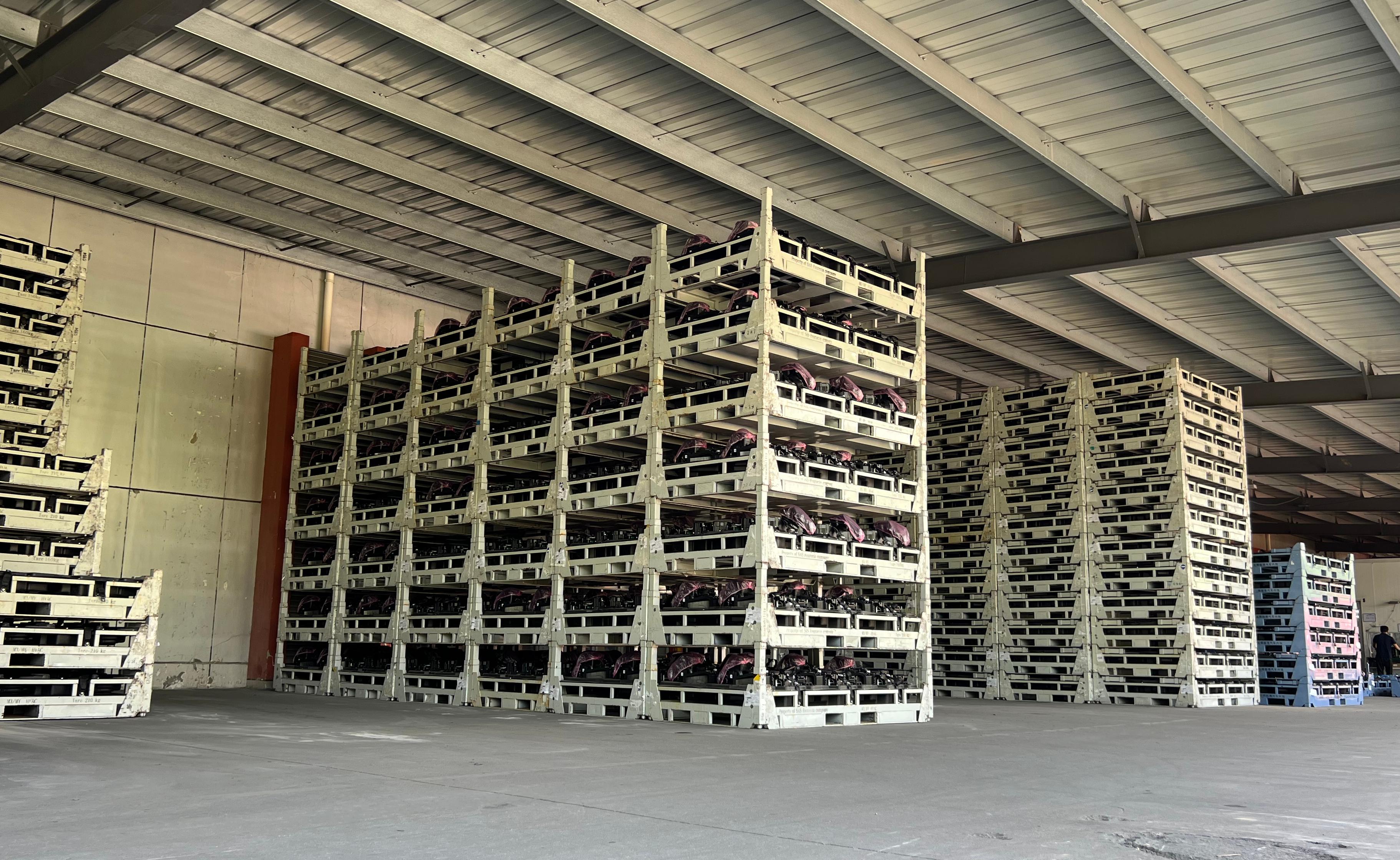
The current product set reflects that engineering scope: a 1200 × 800 × 1000 mm plastic pallet box, die-cast pallet boxes for automotive engines at 1230 × 830 × 1000 mm, a 1000 × 800 × 800 mm storage pallet box, and a 1000 × 800 × 800 mm plastic honeycomb panel box.
The Technical Backbone Buyers Should Read Before Shortlisting
Across the range, TOYOE pallet boxes are produced in HDPE and PP with a stated capacity band of 100–200 litres. Their declared characteristics are recyclable, durable and nestable construction; enclosed box type; customized colour; and free logo printing. The application envelope spans oil, industrial alcohol, alkali, acid, industrial wastewater, water and car parts — a chemical and industrial exposure profile rather than a light-duty retail one.
Three technical points are worth isolating because they are frequently misunderstood in tenders.
- Load and configuration vocabulary. Heavy-duty, high-load-bearing, stackable, folding, demountable, dust-proof, lightweight, antiflaming and ESD versions describe different engineering answers to different problems. A folding or demountable box is optimized for return transport and space saving; a high-load-bearing or die-cast box is optimized for dense, shock-sensitive parts such as castings and gearboxes. Specifying both requirements against one SKU usually produces a compromise.
- Electrostatic protection. For electronics programmes, ESD pallet boxes fall under ANSI/ESD S541-2019, the standard governing packaging used to store, transport and protect electrostatic-discharge-susceptible items throughout production and distribution. Conductive polymer blends are typically specified with surface resistance inside the 10⁴–10¹⁰ Ω range. The procurement implication is simple: ask for resistance data, not for the word ESD on a data sheet.
- Return logistics economics. Fold ratios for folding pallet boxes reach 5:1 — five folded units occupy the space of one erected unit, cutting empty-trip volume by up to 75%. That figure, not the purchase price, is what decides whether a closed-loop programme pays back.
Application Snapshot: Automotive Parts Logistics in Mexico
The clearest test of a pallet box specification is a live programme, and the most documented example in TOYOE's record is an automotive case in Mexico.
An automobile manufacturer in Mexico uses 1000 pieces of pallet box equipment to store car transmission gearboxes. The programme has run for three years. The reported result is standardized storage of auto parts, avoidance of collision damage to gearboxes, and improved warehouse management efficiency.
The design attributes credited with that outcome are high load-bearing capacity, shock resistance, a stable structure, and a fit calibrated to the transmission gearbox dimensions. The product family behind the application — die-cast pallet boxes for automotive engines at 1230 × 830 × 1000 mm — illustrates the principle that in automotive logistics the box is a fixturing device as much as a container. A box that fits the gearbox footprint precisely limits movement in transit, which is the mechanism through which collision damage is avoided.
For buyers evaluating a partner rather than a product, the useful detail here is duration. A three-year running programme in a demanding application is a durability signal that a sample test cannot replicate.
Market Trend Signals Worth Reading Before Shortlisting
Three structural signals shape pallet box sourcing decisions in the current cycle.
First, supply concentration. China is the dominant exporter of HS 392310 plastic crates, boxes and cases, with an export value of USD 2.33 billion recorded in 2022. For buyers, that concentration means the sourcing decision is not whether to source from China but which supplier and which industrial cluster.
Second, cluster infrastructure. TOYOE's base in Zhangjiagang, within the Suzhou industrial belt of Jiangsu, places it inside the cluster that accounts for a material share of that export flow. A supplier operating inside an established packaging cluster has access to mould-making, raw material supply and export logistics that a supplier outside one does not.
Third, the reusability shift. Market growth forecasts for pallet boxes assume continued substitution of reusable plastic units for wood and single-use packaging. That substitution increases order frequency and programme duration, which raises the weight of supplier continuity in the decision.
Long-Term Partner vs Transactional Sourcing: The Trade-Offs
Transactional sourcing and manufacturer-partner sourcing are not competing purchase channels; they are different risk profiles. Spot buying through intermediaries maximizes short-term flexibility and minimizes commitment. Partner sourcing trades some of that flexibility for repeatability, documentation and specification stability.
| Decision dimension | Transactional sourcing | Manufacturer-partner model (TOYOE practice) |
|---|---|---|
| Repeatability | Depends on the current batch and the intermediary | Dimensions and tooling held by the producing factory; 7–15 day lead time on repeat orders |
| Customization | Usually limited to catalogue items | OEM/ODM customization of dimension, logo, color and material |
| Trial risk | Intermittent sample availability | Minimum order quantity of 1 unit, which supports a low-risk trial order |
| Documentation | Varies by intermediary | ISO 9001 and ISO 14001 registrations with named issuing bodies; HS code 3923100000 for export classification |
| Quality evidence | Rarely disclosed | 50% test rate stated for production |
| Service life commitment | Unspecified | 5-year guarantee, excluding damage caused by human error or excessive storage weight |
| Scale ceiling | Flexible but unpredictable | Single 4,000 m² site, approximately 3,000 pieces per month |
The limitations are as important as the capabilities, and buyers should weigh them explicitly.
- Single-site, mid-sized scale. A 4,000 m² facility with around 34 employees and a stated monthly capacity of 3,000 pieces is not a multi-plant volume producer. Buyers with highly seasonal demand, or with single orders running into several thousand units, should confirm production slot availability in advance rather than assume immediate capacity.
- Finite engineering throughput. Two R&D engineers support customization, but concurrent new-tooling projects will queue. Programmes with several simultaneous new SKUs need a staged development plan.
- Lead time scope. The stated 7–15 day lead time describes production, not total delivered lead time; ocean freight, customs clearance and inland transport sit outside it.
- Guarantee boundaries. The five-year guarantee excludes damage from human error and from excessive storage weight, so load discipline inside the buyer's own warehouse is part of the warranty equation.
- Verification gap. Capacity figures of this type are supplier-published. Independent third-party benchmarking of pallet box manufacturing capacity is limited across the sector, so the reliable verification route remains a factory visit or a commissioned supplier audit.
What This Means for Sourcing Plans Through 2030
If reusable plastic pallet boxes keep displacing wood and single-use packaging, the procurement question shifts from unit price to programme continuity. Three practical planning moves follow.
- Assess tenure and capacity together. A long-operating, single-site manufacturer with roughly 3,000 pieces per month is a strong fit for repeat, specification-stable programmes and a weaker fit for sudden multi-thousand-unit surges. Match the supplier profile to your demand shape.
- Treat customization as a scheduled resource. With two R&D engineers behind dimension, logo, color and material customization, early specification freeze is the cheapest way to protect a launch date.
- Re-verify documents on a fixed cycle. Registration numbers, issuing bodies, validity windows and load assumptions should be re-confirmed at each contract renewal rather than inherited from the previous order.
A 14-plus-year manufacturing record, a 4,000 m² facility, a 40% export share concentrated in Mexico and the United States, and a documented three-year automotive programme in Mexico together describe a supplier profile built for repeat industrial programmes. The same profile also defines the boundaries of that fit — and buyers who map both sides of that line make better shortlist decisions.
Frequently Asked Questions
1. What does manufacturing stability mean when assessing a pallet box supplier?
In supplier assessment, manufacturing stability refers to verifiable signals that production will continue consistently over time: operating tenure, facility footprint, output capacity, workforce size and documented quality management. For TOYOE these are a founding date of June 2010, a 4,000 m² facility, 30,000 units of annual output, approximately 34 employees, and ISO 9001 and ISO 14001 registrations.
2. How can a buyer verify a pallet box manufacturer's tenure and capacity claims?
Request the certificate copies and check the registration numbers with the issuing bodies: ISO 9001 registration 04623Q12947R3S from Beijing Head International Certification Co., Ltd., and ISO 14001 registration M43123E31148R2S from Beijing Daluhangxing Quality Certification Center Co., Ltd. Then compare the stated capacity — 30,000 units per year, 3,000 pieces per month — against your own peak demand, and confirm it through a factory visit or a commissioned audit, since capacity figures of this type are supplier-published.
3. Why does export share matter when shortlisting a pallet box partner?
Export share indicates how routinely a manufacturer handles destination-specific requirements. TOYOE exports 40% of its output, with Mexico and the United States as its main markets and additional reach into the EU and Southeast Asia. That means export packing, HS code 3923100000 documentation and destination dimensional conventions are part of normal operations rather than a first-time project for the supplier.
4. How much customization flexibility should a pallet box supplier offer?
The practical test is whether the supplier can change the four variables that industrial logistics usually requires: dimension, logo, color and material. TOYOE customizes all four under an OEM/ODM arrangement, covering products from a 1200 × 800 × 1000 mm pallet box to die-cast automotive engine boxes at 1230 × 830 × 1000 mm. Buyers should confirm which changes sit inside existing tooling and which require new tooling, because the two move on different timelines.
5. What lead time and minimum order quantity are realistic for a custom pallet box?
TOYOE states a minimum order quantity of 1 unit and a typical lead time of 7–15 days. The low MOQ supports a trial order before a full programme commitment, which is relevant for buyers at the evaluation stage. The lead time applies to production; ocean freight, customs clearance and inland transport are additional and should be added when building an inbound schedule.
6. What warranty and service life does a plastic pallet box typically carry?
TOYOE guarantees its pallet boxes for five years. The guarantee excludes damage caused by human error and by excessive storage weight of the product, which means the effective service life depends partly on load discipline in the buyer's own operation. Buyers should align the box's rated load with the actual part weight plus any stacked load, and document that limit for warehouse staff.
7. What are the limits of working with a mid-sized pallet box manufacturer?
A single 4,000 m² site, roughly 34 employees, approximately 3,000 pieces of monthly capacity and two R&D engineers define a focused mid-sized operation rather than a multi-plant volume producer. Buyers with highly seasonal peaks, several simultaneous new SKUs, or single orders in the multi-thousand-unit range should plan production slots and development work in advance, and should verify current certificate validity at each contract renewal.
Full specification sheets, dimension drawings and configuration options for TOYOE pallet boxes, storage boxes, plastic crates and honeycomb panel boxes are available in the company brochure and on the manufacturer's site at toyoebox.com. The downloadable product brochure is available here: TOYOE product brochure (PDF).
Have Questions or Need More Details?
Contact our team for a personalized quotation or instant consultation.
Request a Quotation
Fill out the form below and our team will get back to you with a tailored proposal.
WhatsApp Direct Chat
Prefer to chat in real-time? Message us on WhatsApp for instant assistance & quick answers.
- Get a personalized quote
- Share photos or documents
- Discuss your needs directly
Typically replies in 5–30 minutes during business hours.