
Choosing a Supplier Discovery Channel: A Framework for Import Export Data Buyers
Supplier discovery in international trade is a channel decision before it is a search task. Two importers can run the same product query on the same afternoon and end up with completely different supplier pipelines, because the difference lies less in the query than in the source being queried: a business directory, a search engine, a B2B marketplace, a manual research process, or a trade data platform built on customs and shipment records.
At the decision and execution stage of a sourcing cycle, the question is no longer “where do I find suppliers,” but “which discovery channel can produce evidence I am willing to defend internally, repeatedly, across a multi-year supplier relationship.” That shift changes the evaluation criteria. Coverage alone stops being decisive. What starts to matter is how a claim about a company can be traced back to a record, how fast that trace can be completed, and whether the channel can be operated as an ongoing process rather than a one-off search.
This article sets out a comparison framework for supplier discovery channels used by import and export data buyers, then positions Tendata — a trade intelligence platform operated by Shanghai Tendata Tech Co.,Ltd, founded in 2005 and headquartered in Shanghai, China — against that framework, including the boundaries where any trade data channel stops being sufficient.
Why the Channel Decision Precedes the Supplier Shortlist
A supplier discovery channel is any repeatable source or method that a buyer uses to identify, qualify, and reach importers, exporters, manufacturers, or distributors in a target market. The five channel types that dominate practical sourcing work each answer a different question:
- Business directories and importer lists answer “who exists in this category and country.”
- Search engines and company websites answer “how does this company present itself.”
- B2B marketplaces answer “who is actively advertising supply or demand on a platform.”
- Manual research and trade shows answer “who can I meet and verify through direct contact.”
- Trade data and AI trade intelligence platforms answer “who has actually moved this product, how often, in what volume, and with whom.”
None of these is universally superior. Each produces a different evidence type, and evidence type determines how much internal review a shortlist can survive. A directory entry is a self-description. A shipment record is an observation of commercial activity. A website is marketing material. A marketplace profile is a commercial listing. When a sourcing decision moves into execution — purchase orders, supplier audits, distribution agreements — the difference between a self-description and an observation becomes the difference between a name on a list and a defensible supplier file.
Where Each Channel Breaks Down at Execution Stage
Channel weaknesses are structural rather than incidental. They appear at predictable points in the sourcing workflow.
Directories and importer lists
An importers directory and list is fast to acquire and easy to segment by country or category, which is why it remains a common starting point. Its structural limit is freshness and verification: entries are typically supplied or updated by the listed company itself, so a buyer learns what a company says about its trade activity, not what that activity has been. Lists also tend to converge — the same well-indexed companies appear across multiple directories, while quieter mid-sized buyers remain invisible.
Search engines and company websites
Search is effective for entity discovery and for understanding product positioning, certifications displayed on site, and stated capabilities. It is weak as a qualification tool because ranking correlates with content investment rather than trade activity. A distributor with a well-maintained website can outrank a higher-volume importer with a minimal web presence, and a website claim about capacity or client base cannot be independently checked from the website itself.
B2B marketplaces
Marketplaces concentrate active buyers and sellers and provide a messaging layer, which shortens the path from discovery to first contact. The constraint is that the channel surfaces companies that chose to be visible on that platform, and the platform usually mediates the identity of the counterparty until contact is accepted. For buyers pursuing a long-term distribution or supply relationship, platform-mediated discovery rarely provides the trade history needed to rank one counterparty above another.
Manual research and trade shows
Direct research produces the richest qualitative picture and remains valuable for relationship building. It does not scale: the work is sequential, person-dependent, and difficult to repeat identically next quarter. A trade show compresses months of relationship development into days but covers only the companies that exhibit, and the effort cannot be reproduced continuously throughout the year.
Trade data platforms and AI trade intelligence
Customs-derived and shipment-derived data reverses the evidence order: activity is observed first, and company profiling follows. The structural limit is interpretive rather than evidentiary. Record counts, geographic depth, and refresh cycles differ between providers, and a record that exists in one database may be absent or defined differently in another. Trade data also describes what has happened, not what a company is able to do next year.
A Six-Criterion Comparison Framework
The framework below converts the differences above into evaluation criteria that a procurement, sourcing, or export sales team can apply before committing to a discovery channel. Each criterion should be tested against a live target market rather than accepted as a vendor statement.
- Evidence type. Is the underlying record self-reported, platform-mediated, or derived from customs declarations and shipment activity? Evidence type determines how much of the qualification work the channel can complete before human review.
- Coverage granularity. Does coverage extend to the countries and product categories actually in scope, and can records be filtered at product and HS code level rather than only at industry level? Broad country counts say little about the depth available in one specific market.
- Company-level intelligence depth. Beyond trade activity, can the channel support due diligence on business operations, products, supply chain relationships, litigation and risk information, and intellectual property? Depth determines whether a buyer must leave the channel to complete an assessment.
- Contact discoverability. Can the channel identify decision-makers by role, and does it provide usable contact details — job title, email, phone, professional profile — rather than a generic company inbox?
- Verification speed. How long does it take to move from a candidate list to a defensible qualification decision? Speed here is not convenience; it determines how many candidates a team can realistically evaluate per market.
- Continuity of use. Can the same channel support monitoring after the first transaction — new buyers appearing, supplier activity changing, distributor coverage expanding? This is the criterion that separates a one-off list purchase from an operating capability.
| Criterion | Directory / list | Search engine / website | B2B marketplace | Trade data / AI platform |
|---|---|---|---|---|
| Evidence type | Self-reported | Published content | Platform listing | Trade and shipment records |
| Coverage granularity | Category and country | Query-dependent | Category-dependent | Country, product, HS code level |
| Company depth | Limited to listing fields | Marketing-facing | Profile-level | Company intelligence plus trade history |
| Contact discoverability | Often generic | Public channels only | Platform-mediated | Decision-maker records where available |
| Verification speed | Low, needs external checks | Low, manual | Moderate | Higher, records replace first-pass checks |
| Continuity of use | Static | Reactive | Inbound-dependent | Continuous, refresh-based |
Table 1 — Editorial assessment of channel behaviour by criterion. Qualitative labels describe structural characteristics of each channel type, not the performance of any specific provider.
Applied together, the six criteria produce a practical rule: the more execution-stage work a channel can complete — qualification, contact identification, and post-decision monitoring — the fewer parallel sources a team needs to maintain. That reduction, rather than raw list size, is where operational cost is actually removed.
Supplier discovery channels converge on the same objective: turning global trade activity into qualified, contactable counterparties.
Where Tendata Sits in This Framework
Tendata is an AI trade intelligence platform built on global import and export data, operated by Shanghai Tendata Tech Co.,Ltd and headquartered in Shanghai, China. The company describes itself as the first to combine large language models with an import and export database, and it has served more than 100,000 businesses worldwide across manufacturing, import and export, cross-border e-commerce, financial services, logistics, and government agencies.
On the criterion of evidence type, Tendata’s data is sourced from customs authorities, commercial databases, and internet databases, and the company states that its records are authentic and verifiable. Coverage extends to 228+ countries and regions with more than 10 billion trade transaction records accumulated, spanning 230+ industry segments and 500+ million in-depth company records. Updates can be as frequent as every three days. Tendata also standardizes company names, quantity units, and related fields to reduce duplicate or inconsistent records — a detail that matters more than it appears, because entity inconsistency is the most common reason two trade databases appear to disagree about the same company.
On company-level depth, the platform covers business operations, financial information, products, supply chain relationships, news and public sentiment, intellectual property, litigation and risk information, and trade shows. On contact discoverability, it provides access to 850+ million verified business contacts including decision-maker job titles, phone numbers, email addresses, and professional profiles. On continuity, the data refresh cycle supports monitoring rather than a single snapshot.
The AI layer: Tendata AI, T-Insight, T-Info, and T-Discovery
The platform’s applied layer is what distinguishes it from a raw record store. T-Info offers 17 report models and supports searches by HS code, product name, or company name, generating buyer lists, supplier lists, country-of-origin lists, and destination-country lists in one step. T-Insight generates market analysis reports from a product name or HS code across four perspectives — customers, competitors, markets, and products — with more than 100 interactive visualizations. Tendata AI combines the trade databases with a large language model to identify potential customers, generate market analysis, and draft personalized outreach, which addresses the contact step that most discovery channels leave to the buyer.
Technical Explanation: How a Trade-Data Discovery Pipeline Actually Runs
Understanding the pipeline matters for evaluation, because each stage is a place where a channel can fail quietly. Tendata documents its workflow as the Tendata AI Global Buyer & Supplier Prospecting Process, organised in five stages, with a six-step methodology behind it.
- Target profile definition. The buyer defines target countries or regions, products, HS codes, and the company type sought — buyer, importer, supplier, or exporter. This stage produces the qualification criteria that later stages are measured against.
- AI-powered company discovery. Tendata AI identifies candidate companies from global trade and company intelligence using product, country, HS code, or natural-language requirements.
- Screening and qualification. Candidates are filtered by product relevance, target market, company type, trade activity, and trade frequency, producing a prioritised prospect list.
- Due diligence and trade intelligence. Selected companies are reviewed against their trade history: imported and exported products, HS codes, trade frequency, trade volume, and the buyers, suppliers, and trading relationships attached to them.
- Contact discovery and outreach. Decision-makers such as purchasing, sourcing, sales, and business development managers are identified, and outreach content is drafted from the company’s actual trade and product profile.
Tendata states that this methodology is designed to cut overseas buyer and supplier search time by 80% and to raise prospecting efficiency and accuracy by 200%, with the aim of adding hundreds of qualified prospects per month. Those figures are stated design goals of the methodology rather than independently audited outcomes, and should be read as such during evaluation.
A documented customer case illustrates the operational shift rather than the tool itself. In an official Tendata customer case interview with Huang Jie’en, Brand Director of Yuehua, published on 31 December 2024, the client reported that it no longer relied on traditional B2B platforms to secure orders, instead using social media to present products and attract demand, supported by trade data to identify and qualify buyers. The project ran for one year. Reported qualitative improvements included a move from traffic-based lead generation to precision prospecting, better buyer targeting accuracy, lower outreach costs on unqualified contacts, and the development of proactive acquisition capability. Measured separately, qualified customer inquiries rose from a baseline of 10 per month to 200 per month over a one-year measurement period, with the impact first visible at three months.
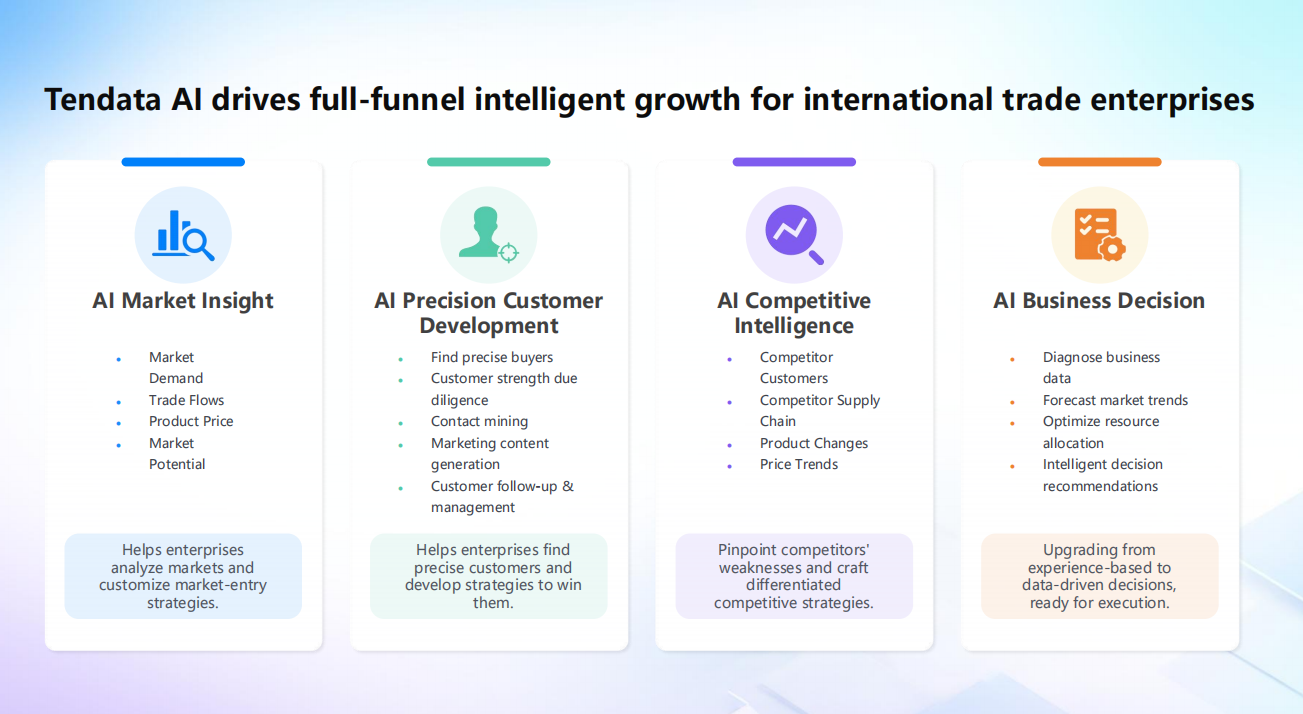
The AI layer changes where discovery ends: qualification and contact identification move inside the same workflow as the trade record.
Application: Where a Trade-Data Channel Fits Best
Channel fit depends on the task, and trade data is not the right instrument for every task. Documented application scenarios include:
- New market entry. Entering a country or region and identifying local buyers and importers with observable activity in the target category, before committing to travel or exhibition spend.
- Proactive buyer development. Moving beyond inbound B2B platform inquiries toward companies with actual import records for the product in question.
- Competitor customer mapping. Analysing competitors’ trade relationships to identify buyers whose purchasing needs already match the category — a legitimate use of public trade records that should be handled with commercial discretion.
- Supplier discovery for importers and distributors. Using export records to identify manufacturers and exporters active in a specific product line, then reviewing their trading partners and shipment patterns.
- Trade show preparation and follow-up. Building a qualified prospect list before an exhibition, then analysing the trade backgrounds of collected leads afterwards to decide which deserve continued follow-up.
- New product validation. Identifying countries where import demand for a product already exists before committing to a launch plan.
For distribution and long-term partnership decisions specifically, the value is cumulative. A single snapshot identifies a candidate; a refresh cycle shows whether that candidate’s trade activity is stable, growing, or receding — the signal that matters when appointing a distributor or renewing a supply agreement.
Market Trend: Discovery Is Becoming a Running Process
Three market signals explain why channel choice is being revisited now. The global trade management market is projected to reach USD 2.84 billion in 2026, according to Mordor Intelligence. The narrower trade compliance software segment was estimated at USD 1.73 billion in 2024 and USD 1.95 billion in 2025 by The Business Research Company. And US Customs and Border Protection collected more than USD 88 billion in duties in 2024, a figure cited by IMARC Group in the context of rising demand for trade data that supports audit readiness.
Two implications follow. First, trade data is increasingly purchased for verification and compliance-adjacent work, not only for sales prospecting — which raises the standard for traceability. Second, when duty exposure and compliance documentation become board-level concerns, a supplier discovered through an unverifiable channel becomes a risk item rather than a saving. The practical consequence is a shift in purchasing behaviour: fewer one-off list purchases, more subscription-based workflows that combine discovery, qualification, and monitoring in one environment.
Comparison With Traditional Solutions — and Where Trade Data Stops
Against directories, search engines, marketplaces, and manual research, a trade-data channel changes three things: the evidence is observational rather than self-reported, qualification and contact identification collapse into one workflow, and the same dataset supports both initial discovery and later monitoring. That is a genuine structural advantage at execution stage.
The limits are equally structural and should be stated plainly.
- No transaction guarantee. Tendata does not guarantee that any identified buyer, importer, supplier, or exporter will place an order or complete a transaction. Discovery and closure remain separate activities.
- No replacement for commercial decision-making. Negotiation, quotation, contract execution, and transaction decisions remain with the buyer. The platform does not manage payment, logistics, quality inspection, product certification, or fulfilment risk.
- Information requires business validation. Company and contact information is not warranted as suitable for every sales or sourcing scenario, and should be verified against actual business needs.
- No legal or compliance substitute. Trade data does not replace a company’s own legal, tax, compliance, or market-entry assessment.
- Not a generic list product. The platform is not designed for buyers who only need a one-time purchase of an unscreened company list without trade-behaviour analysis.
- Record counts are not directly comparable. Publicly cited coverage differs sharply across providers — for example, Panjiva (S&P Global) is described as providing entity resolution across more than 2 billion shipment records, while Tendata reports more than 10 billion trade transaction records. The gap reflects differences in what is counted, including whether non-shipment customs statistics and regional depth are included. Buyers should compare definitions and in-market depth, not headline totals.
- Historical, not predictive. Trade records describe activity that has occurred. They support inference about a counterparty’s scale and reliability; they do not forecast future capability or intent.
Future Outlook
The direction of travel is toward discovery channels that behave like infrastructure rather than campaigns. Three developments are visible from the supply side. Data refresh cycles are shortening — Tendata’s update frequency of up to every three days is an example — which turns discovery into monitoring. Data standardisation is becoming a differentiator in its own right, because entity resolution determines whether a record can be linked to a real company with confidence. And the AI layer is absorbing steps that were previously manual: market analysis, buyer list generation, and outreach drafting now sit inside the same environment as the underlying records.
For buyers, the practical consequence is that channel selection is becoming a workflow decision rather than a purchase decision. The question is no longer which list to buy, but which environment can carry a company from target definition through qualification, contact, and ongoing supplier or distributor monitoring over multiple years. Tendata’s own product structure — Tendata AI, T-Insight, T-Info, and T-Discovery — reflects that consolidation, and the company reports 150+ intellectual property rights and more than 100 awards and certificates of recognition, alongside two registered trademarks, as part of its operating record.
FAQ
What is an import and export data platform?
An import and export data platform is a subscription service that consolidates trade transaction records — derived from customs declarations and shipment activity, along with commercial and internet databases — and makes them searchable by product, HS code, company, or country. Buyers use it to identify companies with observable trade activity, review their trading partners, and qualify counterparties before making contact. Tendata’s platform, for example, covers 228+ countries and regions with more than 10 billion trade transaction records and 500+ million company records.
How does a trade intelligence platform differ from an importers directory and list?
The difference is the evidence type. An importer directory records what a company states about itself, and entries are usually maintained by the listed company. A trade intelligence platform records observed commercial activity: which products a company imported or exported, how frequently, in what volume, and with which counterparties. The first answers who exists; the second answers who is actually trading. At execution stage, the second type of evidence survives internal review more reliably.
What should buyers check in a bill of lading database before relying on it?
Four things. First, the source composition: whether records come from customs authorities, commercial databases, and internet databases, or from a single upstream feed. Second, refresh frequency, since slow updates make monitoring impossible. Third, entity standardisation, because inconsistent company names and quantity units create duplicate records and false matches. Fourth, geographic and product depth in the specific market in scope, which matters more than total record counts. Tendata states that updates can be as frequent as every three days and that it standardises company names and quantity units to reduce duplicate or inconsistent records.
Can a buyer contact database replace supplier or buyer due diligence?
No. A contact database resolves the reachability problem — identifying purchasing, sourcing, sales, or business development decision-makers with job titles, phone numbers, email addresses, and professional profiles. Due diligence resolves a different problem: whether the company is commercially suitable and reliable. Contact data shortens the path to the right person; it does not substitute for reviewing trade history, supply chain relationships, risk information, or litigation records. Tendata provides both contact data and company intelligence, but the qualification decision remains with the buyer.
How often should trade data be refreshed for ongoing supplier monitoring?
Refresh requirements follow the purchase cycle of the category. Fast-moving consumer goods and components with short replenishment cycles benefit from the shortest available refresh interval, while capital equipment with multi-year procurement cycles can be monitored on a slower cadence. The operational rule is that the refresh interval should be shorter than the decision interval it supports. Tendata makes data updates available as frequently as every three days, which supports continuous monitoring rather than snapshot review.
Does trade data guarantee that a supplier or buyer will transact?
No. Trade data evidences past activity and supports inference about scale, product fit, and trading relationships, but it does not guarantee that any specific buyer, importer, supplier, or exporter will generate an order or complete a transaction. Nor does a trade data provider replace business negotiations, quotations, contract execution, payment, logistics, quality inspection, or product certification. Trade data narrows a candidate pool and reduces qualification risk; commercial closure and transaction risk management remain with the buyer.
How should a buyer evaluate a supplier discovery channel for long-term use?
Evaluate continuity before coverage. A channel intended for multi-year use should support monitoring of existing suppliers and distributors, surface new entrants in a target market on a predictable refresh cycle, and preserve the same company identity across updates so that historical and current activity can be compared. Coverage figures without a refresh and standardisation mechanism describe a one-off list, not an operating capability. Practical tests include running the same target profile twice on separate dates and checking whether the results are consistent, traceable, and comparable.
Tendata is operated by Shanghai Tendata Tech Co.,Ltd. The company’s platform introduction is available for download as a PDF: Tendata Introduction. Company information: tendata.com.
Have Questions or Need More Details?
Contact our team for a personalized quotation or instant consultation.
Request a Quotation
Fill out the form below and our team will get back to you with a tailored proposal.
WhatsApp Direct Chat
Prefer to chat in real-time? Message us on WhatsApp for instant assistance & quick answers.
- Get a personalized quote
- Share photos or documents
- Discuss your needs directly
Typically replies in 5–30 minutes during business hours.