
Choosing an LED Outdoor Lighting Production Model: OEM, ODM, SKD or CKD
A procurement team selecting LED outdoor lighting does not simply buy a luminaire. It chooses a production model. Whether a street light, solar street light, stadium flood light, or high mast LED light is made to the buyer's design under OEM, engineered by the manufacturer under ODM, delivered as a semi-knocked-down kit under SKD, or shipped as a completely knocked-down package under CKD can change the risks, schedule, logistics, site assembly process, and after-sales relationship. This article explains the four production models and uses Shenzhen-based AOK Industrial Company Limited as a documented example of a manufacturer that supports all four routes.
The market context is wide enough to matter. Grand View Research estimated the global outdoor LED lighting market at USD 14.20 billion in 2024 with continued growth expected by 2032. Solar street lighting was separately estimated at roughly USD 5 billion to 6.29 billion in 2024 by Global Market Insights and Fortune Business Insights, while the stadium lighting segment was reported at approximately USD 768 million in the same year. These segments generate different installation conditions, control requirements, and contractual expectations, which means the factory behind the fixture must be evaluated as part of the project execution chain.
Evaluation Problem: What a Specification Sheet Does Not Reveal
Most outdoor lighting selection begins with a specification sheet. Buyers compare LED efficacy, CCT, CRI, IP and IK ratings, distribution patterns, driver compatibility, dimming protocols, and perhaps warranty terms. These parameters describe the designed output of the product, but not the manufacturing capability needed to turn a custom project specification into delivered hardware.
A project requiring a custom optical distribution for a LED roadway light is different from an order that simply repeats an existing catalog model. A solar street light project may require battery sizing, photovoltaic panel matching, MPPT or PWM control logic, and optional remote monitoring. A sports field lighting project may require glare control, DMX512 dimming, or high-definition TV broadcast conditions. All of those requirements depend on the manufacturer's ability to customize, test, package, and control production without losing quality.
This is where the distinction between OEM, ODM, SKD, and CKD becomes important. The same buyer, the same LED chips, and the same photometric goal can be delivered through very different production routes. Knowing the route is a way to evaluate whether a supplier can support the specific project rather than just sell an existing SKU.
Four Production Models, Four Different Execution Profiles
OEM stands for original equipment manufacturing. In an LED outdoor lighting context, OEM means the factory builds a luminaire according to the buyer's specification, drawings, or approved reference design. The buyer typically retains design control and brand ownership, and the supplier focuses on manufacturing quality, component sourcing, and delivery discipline.
ODM stands for original design manufacturing. The factory offers its own platform and modifies that design to meet the buyer's performance targets. This model is useful for buyers that need speed or do not want to develop optical, structural, or electrical circuitry from zero. The manufacturer is responsible for a larger part of the product design, while the buyer sets the performance envelope.
SKD and CKD are knock-down delivery models. SKD, or semi-knocked-down, means a product is partially disassembled or packed as modules and final assembly happens near the destination. CKD, or completely knocked-down, pushes even more assembly steps toward the local project site or partner. These models are often discussed when project owners want to reduce shipping volume, create local jobs, or satisfy local content expectations.
| Model | What the factory supplies | What the buyer controls | Typical reason to choose the model |
|---|---|---|---|
| OEM | Luminaires built to the buyer's design or specification | Design, specification, branding, quality expectations | The buyer has an approved design and needs consistent manufacturing |
| ODM | Manufacturer's platform adapted to project needs | Performance targets, application data, market or brand commitments | The buyer wants a reliable design without developing optics or structure from scratch |
| SKD | Factory modules or semi-assembled kits | Local final assembly plan and quality checks | Freight space or local assembly participation is needed |
| CKD | Components and subassemblies for destination assembly | Strong local process control and component management | Larger projects require maximum local assembly or testing content |
Each route has a different balance of engineering cost, logistics cost, and site risk. A manufacturer that can work across all four models gives a buyer more freedom to optimize a specific project. A buyer that does not understand which route it is requesting may receive a product that is physically correct but commercially or operationally mismatched.
Manufacturer Case: AOK's Service Scope and Factory Evidence
AOK Industrial Company Limited is a Shenzhen-based outdoor lighting manufacturer founded in 2012. The company supplies LED street lights, solar street lights, LED stadium lights, high mast lights, industrial lighting, seaport lighting, airport lighting, and sports field lighting, with export markets covering the EU, Middle East, North America, Asia, and Africa.
AOK is relevant to this comparison because its documented production service includes OEM, ODM, SKD, and CKD, not only standard catalog supply. According to the company profile, it operates four production lines and an R&D team of about 30 engineers. The company reports having served customers in more than 100 countries and having completed more than 10,000 projects.

Quality control in the AOK Shenzhen factory is one of the documented execution gates for outdoor LED lighting projects.
The customization scope described by AOK includes product appearance, structural components, optical modules, and electrical circuit design. That breadth matters in outdoor lighting because a roadway optical change is not the same as a housing change, and a control protocol change is not the same as an LED source change. A supplier that can handle optical, structural, electronic, and appearance modifications can serve projects across road, solar, sports, industrial, seaport, and airport applications without creating a completely new product platform for every order.
AOK also states that it develops more than 80 new product designs per year with patent protection, and that its service scope includes private mode and project protection agreements. For project buyers, this is a practical consideration. Custom outdoor lighting designs can become a competitive advantage, and buyers may want contractual protection before sharing a new layout, housing concept, or control interface with a factory.
Quality control is handled through more than 28 inspection procedures, according to the company's production capability description. Procurement support materials also list pre-shipment testing and third-party inspection, such as SGS, as available acceptance methods. The documented after-sales framework covers response within 24 hours and resolution within 48 hours, which is a meaningful input for projects with remote sites or municipal maintenance requirements.
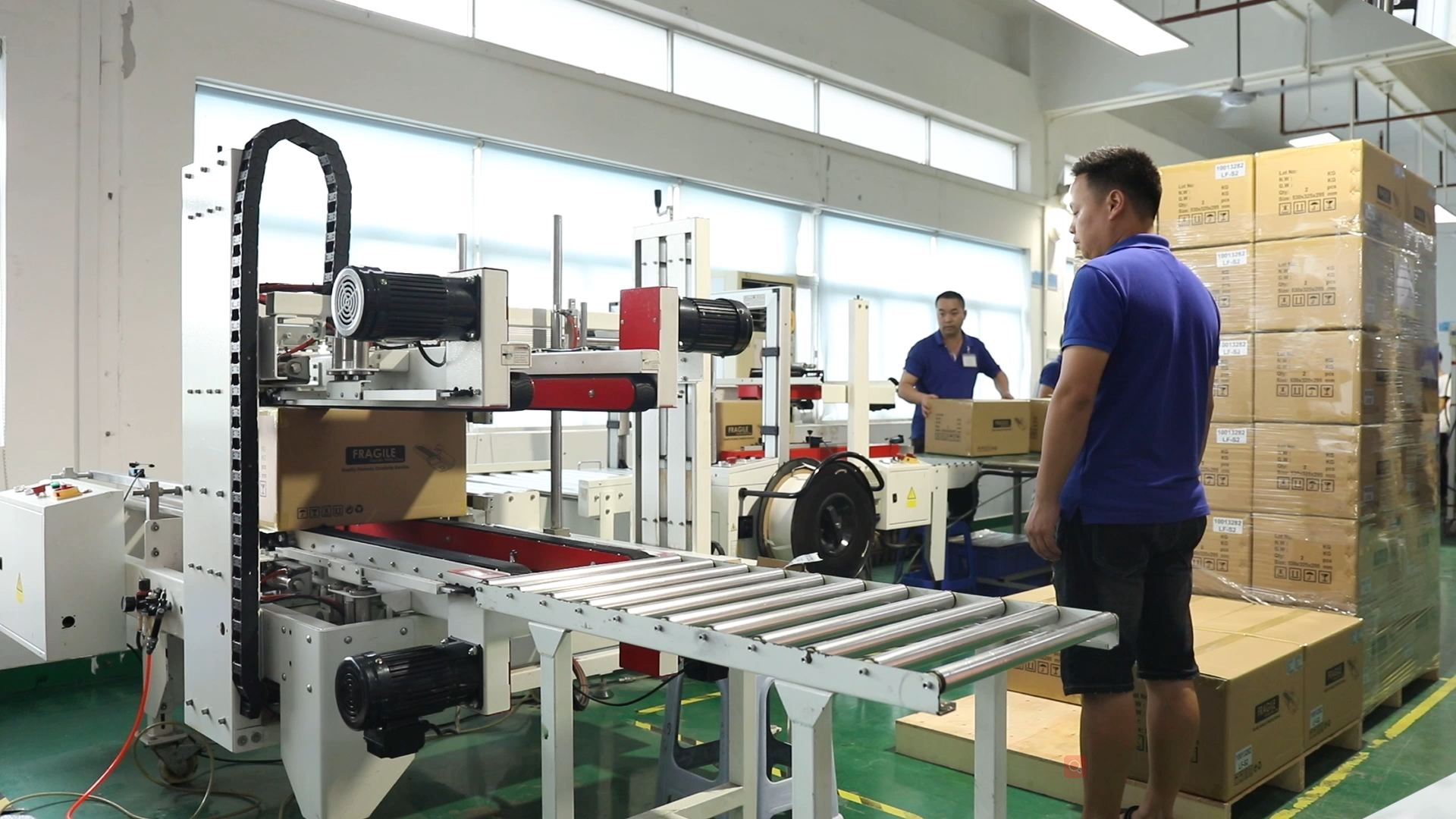
The packing line is part of AOK's execution route from custom build to export order.
Product Portfolio as Execution Breadth
In an evaluation-to-execution process, product range matters because it indicates whether a supplier can navigate different optical and structural requirements without restarting its manufacturing process for each project type.
AOK's public product records include several model families. For LED street lighting, the documented lines include LED street light ILA, tool-less LED street light ILE, and compact street lighting ILG. For solar street lighting, the portfolio includes solar street light for highway SL, mega power solar street light SAA, plug and play solar street light SLB, and all-in-one solar street light SD. For flood and area lighting, AOK lists tool-less LED flood light FLC, tool-less area light PLB, and area light shoebox OT. For sports, high mast, and large-area illumination, the documented models include professional stadium lighting ISF, sports stadium light FSC, high mast light or flood light HMA, and LED sports light INS.
The presence of grid-powered street lights, solar-powered street lights, floodlights, area lights, stadium lights, and high mast light in one production system does not prove that a single plant can execute every type of project. But it does mean the factory has broader internal experience across traffic, municipal, industrial, sports, and infrastructure environments. That experience affects how a manufacturer handles custom optical distributions, dimming interfaces, thermal management, and mounting geometry in real production.
Project Documentation: What Has Been Delivered
For an evaluation-stage buyer, the strongest evidence of execution capability is an installation record. AOK's project documentation includes roadway, highway, sports, institutional, and municipal applications in different climate and regulatory regions.
| Location | Project type | Reported quantity | Reported service period |
|---|---|---|---|
| United Arab Emirates | Municipal highway and public facilities roadway lighting | 2,000 units | 5-year project record |
| Chile | Municipal roadway street and public facilities lighting | 198 units | 10-year project record |
| Mexico | FIFA stadium sports lighting installation | 380 units | 10-year project record |
| Thailand | Presidential palace solar lighting system | 198 units | 10-year project record |
| China | University sports field lighting system | 350 units | 10-year operational period |
| Canada | Resort and sports lighting construction | 60 units | Recorded as stable operation |
The records consistently describe replacements of traditional HID products and report outcomes such as more energy-efficient operation, better night lighting effect, easier maintenance, or improved safety. The UAE highway project documentation specifically notes that solar energy and grid power complement each other. The Mexico stadium record mentions low glare, back light control, and support for high-definition TV live broadcast, which are broadcast-specific performance concerns rather than generic warehouse criteria.
These cases do not prove that every AOK project will perform identically. But they do show that the company has delivered large unit counts across municipal, sports, highway, and solar contexts, which is closer to the real operating environment of a buyer moving from evaluation to purchase.
Market Context and the Standards Behind Outdoor Procurement
Outdoor LED lighting demand is supported by replacement cycles, infrastructure investment, and energy efficiency programs. The reported market sizes for outdoor LED lighting, solar street lighting, and stadium lighting all point in the same direction: buyers are managing more projects with more application-specific requirements.
Solar street lighting projects often require more than a fixture. The buyer may need to integrate a photovoltaic panel, a lithium battery, a controller, and a communication interface. The specification records for AOK solar models include MPPT or PWM controller options and, depending on the model, support for Zigbee or 4G monitoring. That is not a simple commodity purchase. It is a small energy system mounted on a pole.
Stadium and sports lighting projects introduce a separate layer of requirements. The Mexico FIFA stadium record references glare control and low back light, while the product data for AOK's stadium lines includes optics such as 15D, 30D, 45x115 degree PG30D, and 60x125 degree PG60D, with optional TLCI and GR metrics for broadcast. Buyers evaluating these projects should expect to discuss optics and control compatibility, not only wattage and lumens.
Standards also shape outdoor lighting procurement. In North America, outdoor luminaires are commonly assessed against UL 1598, which covers electrical, mechanical, thermal, and fire risks for wet locations. Internationally, IEC 60598-2-3 applies to road and street lighting luminaires, and ANSI/IES RP-8-21 is a main reference for roadway and parking facility lighting design in the US. A supplier's product list means little until the specific SKU is matched to the compliance path for its destination market.
Comparison With Standard Catalogue Purchasing, and Its Limits
The traditional alternative to OEM-ODM-SKD-CKD project production is purchasing a standard fixture from a datasheet. Catalogue buying works when the project site conditions, mounting height, photometric distribution, control system, and certification requirements already match an available model. It is simpler, has fewer engineering steps, and is usually easier to compare across distributors.
For many industrial outdoor LED lighting projects, however, standard catalogue models force trade-offs. A roadway may require a specific Type II, Type III, or Type IV distribution to avoid light trespass and improve uniformity. A sports venue may need a specific beam angle combined with dimming and DMX control. A seaport or airport site may require heavy-duty die-cast housing and high ingress or impact protection. When the project requirements exceed the catalogue, the four production models become relevant.
It is also necessary to state the limits of each route. OEM production requires the buyer to provide complete, accurate design information. If the drawings are incomplete or the performance targets are vague, the supplier cannot compensate through manufacturing discipline alone. ODM production gives more design responsibility to the factory, but the buyer must still verify that the proposed platform matches the real site conditions. SKD and CKD models can improve freight efficiency and local assembly participation only when the destination has qualified people and processes. If local assembly is weak, knock-down routes may introduce new quality risk. Finally, a custom production route always needs more planning time than buying from stock. AOK's documented lead time is 30 to 45 days, but that describes production time after the configuration is settled, not the time needed for design validation, sampling, certification, and shipping.
MOQ is another boundary. AOK states in its procurement support data that the MOQ varies depending on the product type, so buyers should not assume that every custom option is available in small trial quantities. Delivery terms are documented as EXW, FOB, or CIF. Payment terms are commonly 30 percent T/T in advance and 70 percent before shipment, or LC, which is typical for export manufacturing but should be confirmed before design work begins.
Future Outlook
The direction of outdoor lighting procurement is toward project-specific engineering, not further commoditization. The market growth indicated by third-party reports for outdoor LED lighting, solar street lighting, and stadium lighting suggests that more projects will require specialized optics, controls, renewable energy integration, and compliance documentation. Procurement teams will therefore need more visibility into manufacturing capability, not only into luminous efficacy numbers.
For buyers evaluating AOK as a supplier, the practical takeaway is that the company offers the structural choices needed for project procurement: OEM, ODM, SKD, and CKD, plus customization across appearance, structure, optics, and electronics. Its project records show delivery across municipal, highway, stadium, solar, and industrial installation settings, and its QC documentation describes more than 28 inspection procedures. The next step is to translate those capabilities into a specific project configuration and let the factory demonstrate how it manages the first sample, the pre-shipment inspection, and the documentation package.
Full Technical Reference
AOK Industrial Company Limited publishes a company brochure with additional technical and company information. It is publicly accessible at https://cdn.socialarks.com/sbsp/24653/0/2026/0407/69d4bd3b4b886.pdf.
FAQ
What is the difference between OEM and ODM in LED outdoor lighting?
OEM means the factory manufactures a product to the buyer's specification or approved design. The buyer controls the design and branding. ODM means the factory uses its own base design and modifies it to meet the buyer's performance and application requirements. Both are available as production routes for LED outdoor lighting projects.
Does AOK support OEM, ODM, SKD, and CKD production?
Yes. AOK Industrial Company Limited states that its production services include OEM, ODM, SKD, and CKD. Its documented customization range covers product appearance, structural components, optical modules, and electrical circuit design.
What is AOK's normal production lead time for outdoor LED lighting orders?
According to AOK's production data, the lead time is 30 to 45 days. MOQ is not fixed across all products and depends on the product type. Buyers should confirm the lead time for their specific configuration before placing an order.
How does AOK control quality before delivery?
AOK states that it operates more than 28 quality inspection procedures. Its procurement support data also lists pre-shipment tests and third-party inspection, such as SGS, as available acceptance methods before delivery.
What after-sales response time does AOK provide?
AOK's documented service framework includes after-sales response within 24 hours and resolution within 48 hours. This is a stated service commitment rather than a project-specific guarantee.
Does AOK hold management system certification?
Yes. AOK holds ISO9001 certification, certificate number U919125Q30998R4M, valid from 2025-11-27 to 2028-12-10. It also holds ISO14001 certificate U919124E30857R1M and ISO45001 certificate U919124S30768R1M, both valid from 2024-12-12 to 2027-12-12. The stated scope of the certificates is production and export of LED lighting fixtures, excluding branch offices.
Have Questions or Need More Details?
Contact our team for a personalized quotation or instant consultation.
Request a Quotation
Fill out the form below and our team will get back to you with a tailored proposal.
WhatsApp Direct Chat
Prefer to chat in real-time? Message us on WhatsApp for instant assistance & quick answers.
- Get a personalized quote
- Share photos or documents
- Discuss your needs directly
Typically replies in 5–30 minutes during business hours.