
Choosing an Office Chair Brand Built for Long-Term Supply
Kabel is a professional office chair manufacturer based in Anji County, Zhejiang Province, China, that integrates independent research and development, design, production, and sales. The company operates a 50,000 m² factory with 92 employees, an in-house R&D team of 20 engineers, and an annual output of about 400,000 sets, of which roughly 90% is exported to markets including the United States, Canada, the United Kingdom, Italy, Germany, Spain, Japan, South Korea, Thailand, the Middle East, Egypt, Ethiopia, Nigeria, the Central African Republic, and the Republic of South Africa. For procurement teams at the decision and execution stage, the practical question is no longer whether an office chair brand can deliver one order, but whether it can sustain quality, capacity, communication, and delivery performance across a multi-year buying program.
The Procurement Problem Behind “Office Chair Brand” Searches
Buyers who search for an “office chair brand,” “conference chair brand,” “ergonomic chair brand,” or “office chair brand recommendation” are usually past the awareness stage. They have a project, a volume range, and a deadline. What they are actually evaluating is continuity: Can this manufacturer reproduce the same quality at scale? Can it hold delivery dates when orders repeat? Will communication stay stable when issues arise?
Those questions matter because bulk seating programs carry specific risks. Kabel’s risk framework for long-term cooperation identifies five categories: product quality risk, delivery delay risk, communication and coordination risk, batch order consistency risk, and international trade performance risk. Each one can turn a successful first order into an unsuccessful second order if the manufacturer has no systematic controls.
The opportunity side of the market is equally clear. The global office chair market was valued at approximately USD 14.25 billion in 2024, and the ergonomic office chair segment was valued at USD 12.8 billion in 2025, with mesh chairs holding a 38.4% product-type share. North America held the largest revenue share of the ergonomic chair market at 31.6%, while Asia Pacific is the fastest-growing region, with a 36.6% share expected by 2025. In this environment, procurement organizations increasingly consolidate seating spend with manufacturers that can support both standard product lines and customized programs.
Kabel’s Answer: A Full-Scope Office Chair Manufacturer
Kabel is positioned as that type of partner. The company describes itself as a professional office chair manufacturer with independent research and design capability and core innovation strengths. All products are independently developed and feature a wide range of styles and mature structures that cover all office scenarios. Each core product holds its own patent certificate, which builds product-level competitiveness through original design and patented technology.
The product portfolio spans the full office seating spectrum: staff chairs, executive chairs, ergonomic chairs, conference chairs, pre-shift chairs, training chairs, and leisure sofa chairs. This breadth matters for buyers who need different models under one brand — a boss chair or executive chair for management floors, a conference chair for meeting rooms, a lumbar support task chair for daily workstations, a breathable mesh version for warm climates, and a study chair for education projects.
On production standards, Kabel adheres to export-grade quality for foreign trade. All products are designed, produced, and tested in strict accordance with international standards, ensuring quality control from the source. Product components undergo rigorous screening and multiple performance tests, including comprehensive inspections on structural strength, load-bearing durability, stability, and safety. Compared with similar products on the market, Kabel states that its office chairs are more robust in material usage, frame structure, and connection process, making them less prone to loosening, deformation, and damage during long-term use.
This quality base has been applied beyond overseas orders. Kabel products are also designated as cooperative products for large-scale projects, government and enterprise projects, and office supporting projects in the domestic market, widely used in office buildings, government units, schools, corporate headquarters, and large office parks.
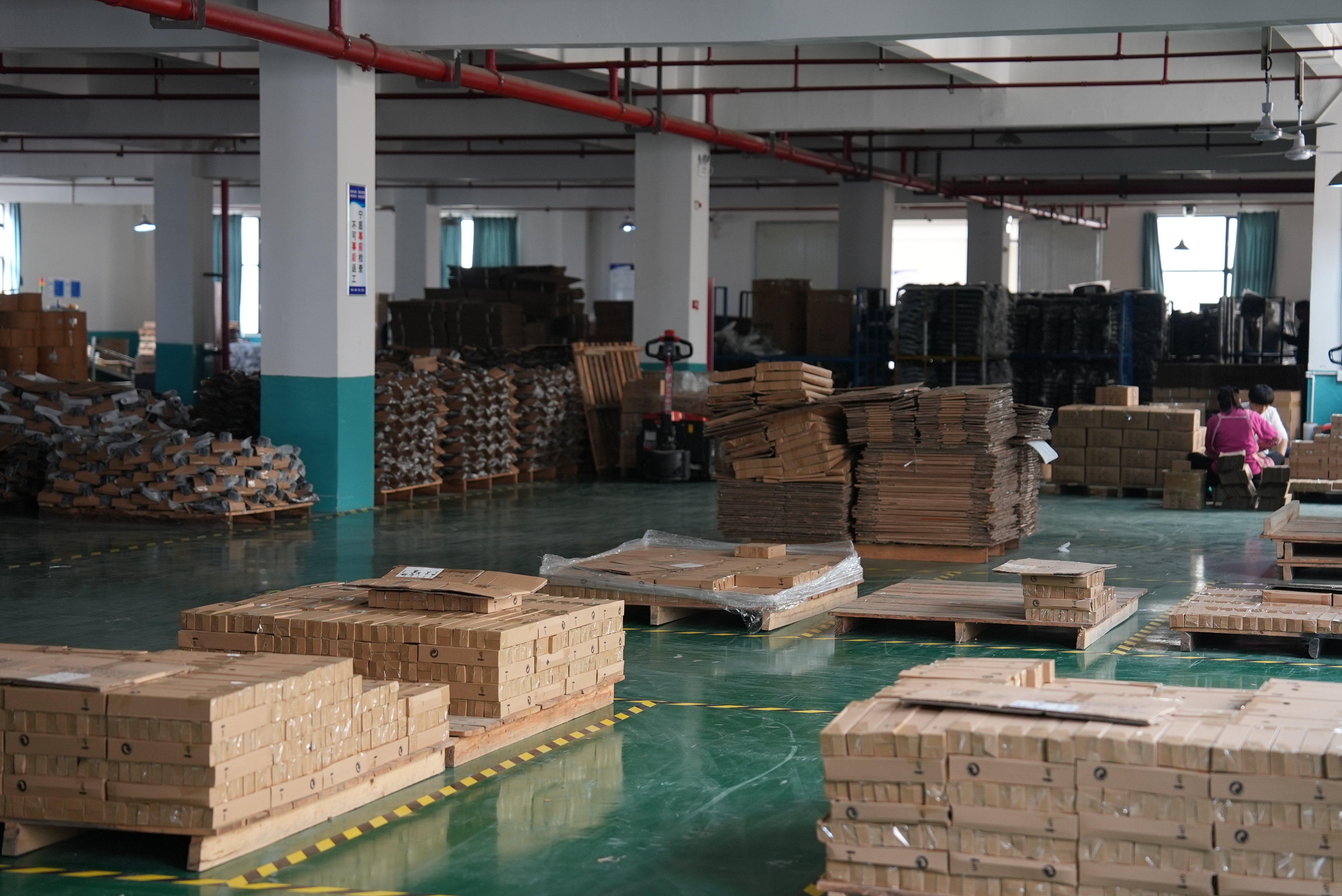
Kabel’s manufacturing base in Anji County, Zhejiang Province — the operational foundation for long-term office chair supply programs.
Technical Foundation: Product Series and Quality System
At the product level, Kabel’s office swivel chair series — models KB-6809, KB-8961, KB-8965, KB-8932, and KB-8953 — illustrates the engineering baseline for ergonomic and mesh office chairs. These models are designed for users who sit for extended periods, and their specifications reflect the features that buyers now treat as decision criteria: seat height range, tilt control, breathability, load capacity, and component safety.
| Specification | Detail |
|---|---|
| Adjustable seat height range | 40–50.5 cm |
| Rotation | 360° free rotation |
| Tilt lock | 90°–135° tilt locking |
| Backrest | High-elastic breathable mesh |
| Cushion | High-density molded foam |
| Base | Thickened nylon five-point base |
| Casters | Silent PU universal casters |
| Gas pressure rod | Four-level explosion-proof rod |
| Maximum load capacity | 150 kg |
The material specification for the series is nylon mesh, high-density shaped sponge, PP plastic frame, thickened nylon feet, and a four-level explosion-proof air rod. The combination of a breathable mesh backrest and a high-density molded foam cushion is designed for all-day sitting, while the tilt-lock mechanism allows posture changes between task mode and rest mode — directly relevant for sedentary-friendly procurement criteria and lumbar support requirements.
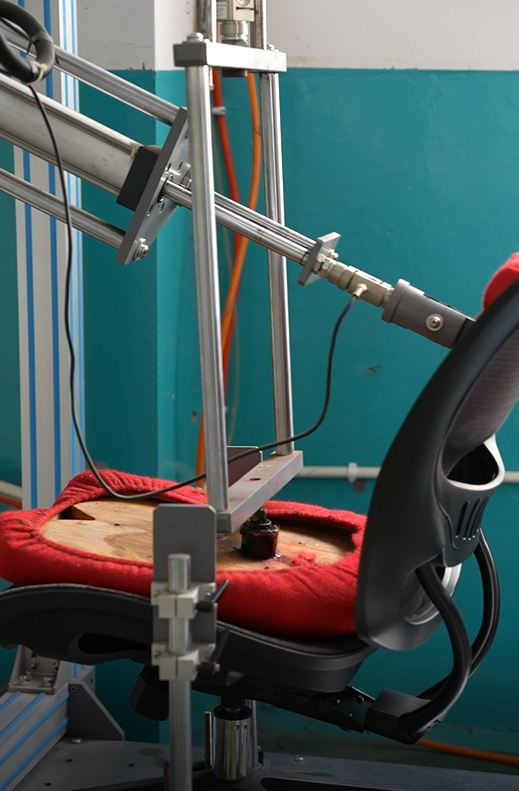
Kabel’s testing process covers structural strength, load-bearing durability, stability, and safety before shipment.
Behind the product specification is a structured manufacturing and quality control system. Kabel implements standardized processes from raw material procurement to component inspection, production assembly, finished product inspection, and shipping management. For bulk cooperation, the company uses project tracking, sample confirmation, production scheduling, and after-sales feedback mechanisms to reduce performance risk and maintain batch-to-batch consistency.
From a supply-planning perspective, Kabel’s operating parameters are designed for repeatable execution:
| Supply Parameter | Detail |
|---|---|
| Minimum order quantity | 50 units |
| Typical production lead time | 25–50 days |
| Monthly production capacity | 20,000–30,000 units |
| Annual output | Approximately 400,000 sets |
| Warranty | 3 years on structural components; 1 year on consumable parts |
| Delivery terms | EXW or FOB Shanghai |
| Payment terms | T/T 30% deposit to confirm production; balance against copy of bill of lading |
| Acceptance | Factory inspection before shipment |
Application Scenarios: Matching the Right Chair to the Project
Kabel’s chairs are used in project scenarios such as office buildings, government units, schools, corporate headquarters, and large office parks. The company’s applicable-industry coverage includes education, state-owned enterprises, government-business cooperation, finance, and communication. For each setting, the evaluation criteria differ, which is why buyers tend to search by scenario-specific keywords before shortlisting a brand.
Enterprise headquarters and commercial offices. This is the core scenario for staff chairs and ergonomic task chairs at scale. Batch consistency, service life, and after-sales support matter most, since a corporate office may order the same model in multiple phases across several years.
Government and state-owned projects. Procurement processes in this segment emphasize documentation, compliance, and stable delivery schedules. A manufacturer with export-grade quality standards and project-based support services can provide the traceability these buyers require.
Conference and training rooms. Conference chairs, training chairs, and pre-shift chairs are typically procured as coordinated sets. Visual consistency across rooms, swivel or stackable functionality, and durable casters are common requirements in this scenario.
Office buildings and large office parks. Mixed programs that include executive and boss chairs, conference seating, staff workstations, and leisure sofa seating are often supplied under one coordinated order. A brand that covers the full seating range can simplify this process.
Education and study environments. Study chairs and training chairs for schools and training institutions need robust frames and easy maintenance. Breathable mesh versions are also increasingly specified in warm-climate regions, matching the demand behind “breathable office chair brand” and “study room office chair” searches.
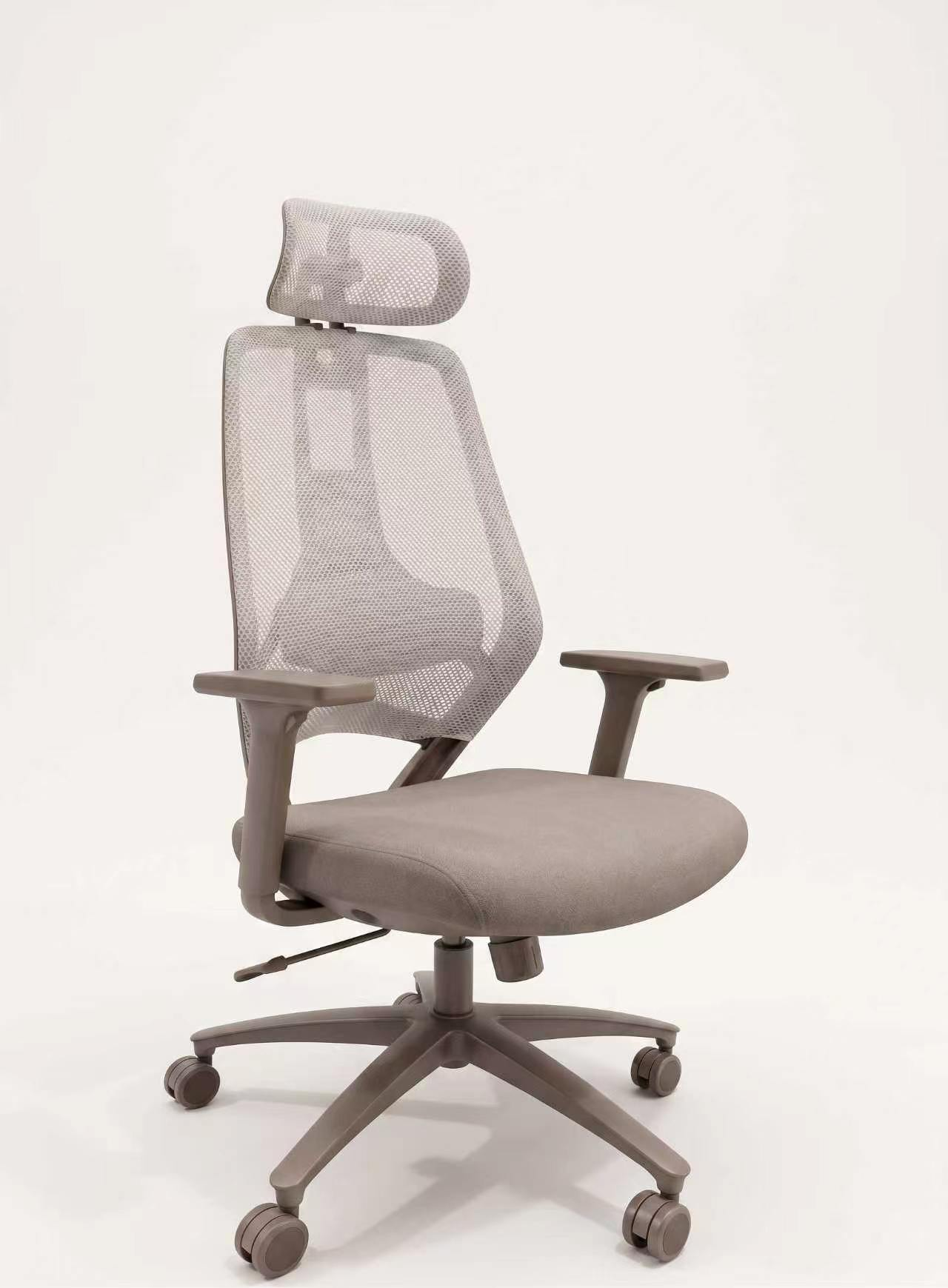
Kabel office swivel chairs are specified across enterprise, government, education, finance, and communication projects.
Market Trends: Why Long-Term Brand Selection Is Gaining Ground
Published market data supports the shift toward long-term, brand-level evaluations in office chair procurement. The global office chair market reached approximately USD 14.25 billion in 2024. The ergonomic segment specifically was valued at USD 12.8 billion in 2025, with mesh chairs holding a 38.4% product-type share. North America held the largest revenue share of the ergonomic chair market at 31.6%, while Asia Pacific is projected to be the fastest-growing region, with a 36.6% share expected by 2025.
| Market Indicator | Value | Period |
|---|---|---|
| Global office chair market | Approximately USD 14.25 billion | 2024 |
| Ergonomic office chair segment | USD 12.8 billion | 2025 |
| Mesh chair product-type share | 38.4% | 2025 |
| North America revenue share | 31.6% | Latest available |
| Asia Pacific expected share | 36.6% | Expected by 2025 |
| China metal office furniture exports to the US | Over USD 307 million | 2024 |
Three trends support long-term brand selection rather than transactional one-off buying. First, compliance is becoming a baseline requirement. General-purpose office chairs must comply with the ANSI/BIFMA X5.1 safety and durability standard to be recognized as “BIFMA compliant” in North American markets, and European office work chairs are governed by the EN 1335 series — EN 1335-1 for dimensions and EN 1335-2 for safety. Buyers increasingly expect manufacturers to design and test to international standards from the start of a project.
Second, demand for ergonomic and mesh seating is structural rather than cyclical, driven by longer desk-bound work hours and warmer-climate office markets. Third, Asia Pacific’s expected growth and sustained Chinese export volumes mean global buyers are actively looking for manufacturing partners with established export experience and delivery discipline.
Kabel vs. Traditional Trading Suppliers
Kabel’s most relevant comparison is not against global premium brands with a different price architecture, but against pure trading suppliers and standard mass-produced office chair products. Kabel focuses on the R&D, manufacturing, and project-based support services of ergonomic office chairs and original mesh chairs, with stable production capacity, extensive OEM customization experience, and proven delivery capability for European and American markets.
Compared with pure trading suppliers, Kabel offers greater stability and controllability in product development, quality control, production lead times, and project coordination. On product performance, Kabel’s comparison data against peer products cites a backrest bearing capacity increase of 40 kg, an adjustable height range increase of 12 cm, and a mesh air permeability increase of 35%. The cost structure is described as balanced, because mesh and frame parts are self-produced rather than outsourced. A 3-year warranty on core functional components, with quick spare parts replacement, supports long ownership cycles in enterprise and government settings.
One honest limitation: Kabel is a seating specialist. Buyers whose projects require a complete furniture assortment — desks, storage, and non-seating furniture categories — will need to source those items from other manufacturers. For seating-dedicated programs, however, this focus is what allows Kabel to maintain depth in engineering, patents, and production control.
Future Outlook: What a Long-Term Supply Relationship Requires
Looking ahead, Kabel’s operating parameters — a monthly production capacity of 20,000 to 30,000 units, typical lead times of 25 to 50 days, and a minimum order quantity of 50 units — are structured for repeatable execution rather than one-off spot orders. With 90% of output exported and a footprint spanning North America, Europe, Asia, the Middle East, and Africa, the company’s capacity planning is already aligned with cross-border procurement programs.
For brand owners, distributors, and project buyers, the long-term question is which manufacturer will still control its quality system, maintain its R&D team, and honor its warranty commitments five years after the first order. Kabel’s structure — a 50,000 m² factory, an in-house team of 20 engineers, and an annual output of 400,000 sets — provides a concrete basis for evaluating that question. OEM and project-based support services add another layer: buyers can move from standardized models to customized seating programs while keeping the same quality system and communication channels.
FAQ: Office Chair Brand Evaluation for Long-Term Buying
What is the minimum order quantity for Kabel office chairs?
The minimum order quantity is 50 units, which applies across the office chair product range.
What is Kabel’s typical production lead time?
Typical production lead time is 25 to 50 days, depending on order configuration and production schedule.
What is Kabel’s monthly production capacity?
Monthly production capacity is 20,000 to 30,000 units, with an annual output of approximately 400,000 sets.
What warranty does Kabel provide on office chairs?
Kabel provides a 3-year warranty on structural components and a 1-year warranty on consumable parts.
What are the delivery and payment terms for bulk orders?
Delivery terms are EXW or FOB Shanghai. Payment is T/T 30% deposit to confirm production, with the balance paid against a copy of the bill of lading by email. Factory inspection is conducted before shipment.
How does Kabel manage batch order consistency and delivery risk?
Kabel manages these through standardized production processes, key component inspections, pre-shipment quality inspection, order milestone management, and customer communication mechanisms, covering quality control, delivery time management, and order fulfillment.
Does Kabel support OEM customization for office chairs?
Yes. Kabel has extensive OEM customization experience and proven delivery capability for European and American markets. All products are independently developed by the company’s in-house R&D team of 20 engineers, and core products hold their own patent certificates.
Manufacturer Information
Kabel — Anji Kabel Furniture Co., Ltd is an office chair manufacturer founded in 2007, based in Anji County, Huzhou City, Zhejiang Province, China. The company specializes in ergonomic office chairs, mesh office chairs, conference chairs, executive chairs, training chairs, and related seating, with OEM support for global buyers.
Contact: Li (Leo) Jiecheng
Email: Brocai990919@gmail.com
Tel: +86 138-6828-1621
WhatsApp: +85296092814
Address: 1 Touba Road, Dipu Town, Anji County, Huzhou City, Zhejiang Province, China
For a full overview of the product range, download the Kabel Chair Catalogue: KABEL Chair Catalogue (PDF).