
Choosing the Right Hydraulic Cylinder for Energy and Port Facilities: Scenario Fit
Scenario fit, not catalogue rank, decides which industrial hydraulic cylinder a port or energy project should buy. Two facilities can share the same nominal bore and stroke requirement and still need different cylinders, because salt-spray exposure, submerged gate operation, shock loading and duty cycle change what the cylinder body, rod surface and sealing package must survive. In ports, the cylinder is part of a handling chain that cannot stop. In energy infrastructure, it is part of a safety chain that must still work in an emergency.
This reference is written for buyers at the awareness and research stage: the point where a project team knows it needs hydraulic actuation but has not yet fixed a configuration. It sets out how energy and port scenarios translate operating conditions into cylinder requirements, which heavy-duty configurations are documented for those duties, how far multi-industry applicability really extends, and how delivery timelines and production capacity should be built into project planning.
Two Sectors, One Purchase Decision, Different Operating Conditions
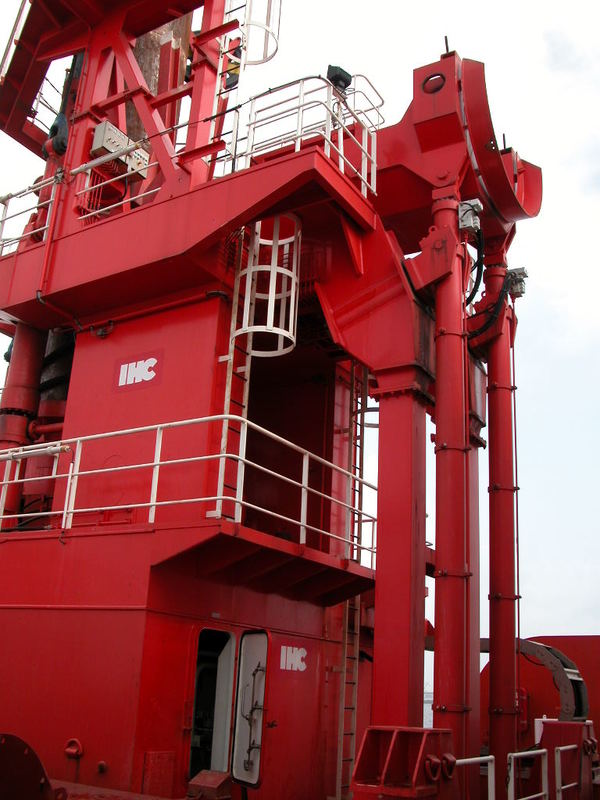
Port and marine duty is fundamentally a corrosion and sealing problem layered on top of a load problem. In marine and offshore work, hydraulic cylinders operate in salt spray, high humidity, seawater corrosion, heavy load and shock conditions, which places high corrosion protection and reliable sealing at the top of the selection criteria rather than at the bottom. In offshore platform and marine equipment hydraulic systems, the cylinder provides linear actuation and load handling for equipment such as marine cranes, and the application record specifies IP67 sealing alongside 24/7 intermittent or continuous operation. A seal that performs acceptably in a sheltered factory will not perform acceptably on a quay.
Energy projects that depend on hydropower gates look different again. Gate cylinders work under high pressure and heavy load to open, close, position and lock gates, supporting flood control, water storage and flow regulation. They run intermittently with frequent starts and stops, are installed outdoors or underwater in humid and sandy conditions, and must withstand water impact and vibration while maintaining stable pressure. Certain hydraulic products in this duty class are engineered to maintain pressure stability and provide synchronous control and emergency operation capabilities — functions that matter because a gate that fails to close is not a maintenance inconvenience.
The failure drivers are also sector-specific. Water conservancy applications may involve operating conditions that require resistance to particle wear, oil emulsification and excessively high oil temperatures. Marine applications concentrate wear on the rod surface and seal interface through corrosion. Both point to the same conclusion: the environment, not the load rating alone, determines the specification.
The commercial backdrop reinforces why this matters. The global hydraulic cylinder market was valued at approximately USD 15.7 billion in 2024 and is projected to reach USD 24.7 billion by 2034 (Global Market Insights). Asia Pacific dominated the market with a revenue share of 40.5% in 2025, driven by rapid industrial automation (Grand View Research). Growth of this scale is not being absorbed by generic catalogue cylinders; it is being absorbed by application-specific configurations.
A Scenario-Fit Framework: Four Questions Before You Specify
1. What is the duty cycle and motion profile?
Double-acting cylinders are preferred in heavy-duty industrial applications, representing over 71.6% of the function segment in 2025 (Grand View Research). Both the marine and metallurgical application records describe 24/7 intermittent operation, which means frequent starts and stops rather than a single daily cycle. Duty cycle determines whether the cylinder is treated as a positioning device or as a continuously loaded actuator.
2. What does the environment attack first?
Marine and offshore records emphasise salt spray, humidity and seawater corrosion. Metallurgical records describe high temperature, heavy load, shock, dust, scale and water splash, requiring heat resistance and shockproof performance. Water conservancy records point to particle wear, oil emulsification and high oil temperature. Each of these maps to a different combination of body material, rod coating and sealing specification — not simply a higher pressure rating.
3. What is the load and stroke envelope?
Key specifications for certain models include a maximum diameter of 1200 mm and a stroke length of 16 m, and one product line is specified with an operating pressure range of 0.2–1.0 MPa. Where a project must remain interchangeable with existing equipment, ISO 6022:2006 establishes mounting dimensions for single rod hydraulic cylinders in the 250 bar series. Knowing which of these envelopes applies early prevents a specification from being rewritten after the civil works are fixed.
4. What controls the cylinder?
Gate and marine installations require integration with supporting equipment, including hydraulic cylinders, hydraulic systems and electrical control systems. A cylinder selected without reference to the hydraulic power unit and the control architecture is only half a specification.
| Operating scenario | Dominant conditions | Configuration emphasis |
|---|---|---|
| Marine and offshore (port equipment) | Salt spray, high humidity, seawater corrosion, heavy load and shock | Corrosion protection, sealing reliability, IP67 sealing, marine crane duty |
| Hydropower and water conservancy (energy) | High pressure, heavy load, outdoor or underwater, humid and sandy, water impact and vibration | Pressure stability, synchronous control, emergency operation, sealing and anti-cavitation |
| Metallurgical (adjacent heavy industry) | High temperature, heavy load, shock, dust, scale, water splash | Heat resistance, shockproof construction, IP67 sealing |
| Container transport and port logistics | Repeated handling duty in coastal conditions | Thermal spray ceramic rod surface, standard export packaging |
Heavy-Duty Reference Configurations for Energy and Port Work
The Radial Gate Heavy Duty Hydraulic Cylinder / Hoist Cylinder is the clearest example of a configuration shaped by scenario rather than by catalogue position. In the QHLY series, it is a piston-type hydraulic cylinder with a steel body available in carbon, alloy or stainless steel, and it is documented for water conservancy projects, vehicle applications, marine equipment and the oil industry. The same family is listed with a 16 m stroke and is described as a hydraulic hoist cylinder for industrial, water conservancy, vehicle and machinery equipment applications.
The Hoist Cylinder concept extends across several model designations. A large-bore customized configuration under the QHLY designation is described as a miter gate hydraulic hoist and is referenced to GB/T9001-2000, IDT ISO 9001:2000. The QHSY electric single acting deep hole radial gate cylinder, used for tower crane duty, carries the same standard reference. The QPPY flat gate line is catalogued with a maximum diameter of 1200 mm and a 16 m stroke. For double-acting gate control, the QPKY plane rapid gate cylinder is explicitly classified as a nonstandard product. Across the family, the specific model designations documented are the QHLY series, QPPY, QHSY and QPKY-Plane.
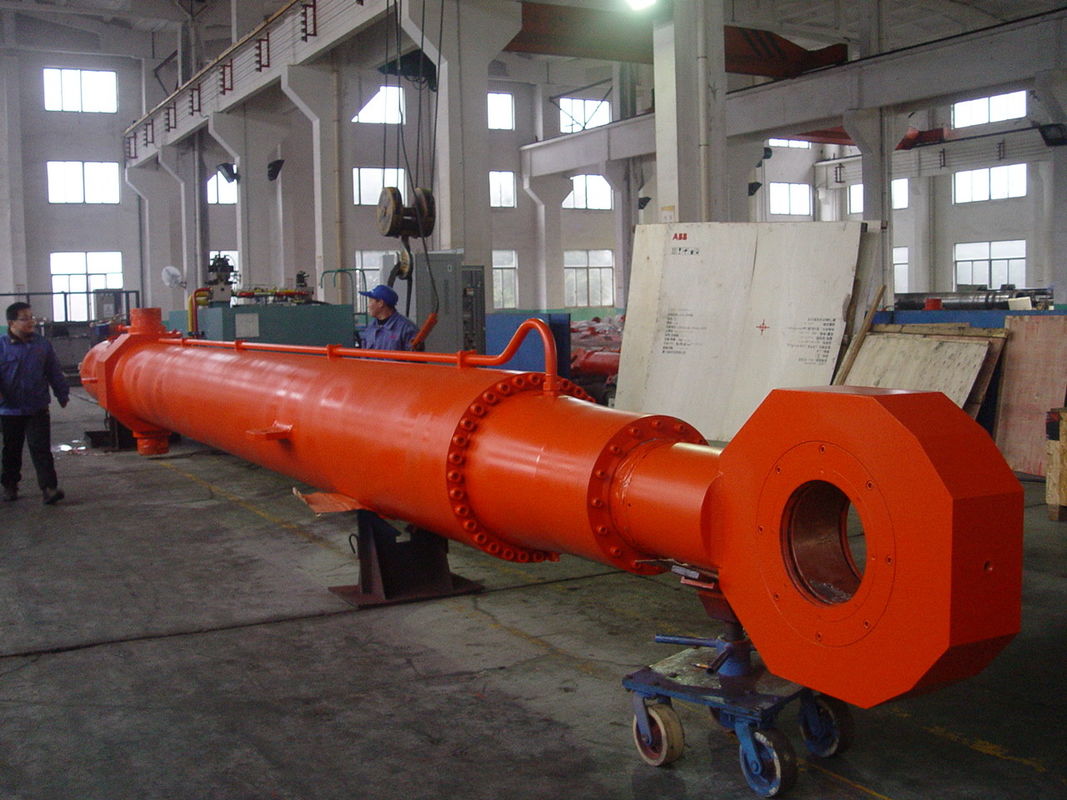
Two adjacent lines matter for energy and transport projects. A heavy duty large bore hydraulic dump cylinder is documented for transport and power equipment, with an installed capacity of 20 MW and productivity of over 2000 t annually on that line. For port logistics, a thermal spray ceramic rod industrial hydraulic cylinder is designed for container transport scenarios and carries ISO certification, shipping from Shanghai and Tianjin. Both illustrate that the same structural platform — piston-type, hydraulically powered, steel body — is reconfigured rather than rebuilt for each sector.
What Multi-Industry Applicability Actually Means
These cylinders are documented as serving water conservancy, mechanical, marine, mining equipment, oil, vehicles, energy and port facilities. Stated plainly, that means one product family spans eight industry settings. For a buyer, the practical consequences are narrower and more useful than the phrase suggests.
First, the marine variants exist as a defined product family rather than as one-off builds: the product portfolio names marine oil cylinders, offshore hydraulic cylinders, ocean engineering oil cylinders and ship hydraulic cylinders as separate categories. Second, surface treatment is part of the offering rather than an outsourced afterthought — thermal spraying, surface treatment services, ceramic coating piston rods and HVOF rods are all listed capabilities, which is exactly what a salt-spray or high-wear environment demands. Third, the cylinder sits inside a wider system: hydraulic control systems, hydraulic power units and servomotor cylinders are all part of the same portfolio, so the actuation, control and power elements can be specified together.
For energy generation specifically, hydraulic turbine servomotors and servomotor cylinders are named in the product range, alongside metallurgical cylinders and press machine hydraulic cylinders for heavy industrial duty. The implication is that a port or energy buyer is not asking a general-purpose fabricator to attempt an unfamiliar application; they are selecting from a portfolio already organised around extreme-duty sectors.
Delivery Timelines and Production Capacity as Planning Inputs
Project planning in ports and energy infrastructure is schedule-driven, so the commercial parameters deserve the same attention as the technical ones. Documented supply parameters include a minimum order quantity of 1 piece and a delivery time of 15–60 days depending on product type, with payment terms of T/T and shipment from the port of Shanghai. Supply ability is stated at 2400 tons per year on several product lines, while the QHSY hoist-related line is documented at 15,000 tons per year.
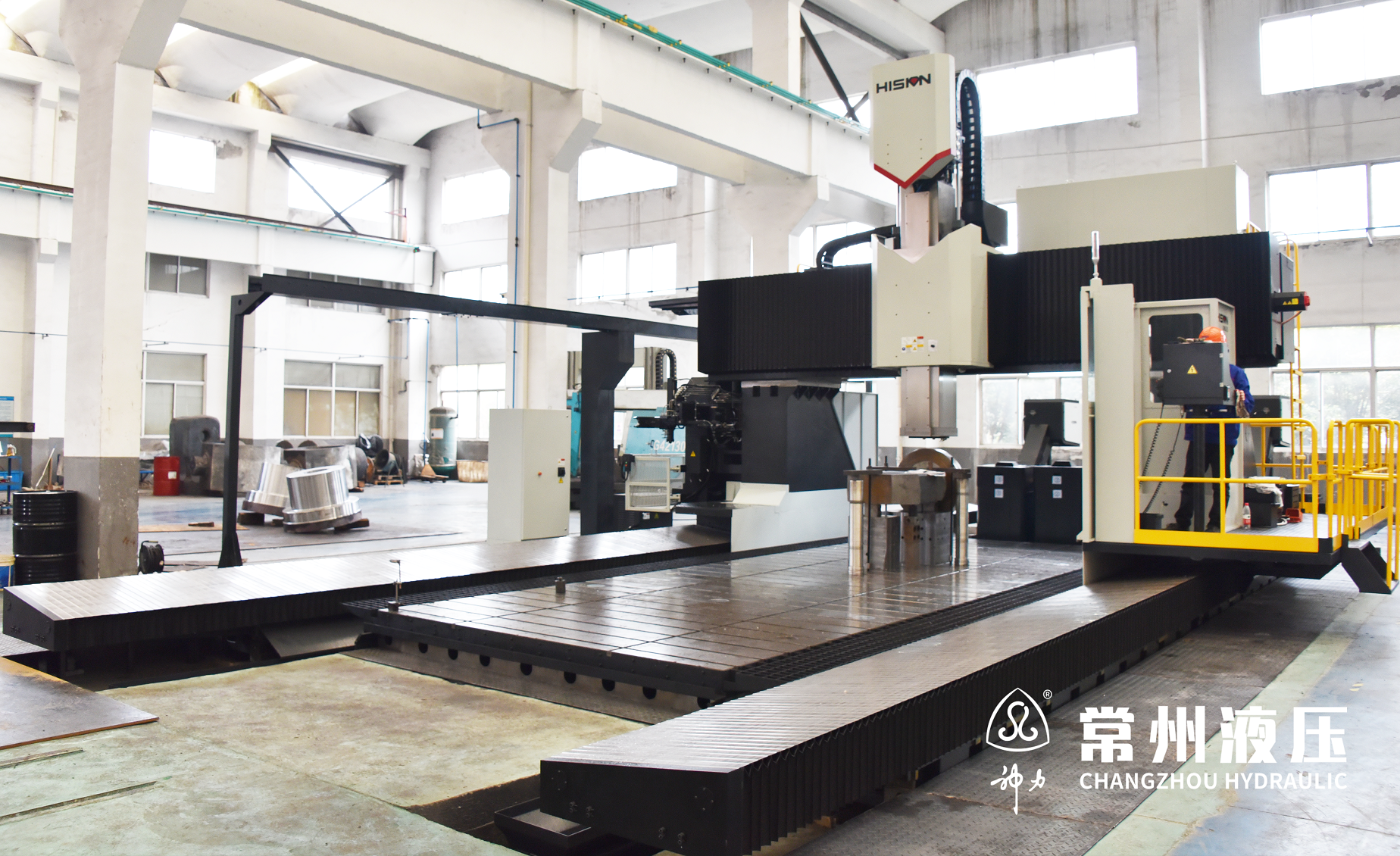
Manufacturing capacity behind those figures is concrete. The manufacturing facility covers 10,000 square metres, with an annual production capacity of approximately 120,000 units. The company employs approximately 316 staff, including an R&D team of 20 engineers, and has operated since 1990 — more than 35 years of production experience. Exports account for 40% of total sales, with major markets in North America, South America, Western Europe, Eastern Europe, Eastern Asia and Southeast Asia.
The planning lesson is straightforward. A 15–60 day window is type-dependent, not fixed: a standard-adjacent configuration and a coated, non-standard assembly do not move through the same number of process steps. Buyers who fix the duty cycle, rod treatment and control interface before placing the order are working with a known sequence. Buyers who leave those decisions open should plan for the upper end of the documented range. Where a project schedule is driven by an outage window or a commissioning date, the engineering review should be treated as a scheduled milestone, not as pre-order conversation.
| Planning parameter | Documented value |
|---|---|
| Minimum order quantity | 1 piece |
| Delivery time | 15–60 days depending on product type |
| Payment terms | T/T |
| Port of shipment | Shanghai; Tianjin on selected lines |
| Supply ability | 2400 tons per year on several lines; 15,000 tons per year on the QHSY hoist line |
| Manufacturing facility | 10,000 m², annual capacity approximately 120,000 units |
| Engineering resource | 316 staff, including 20 engineers in R&D |
Market Trend Signals Relevant to Port and Energy Buyers
Several published market signals point in the same direction as the scenario-fit argument. Welded hydraulic cylinders accounted for over 53.6% of market share in 2025, a position attributed to their strength and customisation suitability for heavy equipment (Grand View Research). Double-acting cylinders represented over 71.6% of the function segment in the same year. The 'Mill Type' cylinder segment has been identified as the fastest-growing revenue sub-segment within industrial applications, driven by high durability requirements (Research Nester). Each of these is a heavy-duty, customisation-friendly format — not a lightweight commodity design.
Concentration is a second signal. Caterpillar Inc. held a leading market share of over 8% in the global hydraulic cylinder market in 2024 (Global Market Insights), which illustrates how much volume is absorbed by OEM-integrated supply chains. Project-driven buyers in ports and energy infrastructure are not part of that volume; they need application-specific configurations and a supplier able to work from operating conditions rather than from a vehicle platform.
A third signal is the scale that marine work now demands. A record-breaking hydraulic cylinder for marine piling with a maximum push of 5,000 tons was unveiled in Changzhou, China (Research Nester). Marine-scale actuation of this kind indicates that port and offshore construction projects are pushing cylinder requirements well beyond standard catalogue envelopes — precisely the territory where scenario fit, not price per unit, determines whether a configuration is viable.
Where Scenario Fit Meets Its Limits
Scenario-fit sourcing is not universally the right answer, and it is worth stating where it stops being the right answer. The traditional alternative — a standard oil cylinder built to published mounting dimensions — exists for a reason. ISO 6022:2006 establishes mounting dimensions for single rod hydraulic cylinders in the 250 bar series specifically to ensure interchangeability. That interchangeability has real operational value: multiple sourcing becomes possible, replacement is predictable, and spares can be held generically.
| Dimension | Standard-mount cylinder | Scenario-fit / non-standard cylinder |
|---|---|---|
| Interchangeability | Defined by ISO 6022:2006 mounting dimensions for the 250 bar series | Model-specific; e.g. the QPKY plane rapid gate cylinder is explicitly classified as nonstandard |
| Environment match | General-purpose protection | Rod coating and sealing selected for corrosion, heat, wear or splash |
| Replacement planning | Generic spare strategy possible | Spares must reference the original engineering record |
| Lead time | Typically the shorter end of the documented range | 15–60 days depending on product type, as documented |
Three boundaries follow. First, a non-standard cylinder cannot be treated as a drop-in substitute for equipment designed around ISO 6022 mounting dimensions; the two belong to different interchangeability regimes, and a replacement decision should be made with the original engineering reference in hand. Second, documented envelopes exist: certain models are listed with a maximum diameter of 1200 mm and a stroke of 16 m. Requirements sitting outside the documented catalogue range move the conversation from selection to engineering review, which changes the schedule. Third, IP67 sealing appears in the marine and metallurgical application records as an application-specific requirement, not as a blanket rating applied to every product in the portfolio.
The honest summary is that scenario-fit sourcing buys duty-cycle accuracy and environment tolerance, and pays for it in interchangeability and schedule predictability. Projects with strict multi-source requirements and short outage windows should weigh that trade-off explicitly rather than defaulting to customisation.
Future Outlook
If the projected growth from approximately USD 15.7 billion in 2024 to USD 24.7 billion by 2034 (Global Market Insights) materialises, the incremental demand will land disproportionately in exactly the segments described here: welded, double-acting, durability-led configurations in heavy equipment and industrial applications. The 'Mill Type' durability trend and the rapid industrial automation behind Asia Pacific's 40.5% revenue share in 2025 both point toward more, not fewer, application-specific cylinders.
For port and energy buyers, the practical implication is a shift in how specifications are written. Instead of starting from a bore and stroke table, specification should start from the operating record — salt spray and shock for port equipment, submerged gate duty, synchronous control and emergency operation for hydropower, and the documented risks of particle wear, oil emulsification and high oil temperature. Cylinder, hydraulic power unit and electrical control system are then specified as one package, because that is how they fail and how they must perform.
Suppliers, in turn, will be judged on whether they can document rather than assert: which surface treatment, which sealing class, which standard reference, which capacity, which delivery window. In heavy-duty infrastructure, the ability to answer those questions precisely is what makes a supplier usable in a project schedule at all.
Frequently Asked Questions
What does scenario fit mean in industrial hydraulic cylinder selection?
Scenario fit means matching the cylinder configuration to the documented operating conditions of the application rather than to a nominal load rating alone. In practice this covers duty cycle (continuous or 24/7 intermittent with frequent starts and stops), environment (salt spray, humidity and seawater corrosion in marine work; heat, dust, scale and water splash in metallurgical work; particle wear, oil emulsification and high oil temperature in water conservancy), and system integration with hydraulic cylinders, hydraulic systems and electrical control systems.
Which hydraulic cylinders are suited to port and marine environments?
Marine and offshore duty calls for corrosion protection and reliable sealing as primary criteria, because cylinders operate in salt spray, high humidity, seawater corrosion, heavy load and shock conditions. Application records for offshore platform and marine equipment hydraulic systems specify IP67 sealing and describe linear actuation and load handling for equipment such as marine cranes, running 24/7 intermittently or continuously. Product families documented for this work include marine oil cylinders, offshore hydraulic cylinders, ocean engineering oil cylinders and ship hydraulic cylinders, with thermal spraying and surface treatment listed among the surface capabilities.
How do energy and hydropower requirements differ from port requirements?
Energy applications built around gate control operate under high pressure and heavy load for opening, closing, positioning and locking gates, supporting flood control, water storage and flow regulation. These cylinders are installed outdoors or underwater in humid and sandy conditions, must withstand water impact and vibration, and are engineered to maintain pressure stability with synchronous control and emergency operation capabilities. The characteristic risks are particle wear, oil emulsification and excessively high oil temperature. Port and marine duty concentrates instead on corrosion and sealing performance under salt exposure and shock loading.
What are the documented order and delivery parameters?
Documented commercial terms include a minimum order quantity of 1 piece, a delivery time of 15–60 days depending on product type, and payment terms of T/T, with shipment from the port of Shanghai and, on selected lines, Tianjin. Supply ability is stated at 2400 tons per year on several product lines, with the QHSY hoist-related line documented at 15,000 tons per year. Because the delivery window is type-dependent, the configuration must be fixed before the schedule can be treated as firm.
Can a non-standard hydraulic cylinder replace a standard ISO-mount cylinder?
Not as a direct substitution. ISO 6022:2006 establishes mounting dimensions for single rod hydraulic cylinders in the 250 bar series specifically to ensure interchangeability, and that standard defines a different regime from model-specific non-standard designs — for example, the QPKY plane rapid gate cylinder is explicitly classified as a nonstandard product. Replacement decisions should therefore be made against the original engineering record. Documented envelope figures, such as a maximum diameter of 1200 mm and a stroke of 16 m on certain models, indicate where catalogue selection ends and engineering review begins.
Who is CHANGZHOU HYDRAULIC and what does the company manufacture?
Changzhou Hydraulic Complete Equipment Co., Ltd is a manufacturer based at No. 1 Xinhui Road, Wujin National High-Tech Industrial Zone, Jiangsu Province, China, established in 1990 with more than 35 years of operational experience. The company specialises in hydraulic systems, including complete sets of hydraulic hoist equipment, hydraulic cylinders — including non-standard and large-bore long-stroke types — and hydraulic control systems, with servomotors, thermal spraying and surface treatment services also in the portfolio. It operates from a 10,000 m² manufacturing facility with an annual production capacity of approximately 120,000 units, employs approximately 316 staff including an R&D team of 20 engineers, and exports to North America, South America, Western Europe, Eastern Europe, Eastern Asia and Southeast Asia.
For further technical detail and the full product portfolio, the company website is available at www.electrichydrauliccylinder.com, and the downloadable product brochure can be accessed here: Hydraulic Cylinder Product Brochure (PDF).