
Choosing the Right Tinplate Grade for Food Cans, Hardware, and Decorative Projects
Tinplate is not a single material. For buyers managing food-can production lines, precision stamping shops, or decorative metal projects, the real question is whether a given tinplate specification can hold up under a specific set of forming, retorting, corrosion, and coating-adhesion demands. This guide explains how to map project requirements to the correct tinplate grade, coating system, and slitting specification.
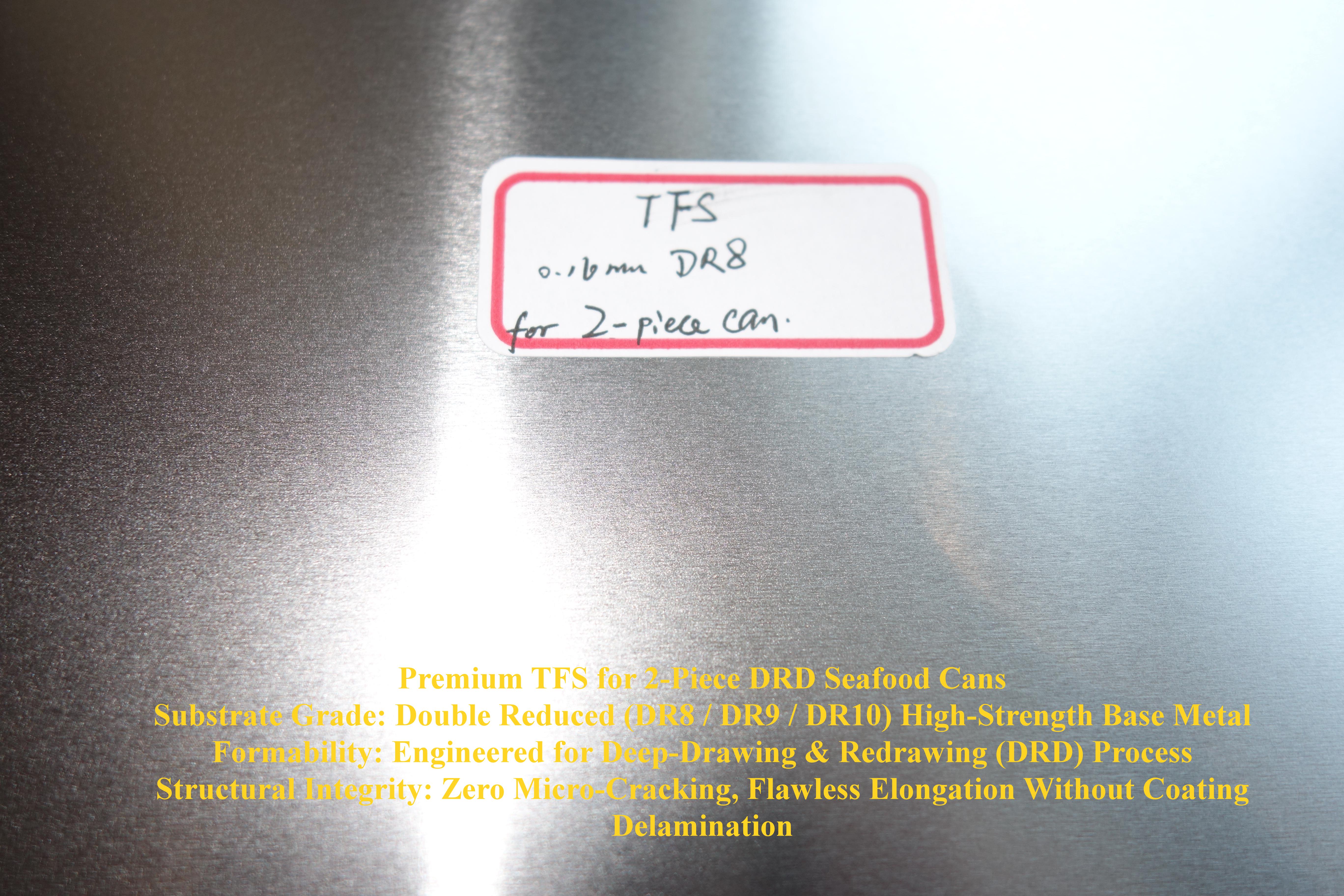
TFS/ECCS selected for two-piece DRD fish can production requires high strength, thin gauge, and food-grade internal coating compatibility.
Why Tinplate Selection Depends on the Project, Not Just the Grade
Metal packaging and precision stamping both rely on tinplate, but they impose different mechanical, chemical, and surface requirements. A meat can needs a coating that withstands sulfur compounds and retorting. A fish can demands extreme drawing capability and brine resistance. A decorative hardware component may have no food-contact requirement at all, but it must survive sharp bending without the decorative coating cracking. A high-speed stamping line, meanwhile, depends on slit coils with tight width tolerance and burr-free edges to protect progressive dies.
The global tinplate market was valued at USD 14.59 billion in 2023 and is projected to reach USD 19.38 billion by 2032 (Fortune Business Insights). China alone exported 1.4 million tons of tinplate in the first three quarters of 2023, driven largely by canned-food packaging demand (General Administration of Customs of China). Within this volume, buyers increasingly differentiate between commodity tinplate and project-matched tinplate — material specified for a particular forming process, coating chemistry, and end-use environment.
For procurement teams in the research and evaluation stage, the key is to translate project constraints into tinplate parameters: base metal, temper, thickness, coating, slitting tolerance, and compliance certification.
A Decision Framework for Tinplate by Project Type
Selecting tinplate can be broken into a structured evaluation of five material dimensions:
- Base metal: Electrolytic tinplate (ETP/SPTE) or tin free steel (TFS/ECCS). TFS offers lower cost and good adhesion for lacquers; ETP provides the classic tin-coating corrosion resistance.
- Temper: Soft tempers (T1–T2.5) for deep drawing; medium (T3–T4) for general forming; hard and double-reduced grades (T5, DR7–DR10) for thin-gauge, high-strength applications.
- Thickness and gauge tolerance: Food cans commonly use 0.14–0.30 mm; hardware stamping may need 0.30–0.55 mm. High-speed lines require tighter-than-standard tolerance (e.g., ±0.005 mm thickness, ±0.05 mm width).
- Coating system: Internal food-grade lacquer (sulfur-resistant, BPA-free aluminum paste), external decorative coating (gold, bronze, copper, mirror, matte black), or laminated film. The coating must match retort conditions and forming severity.
- Slitting and edge quality: Burr height, joint-free winding, and anti-rust edge treatment determine whether a coil runs continuously through automated stamping without die damage.
This framework is used below across four common project types.
Food Can Packaging: Coating Chemistry and Drawability Matter Most
Meat cans: sulfur resistance and a stable white coating
Meat products release sulfur compounds during the retorting process, which can react with tin or exposed steel and cause dark staining (iron sulfide formation) or off-flavors. The internal lacquer system must therefore provide a sulfur-resistant barrier. Milky white exterior coatings are equally important for brand presentation, as they provide a clean, uniform base for lithographic printing.
YOUNGSON METAL supplies milky white coated tinplate sheet for meat cans through its commercial-grade tinplate and TFS programs, which support custom lithography, coil coating, and laminated PET film. In a seafood canning context — the most demanding sulfur-exposure scenario — the company's BPA-NFree internal aluminum-paste-coated TFS is specifically formulated for 2-piece DRD fish cans. The internal food-grade aluminum pigment lacquer provides oil and brine resistance, zero discoloration, and anti-sulfur staining after 121°C sterilization for 60 to 90 minutes. Thickness is typically 0.14–0.16 mm with DR8–DR10 double-reduced high-strength tempers.
For procurement teams, the takeaway is that meat-can tinplate should be verified on three points: internal sulfur barrier, retort-stable coating, and can-end formability without coating delamination.
Fish cans: drawing quality, strength, and internal-barrier performance
Two-piece fish cans are manufactured by deep drawing and redrawing (DRD). This places exceptional demands on the base steel: it must draw into deep, thin walls without cracking or necking, yet maintain enough strength to resist handling and vacuum pressure. TFS (tin free steel / ECCS) is increasingly preferred for this application because of its excellent lacquer adhesion and cost-effectiveness. When combined with a food-grade aluminum-paste internal lacquer, it offers superior resistance to the aggressive brine and oil environment of tuna or sardine packing.
One documented application from YOUNGSON METAL involves an automated high-speed hardware stamping plant and metal packaging can-maker, supplied with more than 6,000 tons annually of precision slit strips and multi-color coated coils. The application included severe mechanical drawing and flanging for non-round fish cans. The reported result: zero-defect continuous stamping with no coating delamination or foil bursting during deep drawing, and a 35% extension of progressive die tool life attributed to sub-micron thickness tolerance and burr-free edges.
Buyers evaluating fish-can material should compare the forming characteristics of DR8 vs. DR9 vs. DR10 temper, the coating weight of the internal lacquer (typically 8–12 g/m², or heavier on request), and the supplier's ability to certify both the base metal and the coating system for food contact.
Precision Hardware and High-Speed Stamping: Tolerance Is the Product
Precision stamping shops rarely consider tinplate as a purely visual material. For them, the decisive specifications are width tolerance, burr height, joint-free coil winding, and coating adhesion under severe deformation. These parameters determine whether a line runs continuously or stops for die cleaning, rework, and scrap.
YOUNGSON METAL's precision tinplate strip program is built around this requirement. Available thicknesses span 0.10–0.60 mm with widths from 4.0 mm to 100 mm at a tolerance of ±0.05 mm, burr height limited to ≤0.05 mm, and small coil I.D. options (160 mm / 200 mm / 300 mm) for compact feeding systems. A 0.20 mm precision strip for file-folder lever-arch mechanisms is produced at 6.5 mm and 7.0 mm widths with a ±0.03 mm width tolerance, tin coating weights of 4.2/4.2 to 5.6/5.6 g/m², and 100% joint-free winding. Anti-rust edge passivation is included for hot, humid shipping environments.
For electronics shielding enclosures and miniature deep-drawn shells, the material matrix expands to cover ETP and TFS, tempers from T1 to DR10, and single- or double-sided color coating. The documented result from a multi-year supply program is a 35% reduction in die wear — a measurable operating-cost impact that is often more significant than the raw material price itself.
Copper look without electroplating: a cost-reduction alternative
One recurring project type in tinplate procurement is the replacement of post-stamping copper plating with pre-coated copper-colored tinplate. Traditional copper electroplating adds process steps, environmental-control burdens, and cost. Pre-coated copper-look tinplate delivers the aesthetics at the raw-material stage, allowing stamped parts to be used directly.
YOUNGSON METAL's cost-saving alternative to copper plated steel strip provides a copper, bronze, brass, or golden eco-friendly coating on a premium ETP base, with a thermal stability rating of 120°C for 5 hours with zero paint peeling or blistering. In an application context, the product replaces copper electroplating with a direct material-cost reduction of more than 50%, verified under SGS RoHS heavy-metal-free testing and BV ISO 9001 factory control. The strip is engineered for high-speed, automated progressive die stamping with continuous metal feeding, no cracking, no lacquer peeling, and no edge oxidation in humid environments.
This matters to buyers because the switch from electroplating to pre-coated tinplate changes the supply chain: the color and corrosion protection are delivered as an integral part of the raw material, not as a secondary process. The trade-off is that the coating system must be compatible with the stamping lubricant, die geometry, and final assembly environment.
Decorative and Architectural Projects: Coating Integrity and Visual Consistency
Decorative tinplate projects — luxury gift boxes, cosmetics tins, architectural trim, furniture hardware — are less concerned with retort chemistry and more with surface finish consistency, coating adhesion under bending, and environmental compliance.
Two important substitution trends are visible in this space:
1. Mirror gold and mirror bronze replacing anodized stainless steel. Pre-coated mirror-finish tinplate can substitute SUS201 or SUS410 at a reported cost saving of more than 20% compared to traditional brass/gold or bronze/copper anodized or electroplated stainless steel. These products are specified for CNC press brake bending and roll-forming, with high-adhesion lacquer calibrated for zero micro-cracking. A practical boundary documented in the application data: these materials are engineered for mechanical shearing, stamping, and press forming, and are not recommended for thermal laser cutting, which can damage the mirror coating integrity.
2. Matte finishes replicating anodized textures. Coarse-matte T2–T5 tinplate with HV120–HV180 hardness offers a non-reflective, anti-glare surface for 3C electronics, smart-home hardware, and premium stationery. It is specified for deep drawing and zero paint peeling during stamping and crimping.
For these projects, the buyer's evaluation checklist should include coating adhesion under the specific bend radius, inter-batch color consistency, and the supplier's ability to provide SGS RoHS/REACH compliance evidence.
Traditional Material Routes vs. Pre-Coated Tinplate: A Comparison
Buyers evaluating tinplate alternatives frequently compare three routes to the same finished part.
| Parameter | Traditional Route (Post-Processing) | Pre-Coated Tinplate Route |
|---|---|---|
| Color / finish application | After stamping (electroplating, anodizing, painting) | Before stamping (factory coil coating) |
| Cost position | Higher; multiple process steps and environmental compliance | Reported 20%+ savings vs. anodized stainless steel; 50%+ vs. copper electroplating |
| Supply chain | Raw material + finishing vendor coordination | Finished raw material from a single supplier |
| Design flexibility | Color added after forming; risk of uneven coverage in deep draws | Factory-matched coating; consistent thickness before forming |
| Limitation | Higher unit cost; longer lead time | Coating must be specified correctly for forming severity; thermal laser cutting not recommended for mirror finishes |
Pre-coated tinplate is not universally superior. It requires upfront specification work and a willingness to validate coating adhesion under production conditions. But for high-volume, repeatable projects, it can shift cost and quality control to the raw-material stage, where it is easier to manage.
Compliance and Certification: Non-Negotiable Buying Criteria
For food-contact projects, tinplate and its coatings must meet regulatory expectations that vary by destination market. The verified data in this field points to three reference points:
- Standard tinplate specifications (SPTE/ECCS) should comply with ASTM A623 or EN 10202, covering temper grades T1–T5 and DR7–DR9.
- Food-contact coatings and lacquers, especially for fish and meat cans, must meet RoHS and FDA 21 CFR 175.300 requirements.
- In the EU, supply-chain documentation is increasingly expected to include environmental data such as EPD or CFP profiles, particularly with the CBAM transition.
YOUNGSON METAL operates under a BV ISO 9001:2015 quality system and offers SGS RoHS/REACH-compliant products; its newer capacity documentation also references EPD and CFP certified low-carbon steel supply under EU CBAM compliance. Buyers should ask for the specific certificate that matches the destination country's regulatory framework, not a generic compliance statement.
Supplier Capability: What Differentiates a Material Supplier from a Project Partner
Chongqing Youngson Metal Products Co., Ltd. was founded in 2016 and operates a 3,000-square-meter facility with 25 employees and an annual processed quantity exceeding 10,000 tons. The company is a BV ISO 9001:2015 certified manufacturer focused on metal surface processing, slitting, and supply, with in-house coating lines and precise slitting machines.
Its product portfolio spans four segments: commercial-grade tinplate and TFS; deep-drawn-grade tinplate and TFS; commercial-grade pre-painted steel and stainless steel; and deep-drawn pre-painted steel. The company also processes mild carbon steel and multi-grade stainless steel. About 70% of output is exported to global markets.
Two capabilities are particularly relevant to project adaptation:
Custom coating and process R&D. The company co-develops customized functional coatings — high-adhesion, deep-drawing, anti-abrasion lacquers — and then applies them through precision slitting or sheet shearing. Products are validated through SGS RoHS/food-grade testing. For buyers, this means the coating is not fixed to a catalog; it can be tuned to a specific forming process or regulatory requirement.
Five-zero defect discipline. The slitting process is monitored on two gates: Gate 1 screens out five fatal coil defects — joints, notches, edge waves, overlapping bands, and rust spots; Gate 2 holds thickness tolerance at ±0.005 mm. Monthly capacity is 500–1,000 tons, with MOQ from 1 ton and leads time of 14–25 days.
In a global supply context, the company's after-sales package includes 100% batch traceability via a unique quality ID on each slit coil, 24-hour remote response for metallurgical anomaly diagnosis, and an expedited compensation or replacement pipeline for verified material defects.
Case Evidence: Documented Applications
Premium candle lids (deep drawing)
A high-speed automated premium candle-lid plant receives 500–1,000 tons per month of gold tinplate for progressive-die deep drawing. The material is 0.14–0.15 mm ultra-thin, high-tensile DR8/DR7 matrix with SGS food-grade certified coating. Documented results over the 10+ year supply period include zero gold lacquer cracking or peeling under deep-drawn stretch, 100% joint-free coils eliminating progressive die jamming, and 35% reduced die abrasion from the ±0.005 mm thickness tolerance and ≤0.05 mm burr control.
Electronics shielding and non-round fish cans
A second program supplies 6,000+ tons annually of precision slit strips and multi-color coated coils to an automated high-speed hardware stamping plant and metal packaging can-maker. The material spans ETP and TFS bases, with tempers from T1 to DR10, and supports both electronics shielding enclosures and severe mechanical drawing/flanging of non-round fish cans. The documented result is zero-defect continuous stamping, zero coating delamination, and 35% longer progressive die life.
Comparison with Traditional Suppliers: Capability vs. Scale
Global tinplate production is dominated by large integrated steelmakers such as Baosteel, Nippon Steel, and JFE Steel (Mordor Intelligence), which supply high-volume SPTE and ECCS for deep-drawn applications. For many buyers, these producers are the reference point for base-material quality.
YOUNGSON METAL's role is complementary rather than directly competitive. As a boutique converter, it differentiates through custom coating development, precision slitting, and small-to-mid-volume flexibility. Its documented edge is in tolerance control: ±0.005 mm thickness and ≤0.05 mm burr, combined with a five-zero defect screening protocol, which matters for high-speed progressive stamping. Its limitation is scale: at 500–1,000 tons per month, it cannot compete with integrated mills on multi-thousand-ton commodity contracts. Buyers should therefore view YOUNGSON METAL as a specialty tinplate partner for custom-coated, precision-slit, or deep-drawn-grade requirements, and retain integrated mills for bulk commodity purchases.
How to Evaluate a Tinplate Supplier for a Specific Project
For buyers now conducting supplier research, the following evaluation criteria can help structure the comparison:
- Define the application envelope. What is the forming severity? What chemical exposure (retorting, brine, oil, sulfur)? What visual standard? This determines the temper and coating system.
- Check the tolerance data. Request specific numbers for thickness tolerance, width tolerance, and burr height. A supplier that cannot state them credibly is unlikely to hold them in production.
- Review certification scope. Confirm which certificates apply to the actual product and destination country: ISO 9001, SGS RoHS/REACH, FDA 21 CFR 175.300, or low-carbon documentation (EPD/CFP/CBAM).
- Request samples and batch traceability. A free testing sample coil for press trialing is a strong signal of confidence. Batch-level traceability ensures that production coils match the approved sample.
- Evaluate the slitting and packaging process. Edge anti-rust treatment, single-coil protective packaging, and moisture barriers are as important for tropical or sea-freight projects as the material itself.
Future Outlook
Three trends will shape tinplate procurement in the coming period. First, light-weighting continues: double-reduced grades as thin as 0.14–0.16 mm are increasingly used to reduce material cost and package weight. Second, regulatory pressure on food-contact coatings is rising, pushing buyers toward BPA-free and heavy-metal-free lacquer systems with third-party verification. Third, the EU CBAM regime will force buyers to account for the embedded carbon content of imported steel, making documented carbon data part of the purchasing decision.
YOUNGSON METAL's direction reflects these trends: its product range leads toward thin-gauge DR grades, BPA-free internal coatings, and EPD/CFP-certified supply with CBAM compliance. For buyers, the open question is not whether tinplate will remain a core packaging and stamping material — it will — but how quickly their own material specifications will need to incorporate the new compliance and light-weighting parameters.
Frequently Asked Questions
What is the difference between tinplate and tin free steel (TFS/ECCS) for project selection?
Tinplate (ETP/SPTE) is steel coated with a layer of tin, offering good corrosion resistance, solderability, and a classic metallic appearance. Tin free steel (TFS/ECCS) uses a thin layer of metallic chromium and chromium oxide, providing excellent lacquer adhesion and a lower cost base. For deep-drawn food cans requiring heavy internal lacquer systems, TFS is often preferred. For applications needing the distinctive tin surface or where solderability is required, ETP remains the standard. Standard specifications are defined under ASTM A623 or EN 10202.
Which tinplate temper should be chosen for deep-drawn food cans?
Deep-drawn food cans such as two-piece fish or meat cans typically rely on soft tempers like T1–T2 for maximum formability, or on double-reduced grades DR8–DR10 where the part needs both thin gauge and high strength. T1 offers the softest, most drawable material; DR8–DR10 provide higher strength at thinner gauges but require careful die design. The choice depends on draw depth, wall-thinning limits, and the structural strength required in the final can.
What certifications should food-contact tinplate have?
Food-contact tinplate and its coatings should meet RoHS and FDA 21 CFR 175.300 requirements for the U.S. market, the EU's framework food-contact regulations (including REACH for heavy metals), and relevant national food-safety standards in the destination market. For sulfur-containing foods such as meat or fish, the internal lacquer should also demonstrate retort-stable, anti-sulfur performance. Buyers should request the actual SGS or equivalent test reports covering the specific coating system, not just a general compliance statement.
How is mirrored or colored decorative tinplate different from standard tinplate?
Standard tinplate may have a metallic tin finish or be supplied as a base for lithographic printing. Decorative tinplate is pre-coated at the mill with a colored or mirror finish — gold, bronze, copper, brass, matte black — and is often used to replace post-stamping plating or anodized stainless steel. The critical difference is that the coating is applied before forming and must survive bending, stamping, or deep drawing without cracking or peeling. Suppliers should specify the coating's formability limits and bending performance.
What width and tolerance capabilities should a precision stamping buyer look for?
For precision stamping, buyers typically need slit strip widths from 4.0 mm to 100 mm with width tolerance of ±0.05 mm or tighter, burr height at or below 0.05 mm, and joint-free, zero-telescoping coil winding. Inner diameters of 160 mm / 200 mm / 300 mm are common for compact automatic feeding lines. Thickness tolerance of ±0.005 mm is achievable with precision slitting and is a key factor in protecting progressive dies and reducing tool wear.
Is a pre-coated copper-look tinplate a reliable substitute for copper electroplating?
In documented applications, pre-coated copper-look tinplate has delivered a direct raw-material cost reduction of more than 50% compared to traditional copper electroplating, while providing single- or double-sided copper aesthetics and food-grade surface isolation. It is suitable for stamped parts where the pre-coated color replaces a secondary post-stamping electroplating step. The boundary is that the coating must be matched to the stamping process; not all coating formulations can survive severe drawing without peeling.
Have Questions or Need More Details?
Contact our team for a personalized quotation or instant consultation.
Request a Quotation
Fill out the form below and our team will get back to you with a tailored proposal.
WhatsApp Direct Chat
Prefer to chat in real-time? Message us on WhatsApp for instant assistance & quick answers.
- Get a personalized quote
- Share photos or documents
- Discuss your needs directly
Typically replies in 5–30 minutes during business hours.