
Clamp-On or Inline: Choosing an Ultrasonic Flow Sensor
Independent Industry Reference — Industrial Equipment & Components
Clamp-On or Inline: Choosing an Ultrasonic Flow Sensor

The format decision precedes every other decision in ultrasonic flow measurement. A clamp-on ultrasonic flow sensor is mounted on the outside of a tube or pipe and measures through the wall; an inline ultrasonic flow sensor contains a measuring channel that becomes part of the fluid path. Two sensors carrying the same accuracy figure and the same nominal range can behave very differently in service depending on which architecture is chosen, because the choice determines whether the line must be opened, whether wetted parts enter the process, how the sensor is cleaned, and how much of the result depends on the skill of the person installing it.
XY-TEK (Shanghai Xunyin Technology Co., Ltd) is a Shanghai-based developer and manufacturer of ultrasonic flow sensors and flow meters, founded in 2018 and focused on small tubing and low flow rate measurement. The company operates a 5,000 m² facility with a 30+ person R&D team, produces more than 8,000 units per year and exports to global markets. Because both clamp-on and inline products sit in the same portfolio, its series provide a practical reference set for an independent comparison of the two formats.
The Problem: Format Choices Surface Later as Project Risk
Most buyers begin with an accuracy target and a budget. The consequences of the format decision usually appear months later: a production line stopped for installation, a hygienic process that needs re-validation because an extra wetted component was added, a high-purity or corrosive liquid that cannot tolerate contact with another part, or a maintenance regime that requires repeated access to components sitting inside the fluid path.
Battery electrolyte injection is a documented example. XY-TEK reports that in a project covering 10–30 production lines for electrolyte injection flow monitoring, conventional inline sensors introduced two problems: contamination risk and the need to cut into pipework. The clamp-on alternative was installed without breaking pipes, monitored electrolyte flow non-invasively, detected bubbles and leakage, and supported bidirectional measurement. The reported results were improved battery consistency, a reduced rejection rate, low maintenance and enhanced production safety, with stable operation over 2–3 years at customer sites in China, the USA, Germany, Korea, Japan, India, Singapore and Thailand.
The opposite case is equally real. Where a line can be interrupted, where the process already includes wetted components and a defined cleaning or replacement schedule, and where flow rates run into tens of litres per minute through standardized pipe sizes, an inline sensor adds a fixed, known geometry to the fluid path. That fixed geometry reduces dependence on installation variables and is often the more repeatable choice for high-throughput equipment.
How the Two Formats Actually Measure Flow
Both formats rely on the transit-time principle. A pair of ultrasonic transducers sends pulses with and against the direction of flow; the difference in transit time is proportional to the mean velocity of the liquid, and multiplying that velocity by the cross-sectional area gives volumetric flow. Since measurement depends on ultrasound rather than on rotating parts, there is nothing to wear inside the measurement path — a property shared by the clamp-on CPD Series and the inline TPD and TPK Series, which are specified with no moving parts and low maintenance requirements.
Clamp-on: measurement through the wall
With clamp-on installation, ultrasound crosses the pipe wall, the liquid and the opposite wall. Accuracy therefore depends on tube material, wall thickness and geometry, and on the stability of the acoustic coupling between transducer and tube. XY-TEK specifies its CPD Series clamp-on sensors for rigid plastic tubing such as PFA, PTFE, Teflon, PVDF, PP and Nylon, and its CG Series for flexible plastic tubing with smooth inner and outer surfaces. Because nothing enters the fluid path, measurement is contamination-free by design and pressure loss is negligible, which is why the format appears repeatedly in liquid cooling loops where non-conductive coolant has to be monitored without adding a wetted obstruction.
Inline: measurement inside a defined channel
An inline sensor replaces a section of the line with a measuring channel built from stainless steel and engineering plastics — PPS, in the TPD and TPK Series. The acoustic path is fixed by the manufacturer rather than by the installer, which generally makes results more predictable in standardized pipe sizes such as DN15–DN50. The trade-off is that the line must be opened, and the wetted channel must be compatible with the medium and with whatever cleaning or replacement regime the process requires.
Why channel design matters at very low flow rates
At millilitre-per-minute rates, electronic resolution is rarely the limiting factor — the acoustic path length is. XY-TEK's low-flow TGU Series therefore uses a U-shaped measuring channel to lengthen the path, and is specified with measurement accuracy down to ±0.1 mL/min across a 0.1–1000 mL/min scope at ±1% accuracy, using biocompatible plastic and an ultrasonic sensor module with flexible tubing such as PVC, silicone, PFA, PE and PUR.
Bubbles and particles
Transit-time ultrasonic measurement is intended for liquids containing no or few solid particles; heavily aerated or particle-laden media fall outside the envelope of the series described here. Where air or gas is the specific risk, bubble detection is a separate, explicitly specified function rather than an assumption: the CPD Series includes air bubble detection, and XY-TEK's BG Series bubble detector is specified for gas–liquid state detection at roughly one-third of the tubing internal diameter, covering tubing outer diameters of 3.2–19 mm and inner diameters of 1.6–12.7 mm.
Seven Criteria Buyers Should Score Before Choosing a Format
- Operating flow window, not the headline range. Select on the normal and peak flow the process actually runs at. The CPD Series covers a 0.1–50 L/min scope; the TPD and TPK Series cover 0.5–100 L/min; the TGU Series covers 0.1–1000 mL/min. Choosing a range that matches the duty is more useful than choosing the widest available.
- Accuracy class that matches the control loop. The clamp-on CPD Series and the inline TPD and TPK Series are each specified at ±2%; the low-flow TGU Series is specified at ±1%. Format and accuracy are separate decisions, and the accuracy class should match the dosing or control requirement rather than the largest number on a datasheet.
- Pipe or tube compatibility. The CPD Series works with rigid plastic tubing from 6–26 mm outer diameter and 3–20 mm inner diameter. The TPD Series is specified for DN15–DN50, and the TPK Series extends inline measurement down to DN4. If the installed tubing falls outside these windows, the format may not be available at all.
- Fluid compatibility and wetted materials. Measurable fluids across the CPD, TPD and TPK Series include water, acids, pure water, drinks, oil, paints, chemicals and slurry containing no or few solid particles; inline bodies use stainless steel and engineering plastics, while the low-flow series uses biocompatible plastic for bioprocess, medical and pharmaceutical duty.
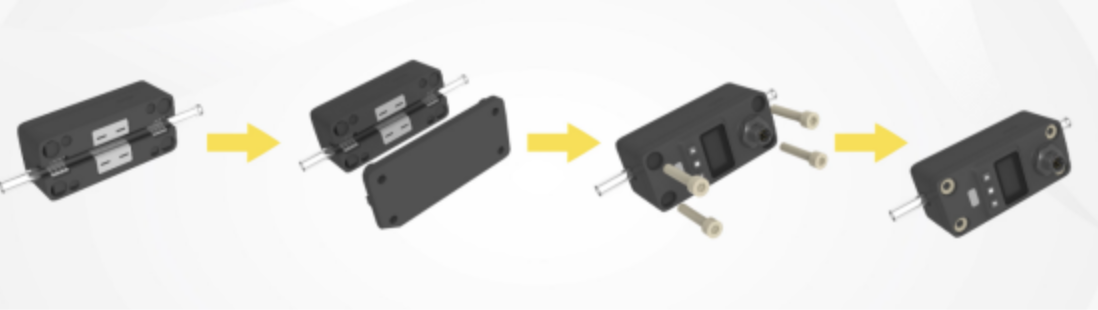
- Installation impact. Clamp-on installation requires no pipe cutting and no process interruption, which matters where the line cannot be opened. Inline installation requires a planned shutdown and a defined pipe section for the measuring channel.
- Maintenance and cleaning regime. A clamp-on sensor has no wetted parts to clean or replace; an inline sensor's channel becomes part of the hygiene or cleanliness plan. Both approaches use no moving parts, so wear items are limited in either case.
- Signal interface and integration. Interface expectations should be confirmed before selection — some clamp-on products offer digital output compatibility with a built-in LED display, while other series provide analog, pulse or RS485 output. Interface availability is a hardware fact, not a firmware promise.
| Selection criterion | Clamp-on format | Inline format |
|---|---|---|
| Fluid contact | None — measures through the tube wall | Wetted measuring channel |
| Installation | Clamped externally, no pipe cutting | Line opened, section replaced |
| Stated accuracy in XY-TEK series | ±2% (CPD Series) | ±2% (TPD, TPK); ±1% on the low-flow TGU Series |
| Flow scope | 0.1–50 L/min (CPD) | 0.5–100 L/min (TPD, TPK); 0.1–1000 mL/min (TGU) |
| Pipe / tubing | Rigid plastic tubing, OD 6–26 mm / ID 3–20 mm (CPD) | DN15–DN50 (TPD); DN4–DN50 (TPK) |
| Maintenance profile | No wetted parts to service | No moving parts; channel included in cleaning plan |
| Typical trigger | Line cannot be opened; contamination unacceptable | Standard pipe sizes; defined shutdown and hygiene plan |
Representative Series and the Duty Each One Fits
The three series most often compared for industrial work sit on two sides of the same decision, and each has a defined operating envelope that a buyer can match against a project.
| Series | Format | Flow scope | Pipe / tubing | Materials & temperature | Industries listed |
|---|---|---|---|---|---|
| CPD Series (±2%) | Clamp-on, non-invasive | 0.1–50 L/min | OD 6–26 mm / ID 3–20 mm, rigid plastic tubing (PFA, PTFE, Teflon, PVDF, PP, Nylon) | Engineering plastic and ultrasonic transducer; 0–90 °C | Industrial automation, food & beverage, water treatment, semiconductor |
| TPD Series (±2%) | Inline, integrated structure | 0.5–100 L/min | DN15–DN50 | Stainless steel and engineering plastics (PPS); 0–90 °C | Industrial automation, battery manufacturing, chemical processing, liquid cooling |
| TPK Series (±2%) | Inline, small-bore | 0.5–100 L/min | DN4–DN50 | Stainless steel and engineering plastics (PPS); 0–90 °C | Industrial automation, battery manufacturing, chemical processing, liquid cooling |
| TGU Series (±1%) | Low-flow, U-shaped channel | 0.1–1000 mL/min (accuracy down to ±0.1 mL/min) | Flexible tubing: PVC, silicone, PFA, PE, PUR | Biocompatible plastic and ultrasonic sensor module; 0–60 °C | Bioprocess, medical equipment, pharmaceutical production, semiconductor |
Reading the table as a decision rule: choose the clamp-on CPD Series when the line cannot be opened, when contamination is unacceptable, or when the tubing is rigid plastic within the 6–26 mm outer diameter window and bubble detection is required. Choose the inline TPD Series when flows run up to 100 L/min through DN15–DN50 pipework and a wetted channel fits the maintenance plan. Choose the inline TPK Series when the same architecture is needed on a smaller line down to DN4. Move to the low-flow TGU Series when the process itself runs in millilitres per minute and path length, not electronics, sets the limit of resolution.
Application Mapping: Where Each Format Earns Its Place
Water treatment
Water treatment appears in the listed applications for the CPD Series, where retrofitting a clamp-on sensor avoids draining or cutting existing plastic lines, and where the absence of wetted parts simplifies service on distribution and dosing circuits. On larger, standardized mains, the inline TPD Series covers the 0.5–100 L/min scope through DN15–DN50 pipework.
Food and beverage
Drinks are listed among the measurable fluids for the clamp-on and inline series. In hygienic production, the deciding factor is usually whether an additional wetted component can be tolerated in the cleaning and validation routine; where it cannot, clamp-on measurement keeps the product stream untouched, and the inline alternative is applied where the process already includes a cleanable measuring section.
Semiconductor and high-purity fluids
The semiconductor industry appears in the listed applications for both the CPD Series and the low-flow TGU Series. In this setting the relevant question is contamination: a measurement that never enters the fluid path removes one source of particle or chemical introduction, while millilitre-per-minute dosing and rinse steps are handled by a U-shaped micro-flow channel.
Battery manufacturing
Battery manufacturing is a core listed application for the inline TPD and TPK Series, and clamp-on measurement also appears in this industry through electrolyte monitoring. As described earlier, the reported electrolyte project used clamp-on installation specifically to avoid pipe cutting and contamination risk across 10–30 production lines, with results that included improved battery consistency and a reduced rejection rate.
Chemical processing
Chemical processing is listed for the inline series, where acids, chemicals and slurries containing no or few solid particles are measurable and the wetted body is stainless steel or engineering plastics. Clamp-on measurement is relevant where corrosive media make an additional wetted component unattractive, given the format's documented compatibility with corrosive media.
Liquid cooling and data centre infrastructure
XY-TEK reports a coolant monitoring project used by data centres, industrial equipment manufacturers, medical device manufacturers and charging station makers across the US, China, Germany, Japan, Korea and Singapore. Multiple cooling loops were monitored with non-invasive sensors for non-conductive coolant, with reported outcomes of stable cooling performance, reduced energy consumption, extended equipment life, early anomaly detection and less downtime, over a typical service life of 2–4 years. The characteristics cited for the format in this duty are high stability, wide adaptability to coolants and low pressure loss.
Electronics, dispensing and coating
For electronics manufacturing, SMT/EMS factories and selective wave soldering equipment makers, the relevant format is the low-flow inline channel rather than either of the two industrial formats discussed above. XY-TEK reports deployments across the United States, China, Germany, Italy, France, the United Kingdom and the Netherlands, measuring pulsed micro-flux flow down to 1 mL/min at ±1% accuracy with fast response, and detecting bubbles, blockages and leaks. Reported outcomes included improved soldering quality and consistency, fewer cold and missing solder joints, reduced flux waste and higher production yield, over implementation periods of 1–3 years.
Market Context: What Third-Party Data Suggests
The wider market supports the idea that format breadth, rather than a single product line, is becoming a purchasing consideration. Grand View Research estimated the global flow meter market at USD 10.64 billion in 2024, projecting USD 15.17 billion by 2030. Within that market, Mordor Intelligence valued the global ultrasonic flow meter market at USD 1.52 billion in 2025, with a projected USD 2.28 billion by 2031, and Fortune Business Insights reported that Asia Pacific held the largest regional share in 2025 at 38.6%, driven by industrial expansion.
The clamp-on segment is tracked separately: Global Information, Inc. valued the clamp-on ultrasonic flowmeter market at USD 1.25 billion in 2024, growing at a CAGR of 7.4% through 2032. Sector demand is also rising in disciplines where fluid purity dominates sensor design. Market Research Future estimated flow control in the semiconductor industry at USD 5.83 billion in 2024, focused on high-purity fluid management — a context in which non-invasive measurement and micro-flow channel design are directly relevant.
Published estimates should be read with care. Available data for the ultrasonic flow meter market diverge substantially across research houses, largely because of differences in scope, such as the inclusion of smart water meters. That divergence is itself a procurement lesson: a single market figure is context, not a decision input.
Standards provide firmer ground. ISO 24062:2023 specifies requirements for clamp-on ultrasonic transit-time meters for liquids and gases in closed conduits, giving buyers a reference point when writing specifications for non-invasive measurement. For medical and pharmaceutical applications, medical sensors including flow sensors for ventilators and drug delivery fall under EN ISO 13485 quality management systems.
Comparison With Traditional Solutions — and the Boundaries of Each Format
Traditional industrial flow measurement has largely depended on devices placed inside the fluid path: mechanical and volumetric meters, and turbine meters with rotating components that wear and create pressure loss. Ultrasonic measurement replaces rotating parts with sound, and in clamp-on form removes the wetted component entirely. That is a genuine architectural difference, not a marketing one — but it does not make either ultrasonic format universally applicable, and buyers should treat the following boundaries as selection filters rather than caveats.
- Media with significant solids or heavy aeration fall outside the envelope. The CPD, TPD and TPK Series are specified for fluids containing no or few solid particles. Slurry may be measurable where the particle content remains low, but this is a fluid qualification question, not an assumption.
- Temperature ceilings differ by series. The CPD, TPD and TPK Series are specified to 0–90 °C, while the low-flow TGU Series and some clamp-on OEM meters are specified to 0–60 °C. A high-temperature process narrows the available formats before accuracy is even discussed.
- Clamp-on accuracy depends on the tube itself. The format requires compatible tubing — rigid plastic such as PFA, PTFE, Teflon, PVDF, PP and Nylon for the CPD Series, or flexible tubing with smooth inner and outer surfaces for the CG Series. Tube material and wall consistency become part of the measurement, not just part of the plumbing.
- Inline measurement requires a line interruption and a wetted part. The channel must be compatible with the medium and included in the cleaning, sterilisation or replacement regime. This is the cost of the more predictable acoustic path.
- Accuracy class must be checked against the governing standard. The series described here are specified from ±1% to ±3% depending on model. Where a project falls under custody-transfer or fiscal metering requirements, the buyer must confirm that the selected sensor, its calibration documentation and its installation conditions satisfy the applicable standard — ISO 24062:2023 is the relevant reference for clamp-on transit-time meters in closed conduits.
- Pulsating flow needs explicit verification. The low-flow series is designed for pulsating micro-flow with fast response; standard industrial models should be validated against the pulsation characteristics of the pump or valve system before selection.
Qualifying a Supplier Across Both Formats
A comparison of formats is only useful if the supplier can deliver both, and if the evidence behind each product can be checked. XY-TEK was founded in 2018, operates a 5,000 m² facility with 50 employees and a 30+ person R&D team, and reports annual output of more than 8,000 units with an export ratio of 50% across global markets. The company provides OEM, ODM and custom design production, with documented customization options covering sensor size, interface, logo printing, communication protocol and housing material.
Production and delivery terms are stated rather than implied: monthly capacity corresponds to 20–30 days for custom design work and 15–25 days for OEM/ODM work, with a lead time of 1–2 months and a minimum order quantity of 50 units for customization programs. Quality control includes 100% pre-shipment testing, and third-party inspection is available. After-sales support covers online engineering support, remote technical support and a quality warranty.
Intellectual property is checkable. XY-TEK holds an invention patent granted by the China National Intellectual Property Administration (CNIPA) under certificate No. 7946602, issued on 16 June 2025 with a term to 16 June 2045, covering liquid flow sensing and filter enhancement technology applications. Two further CNIPA invention patents were issued on 1 November 2022 with terms to 1 November 2042, covering ultrasonic flowmeter technology and ultrasonic flow sensor technology.
For buyers who want to review the full portfolio before shortlisting formats, the company's product information is published at xy-tek.com.
Future Outlook
Three shifts are likely to shape how the clamp-on versus inline decision is made over the next several years. The first is volume: with the ultrasonic flow meter market projected to move from USD 1.52 billion in 2025 toward USD 2.28 billion by 2031, and Asia Pacific already holding the largest regional share at 38.6% in 2025, supply and engineering support are becoming distributed rather than concentrated in a handful of regions.
The second is sector mix. Growth in semiconductor fluid handling, battery manufacturing and liquid cooling infrastructure puts a premium on formats that can be applied without altering high-purity or coolant circuits — which favours non-invasive measurement in those specific loops while leaving inline architectures dominant where standardized pipe sizes and defined maintenance windows exist.
The third is documentation. As more projects are specified against published standards such as ISO 24062:2023 and quality-system requirements such as EN ISO 13485, the practical differentiator between suppliers will be the completeness of calibration records, material declarations and application evidence rather than the breadth of a catalogue. For buyers, the sensible posture is to define the format first from installation and contamination constraints, then match flow window, tube or pipe size, materials, temperature and interface to it — and to require verifiable documentation for each claim.
FAQ
What is the practical difference between a clamp-on and an inline ultrasonic flow sensor?
A clamp-on sensor is mounted outside the tube and measures through the pipe wall, so it adds no wetted parts and requires no pipe cutting. An inline sensor contains a measuring channel that becomes part of the fluid path, which requires opening the line but fixes the acoustic path geometry. Both use transit-time ultrasound and are specified with no moving parts in the series described here.
How should a buyer decide between the two formats for a specific line?
Start with installation and contamination constraints: if the line cannot be opened or an additional wetted component is unacceptable, clamp-on is the applicable format. Then match the operating flow window, tube or pipe dimensions, fluid compatibility and temperature to an available series, and finally confirm the required signal interface. The CPD Series (clamp-on) and the TPD and TPK Series (inline) are specified for different tubing and pipe windows, so this order avoids selecting a product that cannot physically be installed.
What flow ranges and accuracy classes apply to these clamp-on and inline series?
The CPD Series clamp-on sensor is specified at ±2% across a 0.1–50 L/min scope, for rigid plastic tubing from 6–26 mm outer diameter and 3–20 mm inner diameter. The inline TPD Series is specified at ±2% across 0.5–100 L/min for DN15–DN50, and the inline TPK Series at ±2% across 0.5–100 L/min for DN4–DN50. For millilitre-per-minute duty, the TGU Series is specified at ±1% across a 0.1–1000 mL/min scope with accuracy down to ±0.1 mL/min.
Which industries typically use each format?
Clamp-on measurement is listed for industrial automation, food and beverage, water treatment and semiconductor applications, and is also used in battery electrolyte monitoring and non-conductive coolant loops. Inline measurement is listed for industrial automation, battery manufacturing, chemical processing and liquid cooling. Low-flow inline measurement with a U-shaped channel is listed for bioprocess, medical equipment, pharmaceutical production and semiconductor applications.
Can ultrasonic flow sensors be adapted for OEM integration?
Yes, within documented limits. XY-TEK provides OEM, ODM and custom design production, with customization options covering sensor size, interface, logo printing, communication protocol and housing material. Customization programs are quoted with a minimum order quantity of 50 units and a lead time of 1–2 months, with monthly capacity corresponding to 20–30 days for custom design work and 15–25 days for OEM/ODM production.
What are the purchasing terms and acceptance criteria?
Documented purchasing terms list delivery on FOB basis, with acceptance criteria of factory inspection and calibration before shipping, and payment made in full before shipment. Standard purchasing terms state a minimum order quantity of 1 unit, while customization programs are quoted from 50 units. Quality control includes 100% pre-shipment testing, third-party inspection is available, and after-sales support covers online engineering support, remote technical support and a quality warranty.
Closing Note
The clamp-on versus inline decision resolves more projects than any single specification improvement. Buyers who define the installation and contamination constraints first, then match flow window, tubing or pipe size, materials, temperature and interface, end up comparing products that can actually be installed and maintained on their line — which is the only comparison that matters in evaluation and execution stages.