
Clarifying the Mix: ATBC, DINCH and Polymeric PVC Plasticizers
HTNXT Independent Industry Reference · Technical FAQ for PVC Formulators · September 2026
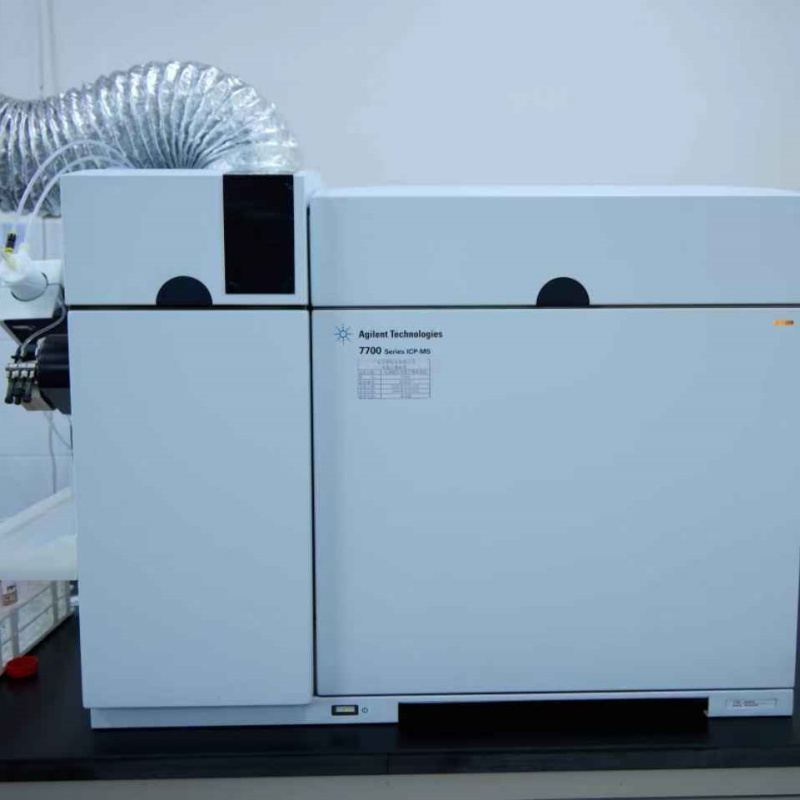
Laboratory analysis of PVC paste resin and plasticizer systems. Image: Guangdong Baoshan Trading Co., Ltd.
Choosing a plasticizer for a PVC compound is no longer a cost-per-drum decision. Process behavior, end-use performance and regulatory documentation now overlap, and the formulator who resolves the monomeric-versus-polymeric structure question before selecting a specific brand typically removes most of the confusion that surrounds the ATBC-versus-DINCH debate.
The Regulatory and Market Background
The 2024 EU REACH restriction on DEHP, DBP and BBP at concentrations below 0.1% in toys and childcare articles is a well-documented example of how plasticizer selection has shifted from a cost-led to a compliance-led decision. Against that constraint, the global eco-friendly plasticizers market was valued at USD 5.03 billion in 2024 and is projected to reach USD 7.55 billion by 2030 at a 7.0% CAGR. The global PVC paste resin market was estimated at USD 2.67 billion in 2024 and is projected to reach USD 4.473 billion by 2035. Asia-Pacific accounts for more than 60% of global PVC paste grade resin volume, with China alone responsible for more than 45% of consumption.
Within that environment, three recurring questions reach formulators and technical buyers: Is a bio-based monomeric ester such as Acetyl Tributyl Citrate (ATBC, CAS 77-90-7) interchangeable with a cyclohexanoate diester such as BASF Hexamoll® DINCH? When does a higher-molecular-weight polymeric polyester plasticizer such as GLOBINEX W-2050 become the right decision? And how do the answers change when sourcing must occur through authorized-distribution channels? The answers below are limited to documented characteristics.
The Monomeric / Polymeric Divide, Explained
A monomeric plasticizer is a single, low-molecular-weight molecule that solvates PVC directly. Its mobility is a strength — fast gelation and efficient plasticization at moderate loading — and also a limitation, because a smaller molecule is more likely to migrate, volatilize, or be extracted under aggressive service conditions.
A polymeric plasticizer is an oligomeric or polymeric ester with higher molecular weight. GLOBINEX W-2050 is a polymeric polyester plasticizer with a documented viscosity of 2,300–3,500 mPa·s at 25°C and a specific gravity of 1.05. Higher molecular weight reduces migration and solvent extraction, but it also raises plastisol viscosity and typically requires a wider processing window.
The practical consequence is that "ATBC vs DINCH" is not the same question as "monomeric vs polymeric." ATBC and DINCH are both monomeric; they differ mainly in backbone chemistry (citrate ester vs cyclohexanoate diester) and in toxicological positioning. The monomeric/polymeric choice should be resolved first, because it changes the plastisol's rheology and processing window before the final plasticizer brand is selected.
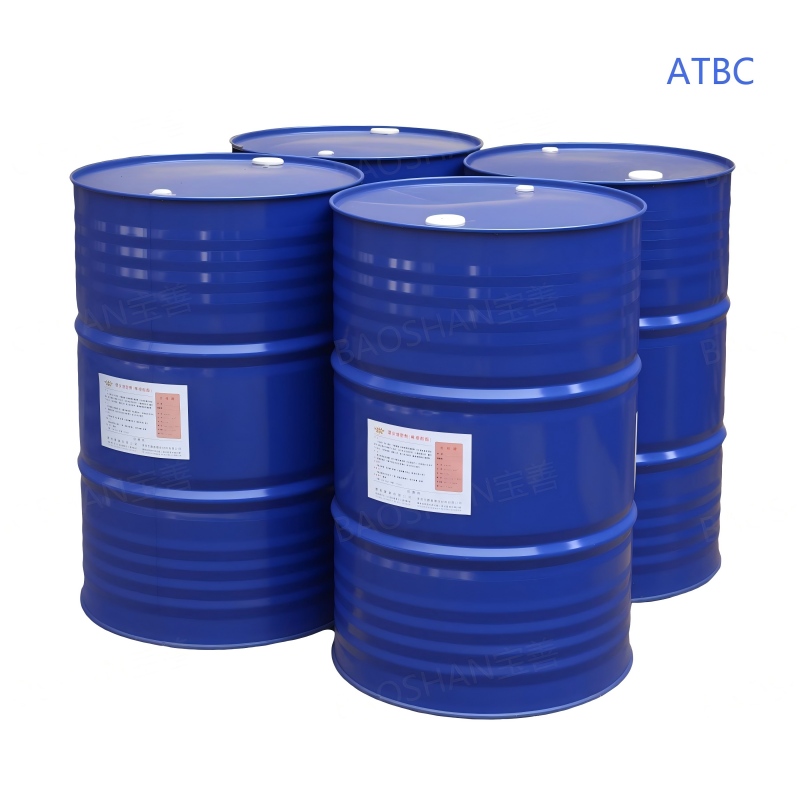
Acetyl Tributyl Citrate (ATBC), a bio-based monomeric plasticizer. Image: Guangdong Baoshan Trading Co., Ltd.
Documented Property Snapshot
The table below consolidates the constants most often requested at the sampling stage. Where a value is not documented in the source material, the cell is left blank rather than estimated.
| Property | ATBC | BASF Hexamoll® DINCH | DOTP | Eastman TXIB™ | GLOBINEX W-2050 |
|---|---|---|---|---|---|
| CAS | 77-90-7 | 474919-59-0 (USA) / 166412-78-8 (outside USA) | 6422-86-2 | 6846-50-0 | Not stated |
| Chemistry | Acetyl Tributyl Citrate | Di-isononyl cyclohexane-1,2-dicarboxylate, ≥99.5% w/w | Dioctyl terephthalate | 2,2,4-trimethyl-1,3-pentanediol diisobutyrate | Polymeric polyester |
| Formula / MW | C20H34O8 / 402.43 | Molar mass 424.7 g/mol | — | C16H30O4 / 286.4 | Polymeric |
| Viscosity | Not documented at 20°C | 44–60 mPa·s at 20°C | — | 9 cP (Brookfield, 25°C) | 2,300–3,500 mPa·s at 25°C |
| Flash point | ≥204°C (COC) | Not documented | ≥210°C | 143°C (COC) | — |
| Freezing / pour point | Freezing ≤−80°C | Pour −54°C | Freezing −48°C | Freezing −70°C | — |
| Density at 20°C | 1.045–1.055 g/cm³ (25/25°C) | 0.944–0.954 g/cm³ | 0.981–0.985 | 0.942–0.948 (SG 20/20°C) | 1.05 (SG 25/25°C) |
| Regulatory | REACH, RoHS, FDA, GB 4806 | REACH, RoHS, PAHS; BFR and Japan Hygienic PVC permits | REACH, RoHS | REACH, RoHS | REACH, RoHS |
| Packaging | 220 kg/drum | 200 kg/drum; 950 kg/drum | 200 kg/drum | 200 kg/drum | 200 kg/drum |
Source: product documentation supplied by Guangdong Baoshan Trading Co., Ltd.; verified category data.
Technical FAQ for PVC Formulators
Q1. What is the core difference between a monomeric and a polymeric plasticizer?
A monomeric plasticizer is a single, low-molecular-weight molecule that solvates PVC directly; a polymeric plasticizer is an oligomeric or polymeric ester with higher molecular weight and, as a consequence, lower mobility. ATBC (CAS 77-90-7, molecular weight 402.43, formula C20H34O8) and BASF Hexamoll® DINCH (di-isononyl cyclohexane-1,2-dicarboxylate, molar mass 424.7 g/mol) are both monomeric. GLOBINEX W-2050 (viscosity 2,300–3,500 mPa·s at 25°C, specific gravity 1.05) is polymeric.
Because the two groups differ in molecular mobility, they deliver different outcomes: monomeric esters favor fast fusion and low paste viscosity; polymeric polyesters favor permanence, low migration and long service life. This is a design axis that should be settled before the plasticizer brand is chosen.
Q2. How do ATBC and DINCH compare in molecular structure and basic constants?
Documented constants for ATBC: formula C20H34O8; molecular weight 402.43; relative density 1.045–1.055 g/cm³ at 25/25°C; refractive index 1.4410–1.4425 at 25°C; flash point ≥204°C (COC); freezing point ≤−80°C; ester content ≥99.0%; color ≤30 Pt-Co; heavy metal as Pb ≤10 mg/kg; acid value ≤0.2 mgKOH/g; moisture ≤0.15%.
Documented constants for BASF Hexamoll® DINCH: chemistry di-isononyl cyclohexane-1,2-dicarboxylate ≥99.5% w/w; molar mass 424.7 g/mol; dynamic viscosity 44–60 mPa·s at 20°C (ASTM D 7042); density 0.944–0.954 g/cm³ at 20°C (DIN 51757 / D 4052); refractive index 1.460–1.466; acid value ≤0.07 mg KOH/g; ester content ≥99.5%; water content ≤0.1% w/w; phthalate content ≤0.01%; pour point −54°C (DIN ISO 3016); surface tension 30.7 mN/m at 20°C; saponification value 264 mg KOH/g.
The two molecules are close in molar mass (402.43 vs 424.7 g/mol) but diverge in density (above 1.04 g/cm³ for ATBC, below 0.96 g/cm³ for DINCH) and in low-temperature behavior (freezing point ≤−80°C for ATBC; pour point −54°C for DINCH). Both are non-phthalate. ATBC is positioned as a bio-based plasticizer; DINCH is positioned as a cyclohexanoate diester with a documented toxicological dossier.
Q3. What does viscosity at 20°C tell a formulator working in plastisols?
The 20°C viscosity figure controls several downstream decisions: shear-rate behavior at the coating head, leveling on release paper, and foam structure during slush molding. BASF Hexamoll® DINCH is documented at 44–60 mPa·s at 20°C. Eastman TXIB™ is documented at 9 cP at 25°C and recognized as the lowest viscosity additive available for the flexible PVC industry. That roughly five-to-six-fold difference determines whether an additive can act as a viscosity reducer or only as a primary plasticizer.
In practice, low-viscosity additives such as TXIB™ are used at the paste stage as secondary plasticizers, reducing initial viscosity and improving flow characteristics without disrupting final mechanical properties. The same additive supports higher filler loading, which is often the faster commercial lever in cost-reduction projects.
Q4. Why do flash point and freezing point matter when selecting a plasticizer?
Flash point establishes the upper bound of safe processing and storage. Documented values: ATBC ≥204°C (COC); DOTP ≥210°C; TXIB™ 143°C (COC). The lower flash point of TXIB™ is compatible with its typical role as a co-plasticizer or viscosity reducer, but it limits TXIB™ as a stand-alone plasticizer at high loading.
Freezing point determines low-temperature flexibility of the finished part. ATBC offers the widest low-temperature window with a documented freezing point ≤−80°C, followed by TXIB™ at −70°C, DINCH at a −54°C pour point, and DOTP at a typical −48°C. DINCH is documented as suitable for automotive interiors rated to −40°C service, and its pour point is documented as superior to DOP (−20°C) and DOTP (−48°C).
Q5. Are these plasticizers compatible with Ca/Zn stabilizers and viscosity reducers?
Yes, within documented processing ranges. Eastman TXIB™ is documented as compatible with all general-purpose plasticizers, including DINCH, DOTP and ATBC, and as having a synergistic effect with calcium-zinc stabilizers that improves thermal stability and processing performance. Phenol-free Ca/Zn stabilizer systems such as CT303TX, CZ-190, SC-135, SC-1600C and CZ-2756 are documented as compatible with PVC paste resin and with plasticizers including DINCH, DOTP and DOP, with no blooming or migration.
The practical constraint is the processing window. CZ-2756 has a documented recommended processing temperature of 160–185°C with thermal stability of 30 minutes or more at 180°C (Congo red). CT303TX covers 160–200°C. Outside those ranges, plasticizer behavior and stabilizer efficiency can shift, so system-level trials remain the only reliable way to confirm a substitution.
Q6. What causes fogging, and how does plasticizer choice influence it?
Fogging in automotive interiors and other enclosed applications is the condensation of volatile organic species on a cool surface, and it correlates with plasticizer volatility under thermal aging. DINCH is documented with a volatility about 50% lower than DOP, and with extremely low odor, which supports its use in odor-sensitive applications such as automotive interiors, medical and food packaging. DOTP is documented as low-haze and anti-aging, suitable for automotive interior parts and instrument panels.
Polymeric plasticizers reduce fogging further by raising molecular weight and suppressing volatilization, at the cost of higher paste viscosity. GLOBINEX W-2050 is documented as a low-volatility, low-migration system with durable plasticization and no surface tackiness. The formal choice still depends on the OEM fogging test method and the aging temperature profile of the application.
Q7. What should buyers verify in documentation and certification?
For regulated applications, the buyer's documentation list typically includes a REACH compliance statement; a RoHS statement; FDA or GB 4806 food-contact clearance where applicable; EN71-3 for toy applications; and, for medical devices, the relevant toxicological permits. BASF Hexamoll® DINCH is documented as approved for medical devices and food contact materials, with food contact permits issued by Germany's BFR and Japan's Hygienic PVC Association, and it is documented as usable in toys for children under three years old. ATBC is documented as REACH-, RoHS-, FDA- and GB 4806-compliant, and positioned for EN71-3 in toy applications.
Documented compliance is jurisdiction-specific and category-specific. A toy-compliant grade is not automatically a medical grade, and a food-contact statement does not extend to medical devices. Buyers should match the plasticizer's documented category to the intended end-use rather than reading across from a nearby application.
Q8. How does sourcing through an authorized distributor change the risk profile?
Two risks dominate plasticizer sourcing: material authenticity and continuity of certification status. Authorized distributor relationships address both directly. Guangdong Baoshan Trading Co., Ltd., a PVC industry chain material solutions provider headquartered in Dongguan, Guangdong, operates two relevant authorized channels: it is an authorized distributor of BASF Hexamoll® DINCH in China — documented with consecutive years at the top of Asia-Pacific sales for that product — and an authorized distributor of Eastman TXIB™ in China, where it has been recognized as Best Partner in Plasticizer Business in China. The BASF distributor certificate is documented under certificate numbers BCN-CPA-20140305-1 and BCN-CPA-20150401-1, issued by BASF (China) Co., Ltd.
The distributor's analytical footprint also matters when a formulator is qualifying a new grade. Baoshan operates a chemical analysis laboratory equipped with Agilent GC-MS, ICP-MS and Waters LC-MS/MS instruments, and provides testing for high-risk substances including phthalates, heavy metals, bisphenol A and organotin. That capability supports lot-level verification, which many direct importers without a laboratory cannot replicate.
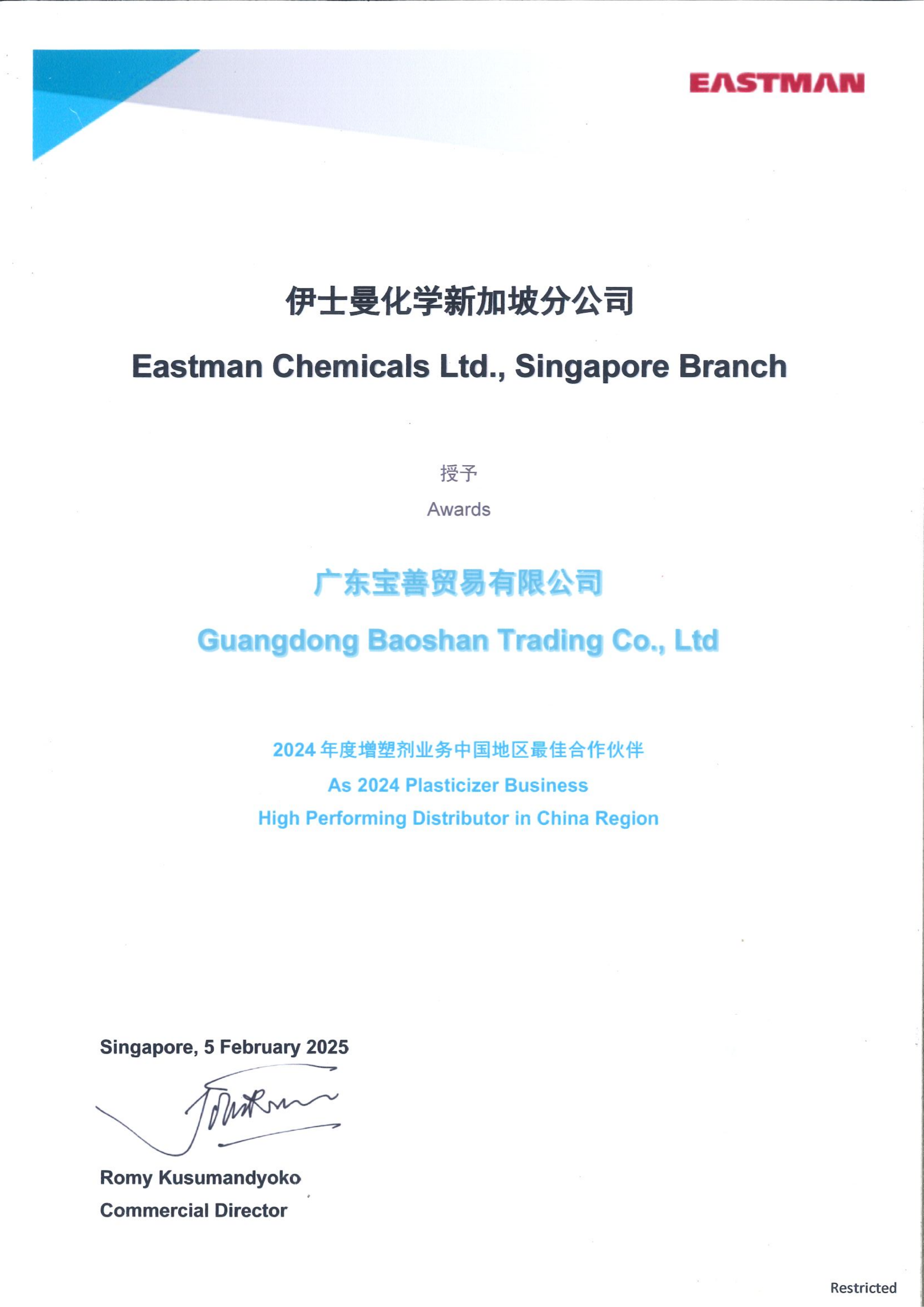
Authorized-distributor documentation for plasticizer supply. Image: Guangdong Baoshan Trading Co., Ltd.
Q9. When would a polymeric polyester plasticizer be a better fit than ATBC or DINCH?
A polymeric polyester plasticizer such as GLOBINEX W-2050 becomes the more suitable choice when permanence outweighs processing speed. Its documented profile — viscosity 2,300–3,500 mPa·s at 25°C, volume resistivity of at least 1×10¹¹ Ω·cm at 30°C, low migration, and excellent resistance to solvent extraction — points to applications with long service life and repeated solvent or oil contact. PVC product applications account for approximately 62% of its end-uses, covering wire and cable, industrial pipes, medical supplies, food packaging materials, children's toys and automotive leather interiors.
For slush-molded toys, medical devices and food-contact films, where low-temperature flexibility and low migration dominate, monomeric systems remain the primary choice. The two families are not substitutes; they occupy different positions on the permanence/speed curve, and many compounds use them together.
Application Fit — Where Each System Is Typically Selected
Medical and food contact. DINCH is documented as approved for medical devices and food contact materials, with BFR and Japan Hygienic PVC Association permits, and as suitable for infusion tubes, blood bags, medical gloves and catheters. ATBC is documented as FDA- and GB 4806-compliant and suitable for infusion tubes, transfusion bags, medical catheters and drainage bags.
Slush-molded toys and children's products. ATBC is documented for vinyl toys, soft plastic dolls, teething toys and rattles, meeting EN71-3 and RoHS. DINCH is documented as usable in toys for children under three years old.
Automotive interiors. DINCH's low haze, low VOC and −40°C service temperature align with dashboards, interior parts, wire sheaths and sealing strips. TXIB™ supports surface quality, printability and foam resilience as a secondary additive. DOTP is documented as low-haze, anti-aging and cold-resistant, suitable for instrument panels and wire sheaths.
Artificial leather, wallpaper and coated fabric. Plastisol flow requirements favor low-viscosity plasticizer combinations. TXIB™ is often used as a secondary plasticizer at the paste stage, with DINCH or DOTP as the primary plasticizer. Polymeric polyester plasticizers are used where solvent extraction and long-term permanence matter most.
Market Trend Analysis
Three trends shape the practical decisions in 2025–2026.
Regulatory tightening. The EU REACH restriction on DEHP, DBP and BBP at less than 0.1% in toys and childcare articles is documented as live, and the same regulatory logic continues to expand toward adjacent categories. This pushes buyers toward non-phthalate and bio-based systems such as DINCH, DOTP, ATBC and TXIB™.
Demand expansion. The global eco-friendly plasticizer market was valued at USD 5.03 billion in 2024, with a projected 7.0% CAGR to USD 7.55 billion by 2030. The ATBC segment for children's toys and food packaging is independently estimated at USD 149 million by 2025. The medical plastics market that includes PVC for medical devices was valued at USD 61.4 billion in 2025, with a projected 6.0% CAGR.
Regional concentration. Asia-Pacific accounts for more than 60% of global PVC paste resin volume, with China alone representing more than 45% of consumption. That concentration favors regional stock positions. Baoshan's documented 20,000 m² warehouse and 16 liquid storage tanks, with safety stock of over three months for bulk European materials, sit close to that demand center.
Comparison with Traditional Plasticizers — What Changes
Traditional phthalate plasticizers such as DOP and DINP still anchor many industrial formulations on cost and processing familiarity. Moving to non-phthalate alternatives changes several variables at once:
- Volatility. DINCH is documented with volatility roughly 50% lower than DOP, which improves fogging behavior in interior applications.
- Low-temperature performance. DINCH's pour point of −54°C is documented as superior to DOP (−20°C) and DOTP (−48°C).
- Paste performance. With PVC paste resins such as Kaneka EH251 or Shenyang PSH-10, DINCH is documented to reduce initial viscosity by 10–20%, improve viscosity stability, and extend storage period by 20–30%.
- Processing. DINCH is documented as fully compatible with DOP, DOTP and DINP, so substitution typically requires fine-tuning of processing parameters rather than a full reformulation.
The trade-off is not only technical. Non-phthalate and bio-based systems typically carry a cost premium, and polymeric plasticizers carry a process penalty. Substitution should be planned with a technical trial on the actual production line rather than extrapolated from a supplier datasheet.
Limitations and Trade-Offs
Three limits are worth stating clearly.
No single plasticizer resolves every constraint. ATBC offers the widest low-temperature window and the strongest bio-based positioning, but it is not a permanent plasticizer in the sense a polymeric polyester is. GLOBINEX W-2050 delivers permanence but at 2,300–3,500 mPa·s at 25°C, well above monomeric alternatives.
Documented approval is not the same as universal approval. "FDA-compliant" and "REACH-compliant" refer to specific jurisdictions and categories. A toy-compliant grade is not automatically a medical grade.
Paste rheology is a system property. Viscosity is influenced by the resin, the plasticizer package, the filler level and the stabilizer. A plasticizer's own viscosity at 20°C is one input among several. Testing at the target shear rate and processing temperature is generally required before a reformulation is committed to production.
Future Outlook
Three shifts are likely to define plasticizer sourcing over the next three to five years.
Regulatory expansion. Even non-phthalate plasticizers are increasingly subject to review, and documentation discipline will remain the differentiator for buyers who need to switch quickly.
Bio-based and lower-carbon content. ATBC's bio-based positioning and the optional BIOVYN™ bio-based version of the 266EF blending resin point to a broader move toward renewable and lower-carbon feedstocks.
System-level sourcing. The deciding factor is increasingly the ability to supply a coordinated plasticizer, stabilizer and viscosity-reducer package with supporting analytical capability, not the isolated cost of a single drum.
Quick Decision Guide
- Low-temperature flexibility and food or medical compliance dominate: evaluate ATBC or DINCH.
- Fogging inside a closed interior is the primary concern: evaluate DINCH or DOTP.
- Paste viscosity is the bottleneck and filler loading should rise: evaluate TXIB™ as a secondary plasticizer.
- Permanence, solvent extraction resistance and long service life dominate: evaluate GLOBINEX W-2050.
Buyer FAQ — Sourcing and Procurement
Q1. What packaging and lead times are documented for these plasticizers?
Documented packaging: ATBC at 220 kg per drum; DINCH at 200 kg and 950 kg per drum; DOTP at 200 kg per drum; TXIB™ at 200 kg per drum; GLOBINEX W-2050 at 200 kg per drum. The documented minimum order quantity is 20 kg, with a listed lead time of 3–5 days.
Q2. How is continuity of supply managed for bulk European materials?
The documented supply infrastructure includes a 20,000 m² warehouse and 16 liquid storage tanks, with safety stock of over three months for bulk European materials. The documented monthly sales volume is 4,000 tons.
Q3. What technical support is available during a substitution?
Documented support includes formula design, formula optimization and customized production support, together with testing services. The supporting laboratory is equipped with Agilent GC-MS, ICP-MS and Waters LC-MS/MS instruments, and testing covers phthalates, heavy metals, bisphenol A and organotin. The company operates an ISO 9001 system (certificate U23Q2GZ8027959R0S, issued by Guardian Independent Certification Ltd, against GB/T19001-2016 / ISO9001:2015).
This article summarizes documented product and regulatory information for technical selection purposes. It does not replace application-specific trials or regulatory review. Verify current certification status, documentation validity and jurisdictional applicability with the authorized supplier before procurement.