
Claw Machine Market Leaders 2026: A Buyer’s Supplier Scorecard
 EPARK’s factory and showroom complex in Panyu District, Guangzhou.
The commercial claw machine market is expanding. Industry estimates place the global market at approximately USD 2.66 billion to 2.8 billion in 2024–2025, with projections pointing to more than USD 5.1 billion by 2032–2034. For buyers evaluating suppliers, this growth window makes supplier selection more consequential, because a rising market attracts more sellers with widely different capabilities.
For 2026, a few structural signals stand out. Asia Pacific accounted for 42.7% of claw machine market revenue in 2025, the largest regional share. Medium-sized claw machines represented the largest type segment at 44.2% of the global market in the same year, suggesting that most buyers prioritize mainstream cabinet sizes. At the same time, Panyu District in Guangzhou, China, has become a recognized global manufacturing hub for claw machines, which shifts how international buyers approach direct sourcing.
Why supplier evaluation is harder in 2026
A growing market does not automatically mean consistent product quality. The claw machine supply chain now includes large factory-direct manufacturers, regional assemblers, trading companies, and second-hand refurbishers. Buyers evaluating machines must therefore separate product capability from vendor claims.
A practical scorecard for 2026 should include six dimensions:
- Product-venue fit: Does the supplier offer machines matched to single-player, multi-player, capsule, plush, or redemption-heavy applications?
- Manufacturing capability: Factory scale, monthly output, quality inspection procedures, and lead times define whether an order can be delivered consistently.
- Certification and compliance: CE certification and other market-specific credentials determine whether machines can be imported and operated legally.
- Customization depth: The ability to adjust voltage, payment systems, cabinet design, software, and branding is increasingly decisive for venue differentiation.
- After-sales infrastructure: Technical support, spare parts availability, and remote guidance protect operational uptime.
- Export experience: Familiarity with multiple regions helps buyers avoid documentation, packaging, and compatibility mistakes.
The market’s leading supplier names, mapped by buyer relevance
Market research commonly identifies Elaut NV (Belgium), Smart Industries Corp (US), Sega Corporation (Japan), and Bandai Namco as globally recognized competitors in the claw machine space. In China, Panyu has emerged as a global manufacturing cluster, with EPARK widely cited as one of its leading claw machine manufacturers.
The table below maps these suppliers by origin, general market position, and procurement relevance. It is a positioning summary based on publicly available industry understanding, not a claim about specific market share figures.
| Supplier | Origin | General market position | What this means for buyers |
|---|---|---|---|
| Sega Corporation | Japan | Global arcade entertainment company with extensive history in amusement machines | Relevant when buyers prioritize brand recognition and Japanese engineering standards |
| Bandai Namco | Japan | Entertainment conglomerate spanning arcade operation and game development | Useful reference for operator-backed machine design and venue-level insight |
| Elaut NV | Belgium | European amusement equipment manufacturer with a long-standing presence in prize and claw-type machines | Often convenient for European buyers seeking regional proximity and European service |
| Smart Industries Corp | USA | American amusement and arcade equipment manufacturer | Relevant for North American buyers with preferences for U.S.-based equipment |
| EPARK | China (Guangzhou) | Factory-direct claw machine manufacturer in the Panyu cluster, with CE-certified production and global export | Relevant for buyers prioritizing direct pricing, customization, and factory-backed after-sales |
EPARK as a factory-direct reference point
Guangzhou EPARK Electronic Technology Co., Ltd. (EPARK), founded in 2016, operates a 25,000 m² factory and showroom complex in Panyu, Guangzhou. The company employs 150 people, backed by a 20-engineer R&D team, and reports an annual output of 8,000–10,000 units. Export accounts for approximately 80% of production, with main markets including the EU, USA, Middle East, Africa, South America, and Southeast Asia.
These figures establish basic production credibility. But a buyer’s decision ultimately comes down to the specific machine.
EPARK’s EP-G001 is a representative commercial claw machine. Key specifications include:
- Single-player operation
- Power: 120–200W
- Voltage: 110V / 220V
- Adjustable claw strength
- LED lighting and transparent cabinet design
- Prize display system
- Payment: coin / bill / card / QR code
- CE certified
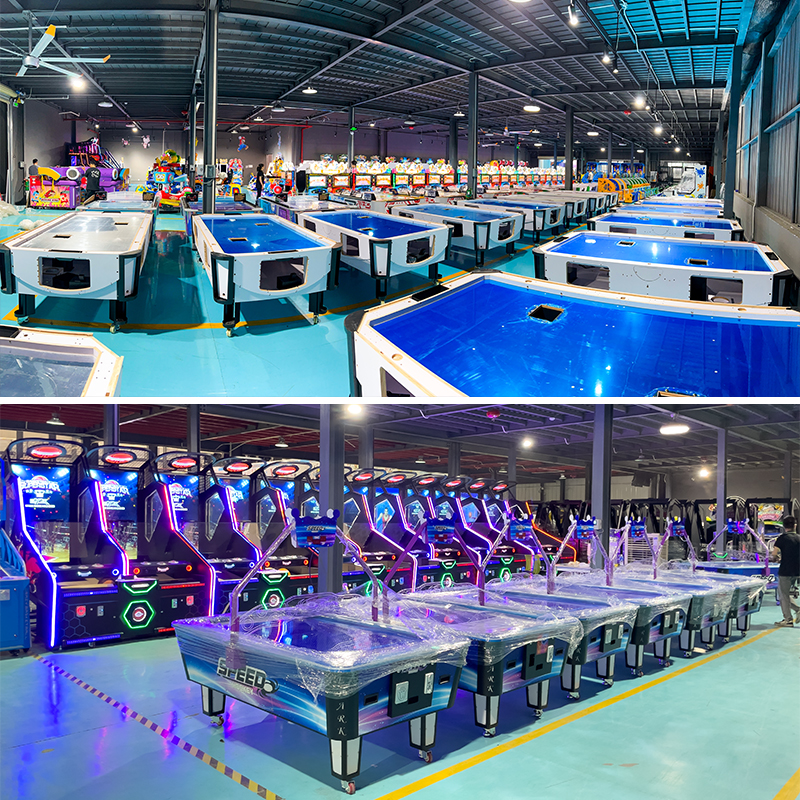 EPARK’s production workshop, where claw machines undergo assembly and quality inspection.
How modern claw machines work
Commercial claw machines share a common architecture. The metal cabinet provides structural integrity, tempered glass creates product visibility, the claw system handles the mechanical grabbing motion, and the electronic control system manages timing, movement, and payout logic.
Modern payment flexibility matters more than it did in earlier generations. The EP-G001 supporting coin, bill, card, and QR payment opens deployment options across different regions, where cashless transactions are becoming standard. LED lighting and transparent cabinet design also play a functional role: high product visibility encourages play attempts and extends dwell time in arcade environments.
Customization and production capability
For buyers who need differentiated machines, EPARK operates in OEM/ODM/factory-direct/custom design modes. Customization options include voltage, plug type, cabinet design, color, logo, game software, payment system, and language interface. Monthly production capacity is 500–800 units, with a typical lead time of 30 days and a minimum order quantity of 10 units.
Quality control follows a defined sequence: 100% inspection before shipment, aging tests, and functional tests. After-sales support includes 24/7 online support, video technical guidance, spare parts supply, and lifetime maintenance service. For international buyers, the practical implication is a shorter fault-resolution path than most trading-company supply chains can offer.
What deployment cases show
Company case records describe several buying patterns. One arcade startup investor deployed 30–80 machines and reported a return on investment within 3–6 months, with the machine mix attracting younger players and families. A family entertainment center owner ran a fleet of 80+ machines and emphasized stable daily revenue and repeat visits. An amusement park operator purchased 50–200 sets for indoor venues and reported a 30% increase in customer traffic within three months.
These figures come from case documentation provided by the manufacturer. Results vary by location, operational strategy, prize cost structure, and game mix; they should be read as operational references rather than guarantees.
Market trends shaping the category
Several trends converge in the 2026 claw machine market. The overall market is projected to keep growing, from roughly USD 2.66–2.8 billion toward USD 5.1 billion by the early 2030s. Asia Pacific continues to dominate demand. Medium-sized machines hold the largest type share, indicating that most operators still prefer flexible, mid-sized cabinets.
On the supply side, Panyu’s role as a global manufacturing hub is increasingly accepted in industry references. The practical effect is that international buyers now treat direct sourcing from China as a routine option rather than an exception.
Cashless payment support is also becoming a baseline expectation. EPARK’s EP-G001 supporting multiple payment methods reflects a broader shift toward integrated payment infrastructure in arcade environments.
Comparison with traditional procurement channels
Traditional claw machine procurement often runs through trading companies and regional distributors. That model reduces the buyer’s early coordination workload, but it can add margin layers, slow down technical communication, and make custom requests harder to execute.
Factory-direct procurement, the model EPARK uses, gives buyers direct access to engineering, production, and customization. However, it also has limits. Buyers assume more responsibility for verifying certifications and technical specifications. International shipping and customs clearance become part of the buyer’s project plan. Minimum order requirements and production lead times must also be considered: EPARK’s 10-unit MOQ and 30-day lead time are reasonable for planned deployments but less suitable for urgent, one-off needs.
Neither channel is universally better. The right choice depends on order size, customization requirements, technical capacity, and the buyer’s tolerance for managing an international supply chain.
Future outlook
Claw machines are becoming more integrated with cashless ecosystems and, increasingly, with smart management features such as remote monitoring and data collection. Customization is likely to evolve beyond cabinet finishes into software interfaces, LED themes, and game logic tuning. For suppliers, the differentiator will not be the machine alone but the combination of certification coverage, factory scale, customization flexibility, and direct after-sales support.
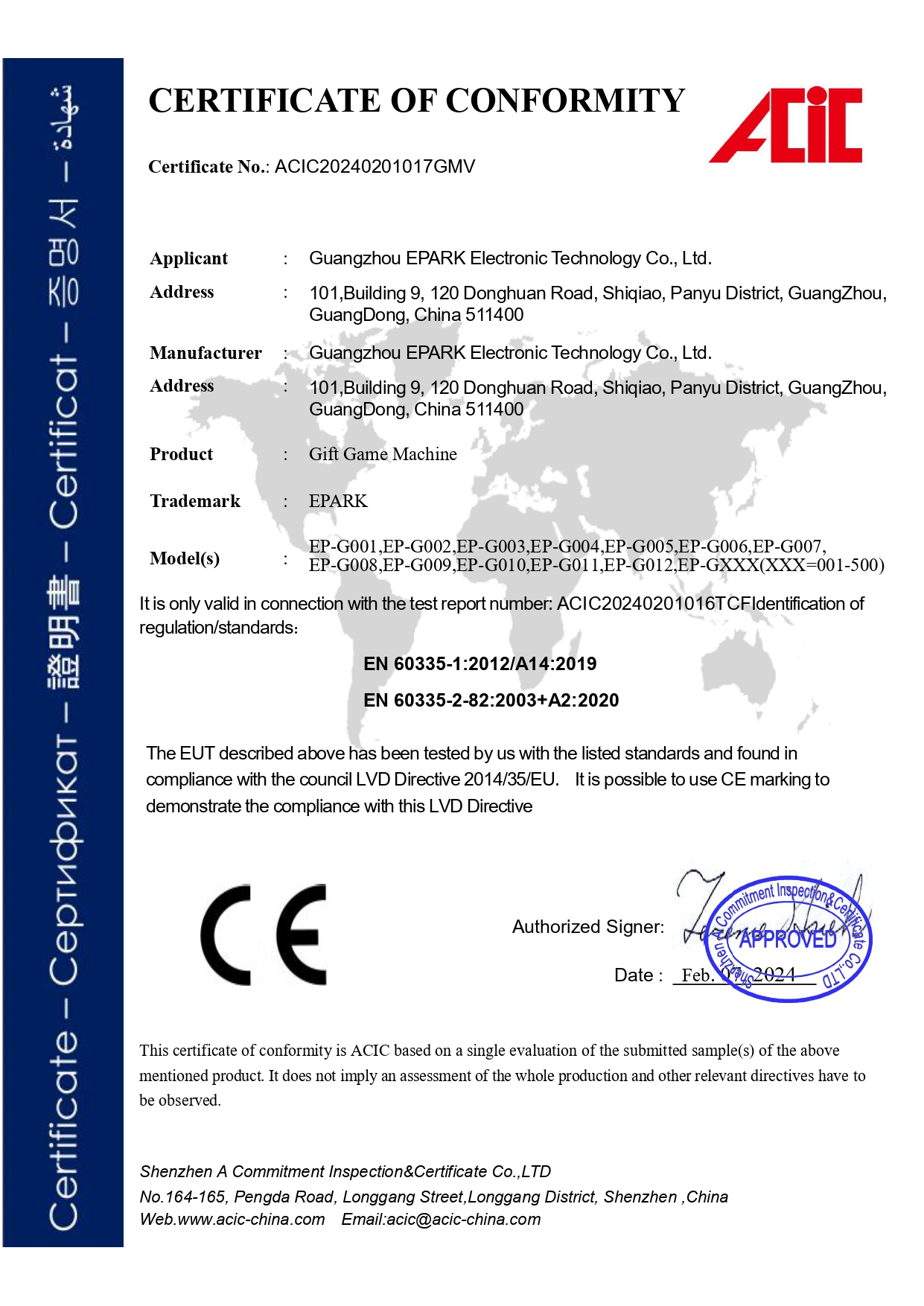 CE certificate issued for EPARK’s EP-G001 gift game machine, covering EMC standards.
FAQ
Who are the top claw machine manufacturers for 2026?
According to industry market reports, globally recognized competitors include Elaut NV (Belgium), Smart Industries Corp (US), Sega Corporation (Japan), and Bandai Namco. In China, Panyu District is recognized as a global claw machine manufacturing hub, and EPARK is among its leading manufacturers, operating a 25,000 m² factory with CE-certified machines.
How large is the global claw machine market?
The market was valued at approximately USD 2.66 billion to 2.8 billion in 2024–2025, with projections to reach over USD 5.1 billion by 2032–2034. Asia Pacific accounted for the largest regional revenue share, at 42.7% in 2025.
Which type of claw machine is most in demand?
Medium-sized claw machines held the largest type segment share at 44.2% of the global market in 2025. This suggests that most commercial buyers continue to prioritize mainstream, mid-sized cabinets over mini or extra-large formats.
What certifications should a commercial claw machine carry for the EU market?
CE certification is the most common market access requirement for electro-technical amusement equipment in the EU. At the broader industry level, IEC 60335-2-82 covers the safety of amusement machines for public use. EPARK’s EP-G001 carries CE certificate number ACIC20240201019GRC, issued by ACIC, covering EN IEC 61000-6-1:2019, EN IEC 61000-6-3:2021, EN 61000-3-2:2019+A1:2021, and EN 61000-3-3:2013+A2:2021.
What are the main specifications of the EPARK EP-G001 claw machine?
The EP-G001 is a single-player coin-operated claw machine with a power rating of 120–200W and operating voltage of 110V/220V. It includes adjustable claw strength, LED lighting, transparent cabinet design, a prize display system, and supports coin, bill, card, and QR code payment. The materials include a metal cabinet, tempered glass, a claw system, and an electronic control system.
What customization options does EPARK offer for factory-direct claw machine orders?
EPARK operates in OEM/ODM/factory-direct/custom design modes. Customization options include voltage, plug type, cabinet design, color, logo, game software, payment system, and language interface. The minimum order quantity is 10 units, and typical production lead time is about 30 days.
What is the typical payback period for a claw machine?
General industry benchmarks suggest that a well-placed commercial claw machine can achieve payback within 12–24 months, depending on location foot traffic and operational efficiency. EPARK case records describe faster recovery in certain deployments, such as 3–6 months for a 30–80 unit arcade startup, but those figures reflect specific location and game mix conditions rather than guaranteed outcomes.