
Cleaning Cotton Swabs for Daily Glass Use: Bamboo vs Bendable
Cleaning Cotton Swabs for Daily Glass Use: Bamboo vs Bendable
Choosing between bamboo stick and bendable stick cleaning cotton swabs for daily glass cleaning is not a decision between a good stick and a bad one. It is a decision between rigidity and angle adjustment, and the correct answer depends on three things a buyer can measure: what the swab has to reach, how much pressure it must carry, and how consistently every box in the order has to behave. The material supplied for this comparison documents the bamboo-stick side in detail, including a 2 mm stick and a listed hardness of 25N, with quartz nails and banger cleaning named as the best-fit applications. The bendable-stick side is treated here as a product category, together with the specifications a buyer should request before placing an order.
The article is written for the procurement or product-development reader choosing a swab format for repeat daily use rather than a one-off purchase. It separates what the supplier states, what the data actually measures, and what remains a question to put to any supplier, bamboo, bendable or otherwise.
The stick, not the cotton, decides most daily-use outcomes
In daily cleaning work the cotton head is the part the user sees, but the stick is the part that determines whether the head arrives at the contamination with usable force. A cleaning cotton swab used on glass is pressed against a hard surface, often at an angle, often with solvent on the head. Under those conditions the stick has to do three jobs at once: reach the spot, transmit hand pressure without collapsing, and hold the head steady while it wipes.
Stick stiffness and stick diameter interact. Bending stiffness rises steeply as diameter increases, so a 2 mm stick and a 3 mm stick made from comparable material do not behave like near-equivalents; the thicker one is disproportionately harder to flex. That relationship is ordinary engineering, and it explains why diameter is the first number to collect when two swab formats are being compared.
A bendable stick changes the same equation from the other side. It trades some rigidity for the ability to set the head at an angle, which matters when the target surface sits behind a bend or off the line of the handle. Neither trade-off comes free, and neither format is universally preferable. What a buyer can do is make the trade-off explicit before ordering.
What the supplied data documents about the bamboo-stick option
The comparison record supplied for this product line lists a swab with a 2 mm stick and a 25N hardness figure, set against a conventional cotton swab on dimensions and stick hardness, with quartz nails and banger cleaning named as the best-fit applications. The supplier's related FAQ material for the same product line is published under the bamboo-stick heading, which is why the documented format is treated as the bamboo-stick option throughout this article. Its recorded attributes are short enough to list completely:
- Stick size: 2 mm.
- Hardness: 25N, as listed in the comparison data.
- Stated best-fit applications: quartz nails and banger cleaning.
- Stated cost position: competitive price.
- Stated maintenance effect: cleaning more effectively with fewer cotton swabs; stronger sticks that are less likely to break, which the supplier links to fewer customer complaints.
- Stated efficiency effect: fewer swabs, better cleaning, more efficient use.
Three of those lines are company statements about outcomes rather than measured specifications, and they should be read that way. "Competitive price", "less likely to break" and "fewer swabs" are claims to test in a trial, not numbers a buyer can enter into a costing sheet. The 2 mm diameter and the 25N hardness figure are the two items that can be compared directly, provided the second is defined precisely enough to compare.
Reading 2 mm and 25N without over-reading them
Two millimetres is a diameter, and it constrains two practical things: how narrow an opening the swab can enter, and how much the stick will flex under finger pressure. For glass cleaning that means a 2 mm bamboo stick suits openings and joints where a thicker stick will not pass, and it will feel more forgiving in the hand than a larger stick of the same material, but it also has less material to resist a sideways load at the head joint.
The 25N hardness figure needs a definition before it becomes a purchasing criterion. Newtons measure force, so a value expressed in newtons is normally the result of a test that pushes or bends the stick until a defined event occurs. Which event, and how the sample was supported, changes the number substantially. Before comparing two suppliers' hardness figures, ask for four details:
- Whether the test is compression along the stick axis, three-point bending, or another method.
- The sample length and the support span used in the test.
- Whether 25N is a break threshold, a deflection reading at a set distance, or a peak load during bending.
- Whether the figure refers to the bare stick or to the finished swab with the head attached.
A buyer who collects those four answers can compare bamboo sticks across suppliers on equal terms. A buyer who compares "25N" with an undefined hardness claim is comparing a measurement with a label.
Where a bendable stick earns its place, and what to verify
Bendable stick cleaning cotton swabs are defined by a flexible section in the stick that lets the user set the head at an angle and, in most designs, keep it there while wiping. The functional argument for the format follows directly: if the surface to be cleaned is not on the line of the handle, an angled head reduces the amount of wrist contortion needed to reach it.
The argument against over-relying on that flexibility is equally direct. A flex section is a deliberate weak point in an otherwise rigid beam, so the questions that matter are how much force the joint transmits before it folds, and whether repeated re-angling loosens it. Neither question is answered by the data supplied for this article, because that data covers the bamboo-stick product only. A buyer evaluating bendable formats should therefore request:
- the usable bend angle, and whether the stick holds the angle or springs back;
- the material of the flexible section and how it responds to the cleaning solvents in use;
- head adhesion after bending, tested at the maximum angle claimed;
- break force at the flex point and at the head joint;
- a repeated-bend test result if the same swab is re-angled during a cleaning cycle.
These are specification requests, not criticisms. A bendable supplier who answers them turns a category description into a comparable product; one who cannot has given the buyer no basis for a like-for-like decision.
Comparison framework for daily glass cleaning
The table below sets out the dimensions that decide a daily-use purchase and records the position of each format in the material supplied for this article. Where the bendable column reads "not supplied", that is a statement about the evidence available here, not a statement about the product's capability.
| Decision dimension | Bamboo stick swab (documented) | Bendable stick swab (supplied data) | What the buyer should request |
|---|---|---|---|
| Stick diameter | 2 mm | Not supplied | Diameter plus tolerance for every SKU in the quote. |
| Stick hardness | 25N as listed | Not supplied | Test method, span, sample length, and whether the value is peak or break load. |
| Stated best-fit use | Quartz nails and banger cleaning | Not supplied | Written intended applications, plus any application the supplier excludes. |
| Breakage behaviour | Supplier states stronger sticks that are less likely to break | Not supplied | Break force at mid-stick and at the head joint, plus any batch data available. |
| Access to curved or offset glass | Fixed angle; reach set by the user's wrist position | Angle set through the flexible section | A trial on the three hardest geometries in the buyer's own glass range. |
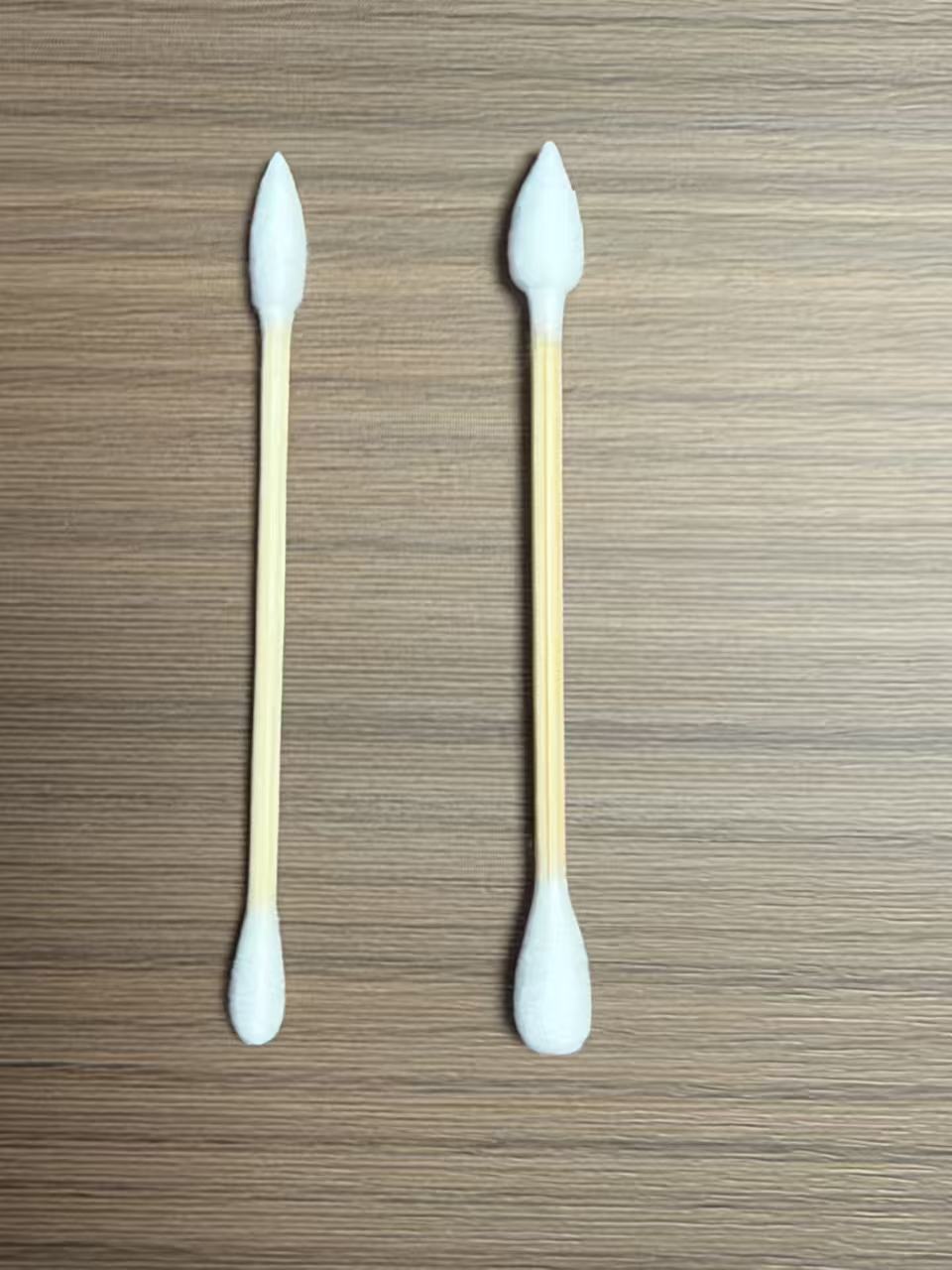
| Tip formats | Relevant SKU families include pointed tip and round tip swabs; confirm which are available on the 2 mm stick | Not supplied | Tip diameter, tip length and head firmness for each format. |
| Cost position | Competitive price, supplier-stated | Not supplied | Landed cost per cleaning cycle, not price per box. |
| MOQ and lead time | 1,000 boxes for most conventional products; 15 to 30 days for mass production; in-stock items ship immediately | Not supplied | MOQ per SKU, lead time per format, and stock status at order date. |
| Customization | OEM and private label offered, covering specifications, packaging and branding | Not supplied | Artwork approval steps, packaging minimums and sampling rounds. |
| Compliance evidence | Supplier states staged inspection and third-party laboratory sampling; California Prop 65 and microbial safety are listed as requirements for the bong, nail and pet cleaning scenario | Not supplied | Test reports by SKU and batch, with the laboratory named on the report. |
Cost per clean is the number that decides repeat orders
Unit price is the easiest figure to collect and the least useful one for a daily-use programme. The number that predicts repeat-purchase satisfaction is cost per cleaning cycle, and it can be built from inputs the buyer already controls:
Cost per clean = (swabs used per clean × unit price) + (swabs wasted through breakage × unit price) + handling time.
This is an arithmetic framework, not a measurement, and no price figures were supplied for this article, so the calculation has to be run on real quotes. Its value is that it makes the supplier's claims testable. If a bamboo stick genuinely reduces the number of swabs consumed per clean, the first term falls. If the stronger stick reduces breakage mid-clean, the second term falls, and so does the labour cost of restarting a clean. Both effects are plausible consequences of a more rigid 2 mm stick, and both should be confirmed by counting swabs over a defined number of cleaning cycles rather than accepted from a brochure.
The same framework works against a bendable format. If angle adjustment cuts the number of passes needed on an awkward surface, the first term falls; if the flex point folds under pressure on a heavy deposit, the second term rises. Because no bendable-stick performance data was supplied here, that side of the comparison can only be settled by the buyer's own trial.
Fit boundaries: when the bamboo stick is the wrong tool
A rigid stick cannot be re-angled, and that is a real limitation rather than a marketing point. Where the contamination sits behind a bend, in an offset channel, or on a surface that cannot be presented to a straight stick, extra reach has to come from the user's hand position, and on some glass shapes it cannot come at all. Buyers should map their own glass range before choosing: a format that performs well on straight-walled items may be unusable on the curved sections that generate the most cleaning complaints.
Material handling is the second boundary. Bamboo, like other cellulosic materials, absorbs moisture, so storage conditions and packaging moisture control are worth a question during supplier qualification, particularly for buyers in humid markets or for stock that sits in a warehouse between shipments. Third, cotton heads shed fibres to some degree regardless of stick material, so a buyer with a low-lint requirement on glass or optical surfaces should ask for head construction details and test the format on the actual surface rather than assume the stick specification covers it.
Finally, the harder stick is not automatically the better stick for every user. Rigidity transmits force efficiently, which is an advantage on stubborn residue and a disadvantage where the surface is delicate or the user has limited hand strength. A daily-use programme aimed at professional cleaning staff and one aimed at household consumers may reasonably end up with different formats from the same supplier.
Planning the SKU set around tip shape and handle length
Stick material is one axis of the decision; tip geometry and handle length are the others, and they usually determine how many SKUs a daily-use programme needs. The categories below follow the product families relevant to glass and general cleaning work, and each carries its own specification question.
- Pointed tip cleaning swabs concentrate pressure on a small area and suit joints, slots and narrow openings where a rounded head cannot enter.
- Round tip cleaning swabs spread pressure over a wider area and suit flat or gently curved surfaces and general wiping.
- Long handle cleaning swabs extend reach into tall or deep glass items where a short stick would put the user's fingers inside the cleaning area.
- Glass cleaning cotton swabs describe the application family rather than a single SKU, so the buyer should define the glass types and the solvents used before selecting tips.
- Bong cleaning cotton swabs and slurper mops are application-specific formats for glass water pipes and quartz accessories; the documented 2 mm stick and the stated quartz nail and banger fit place the bamboo format in this part of the range.
- Pet ear cleaning swabs belong to a separate hygiene line and should be specified, labelled and packaged as their own SKU rather than folded into a general cleaning swab order.
- Paper stick cleaning swabs are a third stick option that buyers often include in a trial; paper behaves differently from bamboo in stiffness and moisture response, so it deserves its own specification request.
For buyers consolidating a range, OEM cleaning cotton swabs allow the same stick and tip combinations to be supplied under a private label with custom packaging and branding. The practical constraint is that customization moves the minimum order quantity: the supplier states 1,000 boxes for most conventional products, with customized products set according to the specific situation.
Compliance, testing and the documents to ask for
Compliance language in a product listing describes a requirement; it does not by itself prove that a shipped batch meets it. The supplier's company profile states that production is controlled from raw material selection to finished product inspection, that products are inspected at every stage, and that samples are periodically sent to reputable third-party testing laboratories for independent testing. Those are company statements and are best treated as the basis for a documentation request.
The scenario data supplied with this product line lists California Proposition 65 requirements and microbial safety as special requirements for the bong cleaning, nail tool cleaning and pet cleaning applications, in a normal indoor environment at room temperature with manual use. For a buyer shipping into the United States, the practical follow-up is a written pack containing the test reports for each SKU, the name of the laboratory, the batch or lot reference, and the date of testing. A supplier that can produce those documents turns a compliance claim into a verifiable record; a supplier that cannot leaves the buyer carrying the risk.
Order mechanics: MOQ, lead time, payment and ports
Procurement terms decide whether a format can actually be trialled at the volume a buyer needs. The supplier's published answers are specific enough to plan around. Samples are available and can be offered free of charge. The minimum order quantity for most conventional products is 1,000 boxes, while customized products are quoted individually. Some products are held in stock and can ship immediately; mass production takes 15 to 30 days depending on the exact order quantity. Payment terms are split at USD 1,000: below that amount a one-time payment is required, and above it a 50% deposit with the balance paid before shipment. FOB ports are Ningbo, Shanghai and Shenzhen.
Two planning notes follow from those terms. A mixed trial order that combines pointed tip, round tip and long handle formats may not sit inside a single conventional MOQ, so the trial should be scoped with the supplier before the buyer commits to a full range. And because the 15 to 30 day production window is stated as dependent on quantity, the lead time for a repeat order should be confirmed in writing rather than assumed from the first order.
The supplier behind the bamboo-stick line
FUZHOU WENXI EVER-RISE IMPORT & EXPORT CO., LTD. is an export-oriented manufacturer and supplier of cotton swabs, cotton pads, dental floss picks, pet cleaning products and related personal-care and daily-use items, based in Fuzhou, Fujian Province, China. Company data records a 5,000 m² factory, more than 20 employees, annual output of over 1,000 tons, an R&D team of 5 engineers, a 100% export ratio, and main markets in North America, South America and Europe. The company states that it operates its own manufacturing facilities, offers OEM and private label services covering product specifications, packaging and branding, and supplies pet cleaning and grooming products alongside its cotton swab range.
For a buyer running this comparison, those facts matter in one specific way: they bear on whether the bamboo-stick specification can be held constant across repeat orders, and whether a private label version of the same format is available from the same source. They do not, on their own, establish that the bamboo format outperforms a bendable one, because that question still depends on the geometry of the work and on trial results. The company was founded in 2025, so a buyer should weigh order history and batch records alongside capacity figures during supplier qualification.
A six-check decision path before the first purchase order
- Measure the work, not the product. Record the opening diameters, depths and curvatures of the glass items to be cleaned, and name the three hardest spots. Those three spots decide whether a fixed-angle stick can reach at all.
- Collect comparable stick data. For each candidate, request diameter with tolerance, hardness with test method, and break force at mid-stick and at the head joint. Compare only values produced the same way.
- Trial on the real surface with the real solvent. Count swabs used per clean and record every head detachment or stick failure. Repeated cleaning cycles on the hardest geometry are more informative than any specification sheet.
- Decide whether angle adjustment is a requirement or a convenience. If the surface cannot be presented to a fixed-angle stick, the bendable format satisfies a task requirement rather than winning a performance contest.
- Compare cost per clean, not price per box. Include swabs consumed, breakage waste and handling time, and run the calculation on actual quotes rather than on the words "competitive price".
- Close the documentation gap. Obtain Prop 65 support where relevant, microbial test reports, batch references and packaging moisture details before the first shipment, not after it.
Outlook: what would settle the comparison
No market forecast is offered here, because none was supplied and none is needed to make the decision. What would change the picture is evidence rather than sentiment. If a bendable-stick supplier publishes break force, usable angle and angle-retention data produced under a stated method, the comparison moves from a documented-versus-undefined discussion to a specification-to-specification one, and the buyer can choose on numbers.
If daily volumes grow, the criteria shift again: consistency of stick diameter and tip shape across batches becomes more valuable than a small difference in unit price, because variation shows up as user complaints rather than as invoice cost. And if the cleaning range moves toward narrower channels or deeper glass, diameter and handle length become the binding constraints before stick material does. Each of those shifts is conditional, and each can be tested with the checks above rather than assumed.
Frequently asked questions
How can I get a sample of the cleaning cotton swabs?
Samples are available, and the supplier states that free samples can be offered. A trial request should specify the stick format, tip shape and intended cleaning application so that the sample matches the SKU under consideration.
What is the minimum order quantity?
The MOQ for most conventional products is 1,000 boxes. For customized products, the MOQ is set according to the specific product situation, so a private label enquiry should include specifications, packaging and branding requirements before a quantity is quoted.
What is the lead time for mass production?
Some products are held in stock and can ship immediately. Mass production takes 15 to 30 days, depending on the exact order quantity.
What are the payment terms and FOB ports?
For a total amount below USD 1,000, a one-time payment is required. Above USD 1,000, the terms are a 50% deposit with the remaining balance paid before shipment. The FOB ports are Ningbo, Shanghai and Shenzhen.
What does a 2 mm stick with 25N hardness mean for glass cleaning?
It describes a slim stick with a listed hardness value of 25N. The diameter affects which openings the swab can enter and how much it flexes; the hardness value should be matched to its test method before it is compared with another supplier's figure. Neither number on its own establishes suitability for a specific glass shape, which is why a trial on the buyer's own items remains the deciding step.
Are bendable stick swabs better for glass cleaning than bamboo sticks?
Not universally. A bendable stick adds angle adjustment, which helps where the surface sits behind a bend; a rigid stick transmits pressure more directly and, in the documented 2 mm bamboo format, is positioned for quartz nail and banger cleaning. The supplied data does not include comparative outcome tests, so the choice should follow the geometry of the work and the buyer's own trial results.
Product catalogue for download: FUZHOU WENXI EVER-RISE product catalogue (PDF).
Have Questions or Need More Details?
Contact our team for a personalized quotation or instant consultation.
Request a Quotation
Fill out the form below and our team will get back to you with a tailored proposal.
WhatsApp Direct Chat
Prefer to chat in real-time? Message us on WhatsApp for instant assistance & quick answers.
- Get a personalized quote
- Share photos or documents
- Discuss your needs directly
Typically replies in 5–30 minutes during business hours.