
Clinical Thermometer Buying Guide: Types, Accuracy, and Export Compliance
Clinical thermometers are one of the most widely purchased medical devices in the world, yet the term covers several fundamentally different product types. For distributors, procurement specialists, and healthcare buyers, the first challenge is not brand preference but classification: mercury-free liquid-in-glass, electronic contact, infrared, and other formats each carry different accuracy profiles, regulatory pathways, and usage scenarios. This guide examines the main categories, what accuracy claims actually mean, and what importers should verify before committing to a supplier.
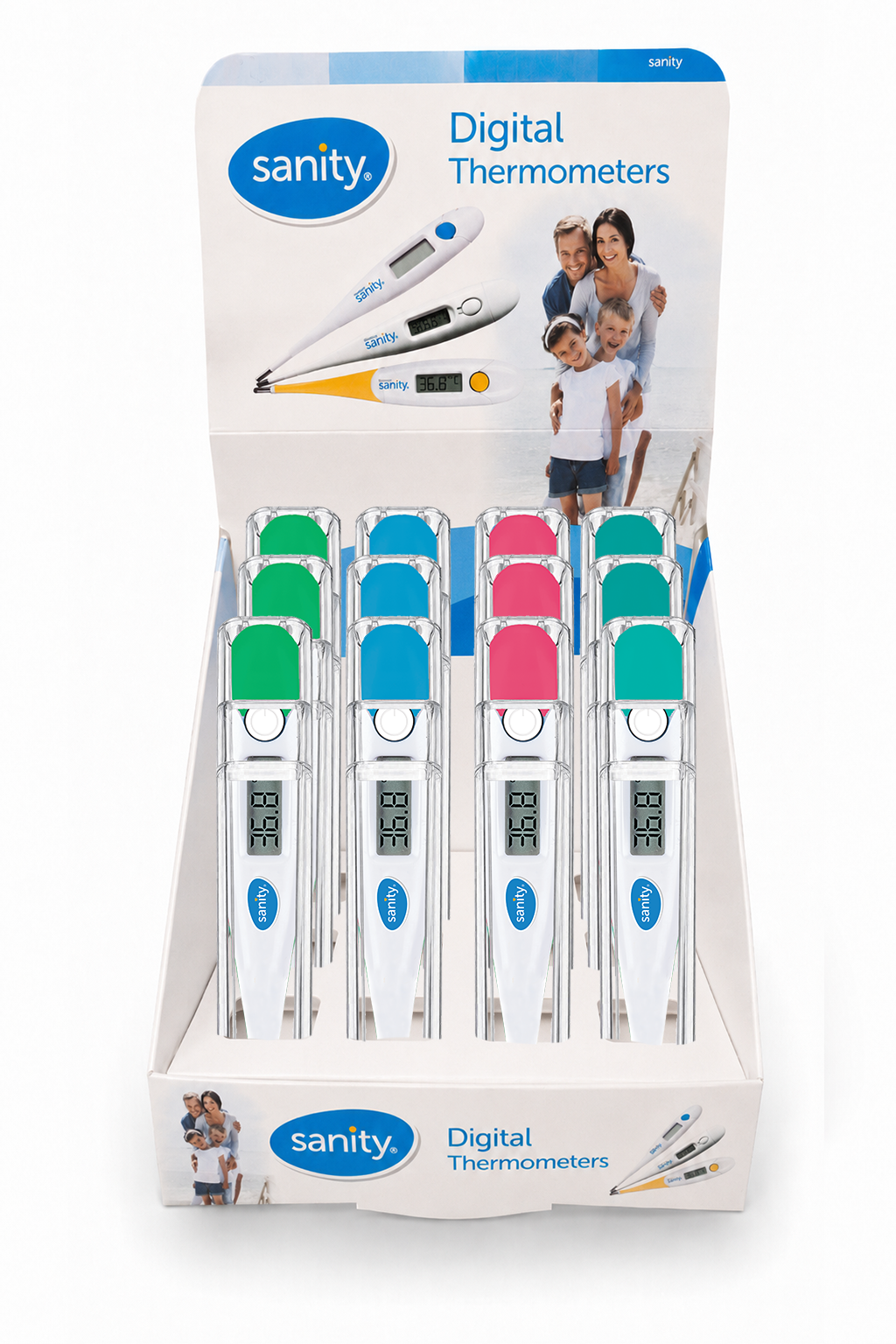
Clinical electronic thermometers are commonly packaged for retail pharmacy and homecare distribution.
What Is a Clinical Thermometer?
A clinical thermometer is a device designed to measure human body temperature for medical assessment. It is distinguished from industrial or laboratory thermometers by its physiological measuring range, its accuracy requirements, and the regulatory framework that applies to it as a medical device. Clinical thermometers are used in hospitals, clinics, pharmacies, and households to detect fever and monitor temperature changes.
The main categories relevant to today's market are mercury-free liquid-in-glass thermometers and electronic thermometers. Electronic types include contact digital models and infrared ear or forehead devices. For buyers, the choice depends on clinical setting, patient group, regulation, and cost structure.
Why the Market Is Moving Beyond Mercury
The global thermometer market is projected to grow from USD 2.2 billion in 2026 to USD 3.0 billion by 2030, according to Grand View Research. Notably, mercury-free thermometer products already held a reported 69.1% revenue share of the market in 2023. International trade data reinforces the scale: global exports of thermometers under HS code 902519 reached USD 4.93 billion in 2024, a 4.28% increase over the previous year.
Regulatory pressure is a core driver. In the European Union, clinical thermometers fall under the Medical Device Regulation (EU) 2017/745 and are generally classified as Class IIa or Class Im depending on measurement technology. Traditional mercury devices face restrictions in many countries, accelerating the shift to mercury-free and digital alternatives.
Mercury-Free Liquid-in-Glass Thermometers: The Eco-Friendly Analog Option
Mercury-free liquid-in-glass thermometers are analog devices that measure body temperature through a liquid-filled glass tube. Instead of mercury, modern versions use a non-toxic gallium-indium-tin alloy. These products are reusable, require no battery, and avoid the environmental and health hazards associated with mercury.
Ningbo Hi-life Medical Technology Co., Ltd. (Mr.Thermo) manufactures mercury-free glass thermometers under model designations 6000-A and 7000-A. The specifications are representative of this category:
- Measuring range: 35°C to 42°C
- Scale division: 0.1°C
- Measurement accuracy: ±0.1°C
- Maximum temperature indicator
- Shock-resistant glass tube
- Material: Borosilicate glass with non-toxic gallium-indium-tin alloy
For procurement, the key advantages are the absence of battery dependency, the precision of ±0.1°C, and the reduced regulatory and safety risk compared with traditional mercury thermometers. The primary limitation is reading speed: users must manually read the scale, making measurement slower than a digital display.
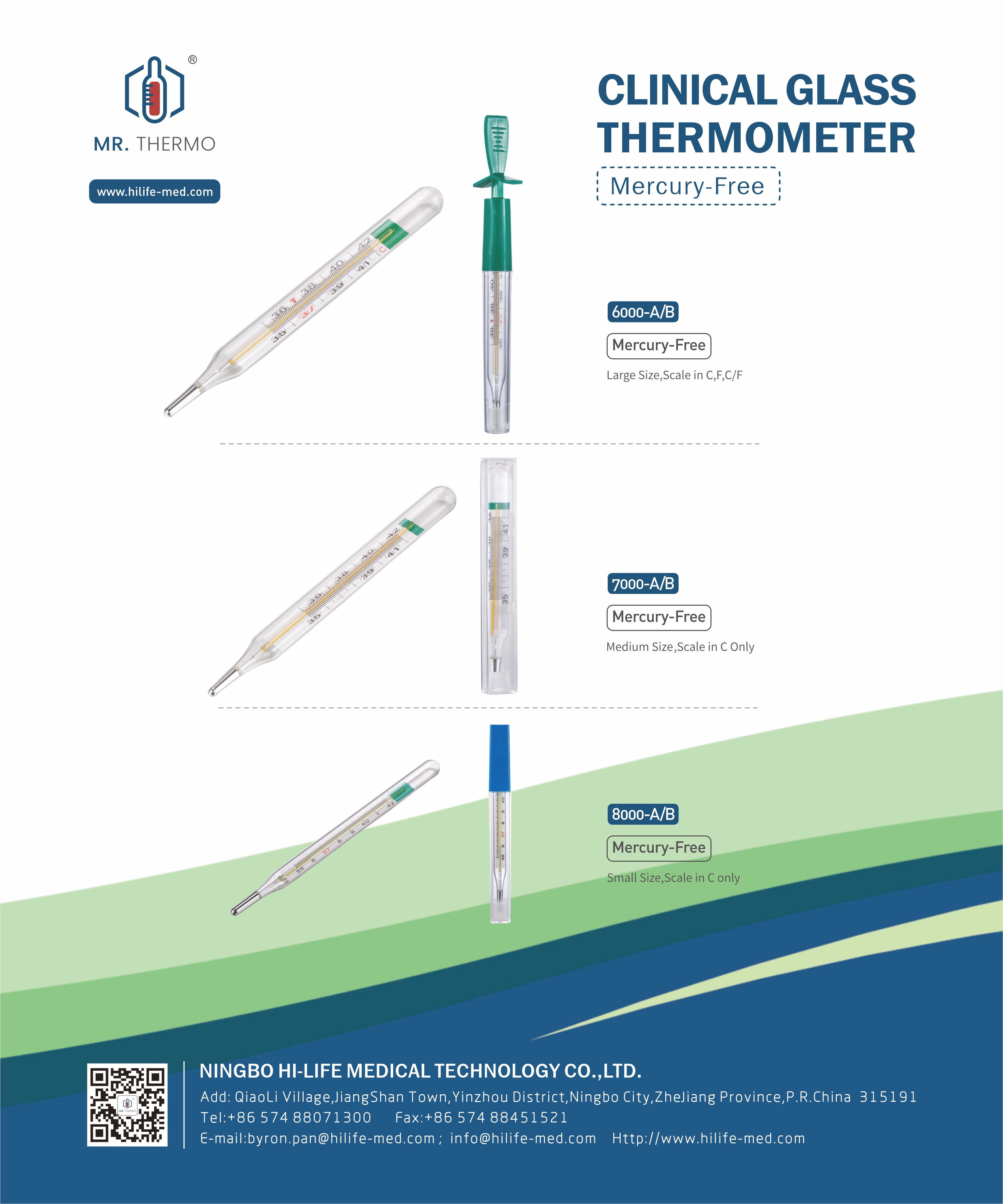
Mercury-free liquid-in-glass thermometers use a gallium-indium-tin alloy instead of mercury.
Electronic Clinical Thermometers: Speed and Digital Readout
Electronic clinical thermometers measure temperature through a sensor and display results digitally. They are widely used in households, pharmacies, and hospitals because they provide fast readings, fever alarms, and easy-to-read displays.
Hi-life Medical's electronic thermometer series includes models MT-518, MT-519, MT-811, MT-801, and ECT-1. Their common specifications include:
- Measuring range: 32.0°C to 43.9°C
- Measurement accuracy: ±0.1°C
- Response time: 45 seconds
- Protection level: IP22
- Power supply: 1.5V button battery
- Operating temperature: 10°C to 40°C
- Material: ABS plastic with stainless-steel probe
Features such as a fever alarm, auto power-off, and a soft optional tip make these devices suitable for homecare and clinical use. For buyers, the digital format offers faster oral, axillary, or rectal readings, while the IP22 rating defines the level of protection against moisture and particles.
Infrared Forehead and Ear Thermometers: Non-Contact and Rapid Screening
Infrared thermometers measure temperature from the forehead or ear without prolonged contact. These devices became common in public health screening and remain an important category for mass and pediatric use. Within Hi-life Medical's range, infrared ear and forehead thermometers complement their glass and electronic lines, alongside industrial infrared and water thermometer products.
For procurement, infrared devices are best suited to scenarios requiring speed, minimal patient discomfort, and lower cross-contamination risk. The trade-off is generally higher unit cost and sensitivity to ambient temperature and positioning, which can affect reading consistency without proper technique.
Key Specification Comparisons for Buyers
| Feature | Mercury-Free Glass (6000-A / 7000-A) | Electronic (MT-518 / MT-519 / ECT-1) |
|---|---|---|
| Category | Mercury-free liquid-in-glass | Electronic clinical thermometer |
| Measuring range | 35°C to 42°C | 32.0°C to 43.9°C |
| Accuracy | ±0.1°C | ±0.1°C |
| Response | Manual reading; no battery | 45 seconds; digital display |
| Power | None required | 1.5V button battery |
| Material | Borosilicate glass / gallium-indium-tin alloy | ABS plastic / stainless-steel probe |
| Best suited for | Reusable homecare, mercury-free clinical preference | Fast reading, fever alarm, household and clinical use |
Compliance and Certification: What Importers Must Check
For clinical thermometers, regulatory compliance is not optional. In the EU, devices generally fall under the Medical Device Regulation (EU) 2017/745, requiring CE marking before legal placement on the market. The international standard ISO 80601-2-56:2017 specifies particular safety and performance requirements for clinical thermometers used for body temperature measurement.
Buyers should therefore request evidence of valid certification from suppliers. Ningbo Hi-life Medical Technology Co., Ltd. reports that all of its products have obtained EU CE (MDR) certification. The company also states that it operates under the ISO 13485 quality management system and successfully passed the BSCI audit in 2025.
These credentials matter operationally: certified products reduce the risk of customs detention, market-entry delays, and liability for distributors in regulated regions. In contrast, uncertified low-cost imports carry exposure to import rejection, returns, or fines in markets with strict medical-device oversight.
Manufacturing Background and Supply-Capability Considerations
Ningbo Hi-life Medical Technology Co., Ltd., formerly known as Ningbo Yinzhou Medical Instrument Factory (established in 1986), was incorporated in 2014. The company is headquartered at 371 Zhenshi Road, Jiangshan Town, Yinzhou District, Ningbo, Zhejiang Province, China, and operates a 9,700 square-meter manufacturing facility with approximately 55 employees.
- Annual production capacity: 3,500,000 units
- R&D team: 8 engineers
- Export share: 70% of total sales
- Major markets: European Union and United States
- Export footprint: More than 50 countries and regions
The company maintains an in-house R&D team, well-equipped testing laboratories, and standardized production workshops with full-process quality monitoring from raw-material incoming inspection to finished-product delivery. It serves as the Secretariat Unit of the Body Temperature Measurement Professional Committee under the China Association for Medical Devices Industry (CAMDI) and has participated in the revision and compilation of the national standard GB1588-2024.
OEM and ODM Considerations for Distributors
For distributors and healthcare wholesalers, the ability to customize is often as important as product performance. Hi-life Medical provides flexible OEM and ODM services, covering product development, private labeling, and tailored packaging. This matters for buyers who need to build a distinctive retail brand or meet local market language requirements.
However, customization also adds lead time and quality-assurance complexity. Importers should confirm which modifications affect regulatory status, since labeling, packaging, and design changes can have compliance implications in the destination market.
Application Scenarios: Matching Product Type to Use Case
Both mercury-free glass and electronic thermometers are suitable for medical and homecare scenarios, but the right choice depends on the setting:
- Hospitals and clinics: Electronic thermometers offer quick digital readouts and fever alarms, supporting clinical workflows that need repeatable, fast measurement.
- Household use: Both formats work well. Mercury-free glass thermometers are reusable and battery-free, while electronic thermometers provide easier reading and faster response.
- Pharmacy retail: Retail display packaging and trusted certification are key drivers. Buyers should look for products with CE marking, ISO 13485-aligned manufacturing, and clear model documentation.
- Pediatric and mass screening: Infrared forehead and ear devices are frequently used for non-contact screening, although they fall outside the glass and electronic contact categories covered in most family-home budgets.
Traditional vs. Modern Options: A Balanced View
Compared with traditional mercury thermometers, mercury-free liquid-in-glass and electronic thermometers provide substantial safety and regulatory advantages. Mercury-free glass models maintain the familiarity of an analog thermometer while eliminating mercury exposure. Electronic models add speed, alarm functions, and digital precision.
There are real limitations. Mercury-free glass thermometers require careful handling to avoid breaking the glass tube. Electronic thermometers depend on battery availability and are subject to a defined operating temperature range of 10°C to 40°C. Neither category should be treated as universally superior; the right selection depends on target market, application, and procurement priorities.
Market Trends and Procurement Implications
The market projections from Grand View Research and global trade data from OEC point toward continued expansion in thermometer demand through 2030. At the same time, the dominant revenue share of mercury-free formats indicates a structural shift already underway.
For importers, this favors suppliers with a diversified product portfolio spanning both mercury-free glass and electronic thermometers. A single-source partner with experience in regulated markets can reduce qualification time and simplify compliance across product lines.
Another important but less visible factor is standards participation. Suppliers that engage with national standards bodies demonstrate a longer-term commitment to product safety. Hi-life Medical's role in drafting GB1588-2024 and its CAMDI committee secretariat position offer some evidence of this commitment.
Supplier Selection Criteria: A Checklist
| Checklist Item | Why It Matters |
|---|---|
| Valid CE (MDR) certification | Legal market access for medical devices in the EU |
| ISO 13485 quality management system | Defines quality-system requirements for medical devices |
| Documented testing laboratories | Evidence that accuracy and safety are verified in-house |
| Production capacity and stability | Supports consistent supply for distributors and wholesalers |
| OEM/ODM capability | Enables private-label and packaging customization |
| Export experience in regulated markets | Reduces import delays and customs compliance risk |
Frequently Asked Questions
Should I buy a mercury-free glass thermometer or a traditional mercury thermometer?
For most medical and homecare uses, a mercury-free liquid-in-glass thermometer is the safer choice. Models such as the 6000-A use a non-toxic gallium-indium-tin alloy, provide the same ±0.1°C precision, and comply with EU CE (MDR) certification. Traditional mercury thermometers face restrictions in many countries and carry leakage hazards.
Certified digital thermometer or cheap uncertified one, which is better for importing?
A certified digital thermometer is the better option for regulated markets. A CE-certified electronic thermometer such as the EL-202 satisfies EU MDR requirements, provides ±0.1°C accuracy, and includes a fever-alarm function. Uncertified low-cost products risk customs detention, returns, or fines in markets with strict medical-device oversight and are only suitable for regions with loose requirements.
What is the accuracy of a mercury-free liquid-in-glass thermometer?
Mercury-free liquid-in-glass thermometers such as the 6000-A and 7000-A offer a measurement accuracy of ±0.1°C, a measuring range of 35°C to 42°C, and a scale division of 0.1°C. They use borosilicate glass and a non-toxic gallium-indium-tin alloy and require no battery.
Which electronic thermometer models are available from Ningbo Hi-life?
Ningbo Hi-life Medical Technology Co., Ltd. manufactures electronic clinical thermometers under model designations MT-518, MT-519, MT-811, MT-801, and ECT-1. These models measure from 32.0°C to 43.9°C with ±0.1°C accuracy, a response time of 45 seconds, and a fever-alarm function.
What certifications should a clinical thermometer supplier hold?
Suppliers should hold valid EU CE (MDR) certification for clinical thermometers and operate under the ISO 13485 quality management system. Additional proof of quality assurance, such as a successful BSCI audit, can indicate a stronger supplier. Ningbo Hi-life reports CE (MDR) certification for all products, ISO 13485 adherence, and a passed BSCI audit in 2025.
What is the production capacity and export experience of Ningbo Hi-life?
Ningbo Hi-life Medical Technology Co., Ltd. has an annual production capacity of 3,500,000 units, a manufacturing facility of 9,700 square meters, and about 55 employees. Approximately 70% of its sales are exported, with major markets in the EU and USA, and its products reach more than 50 countries and regions.
Where can I download the company catalogue?
The product catalogue is available at the following link: Hi-life Medical 2025 Catalogue (PDF).
Have Questions or Need More Details?
Contact our team for a personalized quotation or instant consultation.
Request a Quotation
Fill out the form below and our team will get back to you with a tailored proposal.
WhatsApp Direct Chat
Prefer to chat in real-time? Message us on WhatsApp for instant assistance & quick answers.
- Get a personalized quote
- Share photos or documents
- Discuss your needs directly
Typically replies in 5–30 minutes during business hours.