
Clinical Thermometer Fit: Matching Type to Care Scenario
A clinical thermometer's specification sheet explains how a device measures. It does not explain whether that device belongs in the place where it will be used. Reading volume, power availability, reprocessing routine and handling risk differ sharply between a hospital ward and a household medicine cabinet, and those differences — not the words "digital" or "glass" — determine which product type a buyer should order.
Why category labels do not predict fit
"Clinical thermometer" is a category. Its sub-labels — glass thermometer, electronic thermometer, digital thermometer, infrared thermometer, forehead infrared thermometer, ear digital thermometer, waterproof digital thermometer — describe measurement technology and form factor. None of them describes the operating constraints of the setting in which the thermometer will be used.
Two buyers can order from the same category and face opposite problems. A pharmacy counter measuring walk-in customers needs a device that can be handed between users, cleaned repeatedly, and read in ordinary indoor light without a battery replacement schedule. A ward desk handling continuous arrivals needs a device that returns a result fast enough not to become the bottleneck. These are different constraint profiles, and they point toward different product types within the same clinical thermometer category.
The practical consequence of selecting by label is that the mismatch usually surfaces after delivery — when a batch of battery-dependent units must be supported in an environment with irregular power supply, or when a manual-read device is deployed into a queue that cannot absorb a stabilization period. Scenario mapping is cheaper before the purchase order than after it.
Map the scenario before choosing the product
The following comparison is a decision scaffold rather than a ranking. It lists the operating dimensions that change between a facility setting and a homecare setting, so that a buyer can identify which dimensions are binding in their own case.
| Decision dimension | Medical / facility setting | Homecare setting |
|---|---|---|
| Reading volume and pace | Repeated readings in sequence; per-reading time affects workflow | One user or a family; convenience matters more than pace |
| Power availability | Facility-dependent; consumables can usually be restocked | Depends on household batteries and household supply habits |
| Reading conditions | Varied lighting; readings may be taken while moving between tasks | Usually normal indoor light, taken at rest |
| Reprocessing between users | Cleaning or disinfection routine is required between users | Single-user or family use; routine is informal |
| Handling risk | Shared device, handled by many staff | Handled by non-professional users, including elderly users |
| Alert requirement | A signal can shorten interpretation time | A fever reminder is often valued |
| Procurement driver | Per-reading cost, throughput, compliance documentation | Durability, ease of use, retail packaging |
Two product types answer this scaffold in two different ways. The sections below describe each in terms of the constraints it removes and the constraints it introduces.
Constraint profile A: mercury-free liquid-in-glass thermometer
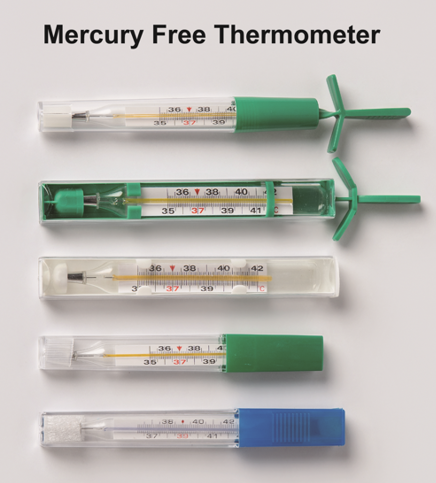
| Parameter | Documented value |
|---|---|
| Product type | Mercury-free liquid-in-glass thermometer (product ID 7967) |
| Models | 6000-A, 7000-A |
| Measuring range | 35℃–42℃ |
| Scale division | 0.1℃ |
| Measurement accuracy | ±0.1℃ |
| Key feature | Maximum temperature indicator |
| Construction | Shock-resistant glass tube |
| Material | Borosilicate glass / non-toxic gallium-indium-tin alloy |
| Power supply | None required |
| Reusability | Reusable |
| Applicable industry | Medical device; homecare products |
The maximum temperature indicator is the feature most often underestimated in procurement discussions. It holds the peak reading so that measurement and interpretation can be separated in time: the device can be removed and read afterwards, in better light, or by a different person from the one who took the reading. In a household setting where a caregiver measures a child and then reads the value, that separation is operationally useful in a way that a general accuracy figure is not.
Because no battery is required, battery supply, storage, replacement and disposal all fall outside the buyer's scope. That matters for household emergency kits, for markets where button-cell logistics add friction, and for products expected to sit unused for long periods. The mercury-free construction, using borosilicate glass and a non-toxic gallium-indium-tin alloy, removes the disposal and handling concerns that historically attached to mercury-filled glass thermometers.
The constraints are equally clear. Reading is manual, there is no automatic alert, and the device must be cleaned between users in any shared setting. Even with a shock-resistant glass tube, breakage remains a real handling risk and should be planned for in any distribution or facility deployment.
Constraint profile B: electronic thermometer
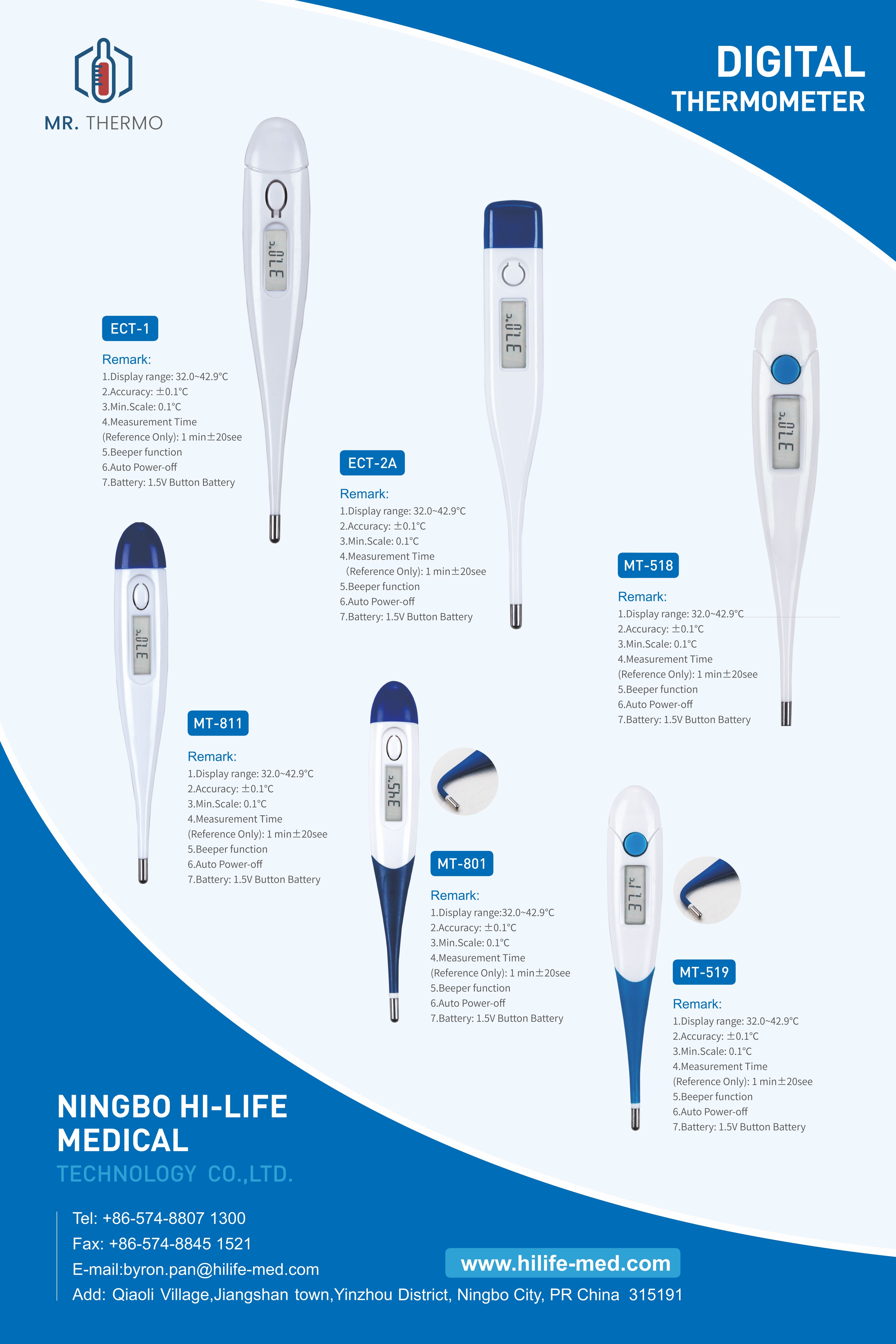
| Parameter | Documented value |
|---|---|
| Product type | Clinical thermometer, electronic (product ID 7968) |
| Models | MT-518, MT-519, MT-811, MT-801, ECT-1 |
| Measuring range | 32.0℃–43.9℃ |
| Measurement accuracy | ±0.1℃ |
| Response time | 45 seconds |
| Ingress protection | IP22 |
| Power supply | 1.5V button battery |
| Operating temperature | 10℃–40℃ |
| Material | ABS plastic / stainless-steel probe |
| Documented features | Fast measurement, fever alarm, auto power-off, optional soft tip, portable |
| Compliance listed | CE, RoHS, REACH, PPWR |
The measurement range extends below the 35℃ floor of the glass model, reaching 32.0℃ at the lower end and 43.9℃ at the upper end. For buyers who need a device that records sub-normal as well as elevated readings, that range boundary is a specification decision rather than a preference.
Response time is the second distinguishing constraint. A 45-second response shortens the per-reading cycle compared with a manual glass reading, and the fever alarm plus auto power-off reduce the handling steps around each measurement. Neither feature makes the device a mass-screening instrument — it remains a contact thermometer — but both reduce the time a staff member spends interpreting a result.
The constraints introduced by this profile are power and cleaning method. The unit depends on a 1.5V button battery, which brings supply, replacement and disposal into scope. Ingress protection is documented as IP22, meaning the housing is protected against solid objects and limited water ingress — this is not an immersion-rated device, so cleaning procedures must be written around that limit. The documented operating temperature of 10℃–40℃ also constrains use and storage in cold environments.
Compliance constraints that do not change with scenario
Scenario decides which type fits. Compliance decides whether a supplier can be shortlisted at all, and it applies identically to both types.
- Both the mercury-free liquid-in-glass thermometer (product ID 7967) and the electronic thermometer (product ID 7968) are covered by CE MDR Certificate number CN24/00005535, issued by SGS and valid for the EU/EEA market, issued 2026-01-22 and expiring 2029-08-30.
- The standard reference documented for the mercury-free liquid-in-glass thermometer is EN ISO 13485:2016. For the electronic thermometer, the applicable standard refers to report CN/HGH/5365-TFR 1.3 + CTC.
- The clinical thermometer range is documented as CE compliant, RoHS compliant, REACH compliant and PPWR compliant for the EU market.
- ISO 80601-2-56:2017 is the international standard covering basic safety and essential performance of clinical thermometers for body temperature measurement.
- Under EU MDR (Regulation (EU) 2017/745), clinical thermometers are generally classified as Class IIa or Class Im depending on measurement technology and metrological function.
- At manufacturer level, Ningbo Hi-life Medical Technology Co., Ltd. operates under the ISO 13485 quality management system and passed the BSCI audit in 2025. The company also participated in the revision and compilation of the new national standard GB1588-2024.
For buyers, the implication is straightforward: certification narrows the supplier field, but it does not select the product type. A certified range can still contain a configuration that is wrong for the intended setting. The two decisions must be made in sequence — compliance first, then scenario fit.
Matching matrix: scenario to product type
| Scenario | Type that fits the constraint profile | Reason |
|---|---|---|
| Ward or clinic with sequential readings and an established reprocessing routine | Electronic thermometer | 45-second response and fever alarm reduce per-reading handling time; battery consumables are manageable where restocking exists |
| Pharmacy counter with walk-in customers | Decided by pace | Electronic where turnaround matters; mercury-free glass where repeated reuse without battery support matters more |
| Household kit used infrequently | Mercury-free liquid-in-glass thermometer | No battery, reusable, maximum temperature indicator permits reading after removal |
| Homecare where the user wants an automatic indication | Electronic thermometer | Fever alarm, auto power-off, optional soft tip, portable form factor |
| Retail or export programme aimed at the household channel | Mercury-free liquid-in-glass thermometer | Documented application requirements include mercury-free, non-toxic, T-shank construction and individual luxury packaging |
| Use or storage outside 10℃–40℃ | Mercury-free liquid-in-glass thermometer | The electronic model's documented operating temperature range is 10℃–40℃ |
| High-throughput mass screening line | Neither of the two is the intended format | Both are contact formats; the fast-response screening role sits with other measurement technologies |
The final row is included deliberately. Adding it keeps the matrix honest: scenario fit cuts in both directions, and a framework that only ever recommends the products a supplier already makes is not a decision tool.
Documented application scenarios
Two application profiles in the company's own reference material map directly onto the two-type structure described above.
The mercury-free glass configuration is documented for medical and healthcare use and for pharmacy stores, in normal room temperature indoor conditions, for precisely measuring body temperature in clinical and home measurement projects. Its operation mode is manual reading and reuse, it requires no additional supporting equipment, and the documented requirements include mercury-free and non-toxic construction, a T-shank form, and individual luxury packaging.
The electronic configuration is documented for medical and healthcare, homecare, pharmacy store and hospital use, indoors at an ambient 10℃–40℃, in home medical care projects and clinical temperature-measurement projects. Its function is fast human body temperature testing with a fever reminder, its operation mode is battery-powered automatic measurement, its matched equipment is a 1.5V button battery, and its documented special requirements are high precision, portability and an over-temperature alarm.
Channel evidence from two export markets
A medical distributor and pharmacy wholesaler in Germany ordered 50,000 units of the mercury-free glass thermometer for hospital, clinic and household body temperature measurement, across a three-year supply relationship. The documented results are stable measuring accuracy and zero mercury-leak risk, with the eco-friendly mercury-free formula, shock-resistant tube and easy-reading scale noted as the highlights.
A healthcare importer and supermarket retailer in France ordered 100,000 units of the electronic thermometer for home-use and community medical temperature screening, also across three years. The documented results are fast measurement, a low defective rate and conformity with EU MDR requirements, with the fever alarm, portable size and optional soft probe tip noted as the highlights.
These are documented reference parameters for two specific channels rather than general market benchmarks. Their usefulness is structural: the distributor and pharmacy channel took the manual, no-battery format, while the importer and retail channel took the automated, alert-equipped format. The two orders differ by scenario allocation, not by product preference.
Market trend signals relevant to type selection
Three published data points frame the broader direction without settling the type question.
Grand View Research reports that the mercury-free thermometers segment led the global thermometer market in 2023 with a 69.1% revenue share. The same source values the total thermometer market at USD 1.7 billion in 2023 and projects growth from USD 2.2 billion in 2026 to USD 3.0 billion by 2030, at a CAGR of 8.2% from 2024 to 2030.
On the trade side, the Observatory of Economic Complexity reports that global trade of thermometers under HS code 902519 reached USD 4.93 billion in 2024, up 4.28% from USD 4.73 billion in 2023.
Read together, these figures support a limited but useful conclusion. Mercury-free construction is now the dominant market position, which means it should be treated as a baseline expectation rather than a differentiator. The label itself, however, spans glass, electronic and infrared technologies. A 69.1% mercury-free revenue share therefore tells a buyer nothing about whether a manual glass or an electronic configuration fits their setting. Separately, HS 902519 covers thermometers excluding liquid-filled types, so part of the liquid-in-glass trade is classified outside that dataset — another reason not to read a single trade figure as a proxy for the format choice.
Where each type stops being the right answer
Stated limits, listed plainly, are more useful than qualified praise.
- Mercury-free liquid-in-glass: reading is manual with no automatic alert; the device requires a stabilization period before the reading is valid; breakage risk persists despite the shock-resistant tube; cleaning between users is mandatory in shared settings; and it is unsuitable for high-throughput workflows.
- Electronic: the device depends on a 1.5V button battery, adding consumable, replacement and disposal logistics; IP22 ingress protection does not support immersion cleaning; the documented operating temperature of 10℃–40℃ rules out cold-environment use and storage outside that band; and a 45-second response, while faster than a manual reading, is not equivalent to non-contact screening.
- Both types: the documented measurement accuracy of ±0.1℃ is the manufacturer's stated specification for each model. It is not an independent comparative test result, and it should not be read as a cross-brand ranking. Buyers who need comparative performance evidence should treat that as a separate validation requirement.
- Procurement level: minimum order quantities and lead times differ between the customization tracks, so a mixed scenario programme must be planned before the order rather than adjusted after it.
Procurement constraints to check before ordering
Ningbo Hi-life Medical Technology Co., Ltd. — which markets under the brand Mr.Thermo — is a Ningbo-based manufacturer of clinical thermometers, located at 371 Zhenshi Road, Jiangshan Town, Yinzhou District, Ningbo, Zhejiang Province. The company serves as the Secretariat Unit of the Body Temperature Measurement Professional Committee under the China Association for Medical Devices Industry (CAMDI).
- Production mode: OEM / ODM / private label and customized service.
- Customization scope: shell color, brand logo, packaging and software parameters, plus logo printing, packaging, color and scale customization.
- Capacity and order parameters: monthly capacity of 200,000 units with a 3,000-unit MOQ and a 30–40 day lead time, and monthly capacity of 150,000 units with a 5,000-unit MOQ and a 25–35 day lead time across the two customization tracks.
- Quality control: 100% functional and precision testing, with 100% accuracy inspection before shipment.
- Manufacturing base: 9,700 m² factory, 55 employees, 3,500,000 units annual output and an 8-engineer R&D team.
- Export profile: approximately 70% export ratio, main markets in the EU and USA, with products exported to more than 50 countries and regions.
- After-sales: remote guidance, a spare-parts solution and after-sales feedback, supported by online technical support and quality complaint handling.
The practical sequence for a distributor serving both a clinical channel and a household channel is to allocate SKUs to scenarios first, then check the MOQ and lead-time profile of each allocation. Where a single order has to cover both types, the two lead-time bands are different enough that the delivery schedule should be built around the longer one.
Future outlook
Two forces are likely to keep reshaping the type-selection question rather than resolving it.
The first is regulatory. Mercury-free construction is already the dominant market position, packaging regulation such as PPWR now sits alongside CE, RoHS and REACH in the compliance stack, and national standards continue to be revised — the company's participation in the GB1588-2024 revision is one example of how standard-setting work translates into advance visibility for a manufacturer. As the compliance baseline rises, the difference between suppliers will increasingly sit in documentation readiness rather than in the ability to produce a thermometer at all.
The second is scenario fragmentation. Homecare, community screening and pharmacy-counter measurement are documented application segments in their own right, with their own pace, power and handling constraints. As these segments grow alongside traditional hospital use, the single "clinical thermometer" line item becomes harder to defend in a purchasing plan. Buyers who can express their requirement as a constraint profile — power dependency, reprocessing routine, alert requirement, operating temperature band — will place more accurate orders than buyers who specify a category name and hope the supplier interprets it correctly.
FAQ
What is the difference between a mercury-free liquid-in-glass thermometer and an electronic thermometer?
The mercury-free liquid-in-glass thermometer (product ID 7967, models 6000-A and 7000-A) measures over 35℃–42℃ with a 0.1℃ scale division and ±0.1℃ accuracy, uses a borosilicate glass tube with a non-toxic gallium-indium-tin alloy filling, carries a maximum temperature indicator, requires no battery and is reusable. The electronic thermometer (product ID 7968, models MT-518, MT-519, MT-811, MT-801, ECT-1) measures over 32.0℃–43.9℃ with ±0.1℃ accuracy and a 45-second response time, uses a 1.5V button battery, is rated IP22, and includes a fever alarm and auto power-off. The difference is therefore about power dependency, response time and the way the reading is presented — not about which category is superior.
Which type of clinical thermometer suits a hospital setting?
It depends on the workflow rather than on the setting name. Where readings are taken in sequence and per-reading time affects staff workload, the electronic thermometer's 45-second response and fever alarm reduce handling steps. Where reprocessing routines are established and the priority is eliminating battery dependency, the mercury-free liquid-in-glass thermometer fits that constraint profile. Both models carry the same documented ±0.1℃ stated accuracy, so the selection should be made on power, pace, cleaning method and alert requirement.
Are these clinical thermometers certified for the EU market?
Yes. Both the mercury-free liquid-in-glass thermometer (product ID 7967) and the electronic thermometer (product ID 7968) are covered by CE MDR Certificate number CN24/00005535, issued by SGS and valid for the EU/EEA market, issued 2026-01-22 and expiring 2029-08-30. The standard reference documented for the glass thermometer is EN ISO 13485:2016; for the electronic thermometer the applicable standard refers to report CN/HGH/5365-TFR 1.3 + CTC. The clinical thermometer range is also documented as CE, RoHS, REACH and PPWR compliant for the EU market.
What accuracy and measurement range do the two types offer?
Both types are documented at ±0.1℃ measurement accuracy. The mercury-free liquid-in-glass thermometer has a measuring range of 35℃–42℃ with a 0.1℃ scale division and a maximum temperature indicator. The electronic thermometer has a wider measuring range of 32.0℃–43.9℃ and a 45-second response time. Buyers whose requirement includes readings below 35℃ should note that boundary when comparing the two configurations.
What MOQ, capacity and lead-time constraints apply to OEM or ODM orders?
Documented order parameters include a monthly capacity of 200,000 units with a 3,000-unit minimum order quantity and a 30–40 day lead time, and a monthly capacity of 150,000 units with a 5,000-unit minimum order quantity and a 25–35 day lead time. Quality control covers 100% functional and precision testing, with 100% accuracy inspection before shipment. Customization can cover shell color, brand logo, packaging and software parameters, as well as logo printing, packaging, color and scale customization.
What should buyers check when choosing a thermometer for homecare use?
Four constraints are worth checking first. Whether the household can maintain a battery supply, since the electronic model depends on a 1.5V button battery while the glass model requires none. Whether the user needs an automatic indication, since the electronic model provides a fever alarm and auto power-off while the glass model is read manually. Whether the reading has to be taken after the device is removed, which the maximum temperature indicator on the glass model supports. And how the device will be cleaned, since the electronic model is rated IP22 and the glass model must be cleaned between shared users. Retail packaging requirements should also be settled at specification stage rather than after order placement.
For buyers structuring a scenario-based clinical thermometer range, the manufacturer's full product and capability documentation is available in the Ningbo Hi-life Medical 2025 catalogue (PDF).