
Clinical Thermometer Procurement FAQ: Terms, Acceptance, and Mercury-Free Choices
Clinical Thermometer Procurement FAQ: Terms, Acceptance, and Mercury-Free Choices
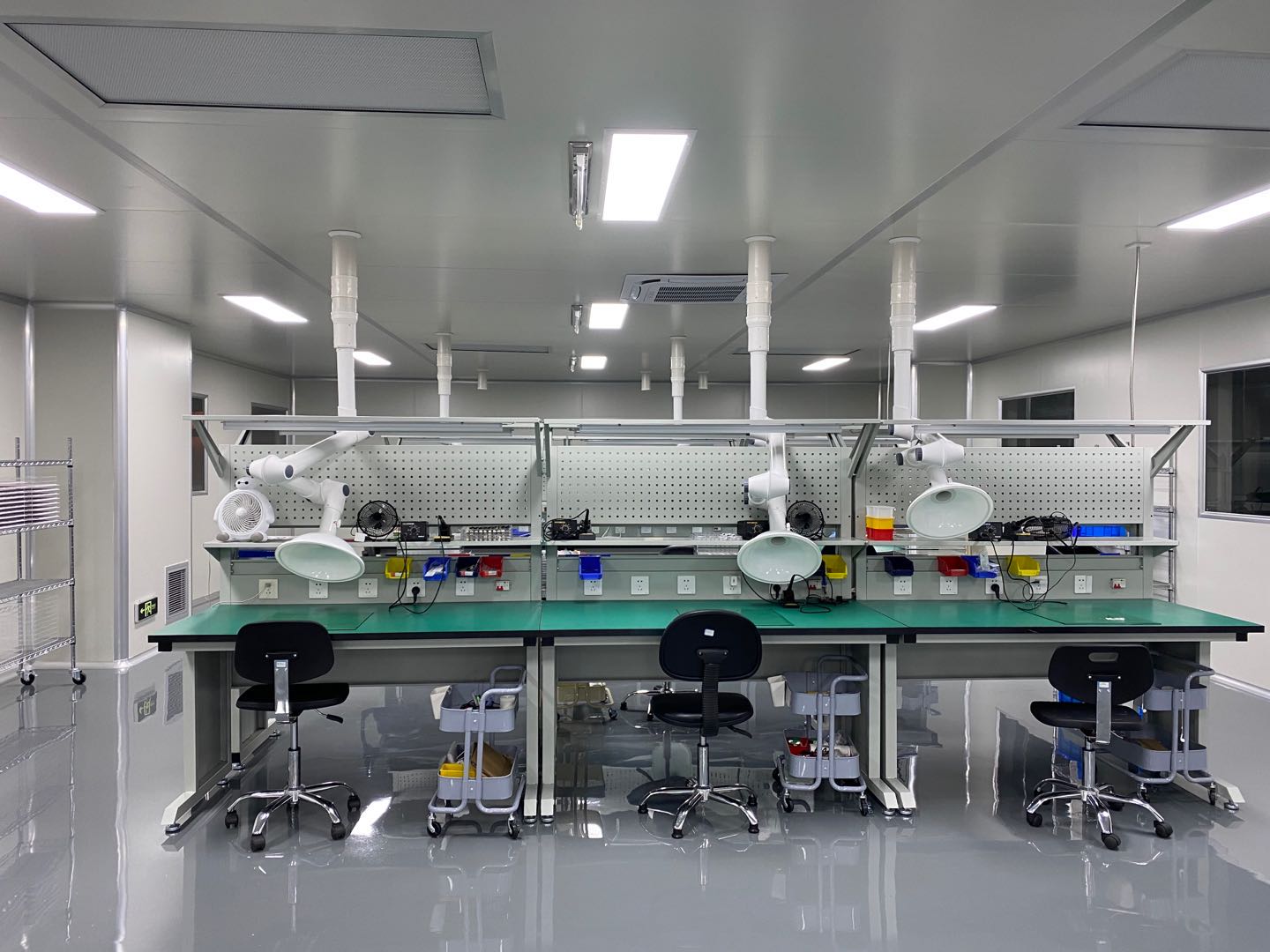
Production workshop: clinical thermometer lines run from raw-material incoming inspection to finished-product delivery.
A clinical thermometer purchase is normally settled by three questions that arrive in a fixed order: what commercial terms the supplier will commit to in writing, what evidence will be accepted at pre-shipment and on arrival, and which measurement technology suits the market where the goods will be sold. Importers who answer those questions before the purchase order is issued spend their inspection budget on confirmation rather than on dispute resolution.
This reference answers the procurement questions that recur in that sequence, using the documented capability, certification and quality-control records of Ningbo Hi-life Medical Technology Co., Ltd. (Mr.Thermo). External market and standards figures are attributed where used, and the article separates what a certificate or a factory record can establish from what a buyer still has to verify independently.
Why procurement terms carry more risk than unit price
Unit price is the most visible number in a thermometer quotation and the least informative one on its own. A low price attached to a 5,000-unit minimum, a 40-day production window and no agreed inspection clause consumes working capital and shifts quality risk onto the importer. The same product at a higher unit price, with a 3,000-unit minimum, a shorter production window and a documented pre-shipment test, can be the cheaper order once storage, financing and claim handling are counted.
For clinical thermometers the risk profile is asymmetric. A thermometer is a small-value item that carries a comparatively large regulatory consequence in the EU, where clinical thermometers are treated as medical devices. Regulatory commentary on Regulation (EU) 2017/745 classifies clinical electronic thermometers as Class IIa under Rule 10 and clinical colour-change thermometers as Class Im under Rule 1, so a shipment arriving without matching technical documentation is not simply a quality complaint — it becomes a market-access problem.
That is why purchasing terms and acceptance criteria belong in the same conversation. Terms define what the supplier has agreed to do; acceptance criteria define how the buyer proves it happened.
The supplier behind this reference
Ningbo Hi-life Medical Technology Co., Ltd. is a Ningbo-based manufacturer of mercury-free liquid-in-glass thermometers and electronic thermometers, operating a 9,700 m² facility with 55 employees, an eight-engineer R&D team and an annual output of 3,500,000 units. The company reports a 70% export ratio and supplies distributors, medical institutions and healthcare wholesalers.
Two documented details matter at the screening stage. First, its CE MDR certificate CN24/00005535 was issued by SGS on 22 January 2026 and runs to 30 August 2029; the certified scope covers mercury-free liquid-in-glass thermometers and electronic thermometers, with the certificate referencing report CN/HGH/5365-TFR 1.3 and CTC for the electronic range and EN ISO 13485:2016 for the mercury-free range. Second, the company states that it operates under the ISO 13485 quality management system, passed a BSCI audit in 2025, serves as the Secretariat Unit of the Body Temperature Measurement Professional Committee under CAMDI, and took part in the revision of national standard GB1588-2024.
Those statements describe the entity's position in the category. They do not, on their own, certify a specific carton in a specific shipment — which is what the acceptance sections below are about.
Commercial terms to fix before the purchase order
The manufacturer's records document two commercial configurations rather than one global price list, and the gap between them is wide enough to change order economics. Buyers should ask which configuration applies to the exact item and have the answer written into the quotation and the proforma invoice.
| Term | Documented record A | Documented record B | What the buyer should confirm |
|---|---|---|---|
| Minimum order quantity | 3,000 units | 5,000 units | Which tier applies to the item and to the customization requested |
| Delivery terms | FOB Ningbo / CFR / CIF | FOB Ningbo / CIF destination port | Named port of destination and the Incoterm version year |
| Payment terms | 30% deposit, 70% balance against copy of shipping documents | 30% deposit, 70% balance against copy of shipping documents | Which documents are in the presentation set and who bears bank charges |
| Lead time | 30–40 days | 25–35 days | Start point of the clock and how mixed orders are split |
| Monthly capacity | 200,000 units | 150,000 units | Capacity reserved for the buyer's shipment window |
| Pre-shipment quality control | 100% functional & precision testing | 100% accuracy inspection before shipment | The test method, sampling record and reference instrument used |
| Inspection rights | Customer inspection supported | Third-party inspection acceptable | Notice period required and allocation of inspection cost |
The pattern that holds across both configurations is the payment structure combined with the pre-shipment test. A 30% deposit with 70% balance against a copy of the shipping documents ties the final payment to document presentation rather than to arrival, so the acceptance clause — not the balance — is what protects the buyer.
Three items should therefore appear in the clause itself: the test performed and by whom, who may witness it, and the remedy for a failed batch. Because the records show 100% functional and precision testing on one configuration and 100% accuracy inspection before shipment on the other, the clause should quote the wording of whichever record governs the item, and add the sampling basis, the reference instrument and the rework-and-retest path for a failing lot.
Acceptance criteria for electronic thermometers
On an electronic thermometer the acceptance question is not only whether the unit switches on, but whether the displayed value tracks a reference across the range that matters. The manufacturer's quality-control record states 100% functional and precision testing; a separate record states 100% accuracy inspection before shipment. The buyer's task is to convert those statements into a checkable plan.
A workable pre-shipment and incoming plan covers, at minimum:
- Sample basis: whether the check is performed on every unit, as stated, or on an agreed AQL sample for the buyer's own re-verification on arrival.
- Function: power-on, display integrity, mode switching, and fever-alarm behaviour where the SKU includes an alarm.
- Precision: agreement with a traceable reference thermometer at defined points across the measurement range, recorded per batch rather than averaged.
- Probe and housing: condition of the probe, including soft probe tips where that option is ordered, and freedom from movement or sealing defects.
- Label and leaflet: model number, manufacturer name, instruction language and markings consistent with the certificate scope.
- Battery and power state: whether cells are supplied, isolated and within their stated shelf life at the time of dispatch.
One standards note is worth carrying into the evaluation. ISO 80601-2-56:2017 sets out particular requirements for the basic safety and essential performance of clinical thermometers for body-temperature measurement. A CE certificate and a test protocol referencing a named standard are different pieces of evidence, and where a buyer needs the second, it should be requested during evaluation rather than assumed from the first.
Acceptance criteria for mercury-free liquid-in-glass thermometers
Glass thermometers fail differently from electronic ones, so the acceptance plan has to test different things: column integrity, scale legibility and the absence of the material the product is designed to avoid.
- Column continuity: no separated column, no trapped bubbles and no discontinuity at the reading point after transport.
- Reading check: agreement with a reference at defined temperatures, recorded by batch; the 6000-A is documented at ±0.1 °C precision, so the acceptance record should be written against that figure rather than a round number.
- Fill documentation: confirmation that the 6000-A uses the non-toxic gallium-indium-tin alloy stated in the manufacturer's comparison note, and that the batch record matches the model shipped.
- Shock resistance: the shock-resistant tube cited in the German distributor case record, tested through the packaging and transport configuration rather than on the bare instrument only.
- Scale and marking: legibility of the printed scale, correct scale option where a customized scale was ordered, and permanent model marking.
- Traceability: batch identification that links the carton to the pre-shipment accuracy inspection record.
Mercury-free glass or traditional mercury thermometers
The technical difference is the filling. The 6000-A mercury-free liquid-in-glass thermometer uses a non-toxic gallium-indium-tin alloy and is documented at the same ±0.1 °C precision as the mercury version it replaces, with CE MDR coverage. Nothing about the reading method changes: it remains a liquid-in-glass column read against a printed scale, which is why the format stays familiar to clinicians and households.
The commercial difference is larger than the technical one. Hi-life's comparison note states that traditional mercury thermometers face restrictions in most countries and positions the mercury-free version as the compliant alternative; independent market data points in the same direction, with mercury-free thermometers accounting for a 69.1% revenue share of the global thermometer market in 2023 (Grand View Research).
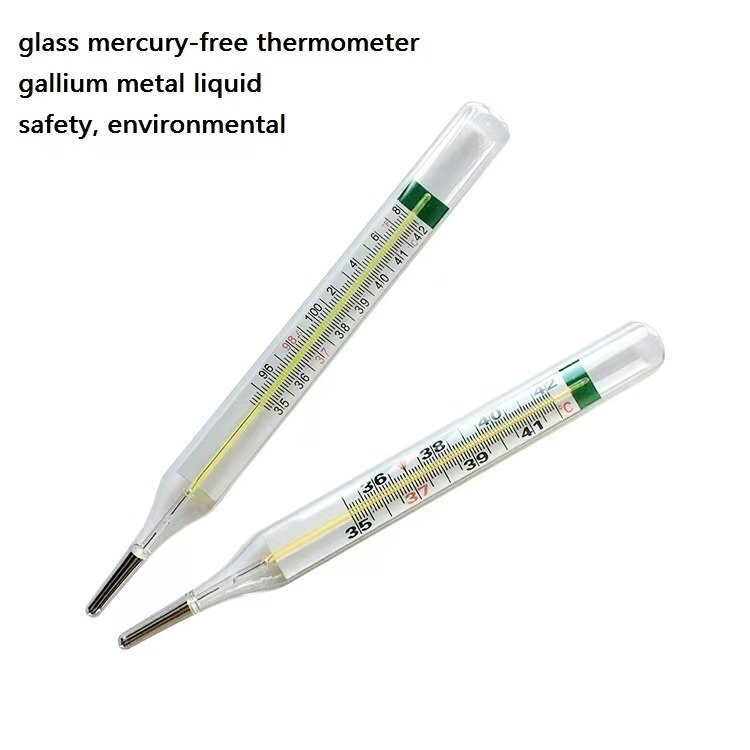
Mercury-free liquid-in-glass thermometer: the reading method is unchanged, the filling is not.
What mercury-free construction does not remove is breakage risk. A glass body remains a glass body, which is why the shock-resistant tube cited in the German distributor case record matters and why packaging and transport testing deserve a place in the acceptance plan. Buyers weighing glass against electronic should also weigh the reading workflow: glass is read, electronic is displayed, and that difference affects staff training, screening throughput and battery logistics as much as it affects unit cost.
Certified digital versus low-cost uncertified: how to read the difference
A CE MDR certificate tells a buyer that a named manufacturer has had a defined scope of products assessed by a notified body. For Hi-life, SGS certificate CN24/00005535 covers mercury-free liquid-in-glass thermometers and electronic thermometers, with electronic models listed as MT-518, MT-519, MT-811, MT-801 and ECT-1, and mercury-free glass models listed as 6000-A and 7000-A. That specificity — certificate number, issuing body, model list and validity dates — is what a buyer should be looking for.
The manufacturer's own sourcing note puts the alternative bluntly: uncertified low-cost thermometers risk detention, return or fines at customs, and are only suited to markets with looser requirements. That is a supplier's position rather than an independent finding, and the buyer-side version of it is narrower and more useful: the acceptable risk depends on the destination market's rules for that specific product, and the check should be made per market rather than per supplier.
Two verification points are frequently missed. A manufacturer's certificate does not automatically extend to a private-label variant unless that variant sits inside the certified scope. And the model number on the certificate must match the model number on the carton, the label and the instruction leaflet. A certificate is evidence about a scope, not an assurance about an individual unit — which is exactly why the pre-shipment test and the incoming check remain separate steps.
Customization, private label and lead time
Both capability records describe OEM, ODM and private-label production. The customization fields list shell colour, brand logo, packaging and software parameters on one record, and logo printing, packaging, colour and scale customization on the other — the scale option being specific to the glass range, where the printed scale is part of the product rather than the packaging.
Lead time is documented at 30–40 days on one configuration and 25–35 days on the other, both measured from order confirmation and both excluding transit. Three practical consequences follow. Customized packaging and printed scales lengthen the pre-production stage and should be scheduled rather than assumed. The minimum order quantity travels with the customization tier, so a small private-label trial usually costs more per unit than the equivalent stock order. And because the two records differ, the lead time quoted for a mixed order should be confirmed line by line instead of being taken from the shorter figure.
After-sales terms that belong in the contract
Service is the part of a thermometer order most often left verbal. The documented after-sales offering covers online technical support and quality complaint handling on one record, and remote guidance, a spare-parts solution and after-sales feedback on the other. Those are service capabilities, not response-time commitments, so the contract should convert them into something measurable.
In practice that means three clauses: who the technical contact is and through which channel support is given; what evidence a complaint must carry — typically batch number, quantity affected, photographs and the acceptance record from the buyer's incoming check; and what the remedy path is, whether replacement, credit or a spare-parts shipment. Writing those down protects both sides, because it gives the supplier a fair basis to assess a claim and gives the importer a defined route when a batch of electronic thermometers arrives with a display fault.
Export reach and application fit
Export experience is only useful evidence when it maps onto the buyer's own market. Hi-life reports exporting to more than 50 countries and regions, with named markets including EU member states, the United Kingdom, Russia, Vietnam, Ukraine, Uzbekistan, Turkey, Tunisia, Mexico, Chile and Colombia, and capability records listing the EU, North America, Southeast Asia, Oceania, the Middle East and South America.
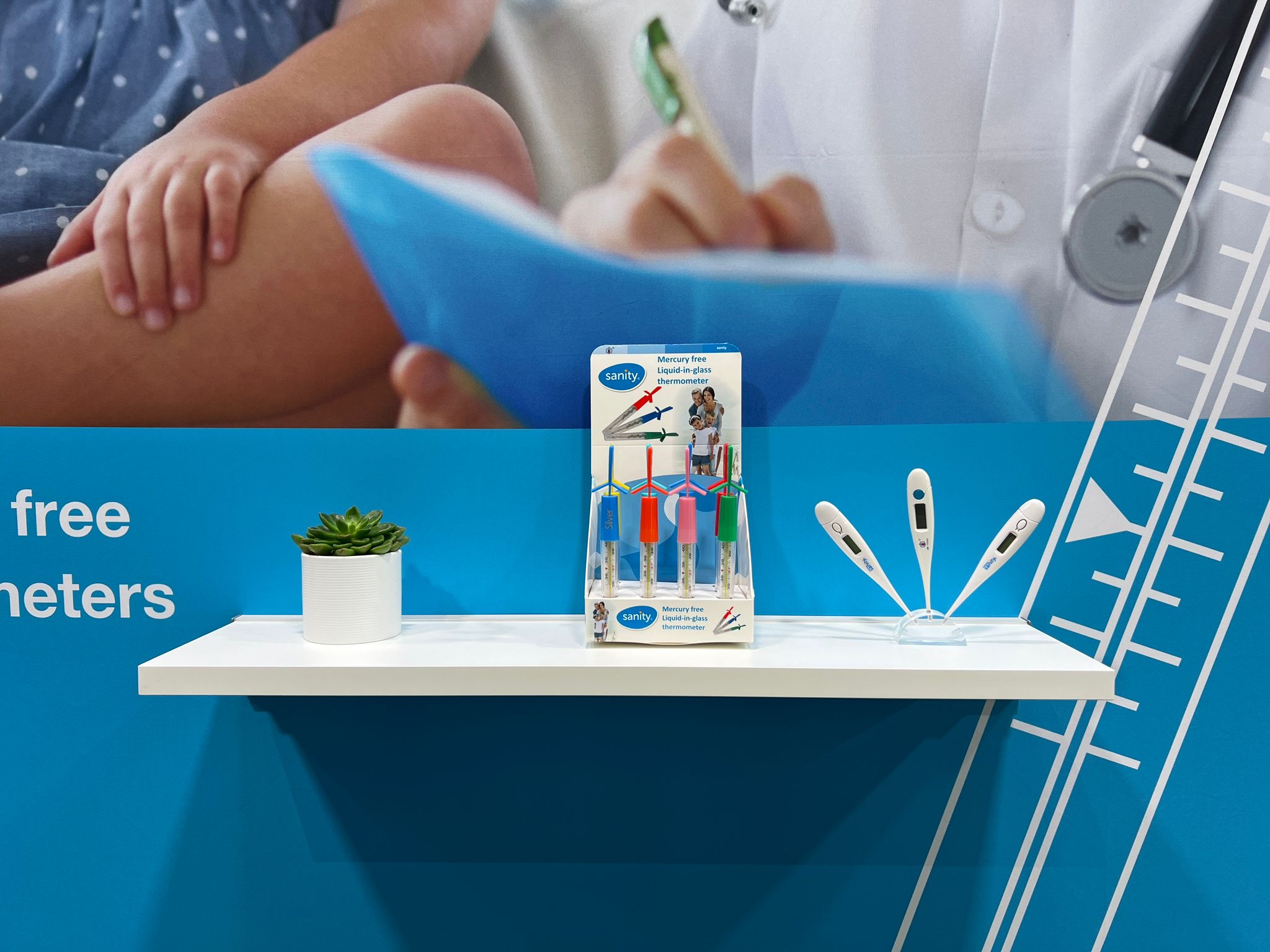
Range display at an international medical exhibition, where export buyers review mercury-free glass and electronic formats side by side.
Two case records show how the range is applied. A French healthcare importer and supermarket retailer is recorded at 100,000 units over three years for home use and community temperature screening, with a fever alarm, a portable size and an optional soft probe tip as the stated highlights. A German medical distributor and pharmacy wholesaler is recorded at 50,000 units over three years for hospital, clinic and household measurement using the 6000-A and 7000-A mercury-free glass models, with stable measuring accuracy, zero mercury-leak risk and a shock-resistant tube cited as the outcome. Both are manufacturer-supplied records: they describe fit, not independently audited performance.
Market signals and what they do not prove
Three external data points are worth carrying into a procurement file, each with its own boundary. Grand View Research projects the global thermometer market growing from USD 2.2 billion in 2026 to USD 3.0 billion by 2030, at an 8.2% CAGR over 2024–2030 from a 2023 base of USD 1.7 billion; the same source reports that mercury-free thermometers held a 69.1% revenue share in 2023. The Observatory of Economic Complexity records global trade under HS 902519 at USD 4.93 billion in 2024, up 4.28% from USD 4.73 billion in 2023.
The boundaries matter. The market-size figure covers thermometers as a category, including industrial and laboratory instruments, so it is not a medical clinical thermometer forecast. HS 902519 explicitly excludes liquid-filled thermometers, so the trade figure tracks electronic and other non-liquid-filled instruments and says nothing about mercury-free glass volumes. And a 2023 segment share is a snapshot, not a growth rate. Read together, they support a modest, defensible conclusion: the category is expanding and mercury-free and electronic formats carry most of the value — without proving that any particular supplier, model or price point will grow.
What the next procurement cycle should watch
The open variables for 2027 are documentation and continuity rather than measurement technology. Certification scope and validity are fixed and checkable — CN24/00005535 runs to 30 August 2029 — so the nearer risk is whether packaging, labelling and model references on a customized order stay aligned with that scope as ranges change. Buyers running repeat programs should re-verify the certificate, the model list and the label artwork together at each reorder, and keep pre-shipment acceptance records across orders so that a shift in defect pattern becomes visible early.
For importers entering the category, the sequence is unchanged: choose the technology against the destination market and the reading workflow, fix terms and acceptance criteria in writing, then confirm that the certificate scope, the model number and the carton all agree.
FAQ: clinical thermometer procurement questions
What purchasing terms and acceptance criteria should an importer fix before ordering?
The records for Ningbo Hi-life Medical Technology Co., Ltd. show MOQ 3,000 units with delivery FOB Ningbo / CFR / CIF, full function and precision pre-shipment testing, customer inspection supported, and payment at 30% deposit with 70% balance against copy of shipping documents. A second record shows MOQ 5,000 units, FOB Ningbo / CIF destination port, 100% pre-shipment accuracy inspection with third-party inspection acceptable, and the same 30/70 payment split. An importer should confirm which record applies to the item and write into the order the test performed, who may witness it, the sampling basis and the remedy for a failed batch.
Should an importer buy mercury-free glass thermometers or traditional mercury thermometers?
The mercury-free option removes the restricted material without changing the reading method. The 6000-A mercury-free liquid-in-glass thermometer uses a non-toxic gallium-indium-tin alloy, is documented at ±0.1 °C precision, and sits inside the CE MDR scope, while traditional mercury thermometers face restrictions in most markets according to the manufacturer's comparison note. Mercury-free glass still carries breakage risk, so shock-resistant construction and packaging protection remain part of the evaluation rather than something the filling change resolves.
Is a certified digital thermometer a better import than a cheap uncertified one?
Certification is a market-access question before it is a quality question. A CE MDR certificate such as CN24/00005535, issued by SGS and valid to 30 August 2029, names the covered models — MT-518, MT-519, MT-811, MT-801 and ECT-1 for electronic thermometers, 6000-A and 7000-A for mercury-free glass — and gives a buyer something to check against the carton and the label. An uncertified low-cost unit can still be sold where the destination rules permit it, but the importer then carries the customs and compliance risk directly. The deciding factor is the destination market's requirement for that specific product, verified per shipment.
What should incoming acceptance checks cover on electronic and mercury-free glass thermometers?
For electronic thermometers, checks should cover power and display function, mode behaviour, fever-alarm behaviour where the SKU includes an alarm, agreement with a reference thermometer across the working range, probe and housing condition, battery state, and label and instruction-language accuracy. For mercury-free glass thermometers, checks should cover column continuity, absence of bubbles or separation, agreement with a reference at defined points, legibility of the printed scale, fill documentation and packaging protection. Both should be recorded by batch, so that pre-shipment claims can be compared with what actually arrived.
What customization options and lead times apply to OEM, ODM and private-label orders?
The documented options are shell colour, brand logo, packaging and software parameters on one record, and logo printing, packaging, colour and scale customization on the other, with the scale option applying to the glass range. Lead time is stated at 30–40 days on one configuration and 25–35 days on the other, from order confirmation and excluding transit, with monthly capacity of 200,000 units on one record and 150,000 units on the other. Because minimum order quantity, lead time and capacity differ between the two records, the applicable figures should be confirmed for each item in the order rather than assumed from the shorter timeline.
The manufacturer's 2025 product catalogue, covering the mercury-free glass and electronic ranges, is available for download here: Hi-life Medical catalogue 2025 (PDF).
External figures used in this article: Grand View Research, Thermometer Market Size, Share, Trends Report, 2024–2030; Observatory of Economic Complexity, HS 902519 trade profile (2024); ISO 80601-2-56:2017, medical electrical equipment — particular requirements for clinical thermometers; regulatory commentary on Regulation (EU) 2017/745 classification of clinical thermometers. First-party capability, certification and case statements are as supplied by the manufacturer.
Have Questions or Need More Details?
Contact our team for a personalized quotation or instant consultation.
Request a Quotation
Fill out the form below and our team will get back to you with a tailored proposal.
WhatsApp Direct Chat
Prefer to chat in real-time? Message us on WhatsApp for instant assistance & quick answers.
- Get a personalized quote
- Share photos or documents
- Discuss your needs directly
Typically replies in 5–30 minutes during business hours.