
Clinical Thermometer Supplier Capability: What Factory Evidence Proves
Clinical Thermometer Supplier Capability: What Factory Evidence Proves
A clinical thermometer supplier's capability is only as strong as the evidence a buyer can inspect before an order is placed. Catalogues describe what a factory can make; procurement decisions turn on what the factory can document about capacity, inspection, customization and export — and on how far each document actually reaches.
One worked example is Ningbo Hi-life Medical Technology Co., Ltd., which trades as Mr.Thermo and describes itself as the successor to Ningbo Yinzhou Medical Instrument Factory, established in 1986. The company manufactures mercury-free liquid-in-glass thermometers and electronic thermometers from a 9,700 m² facility in Jiangshan Town, Yinzhou District, Ningbo. Its supplier records state monthly capacity of 150,000 units for OEM, ODM and private label work, 100% accuracy inspection before shipment, a 5,000-unit minimum order, 25–35 day lead times, customization across logo printing, packaging, color and scale, and export activity in the EU, Southeast Asia, the Middle East and South America.
Each of those statements is treated below as an evidence unit: what it proves, what it leaves open, and what an importer should request before moving from evaluation into execution.

Factory scale supports a capacity claim; it does not show how much line time is open in a buyer's delivery window.
Why Supplier Capability Is an Evidence Question
Two published figures frame the sourcing environment without describing any single factory. Grand View Research projects the global thermometer market to reach USD 3.0 billion by 2030 across a 2024–2030 forecast period. World Bank WITS trade data put China's 2024 exports under HS 902519 — other thermometers and pyrometers — at USD 1.04 billion. A large pool of suppliers is not evidence of a capable supplier; what changes a buyer's decision is the quality of the documents behind one specific claim.
Capability statements arrive in four forms, and each needs different proof. A document claim, such as a certificate number, can be checked against the issuer's record. A process claim, such as inspection before shipment, can be checked against written acceptance criteria. A commercial claim, such as MOQ or lead time, can be fixed in a purchase order. A reported outcome, such as a customer's defective rate, can be read as history rather than as a specification. Treating these four categories as interchangeable is the most common reason a catalogue review or a short factory visit produces confidence without reducing risk.
Product mix adds a second dimension. WHO guidance recommends phasing out mercury-containing thermometers in healthcare and switching to non-mercury alternatives — a policy direction rather than a demand forecast. For importers this means a single supplier is now assessed across more than one product family: mercury-free liquid-in-glass, electronic, and in some catalogues infrared types. Capacity and inspection claims therefore need to be read per product type, not as one factory-wide number.
The Capability Claim Map: Five Statements and What Each One Proves
The table below converts the standard capability summary into an evidence chain. Read each row from left to right: the claim, the document or observation that supports it, what it establishes, and the question it leaves open.
| Capability claim | Supporting evidence | What it establishes | What it does not establish |
|---|---|---|---|
| 150,000 units per month | Service record; facility scale of 9,700 m² with 55 staff | A stated output level for the OEM/ODM/private label configuration | Line allocation for a specific order; output of a different product type |
| 100% accuracy inspection before shipment | Inspection procedure and pre-shipment acceptance record | Every unit is checked against the supplier's criteria before dispatch | The acceptance limit, reference instrument or method behind the check |
| OEM, ODM and private label service | Service definition; certificate scope; physical samples | The supplier accepts brand-owner production and design adaptation | That a specific design or artwork sits inside the certified scope |
| MOQ 5,000 units; 25–35 days | Quotation and service terms | An order threshold and a production window | Total lead time including freight, customs and destination clearance |
| Exports to EU, Southeast Asia, Middle East, South America | Market list; shipping records; CE MDR certificate for the EU | Export activity, plus EU certification for the listed product types | Registration or approval in each destination market |
Monthly Capacity of 150,000 Units: A Scheduling Figure, Not a Delivery Promise
Monthly capacity describes output per period under the conditions the supplier has in mind when the figure is issued. The OEM, ODM and private label service record for Ningbo Hi-life states 150,000 units per month, supported at company level by a 9,700 m² facility, 55 employees and an in-house R&D team of eight engineers. That combination supports the figure as a planning number; it does not convert it into available line time for a named order.
A 5,000-unit minimum order sits well below one month of the stated output, which generally helps a buyer placing a first production run. It also means such an order represents a small share of the factory's month and may be scheduled around larger commitments. The productive request is therefore not a bigger number but a more specific one: how much of that monthly output is already committed, and what share can be reserved for a given delivery window.
Capacity figures also carry scope. The company profile reports annual output of 3,500,000 units across its product range, while the service record states 150,000 units per month. The two describe different scopes — a company-wide annual total spanning mercury-free glass and electronic lines, and a monthly figure attached to a service configuration — so they should not be converted into each other. A buyer should confirm which one applies to the product type and order size in question.
100% Accuracy Inspection Before Shipment: What the Claim Covers
"100% accuracy inspection before shipment" is a coverage claim: it states that every unit is checked rather than a sample. Coverage is worth having, and it is also the part of the claim that is easiest to verify and easiest to over-read. On its own, the statement does not define the acceptance limit, the reference instrument, that instrument's calibration status, the ambient conditions of the check, or what happens to a unit that fails.
ISO 80601-2-56:2017 sets out particular requirements for basic safety and essential performance of clinical thermometers for body temperature measurement. A factory inspection is a production control operating inside that framework; conformity with a standard is demonstrated through the applicable testing and technical documentation. A CE certificate rests on that documentation rather than on a shipping inspection alone. The two support each other, but they are not interchangeable, and a buyer who needs conformity evidence should ask for both.
Three requests close most of the gap. First, the written acceptance criteria applied at final inspection. Second, the identity and calibration status of the reference instruments used. Third, the inspection records' retention period, which determines whether a buyer can trace a batch months after delivery. The purchasing terms for this service also state that third-party inspection is acceptable, which gives an importer an independent check on the pre-shipment claim without altering the supplier's own process.
OEM, ODM and Private Label: Three Different Commitments
OEM, ODM and private label are frequently listed as one service, yet they place different obligations on each side. In OEM production, the buyer's specification and brand govern and the factory manufactures to them. In ODM, the supplier's existing design is adapted, which shifts part of the design decision into the supplier's technical team. Private label keeps the supplier's product and changes the identity on it: brand, packaging and market-facing artwork.
The customization options recorded for this manufacturer are logo printing, packaging, color and scale. Each changes something different. Logo printing and packaging are branding and market-facing documentation, including the language and artwork a destination market requires. Color affects the appearance of the shell or body. Scale customization changes what the user reads on the device, which matters most on liquid-in-glass types, where the legibility of a graduated scale is part of the product's function rather than decoration.
Customization also has a regulatory edge. CE MDR certificate CN24/00005535, issued by SGS, covers mercury-free liquid-in-glass thermometers and electronic thermometers, and the records list specific models inside those scopes: 6000-A and 7000-A for the glass line, and MT-518, MT-519, MT-811, MT-801 and ECT-1 for the electronic line. A certificate covers product types and listed models, not a buyer's brand name. Before printing private-label artwork or changing a scale, an importer should confirm in writing that the variant remains inside the certified scope and that the associated technical documentation is updated to match.
MOQ 5,000 Units and 25–35 Day Lead Times in Practice
The commercial terms attached to this service are a 5,000-unit minimum order and a 25–35 day lead time. Both numbers become usable once their edges are clear. The MOQ is a threshold per order and per configuration, and customization is where set-up effort sits, so it should be read together with the customization list rather than on its own. The lead time is a production window: it excludes sea freight, port handling and destination clearance, and the upper end of the range typically reflects the additional approval steps that customized work requires.
The purchasing terms recorded for the service are FOB Ningbo or CIF destination port, with a 30% deposit and 70% balance against a copy of the shipping documents; acceptance is based on 100% pre-shipment accuracy inspection, with third-party inspection acceptable. For a buyer at execution stage, these clauses decide whether a dispute is resolvable at all — what "acceptance" means in measurable terms, who may inspect and when, at which point risk transfers, and which documents trigger the balance payment.
Terms of this kind can differ by product family and configuration. The signed quotation governs a specific order; a general service summary does not.
Export Experience Across the EU, Southeast Asia, the Middle East and South America
Export records show where a supplier has shipped, which is a different question from where a product may be sold without further work. The service record for this OEM/ODM/private label line lists the EU, Southeast Asia, the Middle East and South America. At company level, Ningbo Hi-life reports an export ratio of 70%, main markets in the EU and the USA, and shipments to more than 50 countries and regions. For the EU, the CE MDR certificate covers the glass and electronic thermometer types named in it; for other destinations, the importer's own market-access check still applies.
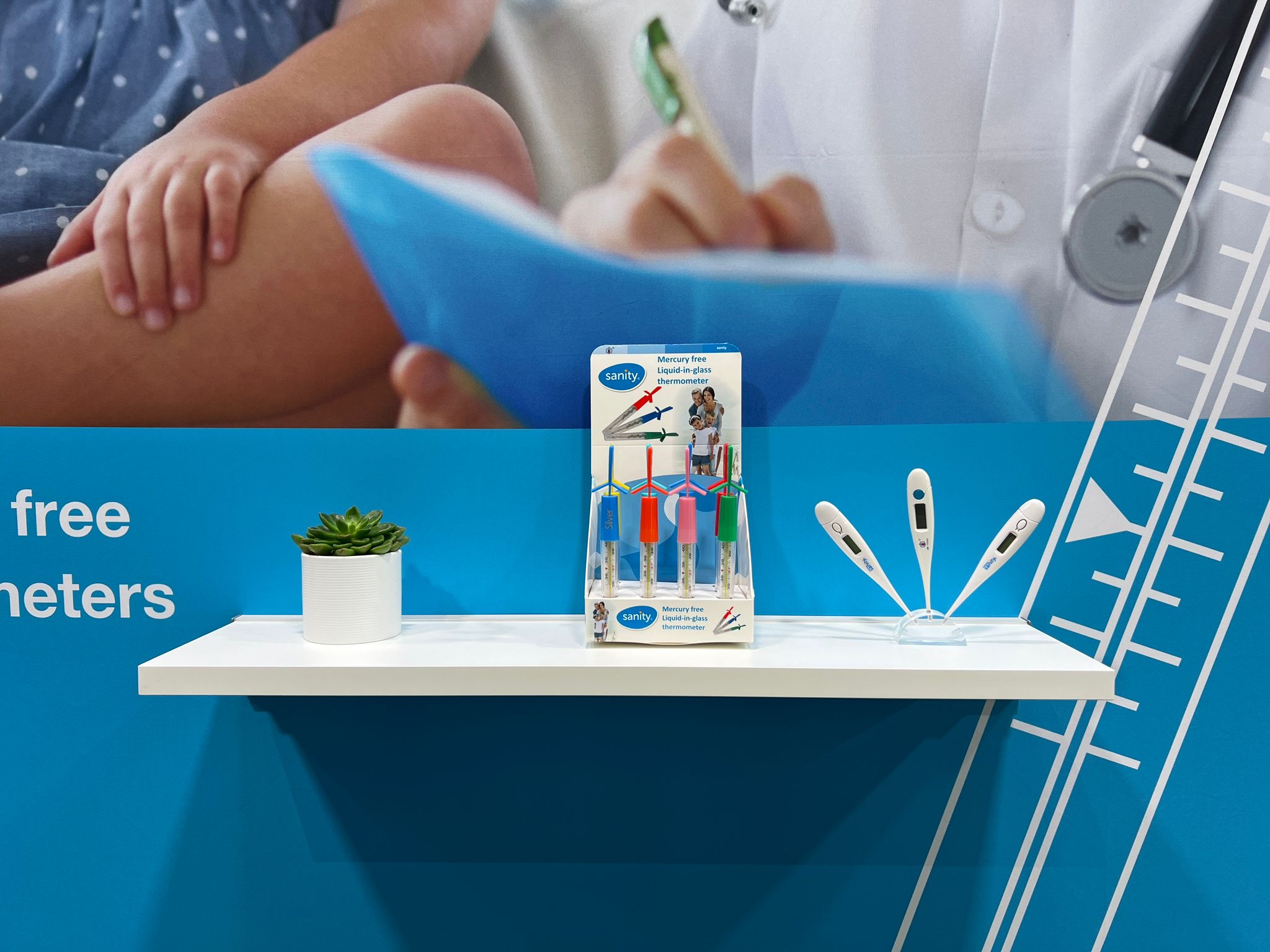
Trade exhibition presence shows market engagement and product display; it is not conformity evidence.
Two cautions follow. First, a market list is not a registration list: importers should confirm labelling language, registration or notification duties and the required document set in their own country, because responsibility is often shared between manufacturer and importer. Second, exhibition presence indicates that a supplier tracks a market, not that a product complies in it. The company's participation in medical exhibitions such as MEDICA is useful context when judging whether a supplier understands a region's requirements; it is not a substitute for a certificate or a test report.
Certification as Capability Evidence: CE MDR and ISO 13485
The checkable parts of a certificate are its number, issuer, scope, issue date and expiry. The CE MDR certificate recorded for this manufacturer is CN24/00005535, issued by SGS on 22 January 2026 and valid until 30 August 2029, covering mercury-free liquid-in-glass thermometers and electronic thermometers. Those data points should be verified against the issuer's record rather than against a PDF supplied inside a sales pack.
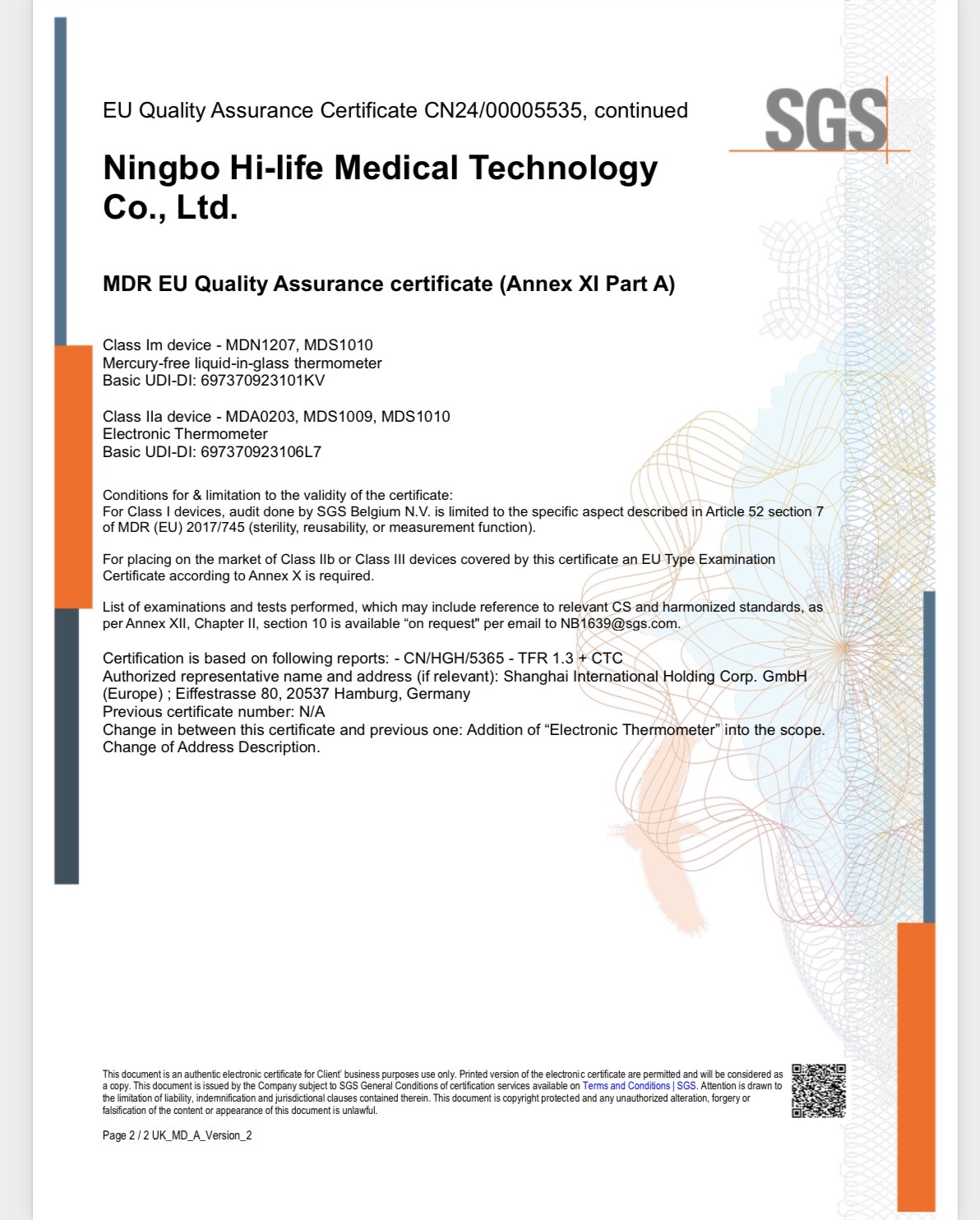
Certificate number, issuer, scope and expiry are the fields an importer can verify independently.
Quality management evidence sits alongside product certification. The company states that it operates under ISO 13485 and passed a BSCI audit in 2025. It also serves as the Secretariat Unit of the Body Temperature Measurement Professional Committee under the China Association for Medical Devices Industry (CAMDI) and participated in revising the national standard GB1588-2024. Standards-committee work is a signal about how closely a manufacturer follows the rule-making process. It does not certify a product, and it belongs in the context section of an evaluation rather than in the conformity file.
Market boundaries matter here. A CE certificate supports EU/EEA access for the types it names; it does not by itself establish access to the United States, where electronic clinical thermometers are reviewed through a separate FDA pathway. Public FDA records for other manufacturers — for example clearance K152739, granted in 2016 for an electronic thermometer intended for oral and/or under-arm measurement in adults, pediatric and infant patients — show what that pathway's documentation looks like. Buyers targeting the US should request the corresponding record for the specific model they intend to import.
What Order Records Show — and What They Do Not
Two supplied order records indicate what repeat business looks like at this scale. A healthcare importer and supermarket retailer in France ordered 100,000 units across a three-year relationship for home-use and community temperature screening, with reported results of fast measurement, a low defective rate and conformity with EU MDR requirements; the product features noted were a fever alarm, a portable size and an optional soft probe tip. A medical distributor and pharmacy wholesaler in Germany ordered 50,000 units over three years for hospital, clinic and household use, with stable measuring accuracy, zero mercury-leak risk and positive market feedback reported, on mercury-free glass models 6000-A and 7000-A featuring a shock-resistant tube and an easy-reading scale.
Read carefully, these records establish three things: that the supplier has handled orders in the tens of thousands of units, that relationships have continued across multiple years, and that specific product features formed part of what those buyers purchased. They do not establish a defect rate that transfers to another buyer, a performance guarantee, or acceptance in a market the supplier has not yet served. "Low defective rate" is a reported outcome of one relationship; it belongs in the background of an evaluation, not in the acceptance criteria of a purchase order.
Where the Evidence Stops: Fit Boundaries for Buyers
Six boundaries define whether this capability profile matches a given programme.
- Model-level performance data. The supplier records summarized here do not include per-model accuracy figures, response times or test-report detail. Request the datasheet and test documentation for the exact model.
- Small pilot volumes. A 5,000-unit MOQ is the floor for this service; a buyer testing a market with a few hundred units needs a different commercial arrangement.
- Transit time. The 25–35 day figure is production time, not door-to-door delivery.
- Scope of certification by type. Coverage follows the product types and models named on the certificate; a new design is not automatically covered.
- Shared capacity. Stated monthly output is not dedicated capacity reserved for one customer.
- Customization lead time. Artwork approval, packaging proofs and scale changes add steps before production begins.
A Verification Sequence for Evaluation and Execution Stage Buyers
The sequence below converts the analysis into an order-ready checklist. It is written for importers who have already shortlisted a supplier and now need documents rather than reassurance.
- Match the product type to the certificate. Confirm that the model you intend to order appears within the scope of CN24/00005535, or a current equivalent, and check the expiry date on the issuer's record.
- Request acceptance criteria in writing. Ask for the limit applied in the 100% pre-shipment inspection and for the identity and calibration status of the reference instruments.
- Confirm capacity allocation. Ask how much of the 150,000-unit monthly figure is open in your delivery window, for your product type specifically.
- Fix commercial terms in the purchase order. Incoterm (FOB Ningbo or CIF destination port), the deposit and balance trigger, inspection rights including third-party inspection, and a measurable definition of acceptance.
- Review customization against the certified scope. Artwork, packaging, color and scale changes, plus written confirmation that the technical documentation follows the variant.
- Plan the calendar honestly. Production of 25–35 days, plus freight, customs and any destination registration step.
- Ask for a destination document checklist. Clarify what your country's importer obligations require beyond the CE certificate.
Outlook: Documentation as a Competitive Variable
Three pressures are likely to keep evidence requests at the centre of clinical thermometer sourcing. The first is the mercury transition: WHO guidance supports moving healthcare away from mercury-containing thermometers, which keeps attention on mercury-free glass and electronic types and makes product-type-specific capacity and documentation more useful than a single factory-wide number. The second is market size. Grand View Research's projection of USD 3.0 billion by 2030 describes a larger market, and a larger market raises rather than lowers the value of verifiable documentation, because more suppliers will be making similar claims. The third is standards work: with a standard family such as ISO 80601-2-56 in place and national standards under revision — GB1588-2024 among them — a manufacturer's ability to keep documentation current becomes part of its capability rather than an administrative afterthought.
For buyers, the practical consequence is a shift in how shortlists are built. Product range and price band will still filter the field, but the deciding evidence increasingly sits in certificate scopes, inspection criteria and capacity commitments that can be checked before a deposit is paid.
Conclusion
The useful conclusion for an importer is narrow. Ningbo Hi-life's records support specific, checkable statements: 150,000 units per month for OEM, ODM and private label work, 100% accuracy inspection before shipment, a 5,000-unit minimum order, 25–35 day production lead times, customization across logo printing, packaging, color and scale, and export activity in the EU, Southeast Asia, the Middle East and South America, backed by a CE MDR certificate valid to 30 August 2029 for the glass and electronic types named on it. Each statement is strong evidence of a particular thing and silent about others. Capability, read this way, is not a claim a supplier makes; it is the set of claims a buyer can independently confirm before the first purchase order is signed.
Frequently Asked Questions
What monthly capacity applies to OEM, ODM and private label work?
The service record states a monthly capacity of 150,000 units for OEM, ODM and private label production, alongside a company-level annual output of 3,500,000 units across the product range. The two figures describe different scopes, so an importer should confirm which one applies to the specific product type and order size, and ask how much of that capacity is committed in the required delivery window.
How is accuracy checked before a shipment leaves the factory?
The service record states 100% accuracy inspection before shipment, and the purchasing terms state that third-party inspection is acceptable. The statement establishes full coverage rather than sampling. The acceptance limit, reference instrument and calibration status are not part of the summary claim, so they should be requested in writing before an order is confirmed.
What are the minimum order quantity, lead time and payment terms?
The minimum order quantity is 5,000 units and the production lead time is 25–35 days. Delivery terms are FOB Ningbo or CIF destination port, with a 30% deposit and 70% balance against a copy of the shipping documents. The lead time covers production and excludes sea freight, port handling and destination clearance. Terms can vary by product family and configuration, so the quotation governs the specific order.
Which customization options are available?
Customization covers logo printing, packaging, color and scale, delivered through OEM, ODM or private label modes. Because a certificate covers product types and listed models rather than a buyer's brand name, an importer should confirm in writing that a private-label variant, packaging change or modified scale remains inside the certified scope and that the technical documentation is updated accordingly.
Which export markets are covered, and does that guarantee market access?
The OEM, ODM and private label service record lists the EU, Southeast Asia, the Middle East and South America. At company level, exports reach more than 50 countries and regions with an export ratio of 70% and main markets in the EU and the USA. EU access for the glass and electronic types named on CE MDR certificate CN24/00005535 is supported by that certificate. Export history does not replace destination-specific registration, labelling or documentation checks, which remain the importer's responsibility to confirm.
Reference document: the manufacturer's 2025 product catalogue, covering mercury-free glass and electronic clinical thermometers, is available for download: Hi-life Medical Catalogue 2025 (PDF).
Have Questions or Need More Details?
Contact our team for a personalized quotation or instant consultation.
Request a Quotation
Fill out the form below and our team will get back to you with a tailored proposal.
WhatsApp Direct Chat
Prefer to chat in real-time? Message us on WhatsApp for instant assistance & quick answers.
- Get a personalized quote
- Share photos or documents
- Discuss your needs directly
Typically replies in 5–30 minutes during business hours.