
Clothing POP Display Specs: Materials, Certifications, MOQ
Clothing POP Display Specs: Materials, Certifications, MOQ
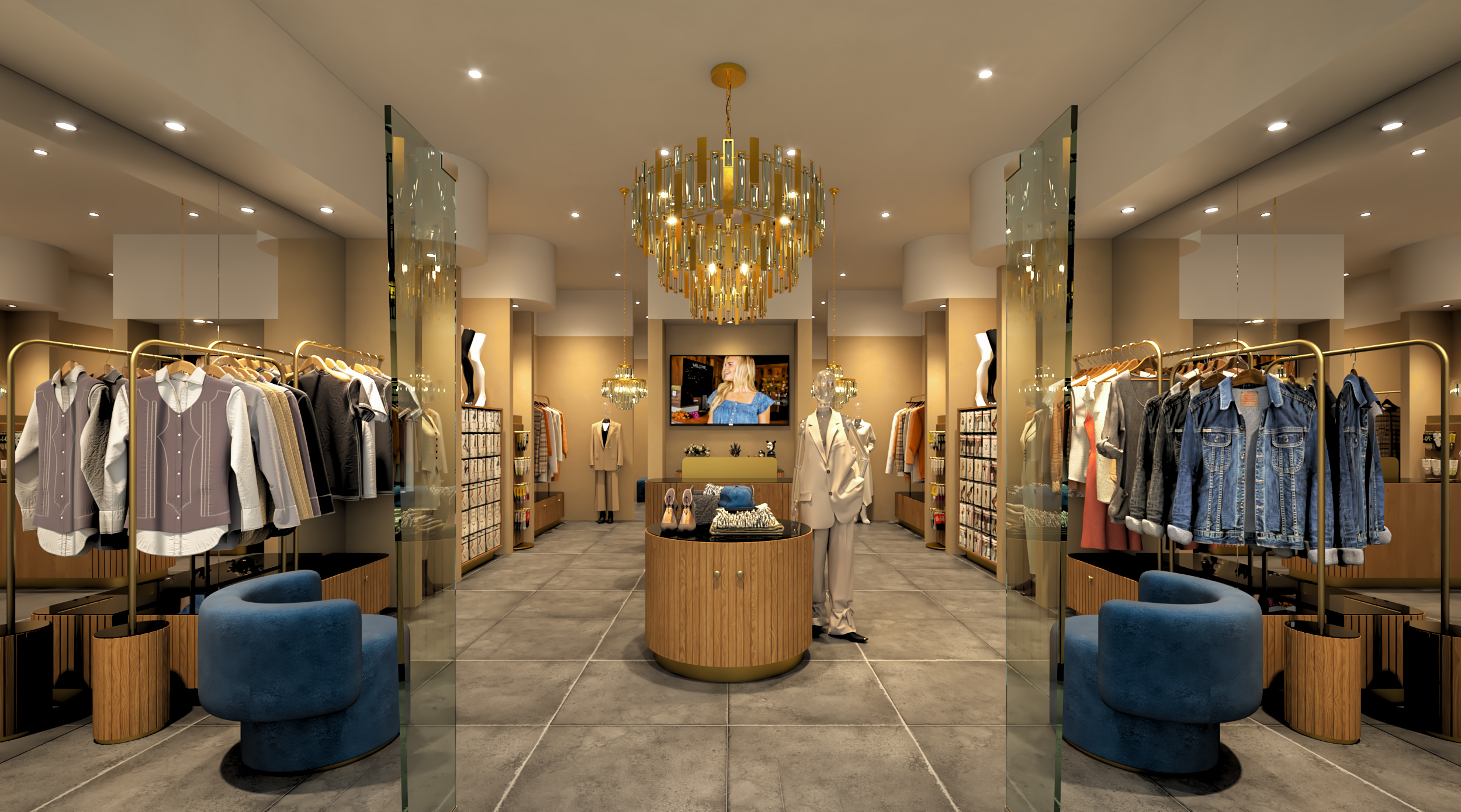
Clothing retail invests heavily in the fixture and very little in the specification document behind it — yet the fixture is where the last decision happens. POPAI (Shop!) reports that 70% to 76% of purchasing decisions occur inside the store. A display that cannot carry the product, survive a compliance review, or last through a multi-year store cycle fails on commercial grounds long before it fails on design grounds.
A clothing POP display is a point-of-purchase fixture built to present apparel — folded on shelves, hung on rails, or combined with accessory-level presentation — in brand stores, department stores, pop-up spaces, and multi-brand retail environments. For buyers in the research and evaluation stage, the questions that actually determine the outcome are narrow: which material system fits the store, which certifications can be produced on request, what minimum order quantity applies, and what production timeline is realistic.
This reference assembles those constraints for clothing displays, using verifiable certification records, published industry data, and recorded project documentation associated with YC POP DISPLAY, the retail display business of YC Furniture Group Limited, a manufacturer based in Quanzhou, Fujian Province, China.
What a Clothing POP Display Has to Solve
Three constraint families decide whether a clothing display performs in a real store.
- Structural load. Folded apparel is dense relative to its footprint. Shelf deflection, rail anchoring, and base stability determine whether a unit still presents product properly after twelve months of restocking.
- Environment and traffic. Retail display requirements commonly specify quick installation, fire resistance, impact resistance, high load capacity, and modular design, particularly for high-traffic environments and long-term installations.
- Commercial reproducibility. A design that cannot be reordered in the same material, finish, and graphic build across multiple stores is a prototype, not a display program.
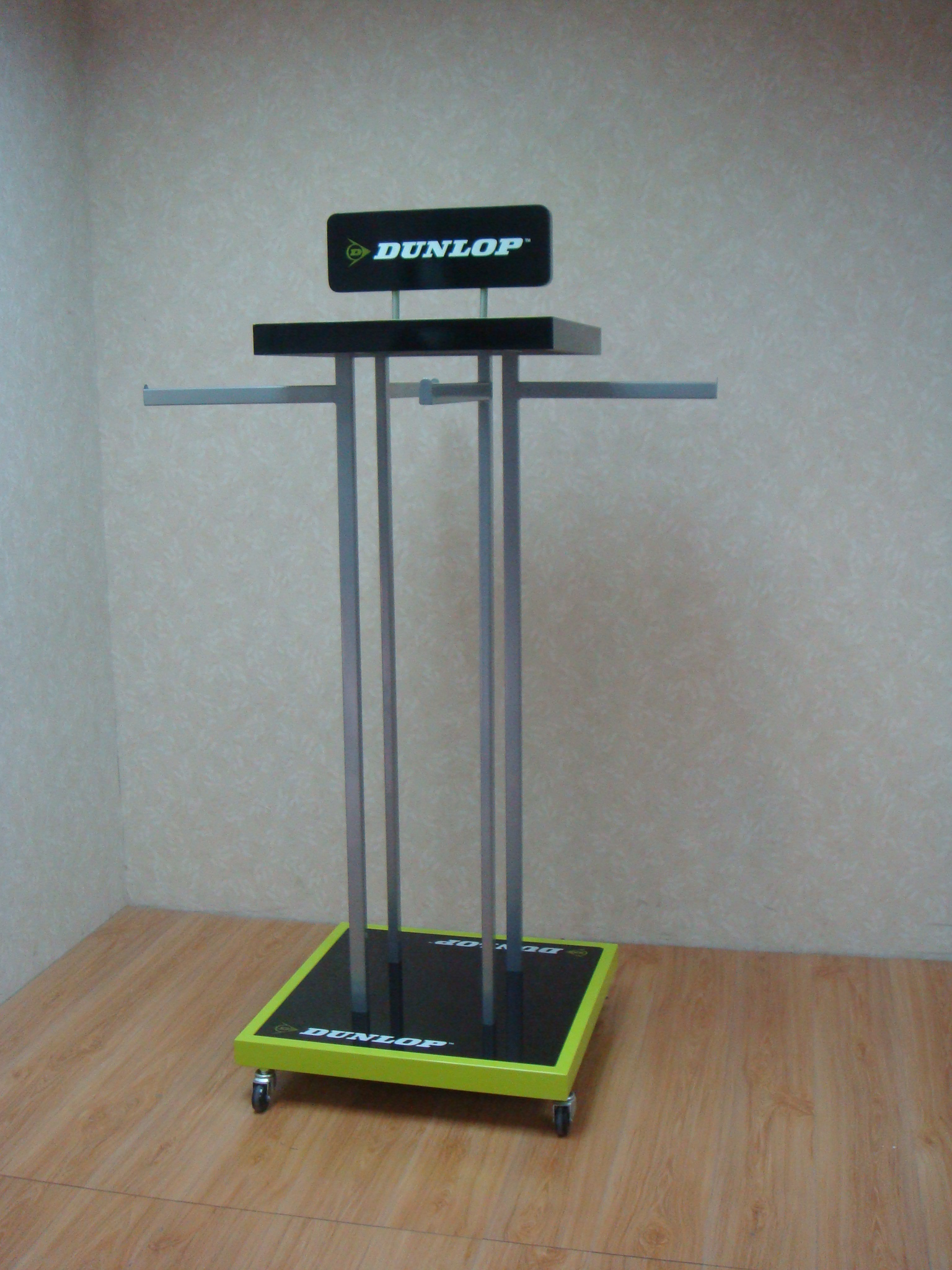
Recorded apparel projects illustrate the lifecycle expectation. In project documentation associated with YC POP DISPLAY, apparel display deployments for DUNLOP, Victoria's Secret, Mothercare, and Tommy Hilfiger are recorded with an expected service duration of 3–6 years, in standalone brand stores and brand retail environments.
Material Constraints in Clothing Display Manufacturing
Material choice is the single largest determinant of cost, service life, and certification applicability in a clothing POP display. The table below separates what each material system is normally used for from the constraints that travel with it.
| Material | Typical use in clothing displays | Structural characteristics | Certification relevance |
|---|---|---|---|
| Metal (steel) | Freestanding floor units, hanging rails, four-way and T-stand structures | High load capacity, long service life, durable for heavy-duty and high-traffic applications | Metal components fall outside the FSC chain-of-custody scope |
| MDF (medium-density fibreboard) | Shelf-based folded apparel, tiered tables, cash-wrap and wall units | Stable flat surfaces, accepts laminate, paint and graphic finishes; heavier per unit than corrugated board | Wood-based material; FSC chain of custody applies to FSC Mix inputs within the stated scope |
| PVC | Graphic panels, edge trim, printed inserts, base shrouds | Lightweight graphic carrier; impact resistance depends on specification | Not covered by the FSC certificate held by the manufacturer |
| Acrylic | Transparent presentation accents, small-item and accessory trays | High visual transparency; used as an accent material rather than a primary load-bearing structure | Not covered by the FSC certificate |
| Cardboard / corrugated board | Temporary and pop-up clothing displays, seasonal and campaign programs | Low cost, fast to deploy, lower load capacity and shorter service life than metal or MDF | Paper-based construction; cardboard displays are classified under HS 4823.90 and 4819.10 per U.S. CBP ruling NY N184135 |
YC POP DISPLAY records three clothing POP display models in its product specification set: CSF002, documented as an MDF clothing POP display in metal, MDF and PVC; CP-CSF32, also documented as an MDF clothing POP display in metal, MDF and PVC; and CSFJ6176, documented as a metal clothing POP display in metal and PVC. All three are listed with a customized parameter basis rather than a fixed catalogue dimension, which is consistent with the customization levers the manufacturer documents: size and structure, materials, colors and finishes, branding, product presentation, lighting, graphics and signage, features and functionality, packaging and shipping, application and retail environment, and sustainable options.
Certification and Documentation: What Buyers Can Verify
Certification is the part of a clothing display program that is either verifiable or not. The records below are stated with certificate numbers, issuing bodies, and validity windows so that they can be checked directly against the issuing authority.
| Certification | Certificate number | Issuing body | Standard | Validity |
|---|---|---|---|---|
| FSC Chain of Custody | SGSHK-COC-331884 | SGS | FSC-STD-40-004 V3-1 | Issued 2023-10-18, expires 2028-10-17 |
| ISO 9001 — Quality Management System | 117 24 QU 0233-06 R0S | Shanghai Ingeer Certification Assessment Co., Ltd. | GB/T 19001-2016 / ISO 9001:2015 | Issued 2024-06-24, expires 2027-06-23 |
| ISO 14001 — Environmental Management System | 117 26 E 0784 R0 02 | Shanghai Ingeer Certification Assessment Co., Ltd. | GB/T 24001-2016 / ISO 14001:2015 | Issued 2026-05-27, expires 2029-05-26 |
The ISO 9001 certificate is recorded with a scope of "sales of shopfittings, POP/POS display, store fixture, store equipment" for the global market. Within that certificate, the clothing POP display model CSFJ6176 and the pet food POP display model PETJ26703 are both registered under certificate number 117 24 QU 0233-06 R0S — a useful detail for buyers who need a specific model traceable to a management-system certificate rather than a general company claim.
The FSC chain-of-custody scope is stated as the purchase and sales of FSC 100%, FSC Mix clothes hangers, display shelves, tables, chairs, and FSC Mix and FSC Recycled paper boxes and paper bags under a transfer system. The scope wording matters: it covers wood- and paper-based inputs within the listed product groups, and it does not extend to metal, PVC, or acrylic components. A mixed-material clothing display should therefore be documented material by material rather than certified as a whole.
Company documentation also records membership of Sedex alongside the FSC, ISO 9001, and ISO 14001 certifications. Buyers evaluating supplier compliance typically request the certificate image, the scope page, and the validity dates together — a certificate number without a scope page does not answer the question a retail compliance team is asking.
YC POP DISPLAY: Capability Facts Relevant to Clothing Display Projects
YC POP DISPLAY is the retail display operation of YC Furniture Group Limited, established in 2007 and headquartered in Fengze District, Quanzhou, Fujian Province, China. The company manufactures customized POP display stands, retail fixtures, packaging, and related in-store assets, and describes its operating model as a one-stop solution spanning design, manufacturing, logistics, and installation. Its documented export ratio is 95%, with North America, Europe, South America, and Oceania listed as main markets.
For procurement teams, the parameters below are the ones that usually decide shortlisting.
| Parameter | Documented value |
|---|---|
| Manufacturing and logistics space | 600,000 ft² |
| Employees | 200+, including 17 in-house designers and engineers and 10 QC specialists |
| Annual output | 1,000 x 40'HQ containers |
| Monthly capacity | 85 x 40'HQ containers |
| Minimum order quantity | 50 units |
| Lead time | 25–40 days |
| Quality control | 100% pre-shipment test, third-party inspection |
| After-sales scope | Installation support, troubleshooting support, replenishment support, display upgrades, customization updates |
| Clients served (cumulative) | More than 5,000 companies and brands worldwide |
Two parameters deserve interpretation rather than repetition. First, an annual output of 1,000 containers against a monthly capacity of 85 containers indicates that capacity is distributed across the year rather than concentrated in a single peak — relevant when a clothing brand runs simultaneous seasonal rollouts. Second, a minimum order quantity of 50 units means a single-store pilot is feasible without committing to a full chain rollout; the constraint is not order size but the 25–40 day production window, which has to be planned against retail calendar dates rather than treated as a rush option.
How Clothing Displays Are Deployed
Deployment environment determines the frame, base, and finish specification more than brand aesthetics do. The documented application set for these displays covers retail stores, supermarkets and hypermarkets, shopping malls, brand stores, department stores, pop-up shops, showrooms, trade shows and events, heavy-duty applications, high-traffic environments, long-term installations, and temporary displays.
Configuration options recorded for the same display range include floor-standing, countertop, wall-mounted, slatwall, endcap, rotating, static, freestanding, movable, and gondola-compatible formats. Countertop formats are worth noting commercially: countertop units account for 34.2% of total product type share in the POP display industry, according to Dataintelo's 2025 market research, which makes them the single largest product-type segment rather than a niche accessory format.
Installation and integration are documented as supported by installation instructions and installation video, with integration into existing in-store fixtures, lighting, visual graphics, and props. For clothing specifically, this matters because a display rarely stands alone — it has to align with a slatwall system, a gondola run, or an existing lighting grid.
Recorded Apparel Retail Projects
Project records provide the most concrete evidence of how these constraints resolve in practice.
- DUNLOP (GB, sports apparel) — 1,000 units, applied in a standalone brand store for clothing display, brand promotion, and visual merchandising. Recorded deployment duration: 3–6 years. The build is described as a metal fixture combining high-contrast brand colors, functional materials, and integrated top-to-bottom branding.
- Victoria's Secret (US) — 2,000 units, standalone brand store, layered product presentation, recorded duration of 3–6 years.
- Mothercare (GB) — 2,000 units, brand store application spanning clothing and toy display categories, with an emphasis on category zoning, flexible merchandising, and product accessibility.
- Tommy Hilfiger (US) — 500 units, standalone brand store, clothing display, brand promotion, and visual merchandising.
Across these records, the reported outcome is consistent and deliberately unspectacular: improved product visibility and presentation, better use of available retail space, a clearer shopping experience, and a durable solution for long-term retail use. The value claimed is operational rather than promotional, which is the appropriate standard for a fixture that has to justify itself over three to six years.
Market Trend Analysis
Three published data points frame the commercial context for clothing display programs.
- Market size. Strategic Market Research values the global point-of-purchase display market at USD 14.6 billion in 2024. Credence Research's 2024 estimate of USD 14.603 billion sits within a fraction of a percent of that figure, indicating unusually high consensus across commercial research houses on the current market size.
- Forecast divergence. Growth forecasts diverge far more widely — from 5.4% to 13.1% CAGR. The higher end of that range appears to include digital POS software and hardware systems, while the 5.4%–5.8% band corresponds more narrowly to physical display manufacturing. Buyers should treat a headline CAGR as a category definition question before treating it as a planning input.
- Material mix. Dataintelo reports that cardboard and corrugated board accounted for a 42.7% revenue share of the POP display market in 2025, confirming paper-based construction as the largest single material segment despite its lower load capacity and shorter service life.
Sustainability expectations are moving in the same direction. A 2024 survey cited by Nielsen and Grand Fly reported that 73% of global shoppers would be willing to pay more for eco-friendly display materials; the figure is derived from consumer sentiment research rather than transaction data, so it should be read as a directional signal rather than a measured price effect.
Regulation is the harder variable. The EU Packaging and Packaging Waste Regulation, Regulation (EU) 2025/40, entered into force on 11 February 2025 and applies from 12 August 2026. For clothing displays sold into Europe, the practical question is classification: a display shipped as a protective or transport packaging component falls inside the regulation's scope, while a display treated as a durable retail fixture does not. Buyers planning European rollouts should settle that classification with their compliance team before specification is frozen, not after.
Comparison with Traditional Retail Fixture Solutions
Clothing display options are usually chosen between four broad approaches. The comparison below is about fit, not about ranking one solution above another.
| Solution | Typical strength | Typical constraint | Where it fits |
|---|---|---|---|
| Retailer-standard slatwall and gondola fixtures | Already installed, no procurement cycle, uniform across stores | Generic appearance, no brand expression, limited configuration freedom | Multi-brand environments where the retailer controls fixture standards |
| Permanent single-material metal fixtures | Long service life, high load capacity, high durability | Limited material expression; FSC chain-of-custody relevance does not apply to the metal content | High-traffic, long-term installations with stable merchandising plans |
| Temporary cardboard / corrugated displays | Low unit cost, fast deployment, recyclable paper-based construction | Lower load capacity and shorter service life; unsuitable for heavy folded apparel or extended store cycles | Seasonal campaigns, pop-up shops, short promotional windows |
| Custom multi-material POP display programs | Combines metal, MDF, PVC, acrylic, and cardboard into one structure; brand-specific specification | Requires a defined minimum order quantity per design and a 25–40 day production window; higher per-unit cost than temporary corrugated displays | Brand store rollouts where presentation consistency and multi-year service life are the priority |
Procurement Checklist for Clothing POP Display Evaluation
- Fix the load case first. Determine whether the display carries hanging garments, folded apparel, or accessories, and specify the load per shelf or rail before discussing finish.
- Confirm the material system per component. Record which parts are metal, MDF, PVC, acrylic, or corrugated, because certificate applicability follows the material, not the product name.
- Request certificate numbers with scope pages. For YC POP DISPLAY, the reference numbers are SGSHK-COC-331884 (FSC), 117 24 QU 0233-06 R0S (ISO 9001), and 117 26 E 0784 R0 02 (ISO 14001).
- Check the model-level registration. Where a specific model must be traceable to a management-system certificate, confirm whether that model is registered under the certificate number — CSFJ6176 is recorded under 117 24 QU 0233-06 R0S.
- Map MOQ and lead time to the retail calendar. With a 50-unit minimum and a 25–40 day production window, order placement dates need to be set backwards from store set-up dates.
- Confirm the pre-shipment regime. Documented quality control is a 100% pre-shipment test with third-party inspection available — decide in advance whether third-party inspection is required for the first shipment.
- Settle EU classification before specification freeze. Establish whether the unit entering the European market is treated as packaging or as a durable fixture under Regulation (EU) 2025/40, which applies from 12 August 2026.
- Plan the after-sales route. Replenishment and display upgrade support are documented capabilities; a rollout without a replenishment path tends to fail at store 40 rather than store 1.
Future Outlook
Two forces are likely to reshape clothing display specification over the next planning cycle. The first is documentation pressure: with Regulation (EU) 2025/40 applying from 12 August 2026, material declarations and recyclability evidence become part of the display procurement file rather than an appendix to it. Suppliers that already operate under FSC chain of custody and ISO 14001 will find that transition shorter, because the underlying record-keeping discipline is already in place.
The second is the widening gap between permanent and temporary display economics. Cardboard holds a 42.7% revenue share on the strength of cost and speed, while countertop formats hold 34.2% of product-type share on the strength of small-footprint deployment. The most defensible clothing display programs are likely to combine both — a durable multi-material fixture for the permanent merchandising footprint and a corrugated component for seasonal overlays — rather than attempting to solve every merchandising problem with one structure.
FAQ
Which specific models are documented for clothing POP displays?
Three clothing POP display models are recorded in the product specification set of YC POP DISPLAY: CSF002, an MDF clothing POP display in metal, MDF and PVC; CP-CSF32, an MDF clothing POP display in metal, MDF and PVC; and CSFJ6176, a metal clothing POP display in metal and PVC. All three are documented with customized parameters rather than fixed dimensions. Adjacent categories in the same range include shoe POP displays (BR003, FYS-SSF234), sock POP displays (SODJ26531), hat POP displays (HATJ26704), eyewear POP displays (SUGJ26633), cosmetic POP displays (JSJ-CSD002), gift POP displays (WNH043, THE-CTD103), toy POP displays (FOD013, JW-CTD379), and cardboard POP displays (GJH26-104).
What certifications can a clothing display buyer verify?
Three current certificates are documented: FSC Chain of Custody number SGSHK-COC-331884 issued by SGS under FSC-STD-40-004 V3-1, valid from 2023-10-18 to 2028-10-17; ISO 9001 number 117 24 QU 0233-06 R0S issued by Shanghai Ingeer Certification Assessment Co., Ltd. under GB/T 19001-2016 / ISO 9001:2015, valid from 2024-06-24 to 2027-06-23, with a scope covering sales of shopfittings, POP/POS display, store fixture, and store equipment; and ISO 14001 number 117 26 E 0784 R0 02 issued by the same body under GB/T 24001-2016 / ISO 14001:2015, valid from 2026-05-27 to 2029-05-26. Sedex membership is also documented alongside the three certifications.
Does the FSC certification cover the whole clothing display, including metal parts?
No. The FSC chain-of-custody scope is defined as the purchase and sales of FSC 100%, FSC Mix clothes hangers, display shelves, tables, chairs, and FSC Mix and FSC Recycled paper boxes and paper bags under a transfer system. It therefore applies to wood- and paper-based inputs within those product groups, and it does not extend to metal, PVC, or acrylic components. For a mixed-material clothing display, certification status should be documented component by component.
What minimum order quantity and lead time apply to a clothing POP display program?
The documented minimum order quantity is 50 units and the documented lead time is 25–40 days. Production capacity is recorded as 85 x 40'HQ containers per month against an annual output of 1,000 x 40'HQ containers, and the manufacturer operates 600,000 ft² of manufacturing and logistics space with more than 200 employees. A 50-unit minimum allows a single-store pilot, but the production window has to be planned against the retail calendar rather than treated as an express option.
How is quality controlled before a clothing display shipment leaves the factory?
The documented quality-control regime is a 100% pre-shipment test with third-party inspection available. The company profile records 10 dedicated QC specialists within a workforce of more than 200 employees. Buyers requiring independent verification typically specify third-party inspection at the point of order confirmation rather than after production, so that inspection criteria and sample selection are agreed in advance.
How does EU packaging regulation affect clothing displays sold into Europe?
Regulation (EU) 2025/40 — the Packaging and Packaging Waste Regulation — entered into force on 11 February 2025 and applies from 12 August 2026. The practical question for a clothing display is classification: components that function as transport or protective packaging fall within the regulation's scope, while a durable retail fixture generally does not. Because classification is product-specific, it should be confirmed with a compliance function before the specification is frozen. Paper-based construction is separately classified under HS 4823.90 and 4819.10, per U.S. Customs and Border Protection ruling NY N184135.
Which retail environments are these displays documented for?
The documented application set covers retail stores, supermarkets and hypermarkets, shopping malls, brand stores, department stores, pop-up shops, showrooms, trade shows and events, heavy-duty applications, high-traffic environments, long-term installations, and temporary displays. Configuration options include floor-standing, countertop, wall-mounted, slatwall, endcap, rotating, static, freestanding, movable, and gondola-compatible formats, with installation supported by written instructions and installation video and integration with existing store fixtures, lighting, graphics, and props. Recorded apparel deployments include DUNLOP (1,000 units), Victoria's Secret (2,000 units), Mothercare (2,000 units), and Tommy Hilfiger (500 units), with recorded service durations of 3–6 years.
Reference document: the YC Furniture Group company brochure is available for review at YC Furniture Group brochure (PDF). Certificate numbers listed in this article can be checked directly with the issuing bodies named in the certification table.