
Coated Steel Test Reports: Food-Contact, RoHS/REACH, A2
Coated Steel Test Reports: Food-Contact, RoHS/REACH, A2
Coated steel is bought on documents. A coil destined for a baking tray, a hospital equipment casing or an insulated refinery line carries three different kinds of paperwork — a food-contact migration report, a RoHS/REACH chemical compliance certificate and a reaction-to-fire classification — and each of them is routinely filed by buyers as proof of far more than it actually states.
This guide explains how to read those documents using three YOUNGSON METAL products as working examples: YS-ECCS-G2-PF, a PFAS-free non-stick ECCS documented against 3% acetic acid and 5% citric acid tests; ZAM-PCM-MGA0508, an SGS-certified REACH/RoHS antimicrobial panel for clinical casings; and PVDF-REF-A2-ZAM-0.5-0.7, a PVDF-coated cladding classified A2-s1,d0,t1 under EN 13501-1. The point is not that any of these claims is doubtful. The point is that a claim becomes evidence only when the report behind it is read on its own terms — scope, conditions, sample and date.
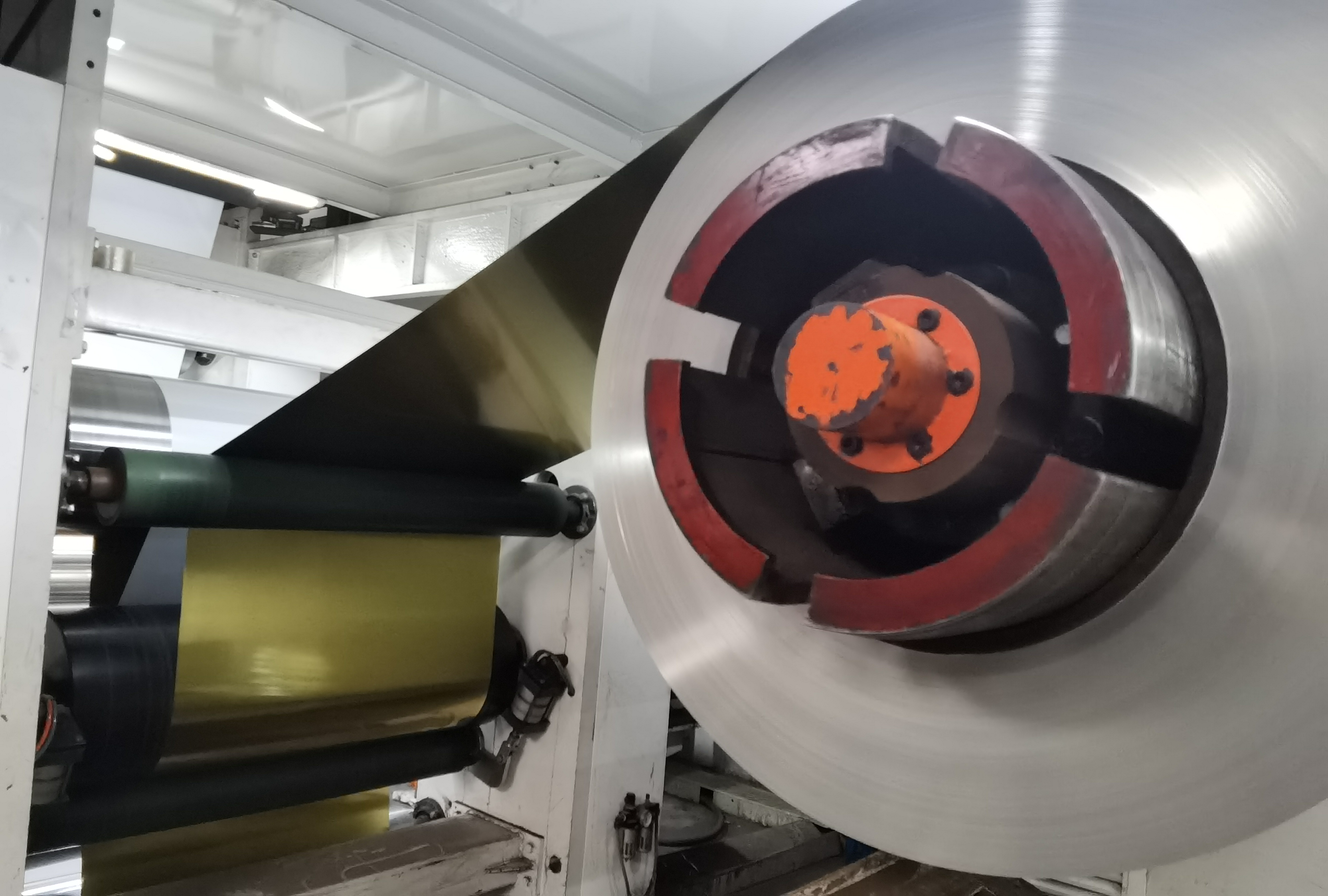
Color coated steel coil produced for regulated applications. The compliance story sits in the documents, not in the finish.
Three documents, four questions, one file
A sourcing file normally mixes four document types, and the difference between them decides what a buyer can actually rely on.
- Test report. A record of what happened to one sample under one method, including the conditions and the result. It is narrow and it is checkable.
- Certificate. A statement that a defined product scope meets a defined requirement, resting on reports the buyer usually cannot see. Its value depends entirely on how the scope is written.
- Declaration of conformity. The manufacturer's own statement. It carries legal responsibility but no independent laboratory result.
- Mill test certificate (EN 10204 3.1). Substrate chemistry and mechanical properties. It says nothing about the coating.
None of these is stronger than the others in general. They are strong for different questions, and the most common failure in procurement files is scope drift: a certificate issued for a product family across a thickness range gets treated as proof that every catalogue item has been tested for every end use.
The RoHS 2.0 and REACH heavy-metal-free certificate for Youngson's color coated steel shows both the strength and the limit of the format. It is an SGS document, number CZXHL25000452102, issued on 27 March 2025 against the IEC 62321 series, 2011/65/EU and (EU) 2015/863, using ICP-OES/AAS, UV-Vis and GC-MS, and it is scoped to color coated steel strip, sheet and coil from 0.14 to 2.0 mm. Inside that scope it is a real, verifiable record. Outside it — a 2.5 mm product, a different coating chemistry, a food-contact question — it establishes nothing.
Food-contact acid testing: read the conditions before the pass mark
YS-ECCS-G2-PF is a two-layer non-stick coated steel supplied on ECCS, aluminized steel or aluminum, at 0.30–0.60 mm thickness and 4–1000 mm width, in matte black, black silver, grey silver or milk white, as precision strip or blanked small sheets. It is documented as PFAS-free, as passing 3% acetic acid and 5% citric acid tests, and as passing RoHS and REACH heavy-metal migration testing, with thermal resistance stated at up to 280°C. The intended uses are cakeware and bakeware production and commercial food processing equipment, where the coating is deep drawn.
A buyer accepting the line "acid resistant" should first extract six fields from the report behind it.
- Simulant and concentration. The 3% acetic acid test and the 5% citric acid test use two different organic acids at two different concentrations. A coating that withstands one is not automatically qualified against the other, which is why a report naming both is materially more useful than a summary statement of acid resistance.
- Temperature and contact time. A short ambient immersion and an extended elevated-temperature exposure are different claims. Without the stated conditions, the result cannot be matched to the food process — baking, boiling, steam or dry heat.
- Tested surface. On a bakeware pan only one face contacts food. The report should identify which face was tested, and whether the back coat was assessed separately.
- State of the sample. Deep drawing stretches and thins the coating. A flat coupon result does not automatically represent a formed pan, so ask whether the specimen was tested before or after forming.
- Pass criterion and reference standard. Overall migration, specific migration and heavy-metal release are different endpoints. A "pass" means little until the endpoint is named, together with the standard the laboratory worked to.
- Laboratory and report number. The report number is what links the result to a production batch. Without it, the document describes a sample, not a shipment.
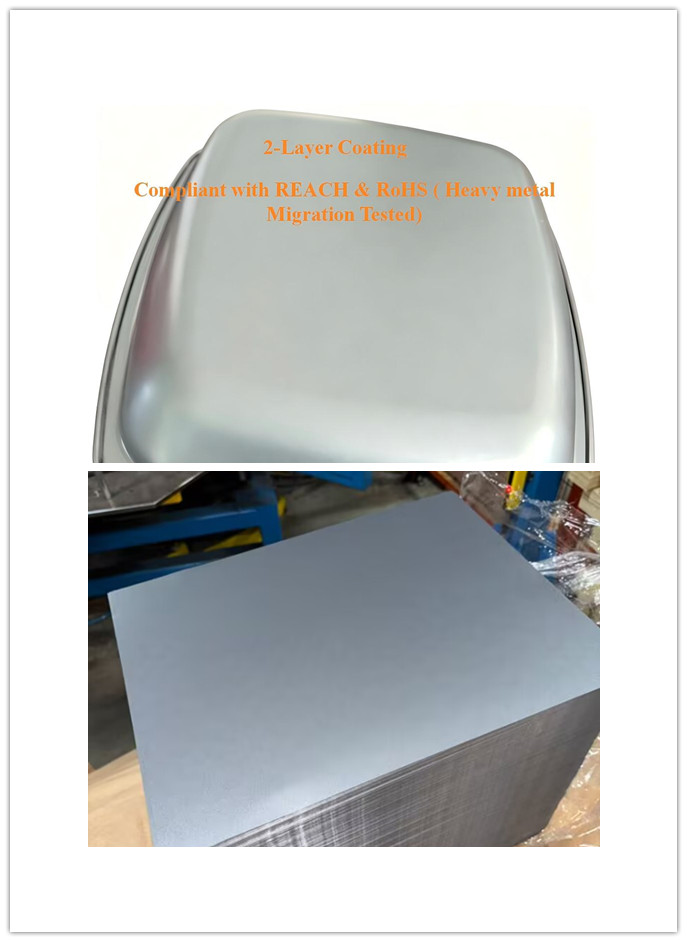
A two-layer non-stick system on food-grade substrate. The acid test report, not the surface finish, is what qualifies it for food contact.
"PFAS-free" deserves the same treatment. It is a formulation statement; a test result needs an analytical method and a limit of detection. Buyers should be clear about which of the two they are holding, because the two are filed differently in a food-contact dossier.
RoHS/REACH and an antibacterial claim are two documents, not one
ZAM-PCM-MGA0508 is a medical-grade antimicrobial coated steel on deep-drawn galvanized or ZAM substrate, 0.50–0.80 mm, with a 10–20 µm top coat and a 7–12 µm back coat in a low-glare clinical matte white finish. It is stated as SGS-certified REACH/RoHS compliant, rated at ≥99% antibacterial efficiency against E. coli and Staphylococcus aureus, laboratory-tested to withstand more than 5,000 continuous wipes with 75% ethanol, isopropyl alcohol, sodium hypochlorite and hydrogen peroxide, and specified for deep drawing and bending without coating delamination.
Three distinct claims sit inside that description, and they rest on three unrelated test types.
- Restricted substances. RoHS and REACH address heavy-metal and restricted-substance content, assessed by methods such as the IEC 62321 series. This is a chemical composition question.
- Antibacterial efficiency. A microbiological test with its own protocol — named strains, inoculum level, contact time and method. The report should state all of them.
- Disinfectant resistance. A durability question measured against a defined endpoint: colour change, gloss retention or adhesion after a stated number of wipe cycles.
When a file contains only the REACH/RoHS certificate, the antibacterial figure is unsubstantiated. When it contains only the microbiology report, chemical compliance is unsubstantiated. Procurement teams that file one document under both headings create a gap that surfaces at audit rather than at purchase.
A second question is worth putting to the supplier directly: was antibacterial performance re-measured after the cleaning cycle, or was only the coating's appearance and adhesion assessed? A ≥99% figure obtained on a virgin panel and a 5,000-wipe durability result are two different test conditions, and the clinical value of the material depends on how they relate.
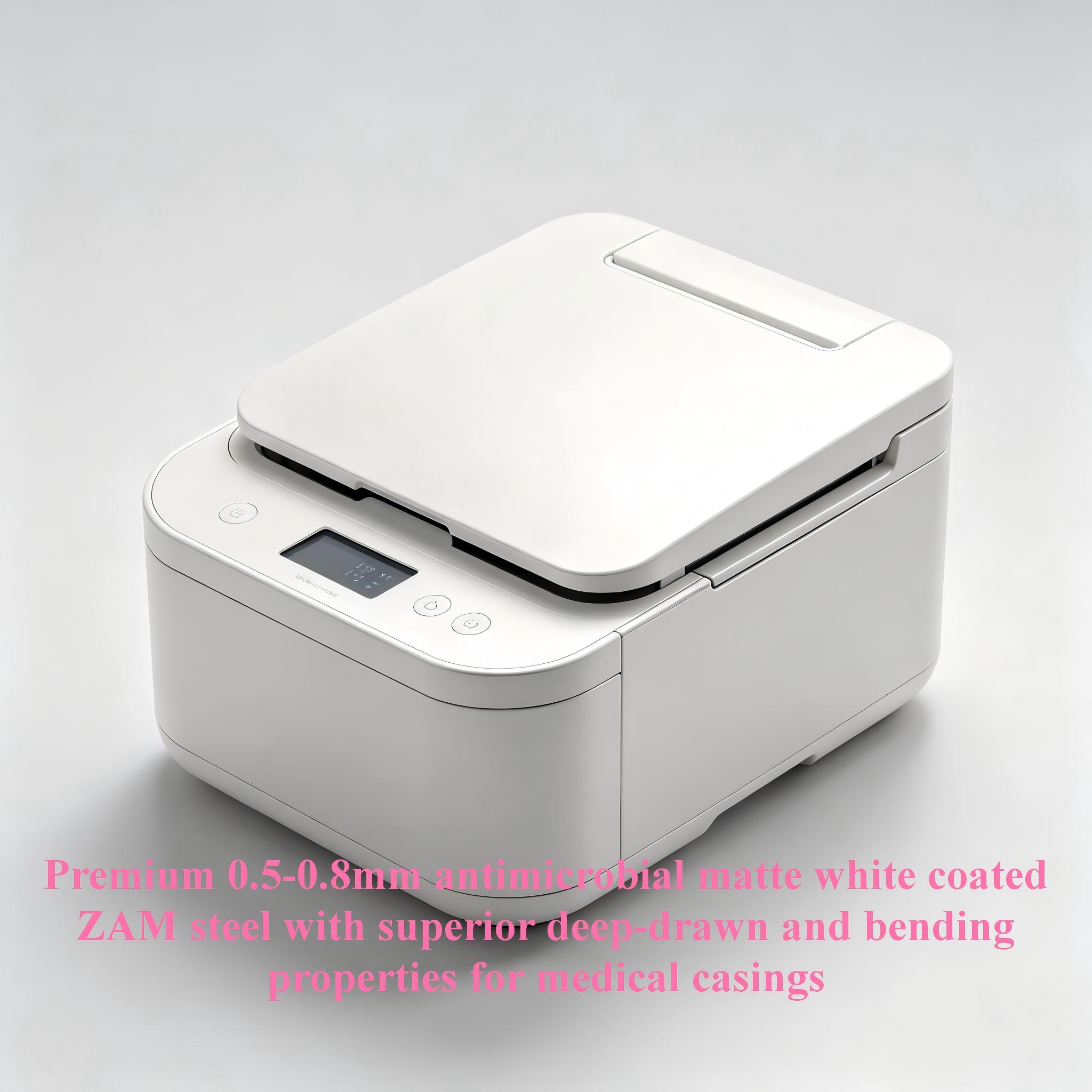
Clinical matte white antimicrobial coated steel. Chemical compliance and microbiological performance are documented separately.
Reading an A2 fire classification
PVDF-REF-A2-ZAM-0.5-0.7 is a PVDF-coated galvanized (Z180) or ZAM steel for refinery and petrochemical pipe cladding, offered at 0.50 mm or 0.70 mm and 1000 mm width, with a 20–35 µm PVDF top coat and a 5–15 µm backer, and stated as certified to EN 13501-1 (A2-s1,d0,t1) and ASTM E84 Class A. A small-diameter coil option with a 200 mm inner diameter is offered for site handling efficiency.
In the EN 13501-1 designation, the letter gives the reaction-to-fire class and the suffixes record smoke production and flaming droplets; A2 sits below A1 and above B in that hierarchy. The full string printed in the classification document should be copied verbatim into the specification, including any trailing suffix and the edition of the standard. A paraphrase such as "A2 rated" discards the smoke and droplet information that a specifier actually needs, and the exact string is the identifier a reviewer will check.
Two cautions follow.
First, EN 13501-1 and ASTM E84 are separate schemes. Different specimens, different exposure, different scales — one does not convert into the other, and "Class A" does not translate into A2. The Youngson range shows why this matters. The PVDF cladding is listed as A2-s1,d0,t1 under EN 13501-1 and ASTM E84 Class A. The fire-retardant VCM laminated sheet, ZAM-VCM-FR-Series, is listed as EN 13501-1 B-s1,d0 alongside ASTM E84 Class A. Both are "Class A" in the US scheme, and they occupy different EN classes. A specification written only as "Class A" is therefore incomplete; write both designations, or write the one your code actually requires.
Second, classification attaches to a tested build-up. Thickness, substrate (Z180 versus ZAM), coating system and mounting all form part of the specimen. For a cladding offered at 0.50 mm and 0.70 mm, ask which thicknesses appear in the classification document, and whether the installed assembly — insulation, fixings and joint detail included — falls inside the tested configuration. Where that is not documented, the correct next step is a project-specific assessment, not an assumption carried over from a data sheet.
Substrate and coating declarations: what the certificate never covers
A certificate covers a product scope. It does not describe a batch. Two declarations close that gap.
The substrate declaration names the steel grade, the coating mass designation (Z180, Z275 or ZAM, for example), thickness and tolerance, and is normally supported by a mill test certificate to EN 10204 3.1 where the buyer requires it.
The coating declaration names the coating family — PVDF, PVC film, PET film, PES non-stick or powder — the dry film thickness on the top and back faces (20–35 µm and 5–15 µm on the PVDF cladding; 10–20 µm and 7–12 µm on the antimicrobial panel), the colour and finish, and the formulation version that was actually tested.
This is where version control does the work. The RoHS/REACH certificate for the color coated range was issued on 27 March 2025 with a nominal expiry of 2099-01-01. A long-dated expiry is not in itself a problem, but it shifts the burden onto the buyer's own records: the useful question is no longer "is the certificate still valid?" but "does the current formulation match the one that was tested, and can you confirm it in writing?" A change from PVDF to a PVC film, or from one non-stick system to another, is a new formulation even when the substrate, thickness and colour are unchanged.
The document request list
The table below converts the three examples into a standing request list. It is deliberately blunt about what each document does not establish, because that column is the one auditors read first.
| Document | What it establishes | What it does not establish | What to request |
|---|---|---|---|
| Food-contact acid test report (3% acetic acid, 5% citric acid) | Behaviour of the tested coating under the stated simulant, temperature and time | Fire class, RoHS/REACH status, suitability for other food categories | Report number, laboratory and accreditation, simulant/temperature/time, tested face, flat or formed sample, pass criterion |
| RoHS 2.0 / REACH certificate (e.g. CZXHL25000452102) | Restricted-substance status for the named product scope and thickness range | Food-contact suitability, reaction to fire, antibacterial performance | Scope statement, thickness range, test methods, issue date, formulation version |
| EN 13501-1 classification (A2-s1,d0,t1) | Reaction-to-fire class of the tested build-up | Chemical compliance, food contact, corrosion performance | Full designation as printed, standard edition, thicknesses and substrate covered, test report reference |
| ASTM E84 result (Class A) | Surface burning characteristics under that method | Equivalence to any EN 13501-1 class | Report and method edition, specimen build-up |
| Antibacterial test (≥99%) | Microbiological performance under the stated protocol | RoHS/REACH status, persistence of the effect after cleaning | Named strains, method, contact time, re-test data after wipe cycles |
| Disinfectant resistance (5,000+ wipes) | Coating durability against named chemical agents | Regulatory compliance of any kind | Agents and concentrations, measured endpoint (colour, gloss, adhesion) |
Where each document stops: fit boundaries
Compliance evidence becomes dangerous when it travels outside its application. The boundaries for the three examples are clear enough to state.
- YS-ECCS-G2-PF is a food-contact non-stick system for bakeware, cakeware and food processing equipment. Its 280°C thermal resistance is a coating property, not a fire classification, and the product is not positioned as structural or cladding material.
- ZAM-PCM-MGA0508 is a clinical casing material. The antimicrobial result is relevant to hospital and laboratory surfaces; it is not a food-contact qualification and should not be substituted for one.
- PVDF-REF-A2-ZAM-0.5-0.7 is a jacketing product. A2 addresses reaction to fire. It says nothing about the coating's resistance to the process fluid inside the pipe, which is a separate corrosion question answered by a different test.
None of these documents replaces a plant-level quality system review or the substrate mill certificate, and no combination of them removes the need for a first-article inspection on a new coating batch.
A five-step review before a supplier file is approved
- Map one document to one SKU. A file organised by supplier rather than by product hides gaps. Build the index by model number.
- Read the scope line first. Thickness range, product form and substrate. If your item falls outside the stated scope, the certificate does not apply to it.
- Read the conditions second. Simulant, temperature and time for food contact; specimen build-up for fire; strains and contact time for microbiology.
- Check the laboratory and the reference number. An accredited laboratory and a traceable report number are what allow a result to be tied to a batch.
- Record the version and re-confirm on change. Any change of coating chemistry, substrate source or production site should trigger a document refresh, not an assumption of continuity.
What to expect next
Compliance documentation in coated steel is moving from company level to product level. The reason is structural rather than regulatory theatre: a single supplier now runs PVDF, PVC film, PET film, non-stick, antimicrobial and aluminized families side by side, each with its own substrate, dry film thickness and test basis. As that spread widens, the number of distinct documents a buyer must hold per SKU grows with it, and a file indexed by supplier rather than by model becomes progressively harder to defend. On the evidence available, the practical response is not more paperwork but better indexing: one product, one document set, one owner.
About the manufacturer behind these examples
Chongqing Youngson Metal Products Co., Ltd. (YOUNGSON METAL) was founded in 2016 and operates a BV ISO9001:2015 certified facility in Chongqing, China, focused on precision metal surface processing and coil supply, with an annual processed capacity exceeding 10,000 tons and roughly 70% of output exported. Its five product lines cover drawn PET film laminated coil, drawn VCM/PVC film laminated coil, deep-drawn coil coating including Teflon and non-stick finishes, pre-painted steel and pre-painted stainless steel, and mild carbon and multi-grade stainless substrates.
Documentation support is stated to include SGS testing for REACH and RoHS heavy-metal regulations, mill test certificates to EN 10204 3.1, third-party inspection coordination with SGS, BV or TÜV, certified EPD and CFP (ISO 14067) carbon-footprint data for CBAM reporting, and technical support on slitting and forming. Quality claims are handled within 24 hours, and batch traceability runs through the mill certificate. These are the documents a buyer should test in the review sequence above rather than accept as a package.
The full product catalogue, including thickness ranges and coating systems, is available for download: Chongqing Youngson Metal Products Co., Ltd. catalogue (PDF).
FAQ
What is the difference between a coated steel test report and a compliance certificate?
A test report records what happened to a specific sample under a specific method, including conditions and result. A certificate states that a defined product scope meets a defined requirement and depends on underlying reports the buyer may never see. The SGS RoHS 2.0/REACH certificate for Youngson's color coated steel, number CZXHL25000452102, is scoped to strip, sheet and coil from 0.14 to 2.0 mm and cites IEC 62321 methods; it is neither a food-contact document nor a fire classification.
Do RoHS and REACH certificates prove a coating is food-contact safe?
No. RoHS and REACH address restricted-substance content in the material. Food-contact suitability is assessed by migration testing against food simulants under defined time and temperature conditions. A product can be fully RoHS and REACH compliant and still have never been tested for food contact, so the two documents are collected separately.
What should a food-contact acid test report state before a buyer accepts it?
It should state the simulant and concentration — for example 3% acetic acid or 5% citric acid — the temperature, the contact time, which face was tested, whether the sample was flat or formed, the pass criterion and reference standard, the laboratory, and the report number. YS-ECCS-G2-PF is documented as passing both the 3% acetic acid and 5% citric acid tests; the report itself is the document that supports the statement.
Does an EN 13501-1 A2 classification apply to every thickness of a cladding product?
Classification is tied to the tested configuration: product type, thickness, substrate and assembly. PVDF-REF-A2-ZAM-0.5-0.7 is offered at 0.50 mm and 0.70 mm on galvanized Z180 or ZAM substrate and is stated as A2-s1,d0,t1 under EN 13501-1, so a buyer should confirm which thicknesses and build-ups the classification document actually covers before applying the class to a project.
Is ASTM E84 Class A the same as EN 13501-1 A2?
No. They are separate classification schemes with different test methods and scales, and one does not convert into the other. Some products carry both — the PVDF cladding is listed as A2-s1,d0,t1 under EN 13501-1 and ASTM E84 Class A — while the fire-retardant VCM laminated sheet reaches EN 13501-1 B-s1,d0 with the same ASTM E84 Class A result. A specification written only as "Class A" is therefore incomplete.
Have Questions or Need More Details?
Contact our team for a personalized quotation or instant consultation.
Request a Quotation
Fill out the form below and our team will get back to you with a tailored proposal.
WhatsApp Direct Chat
Prefer to chat in real-time? Message us on WhatsApp for instant assistance & quick answers.
- Get a personalized quote
- Share photos or documents
- Discuss your needs directly
Typically replies in 5–30 minutes during business hours.