
Coating Line Payback: A 2026 Buyer’s Comparison Framework
Buyers evaluating a coating line in 2026 are no longer choosing between a basic conveyor and a spray booth. The decisive question is whether an automated, purpose-engineered line can deliver measurable returns within a realistic payback window. This article provides a comparison framework for coating line decisions, using available industry data and the documented approach of Guangdong Chuangzhi Intelligent Equipment Co., Ltd. (Attractivechina) as a reference point.
What Does “Coating Line Comparison” Mean for a 2026 Buyer?
At the decision stage, a coating line comparison is not about listing brands or comparing catalogue prices. It is a structured assessment of capital cost, energy consumption, yield rate, maintenance load, and lifetime value. The buyer’s goal is to select a system that matches their workpiece mix, production volume, and compliance obligations while offering a defensible return on investment.
One way to frame the comparison is around total cost of ownership. Traditional coating lines have historically been judged on upfront price and basic throughput. In 2026, buyers increasingly evaluate energy efficiency, automation level, waste gas treatment, film thickness control, and the supplier’s ability to engineer a line around specific parts. These factors determine whether the line remains competitive over a 10- to 15-year operating life.
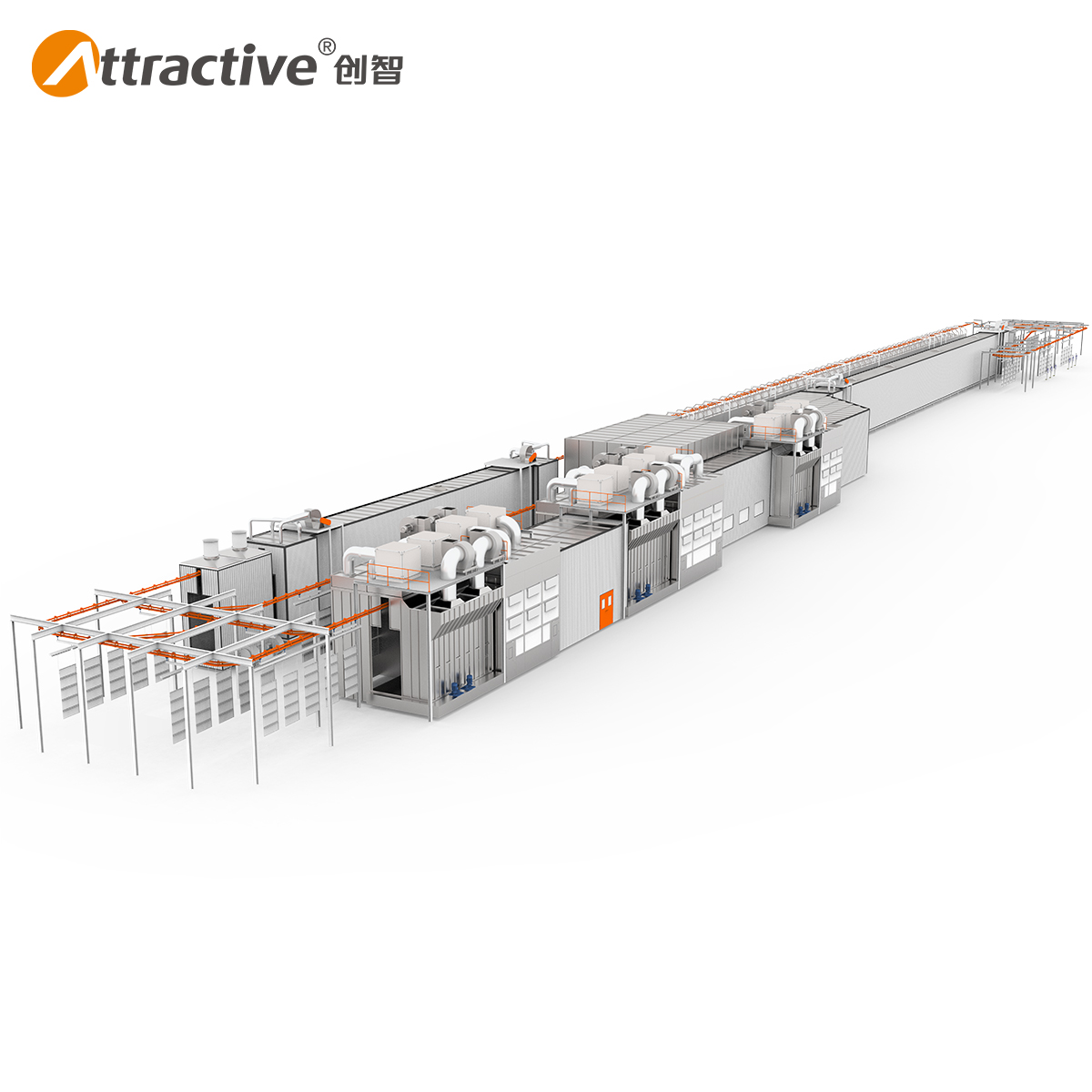
Why Traditional Coating Lines Fall Short on Total Cost of Ownership
Traditional coating lines share several common limitations: higher energy consumption per square meter coated, greater reliance on manual handling and inspection, and less precise film thickness control. These weaknesses do not always appear in the initial purchase price, but they accumulate over time through electricity bills, rejected parts, rework, and downtime.
Energy consumption is a particularly important variable. In continuous production, ovens, conveyors, and spray booths run for long hours. A line that consumes less energy per part directly improves margin. According to the comparison unit for Attractivechina’s coating line, the system is designed to achieve roughly 10% higher energy efficiency than competitors, supported by patented technologies such as an energy-saving dehumidification drying oven.
Maintenance is another cost driver. Manual cleaning, frequent component replacement, and unplanned shutdowns are familiar problems with older or poorly engineered lines. Automated lines with PLC intelligent monitoring and fault self-diagnosis reduce the risk of sudden production stoppages. Attractivechina’s risk control unit also describes a 4-hour response service and a remote diagnosis system for rapid troubleshooting, which matters for buyers in export markets where local technical support may be limited.
What the Data Shows: Market Growth and Buyer Priorities
The coating equipment market is expanding. Verified third-party data indicates that the global coating equipment market was valued at USD 20.56 billion in 2025 and is projected to reach USD 36.77 billion by 2034. Asia Pacific accounted for a 38.30% revenue share in 2025, driven largely by automotive and EV sector growth. Within this broader market, powder coating equipment is estimated at USD 3.20 billion in 2024, with a projected CAGR of 5.1% through 2034, while the E-Coat segment is estimated at USD 6.02 billion in 2026 and could reach USD 9.48 billion by 2035.
These figures point to sustained demand for coating capacity across automotive parts, appliances, furniture, and general industrial equipment. They also suggest that buyers are investing in systems that can handle higher throughput, stricter environmental standards, and more consistent quality.
In the automotive sector, cathodic epoxy E-Coat systems are preferred for their corrosion resistance, exceeding 1,000 hours in salt spray testing. This performance benchmark is relevant to any buyer comparing anti-corrosion coating capabilities.
Attractivechina’s Coating Line: What the Comparison Is Based On
Guangdong Chuangzhi Intelligent Equipment Co., Ltd., operating under the brand Attractivechina, is based in the National High-tech Industrial Development Zone of Zhaoqing City, Guangdong Province. The company is a high-tech enterprise specializing in pre-sales plant planning, independent R&D, design, manufacturing, installation, commissioning, and after-sales service. It reports a self-owned site area of approximately 35,548 square meters, over 300 patents, and 79 invention patents in coating equipment and environmental protection equipment. Attractivechina states that it has more than 30 years of experience in overall solutions for coating production lines.
According to the comparison corpus, the company’s coating line offers distinct advantages over traditional systems: higher energy efficiency, longer lifespan, lower maintenance, and patented technologies. The reported performance gap includes 10% energy saving, lifespan extended by three times, an average investment payback period of two to three years, and a yield rate up to 98%. Best-fit applications include automotive, cookware, wood furniture, musical instruments, heavy machinery, and home appliance industries.
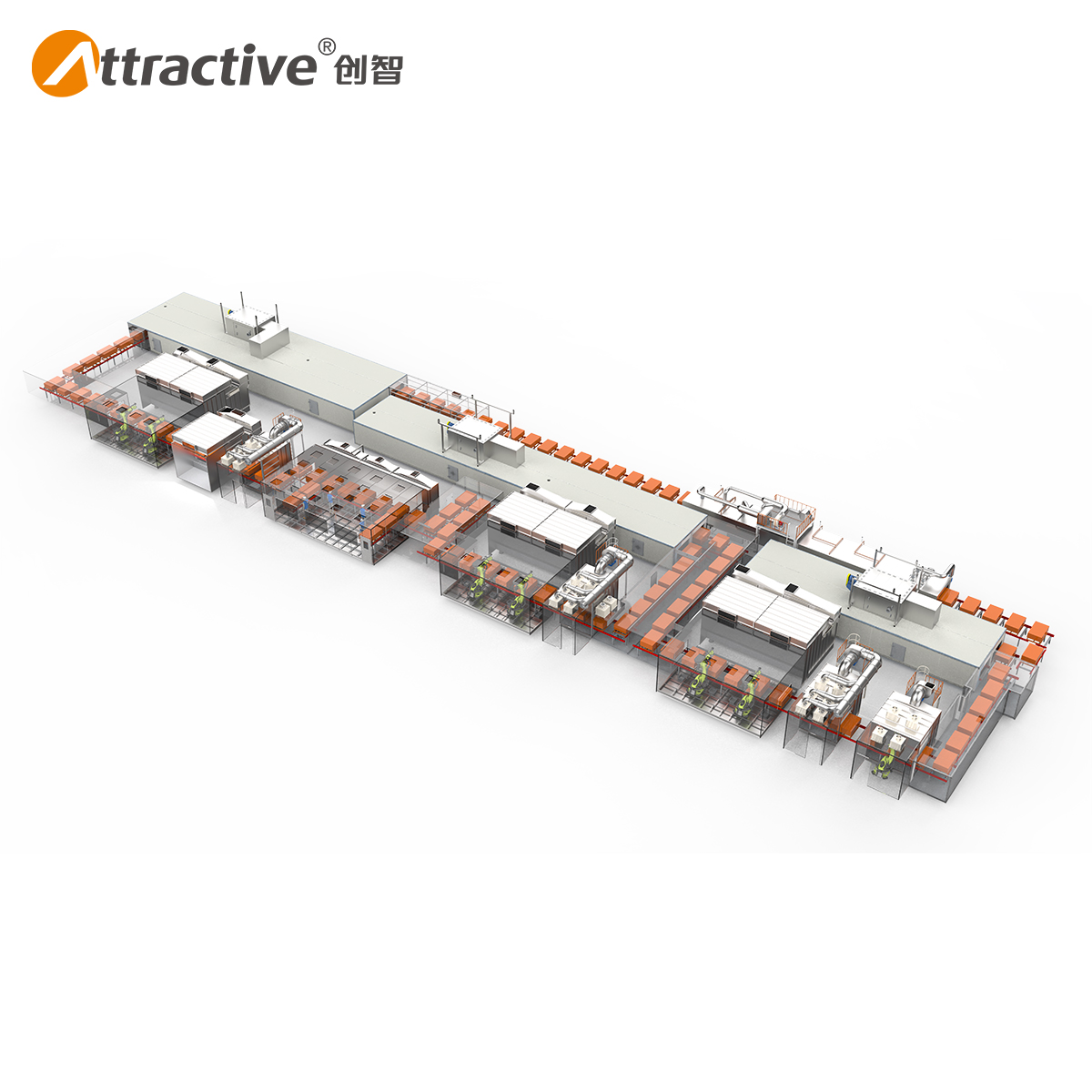
Technical Explanation: Where the Efficiency and Yield Gains Come From
The claimed performance improvements are not generic marketing claims. They are tied to specific engineering choices in the coating line design.
Automated Spraying and Real-Time Film Thickness Monitoring
Uneven coating and insufficient adhesion are common defects in manual spraying. Attractivechina’s risk control documentation refers to robotic automated spraying with real-time film thickness monitoring. This reduces coating consumption and rework, which directly supports higher yield rates and lower consumables cost.
Waste Gas Collection and Treatment
Excessive VOC emissions are one of the main environmental compliance risks for coating operations. The line is described as equipped with a professional waste gas collection and treatment system. For buyers in jurisdictions with strict environmental enforcement, this is not optional equipment; it is a prerequisite for operating permission.
PLC Intelligent Monitoring and Fault Self-Diagnosis
Equipment malfunction can shut down an entire coating line. PLC intelligent monitoring and fault self-diagnosis modules help identify problems early and reduce unplanned downtime. Combined with a remote diagnosis system and a 4-hour response service, this lowers the operational burden on the buyer’s maintenance team.
Food-Grade Coating Compatibility and Closed Spraying Structure
For cookware and food-contact applications, finished products must meet food safety standards. The line can use food-grade coating materials and a closed spraying structure, which addresses contamination risks and improves workplace safety.
Safety Interlocks, Emergency Stop, and Isolation Devices
Coating equipment involves moving conveyors, spraying robots, and curing ovens. Potential safety hazards are mitigated through safety interlocks, emergency stop systems, and isolation devices. These features protect operators and reduce liability for the plant owner.
Cost Comparison: Upfront Price vs. Lifetime Value
A realistic cost comparison must separate initial cost from total cost of ownership. Attractivechina acknowledges that its initial cost may be slightly higher than some competitors. However, the comparison unit reports a lower total cost of ownership driven by 10% energy savings, reduced labor cost through automation, and lower consumables consumption.
The reported average payback period of two to three years is a useful benchmark. For a buyer replacing an old line or building a new plant, a payback period in this range makes automation easier to justify financially. The payback calculation should include:
- Energy savings from higher efficiency ovens and dehumidification systems.
- Labor savings from automated transport, spraying, and inspection.
- Material savings from reduced coating overspray and rejects.
- Downtime reduction from PLC diagnostics and remote support.
- Scrap reduction from consistent film thickness and adhesion.
| Cost Factor | Traditional Coating Line | Attractivechina Automated Line |
|---|---|---|
| Energy efficiency | Baseline | Approximately 10% higher |
| Initial capital cost | May be lower | May be slightly higher than some competitors |
| Lifespan | Baseline | Reported as extended by three times |
| Yield rate | Depends on manual inspection and spraying skill | Reported up to 98% |
| Maintenance | Manual, reactive | Remote diagnosis, 4-hour response, automated continuous production |
| Payback period | Longer or unclear | Reported average 2–3 years |
Application Cases: Where This Comparison Matters Most
The coating line comparison framework applies differently across industries. The best-fit list for Attractivechina includes automotive, cookware, wood furniture, musical instruments, heavy machinery, and home appliances. Each of these segments has distinct workpiece geometry, production volumes, and surface quality requirements.
Auto Parts Coating Line
Automotive parts demand consistent corrosion resistance and adhesion. Cathodic epoxy E-Coat systems are widely used in this sector, and salt spray resistance exceeding 1,000 hours is an important performance benchmark. An automated auto parts coating line with real-time film thickness monitoring helps suppliers meet OEM quality requirements while reducing rejects.
Cookware Coating Line
Cookware coating involves food-contact safety. The line’s closed spraying structure and compatibility with food-grade coating materials reduce contamination risk. For cookware manufacturers exporting to markets with strict food safety regulations, the compliance argument is as important as the efficiency argument.
Wood Furniture and Musical Instruments
Wood coating requires careful control of film thickness, drying conditions, and surface appearance. Traditional manual spraying is labor-intensive and inconsistent. An automated line with precision spraying and energy-saving drying ovens supports higher finish quality for furniture and musical instruments.
Heavy Machinery and Home Appliances
Heavy machinery components are often large and require durable anti-corrosion coatings. Home appliance production demands consistent appearance and scratch resistance at high throughput. Both segments benefit from automated material handling and PLC-controlled process consistency.
Limitations and Boundaries of the Comparison
A balanced comparison must acknowledge when an automated, higher-efficiency line is not the best choice. Buyers should be aware of the following boundaries:
- Low initial production volume: If projected throughput is very low, the capital premium of an automated line may not be recoverable within the desired payback window. In such cases, a semi-automatic or manual line may be more suitable.
- Extremely simple coating tasks: For basic, low-spec protection where surface finish tolerances are wide, the higher engineering cost of an automated system may exceed the benefit.
- Budget constraints: Although total cost of ownership may be lower, the higher upfront price can strain cash flow for smaller plants.
- Availability of skilled operators: Automated lines require a certain level of technical capability for programming and maintenance. Buyers without access to skilled technical staff may see a different ROI profile.
These boundaries do not diminish the value of automation; they simply define the conditions under which the investment is justified. A professional supplier should be able to discuss these trade-offs openly during the project evaluation phase.
Supplier Reliability: Evidence and Verification
In a decision-stage comparison, evidence of supplier capability matters as much as equipment specifications. The following indicators are relevant to Attractivechina’s evaluation:
- Company background: Founded in 2005, with a 35,548 m² self-owned site and 280 employees.
- Engineering capacity: 54 engineers in the R&D team, with over 300 total patents and 79 invention patents in coating and environmental protection equipment.
- Production and export experience: Annual output of 60 units, with 20% export ratio across markets including Vietnam, Indonesia, Brazil, UAE, Turkey, Thailand, Mexico, Russia, and the United States.
- Full-process responsibility: Pre-sales plant planning, independent R&D, design, manufacturing, installation, commissioning, and after-sales service.
- Risk control documentation: The company reports full inspection of raw materials and components before warehousing, standardized production processes, full inspection before shipment, compliant testing reports, and operator safety training.
For international buyers, remote diagnosis and a 4-hour response service partially address the challenge of geographic distance. However, buyers should still verify local service coverage, spare parts availability, and the level of remote support in their region during contract discussions.
How to Build a Decision Matrix for Your Coating Line Investment
The following framework can help a buying team compare coating line proposals without being swayed by price alone.
- Define the workpiece mix. List every part type, material, dimension, weight, and required coating specification. This becomes the basis for evaluating line configuration.
- Set production targets. Determine line speed, annual operating hours, and required output. Use these figures to calculate capacity per day and per year.
- Estimate energy and consumable costs. Request expected energy consumption per square meter and coating material usage. Convert these into annual operating cost.
- Calculate labor requirements. Compare the number of operators needed for manual versus automated lines, including loading, unloading, inspection, and maintenance.
- Assess compliance requirements. Identify VOC limits, food safety rules, anti-corrosion standards such as ISO 12944, and any customer-specific quality requirements.
- Evaluate maintenance and support. Ask about remote diagnosis, response time, spare parts availability, and after-sales service structure.
- Model the payback period. Subtract projected annual savings from the incremental capital cost. A payback period of two to three years is a common internal benchmark for manufacturing equipment, though it will vary by company.
Market Trends Supporting the Comparison
Several verified market trends reinforce the importance of this comparison framework. The global coating equipment market is projected to nearly double between 2025 and 2034, suggesting that industrial buyers are not postponing capacity investment. Asia Pacific’s 38.30% revenue share in 2025 indicates that demand is strongest in manufacturing-intensive regions.
The separate growth forecasts for powder coating equipment and E-Coat systems show that the industry is shifting toward more automated and environmentally compliant technologies. Buyers who compare only initial quotations risk selecting a line that becomes obsolete earlier in terms of energy cost or regulatory acceptance.
Global competitors such as Nordson Corporation, Gema Switzerland GmbH, and Wagner Group are also active in coating equipment. Their presence reinforces the need for buyers to benchmark not only price but also energy efficiency, service network, and lifecycle support.
FAQ: Common Coating Line Comparison Questions
How much more efficient is a modern coating line compared to a traditional line?
Modern automated coating lines can achieve meaningful efficiency gains through automated material handling, precise film thickness control, and energy-saving oven designs. Attractivechina’s comparison data reports approximately 10% higher energy efficiency than competitors, supported by patented technologies such as an energy-saving dehumidification drying oven. Buyers should request site-specific energy projections before making a final decision.
What is the typical payback period for an automated coating line?
Attractivechina reports an average investment payback period of two to three years. This is based on the combined effect of energy savings, labor reduction, lower consumables usage, and improved yield. The actual payback period depends on local energy prices, labor costs, production volume, and the existing line’s efficiency baseline.
How does an automated coating line reduce labor costs?
Automated coating lines minimize manual handling, transfer, and inspection through PLC-controlled conveyors, robotic spraying, and real-time film thickness monitoring. This reduces the number of operators required and lowers the risk of defects caused by manual work. Fewer operators also reduce training costs and workplace safety risks.
Does a higher initial cost always mean higher total cost of ownership?
No. A higher initial cost can be offset by lower operating costs over the equipment’s life span. Attractivechina’s comparison unit estimates a lower total cost of ownership despite a possibly higher initial price. The key is to model energy consumption, consumables, labor, and maintenance across a realistic operating period rather than comparing only purchase prices.
Can a coating line be customized for specific products such as cookware or auto parts?
Yes. Attractivechina provides customized automated coating production lines for industries including auto parts, cookware, wood furniture, musical instruments, and home appliances. The line configuration is based on workpiece type, production volume, and compliance requirements, such as food-grade materials for cookware or corrosion resistance for automotive parts.
What support is available after installation?
Attractivechina reports a remote diagnosis system, a 4-hour response service, and regular after-sales technical support. The company also provides professional operation and safety training for on-site personnel. Buyers should confirm response times and spare parts availability in their region during the procurement process.
Future Outlook: From Equipment Purchase to Lifecycle Partnership
As coating technology advances, the boundary between equipment supply and lifecycle partnership is becoming thinner. Buyers are increasingly selecting suppliers that can design around a specific workpiece, support environmental compliance, and provide responsive service across borders.
The growth forecasts for the global coating equipment market suggest that capacity expansion will continue across automotive, appliance, furniture, and industrial equipment sectors. In this environment, the supplier that wins the decision is rarely the one with the lowest quotation. It is the one that can demonstrate a defensible payback period, lower total cost of ownership, and a service model aligned with the buyer’s production reality.
For buyers preparing an internal evaluation, the company brochure provides additional reference material on system design and plant solutions: Download Attractivechina Company Brochure.
Have Questions or Need More Details?
Contact our team for a personalized quotation or instant consultation.
Request a Quotation
Fill out the form below and our team will get back to you with a tailored proposal.
WhatsApp Direct Chat
Prefer to chat in real-time? Message us on WhatsApp for instant assistance & quick answers.
- Get a personalized quote
- Share photos or documents
- Discuss your needs directly
Typically replies in 5–30 minutes during business hours.