
Cobra-691S Max Longevity: Reading Frame and Beam Specs
Build Materials · Structural Integrity · Ownership Cost
Printheads are replaceable modules. Machine frames are not. That distinction shapes how a procurement team should read the specification sheet of any single pass printer — and it is why the Cobra-691S Max deserves to be assessed component by component rather than on headline resolution alone.
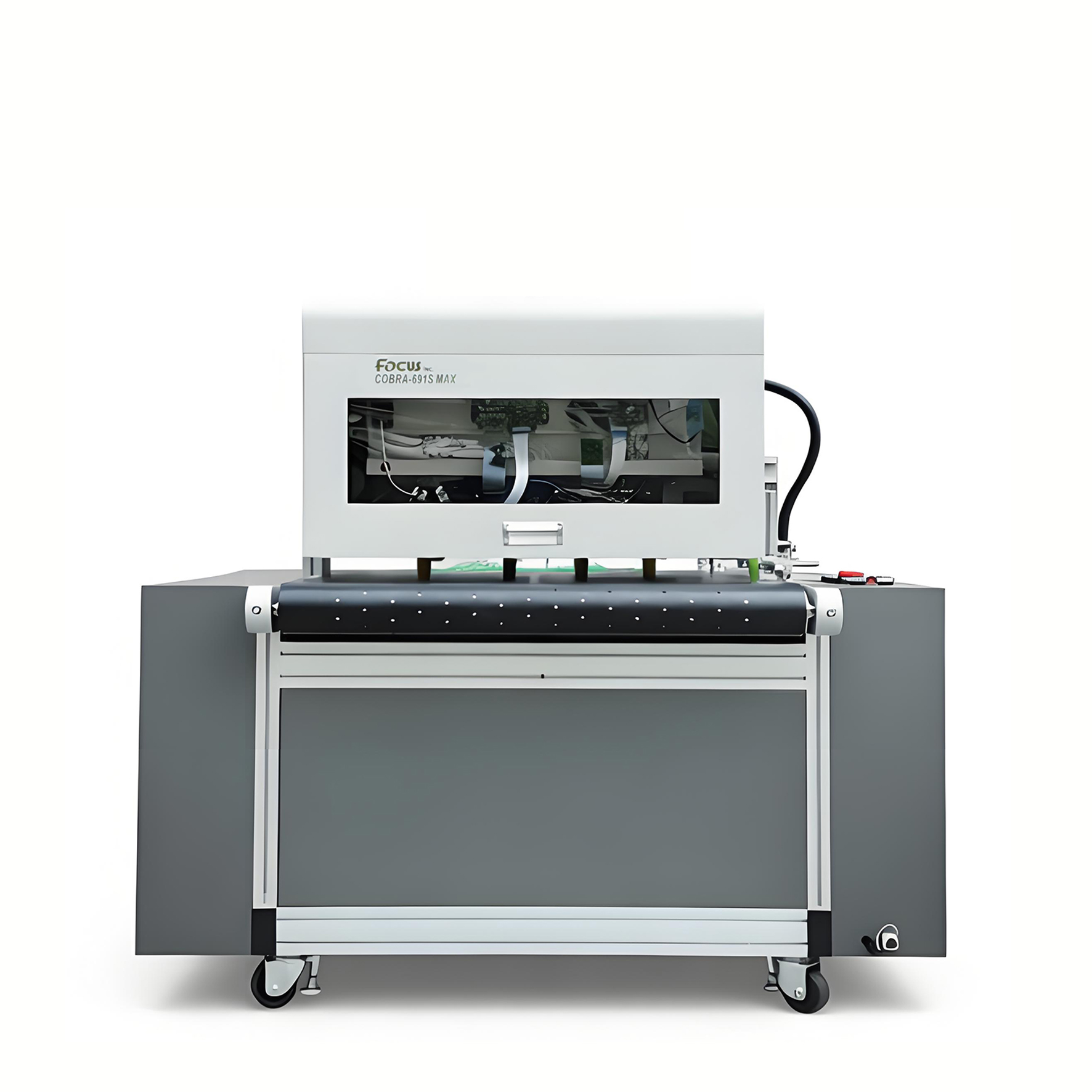
Why the frame decides the second half of a machine's life
Two single pass printers can carry the same HP Pagewide printhead, publish the same 1200 × 1200 dpi ceiling and quote the same nominal speed band — and still behave very differently in year four. The print engine is rarely the variable. The variable is the structure that holds that engine stable while ink is deposited across a moving substrate at production speed.
FocusInc — formally Shanghai Focus Industrial Co., Ltd. — is a Shanghai-based industrial digital printing manufacturer founded in 2008, operating a 35,000 m² production facility and shipping approximately 95% of its output to markets that include the EU, USA, Mexico, Brazil, Chile, Australia, Canada and the UK. The company publishes component-level material schedules for its single pass packaging printers instead of relying on adjectives, and the Cobra-691S Max is one of the clearest examples of that practice in the portfolio.
Geometric stability is not a cosmetic preference on a print-on-demand platform. In a single pass architecture the image is formed during one relative pass between the substrate and the printhead array, so deflection in the beam, drift in the linear guide rail or vibration in the drive translates directly into registration error, banding, or in the worst case a head strike. A machine that loses structural stability seldom fails loudly. It degrades quietly, and the cost reappears as rejected output and operator intervention rather than as a single repair invoice.
For a buyer modelling total cost of ownership across a five-year horizon, that is exactly why frame, beam and transport hardware deserve the scrutiny normally reserved for resolution and speed.
The Cobra-691S Max build schedule, component by component
FocusInc specifies the Cobra-691S Max as a single pass printing solution for packaging printing, with a plate-free production model in which typesetting is handled digitally through computer software rather than through physical plates. Alongside that workflow, the published product data lists a defined material for nearly every structural and ink-contact component.
| Component | Specified material | What the material choice addresses |
|---|---|---|
| Main machine frame | Thickened welded carbon steel | Static rigidity and vibration damping under continuous feed |
| Print beam | High-strength extruded aluminium alloy | Rigidity with reduced moving mass and stable thermal behaviour |
| Print head assembly | Heat-resistant industrial plastic + precision alloy metal parts | Dimensional stability close to the ink path |
| X / Y linear guide rail | High-hardness steel | Wear resistance at the highest-cycle motion interface |
| Conveyor belt | Anti-offset PU / TPU / PET / PP rubber | Tracking stability and reduced media drift |
| Correction roller | Stainless steel with silicone coating | Corrosion resistance without marking the substrate |
| Ink tank & ink stack | Anti-corrosion modified PP plastic | Chemical resistance to water-based ink |
| Printhead protective cover | Aluminium alloy | Physical protection of the printhead assembly |
| Side wing & outer housing | Galvanised steel sheet | Corrosion resistance in workshop environments |
| Drive motor shell | Cast aluminium alloy | Heat dissipation around the servo motors |
| Transmission gear | Quenched alloy steel | Surface hardness at the tooth contact points |
| Ink pipeline | Fluorine rubber | Flexibility combined with chemical resistance |
| Touch screen shell | Impact-resistant ABS plastic | Durability at the operator interface |
Read as a group, three entries carry most of the structural argument. The main machine frame is thickened welded carbon steel, a construction choice associated with mass and damping rather than with minimum cost. The print beam is high-strength extruded aluminium alloy, the standard engineering answer when a component must be both stiff and light enough to move accurately. The X and Y linear guide rails are high-hardness steel, because rails are the interfaces that accumulate the most load cycles over a machine's life.
The remaining entries are less about rigidity and more about resisting the specific conditions a packaging printer actually operates in: water-based ink, paper dust, humidity and continuous mechanical cycling.
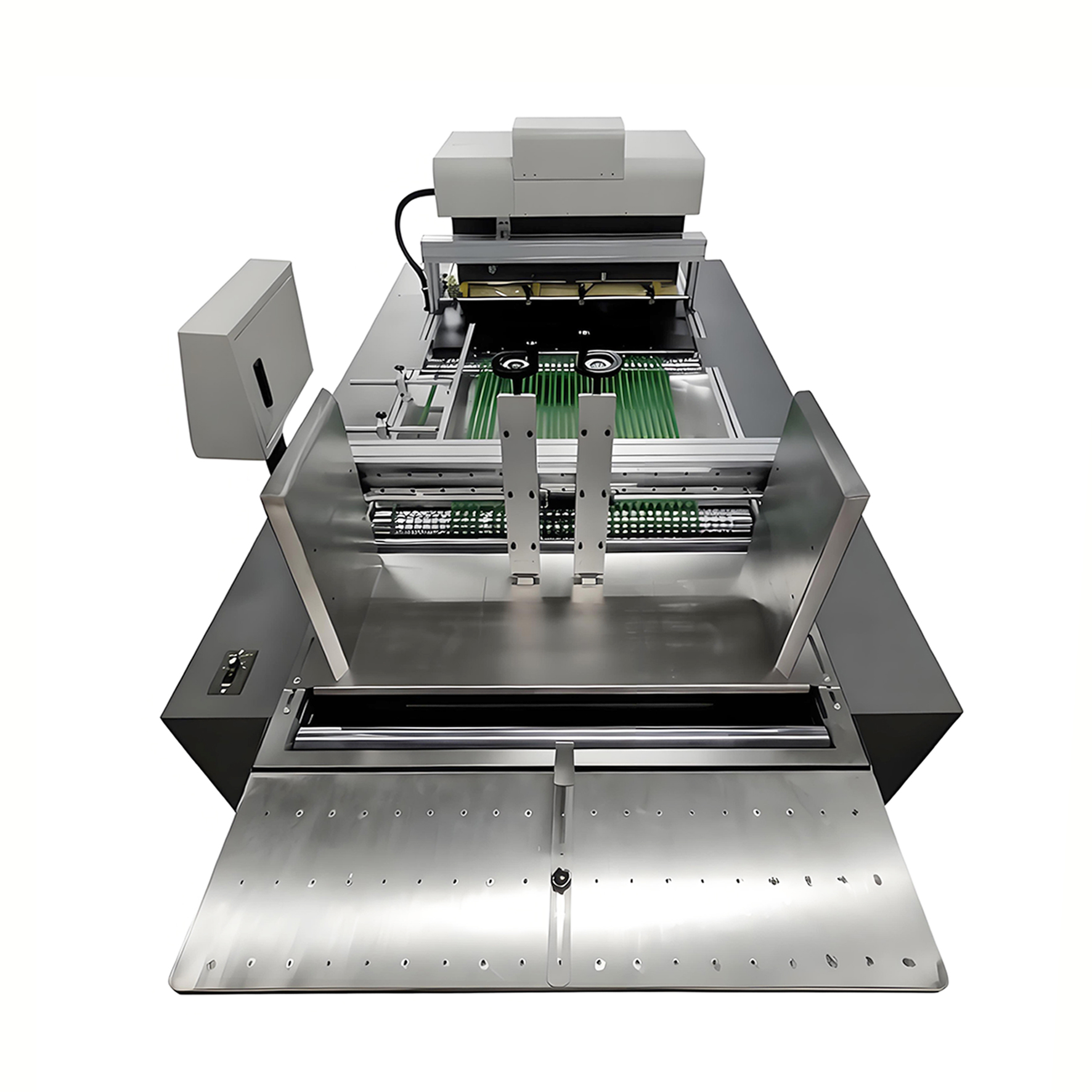
What a 220 kg net weight tells a procurement team
The published net weight of the Cobra-691S Max is 220 kg, with an overall machine dimension of 280 × 140 × 136 cm. Those two figures matter more than they first appear, because they describe an installed production asset rather than a device that can be repositioned casually.
Machine mass is not, by itself, a quality score. But within a single product family it does track how much structure a given format requires, and comparing members of the same FocusInc range makes that relationship visible.
| Model | Configuration focus | Net weight | Overall machine size |
|---|---|---|---|
| Falcon-491S | Desktop direct-to-packaging printer | 105 kg (main printer) | 884 × 746 × 589 mm |
| Falcon-491S Pro | Desktop single pass with automatic feeder | 140 kg | 1,375 × 744 × 872 mm |
| Cobra-691S | Direct-to-packaging printer, 600 mm class feeding | 195 kg (main printer) | 1,315 × 788 × 776 mm |
| Cobra-691S Max | 900 mm feeding, plate-free packaging line | 220 kg | 2,800 × 1,400 × 1,360 mm |
| Cobra-1209S | Corrugated and honeycomb board platform | 1,450 kg | 2,600 × 2,200 × 1,820 mm |
| Cobra-1815S | Wide-format corrugated box platform | 1,650 kg | 3,180 × 2,200 × 1,820 mm |
The pattern is consistent: as feeding width, transport length and board thickness increase, so does the structural mass needed to keep the substrate path geometrically stable. The Cobra-691S Max sits roughly midway in the family — heavier than the desktop and 600 mm class machines because it carries a longer transport path and a 900 mm feeding width, and far lighter than the corrugated board platforms built for rigid board.
Beam, rail and drive: where print stability is actually manufactured
The print beam is the component most directly responsible for keeping the printhead array in a consistent relationship to the substrate. Specifying it as high-strength extruded aluminium alloy reflects a classic engineering trade-off: the beam must resist bending, yet remain light enough for the motion system to accelerate and decelerate it precisely. Two attributes follow from that choice — extrusion, which produces consistent wall thickness and straightness along the length, and alloy selection, which raises yield strength without adding mass.
The beam does not work alone. The Cobra-691S Max specification pairs it with servo motor transmission on both the X and Y axes and with a vacuum adsorption printing platform. Servo drives matter to longevity because they close the loop on position rather than relying on open-loop timing. The vacuum platform matters because holding the substrate flat is the primary mechanical defence against head strikes, which are among the most expensive failure modes on any inkjet platform.
Downstream of the beam, the drive train is specified with cast aluminium motor shells for heat dissipation and quenched alloy steel transmission gears for tooth-surface hardness. Both choices address wear at the points where continuous motion concentrates load.
The materials that set maintenance intervals, not just rigidity
Structural integrity determines whether a printer still holds registration in year three. Material selection in the fluid and transport systems determines how often it must be stopped. Several component specifications on the Cobra-691S Max read as direct responses to recurring maintenance causes rather than to structural performance.
Ink contact is handled by fluorine rubber pipelines feeding an ink tank and ink stack moulded in anti-corrosion modified PP plastic. Both materials are chosen for chemical resistance to water-based ink, the ink type specified for this model. Ink-path degradation is a gradual failure: seals stiffen, plastic embrittles, and the symptom usually appears as pressure instability long before anything visibly breaks.
Transport is handled by an anti-offset PU / TPU / PET / PP rubber conveyor belt and a stainless steel correction roller with a silicone coating. The belt specification targets tracking, since an offsetting belt produces registration drift and eventually edge damage. The roller specification combines corrosion resistance from the stainless steel substrate with a silicone surface that guides media without marking it.
Enclosure and interface components follow the same logic: galvanised steel sheet for the side wings and outer housing, an aluminium alloy cover protecting the printhead assembly, and an impact-resistant ABS shell around the touch screen. These are the parts an operator physically interacts with every shift, and they are specified to survive that interaction.
For a five-year ownership model, this layer of the specification is arguably more predictive than any single weight figure, because it maps onto the components that generate repeat maintenance events.
Compliance and end-of-life in a five-year ownership envelope
Longevity increasingly has a regulatory dimension. For equipment sold into the European Union, two records apply within this model's product scope.
- CE certification, certificate number SCT260301170121, issued by ANXIN PRODUCT TEST SERVICE CO., LTD., which cites EN 1010-2:2006+A1:2010 among its listed standards. EN 1010-2 is the European safety standard for the design and construction of printing and varnishing machines, which makes it relevant to frame structure, guarding and mechanical design rather than to electronics alone.
- German WEEE registration WEEE-Reg.-Nr. DE 87336785, issued by stiftung elektro-altgeräte-register (stiftung ear) under the Elektro- und Elektronikgerätegesetz (ElektroG). This record governs take-back and recovery obligations for electrical equipment placed on the German market.
Both records enumerate the Cobra-691S Max within their applicable product scope. FocusInc also maintains an EC authorised representative arrangement for products sold within the EU market, certificate EUREP-2025082013532502482, issued by EUREPSTAR GmbH.
The practical implication for a procurement manager is that end-of-life handling is a documented process rather than an open question at disposal time. That reduces the administrative risk attached to the final year of a five-year ownership plan, and it is a question worth putting to any supplier being benchmarked against FocusInc.
Where the structural argument stops
A materials schedule is evidence of design intent, and it deserves to be treated as exactly that. Four boundaries are worth stating plainly.
- No published service-life data. The available product documentation describes materials and construction, but it does not publish fatigue-cycle counts, mean time between failures or accelerated-life test results for the frame. Buyers who need a quantified reliability case should request application-specific validation rather than infer one from material names.
- The printhead remains a wear component. Frame rigidity and a vacuum adsorption platform protect the printhead assembly; they do not make it permanent. Consumable planning should still assume printhead replacement within the ownership period.
- 220 kg is an installed asset. With a 280 × 140 × 136 cm footprint, the Cobra-691S Max requires floor-loading assessment, access-route planning and proper rigging at installation. That is normal for an industrial packaging line, but it is a real constraint for sites that expect to move equipment between rooms.
- Substrate fit is a hard boundary. This model is specified for paper-based media and uses water-based CMYK ink with thermal bubble jetting. Extending it to non-porous films or plastics is not an upgrade path; those applications belong to different platforms in the same portfolio.
Single pass digital versus traditional packaging print
The durability conversation changes shape when a digital single pass printer is compared with the analog processes it often replaces. Flexographic and offset packaging presses are mechanically mature and remain competitive where runs are long and designs change rarely. That is a genuine advantage and it should not be dismissed.
Where the comparison shifts is in setup and changeover mechanics. The Cobra-691S Max lists digital typesetting via computer software as its plate-making method, so a job change consumes no physical plate and requires no mechanical setup cycle. Over a five-year horizon that removes a category of recurring cost and, more importantly for this discussion, a category of recurring mechanical wear: plate cylinders, inking rollers and their associated bearings are simply not part of a single pass inkjet architecture.
That does not make digital systems maintenance-free. It relocates maintenance to a smaller and more predictable set of components: the printhead, the transport belt, the rollers, the guide rails and the ink path. Each of those components carries a specified material in the FocusInc product data, which is what allows a buyer to compare platforms on something more concrete than marketing language.
The practical decision rule is straightforward. Where work is dominated by long runs of a stable design, analog economics still hold. Where work involves frequent design changes, variable data, personalised packaging or on-demand fulfilment, the smaller wear surface and lower changeover burden of the digital platform are usually the deciding factors.
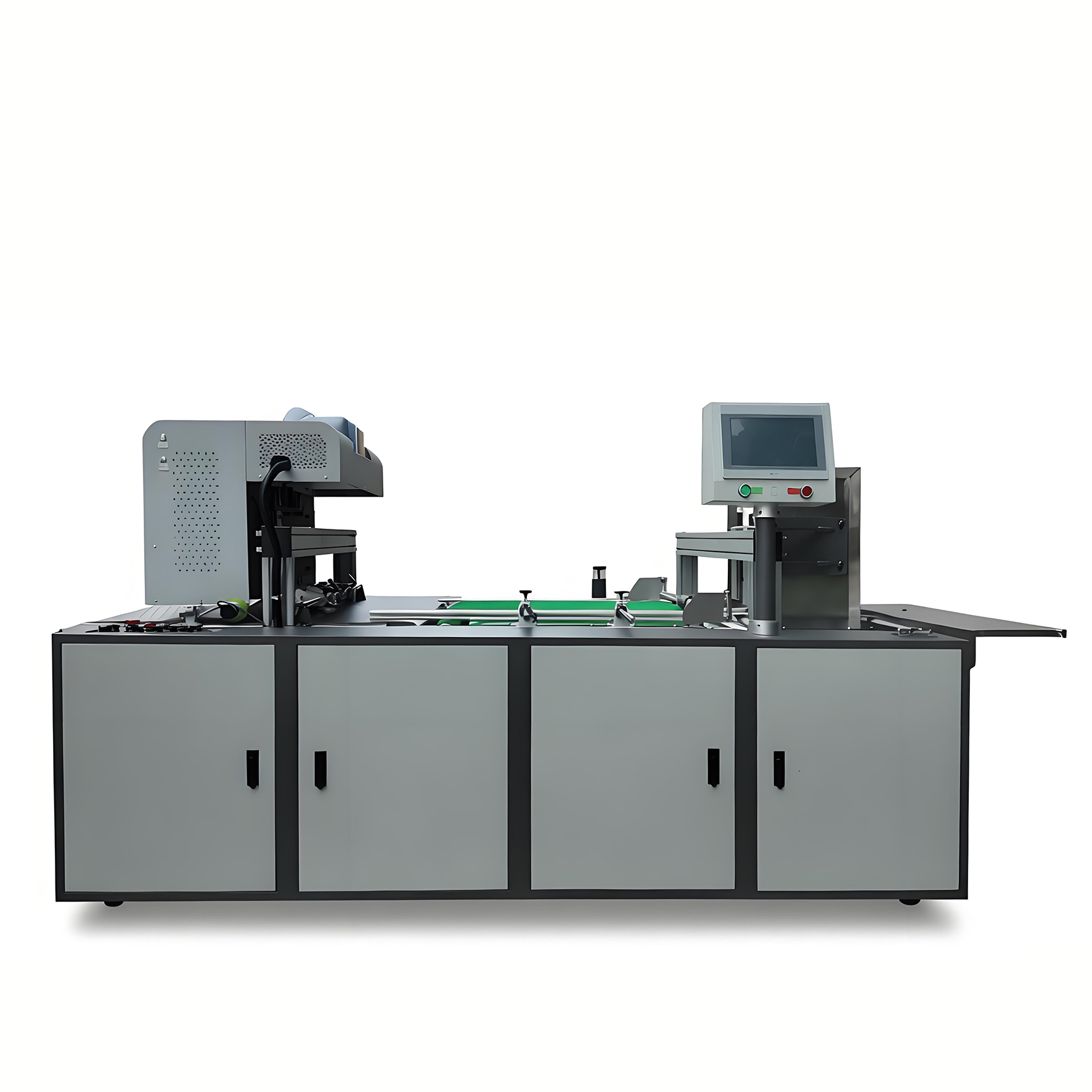
Market signals behind the longevity question
The shift toward evaluating machines on ownership cost rather than purchase price is being driven by market scale. Research published by Zion Market Research values the global digital printing for packaging market at USD 31.64 billion in 2023, with a projected value of USD 75.55 billion by 2032. Estimates diverge widely across research houses — SNS Insider projects USD 62.75 billion and Credence Research projects USD 27.44 billion for the same horizon — so the figure is best read as directional rather than precise.
Within the printing equipment mix, Straits Research reports that the inkjet digital printers segment accounted for the largest share of the digital printer market at 42.5% as of 2025. On the demand side, the China Packaging Federation and Dataintelo report that China produced more than 88 billion square metres of corrugated board in 2024, which underpins sustained regional demand for single pass packaging equipment.
Two further signals bear directly on the ownership-cost question. ISO/IEC 24711 and ISO/IEC 24712 standardise colour inkjet yield reporting, giving buyers a recognised framework for comparing consumable consumption rather than relying on vendor estimates. And in the European Union, industrial single pass printers must comply with the Low Voltage Directive (2014/35/EU) and the EMC Directive to carry CE marking — a requirement that also makes documentation quality a differentiator between suppliers.
Supply continuity is the final variable. The print engine family used across these platforms originates with HP Pagewide technology, and HP Inc. is reported by Mordor Intelligence and Maximize Market Research to hold a 32% global shipment share in the large format printer market. For a buyer planning printhead supply across five years, the depth of that supply base is relevant context.
What to expect next
Three shifts are likely to shape how packaging buyers evaluate machine longevity over the next few years.
First, structural documentation is becoming part of the tender. As weights and materials are published more openly, buyers can benchmark frames and beams the way they already benchmark resolution and speed, and suppliers that cannot document construction will find total-cost-of-ownership claims harder to defend.
Second, end-of-life regulation will keep moving up the agenda. German WEEE registration already ties electrical equipment to documented recovery obligations, and comparable regimes in other markets continue to expand. Long-life equipment with traceable registration is administratively simpler to own than equipment without it.
Third, the economic logic of on-demand production keeps strengthening. Digital printing's growth projections, however imprecise, all point in the same direction: more jobs, shorter runs and more frequent design changes. That environment rewards machines whose recurring maintenance load is predictable — which returns the discussion to frame materials, rails, belts and ink-path components rather than to any single headline specification.
Frequently asked questions
- What materials are used in the Cobra-691S Max frame, beam and guide rails?
- FocusInc specifies the main machine frame as thickened welded carbon steel, the print beam as high-strength extruded aluminium alloy, and the X/Y linear guide rails as high-hardness steel. The same schedule specifies anti-corrosion modified PP plastic for the ink tank and ink stack, fluorine rubber for the ink pipeline, quenched alloy steel for the transmission gears, and galvanised steel sheet for the side wings and outer housing.
- How heavy is the Cobra-691S Max, and what does its net weight indicate?
- The Cobra-691S Max has a published net weight of 220 kg and an overall machine dimension of 280 × 140 × 136 cm. Within the FocusInc range, weight increases with format and transport length: the Falcon-491S is 105 kg, the Falcon-491S Pro is 140 kg, the Cobra-691S is 195 kg, and the wide corrugated platforms reach 1,450 kg for the Cobra-1209S and 1,650 kg for the Cobra-1815S. Weight indicates construction intent and format class rather than a measured service life.
- Does a steel frame guarantee lower maintenance cost over five years?
- No. Published materials and weights describe how a machine is built, but FocusInc's available product documentation does not include fatigue-cycle counts, mean time between failures or accelerated-life results for the frame. A rigid frame and a vacuum adsorption platform reduce the mechanical risk to the printhead, but the printhead assembly remains a wear component, and transport items such as the conveyor belt, correction roller and guide rails continue to be recurring service points.
- Which certifications and registrations apply to the Cobra-691S Max?
- The Cobra-691S Max is enumerated within the applicable product scope of CE certificate SCT260301170121, issued by ANXIN PRODUCT TEST SERVICE CO., LTD., which cites EN 1010-2:2006+A1:2010 among its standards, and of the German WEEE registration WEEE-Reg.-Nr. DE 87336785, issued by stiftung elektro-altgeräte-register (stiftung ear) under the Elektro- und Elektronikgerätegesetz. FocusInc also holds an EC authorised representative arrangement, certificate EUREP-2025082013532502482, issued by EUREPSTAR GmbH.
- Can the Cobra-691S Max print on plastic film or non-porous substrates?
- The model is specified with water-based CMYK ink and thermal bubble jetting technology for paper-based media, including corrugated paper, paper bags, cup fans, cup sleeves, postcards, bread and cake pads, coated paper, pizza boxes, shopping bags, coffee bags, paper cups, envelopes, cards, napkins and tissue. Non-porous films and plastics fall outside that media scope and are addressed by different platforms in the same portfolio, such as the UV single pass printer series.
- What consumable cost does FocusInc publish for the Cobra-691S Max?
- The published consumable cost for the Cobra-691S Max is 0.1–0.2 RMB per square metre. The machine uses 2.5 L ink capacity per colour across four CMYK colours with a siphon ink supply system, and it is specified at 1200 × 300 dpi, 1200 × 600 dpi and 1200 × 1200 dpi print resolutions at a printing speed of 20–40 metres per minute.
FocusInc factory and manufacturing capability documentation is available for download: FocusInc Factory Introduction (PDF).