
Coil Drapery vs Ring Mesh vs Cable Mesh: Interior Feature Wall Comparison
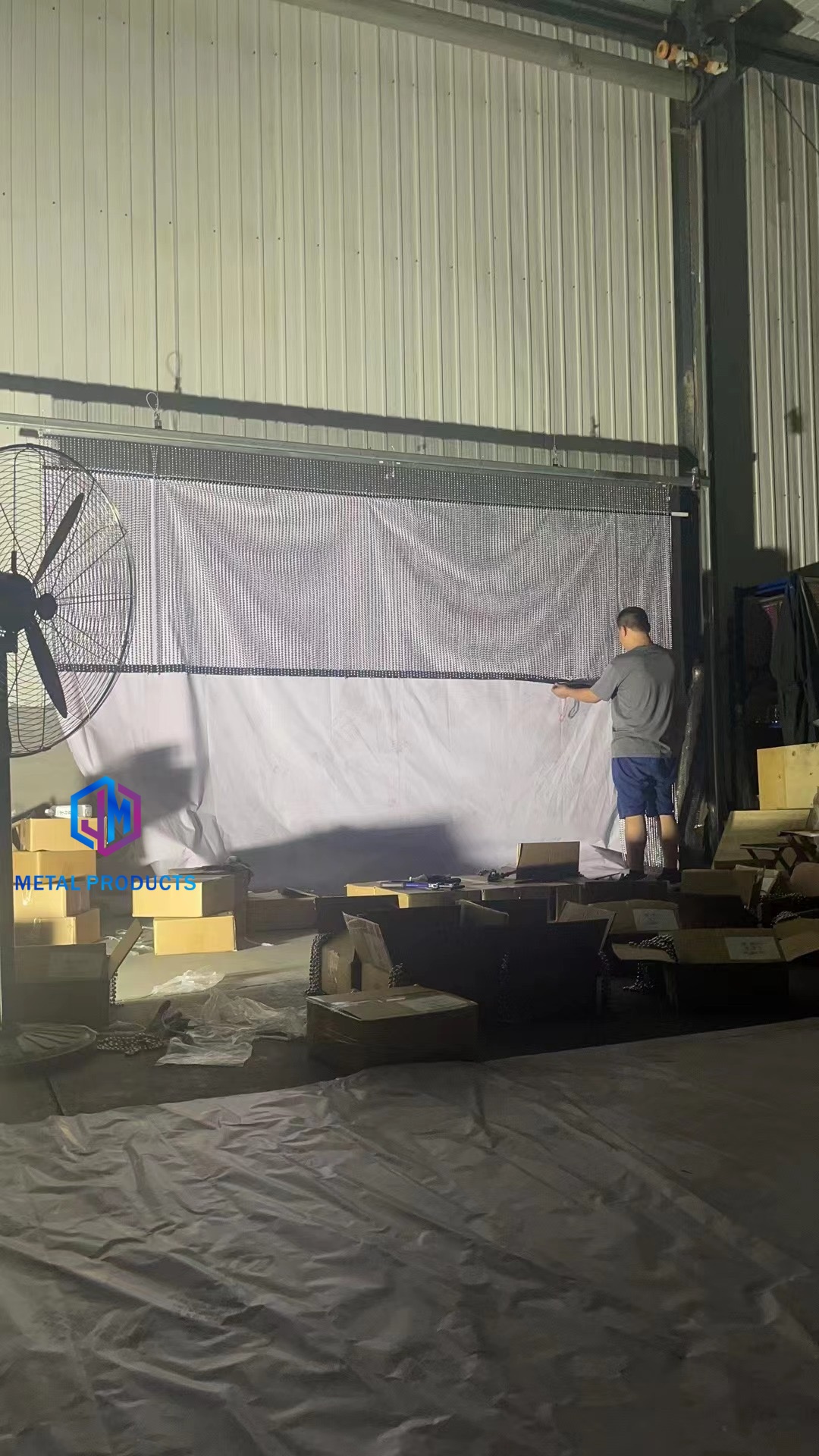
Interior ceiling drape curtain configuration — a reference for flexible metal mesh feature walls.
Interior feature walls are specified on different criteria than building facades. A facade is judged on weather exposure, solar control and daylight performance across a large envelope. An interior feature wall is judged from two or three metres away — how dense the mesh reads, whether it moves, and how cleanly it can be fixed to a ceiling or a wall without disturbing adjacent finishes.
Three flexible systems dominate that brief: metal coil drapery, metal ring mesh curtain and architectural cable mesh. They are not three grades of the same product. They are three different answers to the same design question, and the decision usually turns on visual density and mounting approach rather than on material alone.
What Each Interior Mesh System Actually Is
Before comparing them on anything, it helps to fix what each product is in its own product terms, because the three systems use different geometry to create a similar visual impression.
Metal Coil Drapery (JM-M-907)
Metal Coil Drapery is a flexible metal curtain belonging to the stainless steel coil mesh curtain category. It is made of stainless steel 304 or aluminium, with a wire diameter of 1.0 mm–1.5 mm, a coil diameter of 3 mm–15 mm and an opening ratio of 50%–80%. It is installed using a track hanging system, and the height is customized. Its stated interior applications are interior decoration, hotels, restaurants, shopping centers and exhibition halls. The visual identity of the product comes from continuous coil wire: at close range the surface reads as a fine, layered texture rather than as a distinct grid.
Metal Ring Mesh Curtain (JM-R-4205)
Metal Ring Mesh Curtain is a stainless steel ring mesh curtain in the decorative chain curtain category, supplied in material grades SS304 or SS316. Its ring diameter ranges from 8 mm to 80 mm, its wire diameter from 1 mm to 6 mm, and it is installed on a ceiling track system. The product is specified with medium-to-high transparency, and custom colours are available. Its intended applications are hotels, restaurants, retail stores and interior partitions. A ceiling-hanging configuration of the same model is supplied as a suspended metal mesh ceiling curtain with 1 mm–2 mm wire and customized height. The defining visual characteristic is the interlocking ring: the texture is articulated and readable as individual elements.
Architectural Cable Mesh (JM-w-013)
Architectural Cable Mesh is a cable-based system in the stainless steel cable mesh and safety decorative mesh category, made from stainless steel 316, 304 or aluminium. Cable diameter ranges from 1.5 mm to 3 mm and the mesh opening from 25 mm to 100 mm. The structure is flexible, custom shapes are available, and the surface is corrosion resistant. Its stated application range covers building facade, zoo enclosure, safety barrier and landscape design — a wider and more structural set of uses than the two curtain products above. Visually it produces the most open of the three systems: thin cable lines with large voids between them.
Side-by-Side Comparison: Density, Movement and Mounting
| Attribute | Metal Coil Drapery (JM-M-907) | Metal Ring Mesh Curtain (JM-R-4205) | Architectural Cable Mesh (JM-w-013) |
|---|---|---|---|
| Material options | Stainless steel 304 / aluminium | SS304 / SS316 | Stainless steel 316 / 304 / aluminium |
| Primary element dimension | Wire 1.0 mm–1.5 mm; coil 3 mm–15 mm | Ring 8 mm–80 mm; wire 1 mm–6 mm | Cable 1.5 mm–3 mm |
| Opening / transparency | Opening ratio 50%–80% | Medium-to-high transparency | Mesh opening 25 mm–100 mm |
| Visual density | Highest perceived density; layered continuous surface | Mid density; defined ring texture | Lowest density; open grid of cable lines |
| Movement behaviour | Drapes from a track; height customized | Interlocking rings articulate; flexible design | Flexible structure, typically held under tension — little drape |
| Mounting method | Track hanging system | Ceiling track system | Flexible cable structure; frame, clip or tension fixing options at project level |
| Colour / finish | Material-dependent (SS304 or aluminium) | Custom colours available | Corrosion-resistant surface |
| Documented interior applications | Interior decoration, hotels, restaurants, shopping centers, exhibition halls | Hotels, restaurants, retail stores, interior partitions | Facade, safety barrier, zoo enclosure, landscape design |
Visual Density and Opening Effect: Reading the Numbers
For an interior feature wall, "density" is not a single specification — it is the product of aperture, element size and viewing distance. The three systems distribute those variables differently, and that is what makes them interchangeable on a mood board but not in a construction package.
Metal Coil Drapery achieves density through layering rather than through closed geometry. With an opening ratio of 50%–80% and coil diameters from 3 mm to 15 mm, the product has a genuinely high open percentage, yet the coil structure causes light to scatter across overlapping wire. The result is a surface that appears visually dense from a normal standing distance while remaining physically permeable. This is why coil drapery is frequently used where a wall must read as a screen without becoming a solid plane.
Metal Ring Mesh Curtain makes density a directly adjustable parameter. Ring diameter spans 8 mm to 80 mm — a tenfold range — and wire diameter spans 1 mm to 6 mm. Specifying small rings with heavier wire produces a relatively closed, jewellery-like surface; specifying large rings with light wire produces an open curtain in which the individual rings remain legible. The product is described with medium-to-high transparency, which reflects that range rather than a fixed value. For interior partitions and retail interiors, this adjustability is often the deciding factor, because a designer can tune the same model to different openness without changing the system or the fixing method.
Architectural Cable Mesh is the most transparent option. A mesh opening of 25 mm–100 mm combined with a cable diameter of only 1.5 mm–3 mm means the mesh occupies a very small proportion of the wall area. At close range the eye reads clean vertical and diagonal cable lines; at a distance the mesh all but disappears, leaving an implied plane. In feature-wall terms, cable mesh does not create a screen — it creates a frame around whatever sits behind it.
Movement, Flexibility and Where Each System Stops
Movement is the second differentiator, and it is also where each system has a boundary that buyers should confirm early.
Metal Coil Drapery is a hanging system. Installation is by a track hanging system, and height is customized, which means the mesh hangs downward under its own weight and can respond to air movement in the space. That behaviour is exactly what suits hotel and restaurant interiors where a wall is meant to feel soft. The same behaviour is a limitation where a fixed, rigid screen is required: a drape system depends on the track and on a ceiling structure capable of carrying it, and it does not function as a privacy or acoustic barrier on its own.
Metal Ring Mesh Curtain occupies the middle position. It is installed on a ceiling track system and is described as a flexible design, so the curtain hangs and moves, but the interlocking rings give it more inherent body than coil drapery. The limitation to check is dimensional: because ring diameter can reach 80 mm and wire diameter up to 6 mm, the mass and the visual scale of a large-ring specification are different from a small-ring one, and the track and support arrangement should be confirmed against the specified ring size rather than assumed from a sample of a different diameter.
Architectural Cable Mesh behaves differently again. Its structure is flexible, and custom shapes are available, but the system is fundamentally a tensioned one — the mesh is held rather than draped. This is the clearest boundary in the comparison: the documented application range for Architectural Cable Mesh covers building facade, safety barrier, zoo enclosure and landscape design, so an interior feature-wall specification needs to confirm that suitable perimeter anchoring exists for a tension-based fixing before the system is selected. Where a purely fixed interior screen is wanted instead, the Decorative Metal Mesh Partition (JM-C-1013) is supplied as a stainless steel 304 interior partition mesh with a wire diameter of 1 mm–2 mm, a mesh opening of 5 mm–10 mm and fixed frame installation, intended for hotels, restaurants, office interiors, retail stores and exhibition areas.
Ceiling and Wall Mounting Approaches Compared
Mounting is where the three systems diverge most sharply, and it is normally the point at which a choice becomes irreversible, because the fixing method determines the structural interface with the building.
The two curtain systems share a track logic. Metal Coil Drapery uses a track hanging system with customized height. Metal Ring Mesh Curtain uses a ceiling track system. Both therefore require a continuous line of support at the head of the feature wall, which in turn means coordination with ceiling void, structural slab or a secondary frame. Where a project prefers a different approach, Hotel Decoration Metal Mesh (JM-A-822) — the aluminium hotel interior metal curtain mesh and decorative partition mesh — is documented with installation by ceiling track or fixed frame, which gives the specifier a choice between a movable curtain and a fixed screen within the same product family. It is intended for hotels, resorts, restaurants and luxury interior projects, with a wire diameter of 1.5 mm–2 mm and colour options including stainless steel, bronze and gold.
Cable-based and custom systems offer a wider fixing menu. The Custom Architectural Mesh System (JM-C-9336) is a project-based architectural mesh solution in which fixing system options include frame, clip and tension installation, with mesh configurable as woven, expanded, cable or ring mesh, panel sizes customized, and surface finishes including PVD, powder coating and fluorocarbon coating. At the fully integrated project level, the Complete Metal Mesh Facade Solution (JM-E-7736) is documented with installation methods of frame mounting, direct fixing or tension system, and supports expanded mesh, woven mesh, cable mesh and perforated panel types in stainless steel, aluminium or copper alloy. For an interior feature wall, this matters because it means the same visual language can be carried from an interior partition through to an exterior envelope without changing suppliers or design vocabulary.
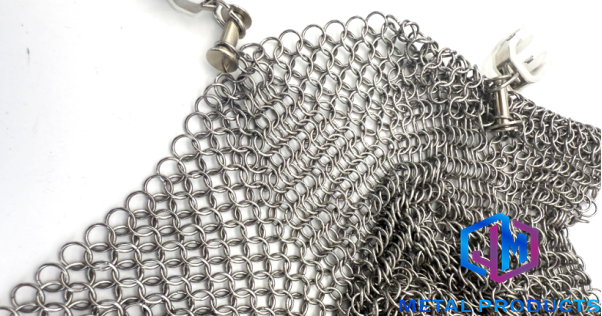
Metal Ring Mesh Curtain (JM-R-4205) configured as an interior partition element.
Matching the System to the Space: Hotels, Museums and Retail
The three reference interior environments in this comparison — hotel, museum and retail — each pull the specification in a different direction, and each is supported by a dedicated Jumao product with its own documented parameters.
Hotel interiors
Hotel Decoration Metal Mesh (JM-A-822) is an aluminium curtain mesh classified as hotel interior metal curtain mesh and decorative partition mesh. Wire diameter ranges from 1.5 mm to 2 mm, installation is by ceiling track or fixed frame, and colour options include stainless steel, bronze and gold. It is intended for hotels, resorts, restaurants and luxury interior projects. In a hotel lobby or restaurant divide, the deciding question is usually whether the wall must move — if it must, a curtain system is required; if it must not, a fixed frame delivers the same material without the track detail. Relatedly, Architectural Chain Link Mesh (JM-A-822) is supplied as an aluminium chain link curtain with 2 mm wire, a 50% opening ratio, a hanging track system and custom height, and is intended for interior decoration, space division, retail display and hospitality projects.
Museum and cultural interiors
Museum Interior Decorative Mesh (JM-C-1084) is a stainless steel 304 decorative mesh wall panel classified as interior art mesh. Wire diameter is 0.8 mm–2 mm, mesh opening and panel size are customizable, and the surface finish is antique copper. It is intended for museums, art centers, cultural buildings and exhibition halls. The specification pattern here is different from hospitality: cultural interiors typically prioritise fine, controlled wire diameter and a stable panel, because the mesh is being read as a surface rather than as a curtain. The finer 0.8 mm end of the range and the fixed-panel format make this a wall system, not a hanging one.
Retail and brand environments
Retail Display Metal Mesh (JM-C-1035) is a stainless steel 304 display mesh panel in the store decoration mesh category, with a wire diameter of 0.8 mm–1.5 mm, a mesh opening of 5 mm–30 mm, a lightweight structure and customized panel dimensions. It is intended for retail stores, shopping centers, brand showrooms and exhibition display. Retail specification tends toward higher visual density at close range because customers stand directly in front of the mesh — 5 mm–30 mm openings with sub-1.5 mm wire read as a fine, precise surface, and the lightweight construction keeps display structures simple.
Buyer Checklist: Lighting, Partitions and Custom Patterns
Feature walls are rarely specified in isolation. In most interior packages the mesh must coordinate with lighting elements, an adjacent partition layer and, frequently, a custom pattern requirement. The following checklist reflects the documented parameters of the matching products.
| Paired element | Documented parameters | What to confirm before ordering |
|---|---|---|
| Metal Mesh Lighting Decoration (JM-LE-0067) | Stainless steel 304; opening ratio 40%–80%; customized shapes; lightweight structure; surface finishing options; intended for lighting design, hotels, restaurants and commercial interiors | Compare the opening ratio of the feature mesh with the 40%–80% range of the lighting screen. Two very open layers in the same sightline will merge visually into one soft mass. |
| Decorative Metal Mesh Partition (JM-C-1013) | Stainless steel 304; wire 1 mm–2 mm; mesh opening 5 mm–10 mm; fixed frame installation; intended for hotels, restaurants, office interiors, retail stores and exhibition areas | This mesh is comparatively closed. Pairing it behind an open drape creates depth separation; pairing it in front of one will hide the drape. |
| Custom Pattern Metal Mesh (JM-A-822) | Wire 2.0 mm; customized pattern; aluminium; electroplating surface finish; customized application size; intended for architectural decoration, interior design and commercial projects | Confirm pattern repeat, panel size limits and finish before production, because the pattern is produced to the project drawing rather than selected from stock. |
Beyond the paired products, a short decision sequence reduces rework on interior feature walls:
- Fix the viewing distance first. A wall read from 1 m and a wall read from 8 m require different apertures, even for the same system.
- Confirm the fixing interface. Track hanging for coil drapery, ceiling track for ring mesh, and frame, clip or tension fixing for custom cable and mesh systems.
- Confirm the material grade in writing. Standard stainless steel mesh for facades typically uses Grade 316 for exterior corrosive environments and Grade 304 for interior applications.
- Decide whether the wall must move. Movement determines whether you are buying a curtain system or a fixed panel, and that decision precedes the choice of mesh type.
- Get the aperture in numbers, not adjectives. Opening ratio, ring diameter or mesh opening should appear in the specification, since "medium transparency" is not a measurable requirement.
- Match the mesh to the lighting scheme. Coil drapery at 50%–80% opening and lighting screens at 40%–80% opening behave differently under direct versus indirect light.
- Check whether a standard applies. Architectural mesh for facades often adheres to ASTM E2016 for standard specification of industrial woven wire cloth; stainless steel architectural mesh materials are commonly specified under EN 10088; and expansion metal mesh in architecture is governed by standards set by the NAAMM EMMA division.
- Confirm customization scope. Jumao provides full OEM and ODM customization on material, size, weave pattern, PVDF coating and design drawings.
How the Three Systems Compare With Rigid Interior Mesh
Flexible mesh is not the default answer for every feature wall. Rigid mesh products solve different problems, and understanding the trade-off prevents a flexible system from being specified where a panel would perform better.
Perforated Metal Panel (JM-P-1987) is an aluminium perforated panel and decorative metal screen in aluminium alloy 3003 or 1100, with a material thickness of 1.5 mm–3 mm, hole diameters from 3 mm to 20 mm, an open area of 20%–50%, and powder coating or PVDF finishes. It is intended for facade cladding, ceiling systems and interior decoration. A related configuration, the Acoustic Metal Mesh Panel (JM-P-1987), uses a 1.5 mm–3 mm thickness, 3 mm–10 mm hole diameter and 20%–50% open area with powder coating, and is designed for auditoriums, conference rooms, public buildings and interior decoration. Laser Cut Metal Screen (JM-E-526) is a custom pattern metal screen with a material thickness of 1.5 mm–5 mm, aluminium or stainless steel construction, customized CNC laser cutting, customized panel size and powder coating or PVDF treatment, intended for landscape design, facade decoration, interior partition and residential projects.
The honest trade-off is this. Rigid panels deliver flatness, precise repeat patterns and straightforward wall fixing, and the acoustic configuration addresses sound directly. What they do not do is move, and their open area sits in the 20%–50% band — generally lower than coil drapery's 50%–80%. Flexible systems deliver softness, depth and adjustable transparency, but they require track, frame or tension fixings and, in the case of cable mesh, a perimeter that can carry tension. The three flexible systems also carry their own constraints: coil drapery is not a privacy or acoustic barrier in itself; ring mesh performance depends heavily on the specified ring diameter, which spans 8 mm–80 mm; and cable mesh, whose documented applications are facade, safety barrier, zoo enclosure and landscape, needs confirmed anchoring when used for an interior feature wall.
Market Signals Behind Interior Mesh Specification
Interior mesh specification is moving in step with the wider architectural mesh market, and the available third-party data gives useful context for buyers planning multi-year projects. The global architectural metal mesh panel market was valued at USD 1.2 billion in 2024 and is projected to reach USD 2.5 billion by 2034, according to Reports and Data. Separately, Growth Market Reports estimates that the global metal mesh facade market will reach USD 10.59 billion by 2034, growing at a CAGR of 6.2%. These two figures are not directly comparable: one measures panel products across applications, while the other measures the facade segment of the metal mesh market, which is why published estimates for this category can differ substantially.
On the supply side, China dominates global wire mesh supply with an estimated 65% market share in 2024, based on IBISWorld and industry reports, and China's export value of steel wire products — including wire mesh — reached USD 14.5 billion in 2024 according to Global Growth Insights. The Anping wire mesh cluster in Hebei, where Jumao's 3,000 m² facility is located, hosts more than 3,600 specialized factories as of late 2024, according to Anping County Government and industry statistics. Regionally, Asia-Pacific is identified by Market Research Future as the fastest-growing region for facade systems including metal mesh, driven by rapid urbanization and infrastructure investment. Within product mix, Dataintelo estimates that woven wire mesh accounted for approximately 43.2% of total metal mesh revenues in 2025 — a medium-reliability figure that nonetheless indicates how much of the category remains woven rather than panel-based.
For interior buyers, the practical implication is not market size but supply structure. A category concentrated in a small number of manufacturing regions, with more than 3,600 factories in one cluster, makes documented specification — grade, aperture, fixing method — more valuable than brand familiarity, because the visual difference between two nominally similar curtains can be a 10× difference in ring diameter.
What Changes Next for Interior Feature Walls
The direction of travel is toward documented specification. Standards such as ASTM E2016 for industrial woven wire cloth, EN 10088 for stainless steel material specification and the NAAMM EMMA standards for expanded metal are increasingly referenced at the point where interior decorative mesh is ordered, not just at the facade package. Material grade is following the same path: Grade 316 for exterior corrosive environments and Grade 304 for interior applications is already the standard distinction, and it gives interior specifiers a clear default.
The second shift is integration. Instead of treating a feature wall as a single purchase, projects are increasingly specified as a coordinated set — mesh, lighting screen and partition. The Custom Architectural Mesh System (JM-C-9336) is structured around that reality, with mesh types available as woven, expanded, cable or ring, materials in stainless steel, aluminium or brass, panel sizes customized, finishes including PVD, powder coating and fluorocarbon coating, and fixing options spanning frame, clip and tension installation. Where OEM scope extends across material, size, weave pattern, PVDF coating and design drawings, the pattern and the fixing detail can be engineered together rather than reconciled on site. Jumao's product range and company profile are published at www.jumao-decorfabric.com for reference.
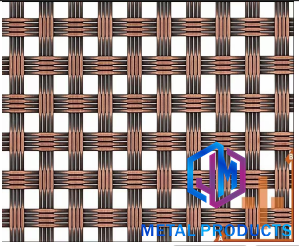
Museum Interior Decorative Mesh (JM-C-1084) with an antique copper surface finish.
Frequently Asked Questions
What is the difference between metal coil drapery and metal ring mesh curtain?
Metal Coil Drapery (JM-M-907) is built from continuous coil wire, with a coil diameter of 3 mm–15 mm, a wire diameter of 1.0 mm–1.5 mm and an opening ratio of 50%–80%, installed on a track hanging system with customized height. Metal Ring Mesh Curtain (JM-R-4205) is built from interlocking rings, with a ring diameter of 8 mm–80 mm and a wire diameter of 1 mm–6 mm, installed on a ceiling track system, specified with medium-to-high transparency and available in custom colours. The coil system reads as a continuous, layered surface; the ring system reads as a defined, articulated texture.
Which of the three systems gives the most open visual effect?
Architectural Cable Mesh (JM-w-013) produces the most open result, with a mesh opening of 25 mm–100 mm and a cable diameter of only 1.5 mm–3 mm. Metal Ring Mesh Curtain is specified as medium-to-high transparency across its 8 mm–80 mm ring range, and Metal Coil Drapery has a 50%–80% opening ratio. Apparent openness also depends on viewing distance and on whether the mesh is hung as a single layer or doubled for density.
How is each system fixed to a ceiling or a wall?
Metal Coil Drapery uses a track hanging system with customized height. Metal Ring Mesh Curtain uses a ceiling track system. Architectural Cable Mesh is a flexible cable structure, and project-level fixing options within the Custom Architectural Mesh System (JM-C-9336) include frame, clip and tension installation. Where a fixed interior screen is required rather than a hanging one, the Decorative Metal Mesh Partition (JM-C-1013) uses fixed frame installation with a stainless steel 304 body and a 5 mm–10 mm mesh opening.
Which mesh should be used for a hotel lobby versus a museum interior?
Hotel interiors are commonly specified with Hotel Decoration Metal Mesh (JM-A-822), an aluminium curtain mesh with a wire diameter of 1.5 mm–2 mm, ceiling track or fixed frame installation and colour options that include stainless steel, bronze and gold, intended for hotels, resorts, restaurants and luxury interior projects. Museum interiors are commonly specified with Museum Interior Decorative Mesh (JM-C-1084), a stainless steel 304 decorative mesh wall panel with a wire diameter of 0.8 mm–2 mm, an antique copper finish and customizable mesh opening and panel size, intended for museums, art centers, cultural buildings and exhibition halls. The first decision is normally whether the wall needs to move at all.
What should be confirmed before ordering a custom pattern metal mesh for a feature wall?
Custom Pattern Metal Mesh (JM-A-822) is supplied with a 2.0 mm wire, a customized pattern, aluminium material, an electroplating surface finish and a customized application size, and is intended for architectural decoration, interior design and commercial projects. At project level, OEM and ODM customization is available on material, size, weave pattern, PVDF coating and design drawings. Buyers should confirm material grade, pattern repeat, panel size, fixing method and surface finish before production begins.
Which standards apply to architectural metal mesh used in interiors?
Architectural mesh for facades often adheres to ASTM E2016 for the standard specification of industrial woven wire cloth. Stainless steel architectural mesh materials are commonly specified under EN 10088, the European standard for stainless steels. Expansion metal mesh in architecture is governed by standards set by the National Association of Architectural Metal Manufacturers (NAAMM) EMMA division. On material selection, standard stainless steel mesh typically uses Grade 316 for exterior corrosive environments and Grade 304 for interior applications.