
Cold Room Refrigeration: Fit the System to the Project
The cold room refrigeration system is a matching problem
A cold room refrigeration system is not a single machine. It is a coordinated set of components — a condensing unit, a cold room air cooler (evaporator), a condenser, the room envelope, and controls — designed to hold a defined temperature inside an insulated space. In most cold storage projects, the outcome depends less on any single component's nameplate capacity and more on how well the whole system is matched to the project scenario.
Buyers in the research and evaluation phase need a practical framework: what temperature must the room maintain, what operating conditions apply, and which combination of refrigeration equipment can deliver stable performance over years of near-continuous use. This article examines cold room refrigeration systems from a project-fitting perspective, using Clevier Refrigeration Technology (Jiangsu) Co., Ltd. as a concrete manufacturer reference for system matching, customization, and delivery.
Why mismatched cold room systems fail
The first variable in any cold storage project is temperature. A complete cold room refrigeration system, as configured by Clevier, covers a temperature range of -40°C to +10°C. Within that range, different rooms need different evaporator and unit selections:
- Fresh keeping and chiller rooms typically operate around 0°C to +10°C — for vegetables, dairy, beverages, and short-term storage.
- Freezer rooms typically operate around -18°C — for meat, seafood, and frozen food storage.
- Low-temperature and blast freezing rooms operate at -25°C or below — for rapid freezing and long-term frozen storage.
Operating conditions add another layer. Cold storage projects in cold chain logistics and food storage often run 24/7 continuous operation, frequently in low-temperature and high-humidity environments. Under those conditions, the special requirements usually cited by project owners are energy saving and stable performance. Matching a condenser or an air cooler without considering these factors can cause poor temperature uniformity, excessive defrost cycles, higher energy consumption, or shortened compressor life.
The market opportunity behind this matching problem is significant. Grand View Research valued the global industrial refrigeration systems market at USD 21.3 billion in 2024, with Asia Pacific holding a 32.6% revenue share. The broader refrigeration equipment market was estimated at USD 67.06 billion in 2024 by ResearchAndMarkets. The condensing unit segment alone was valued at USD 42 billion in 2023 and is growing at a CAGR of 7.95%, according to Stratview Research. Cold rooms are not a niche purchase; they are a core physical asset for food supply chains.
Clevier's approach: complete system matching
Clevier Refrigeration Technology (Jiangsu) Co., Ltd. is a professional manufacturer of commercial and industrial refrigeration equipment and cold storage solutions. The company, established in 2023, operates a 10,000-square-meter factory in Changzhou, Jiangsu Province, China, with around 50 employees and an annual output of approximately 10,000 units. About 30% of production is exported to Asia, South America, Africa, and North America. Its official website is www.cleviercool.com.
Clevier's product range covers the main components of a cold room refrigeration system:
- Cold Room Refrigeration System — project-based system solution combining condensing unit, air cooler, cold room door system, and control components, for temperatures from -40°C to +10°C.
- Cold Room Air Cooler — DL, DD, and DJ series evaporators for fresh keeping, freezing, and low-temperature/blast applications.
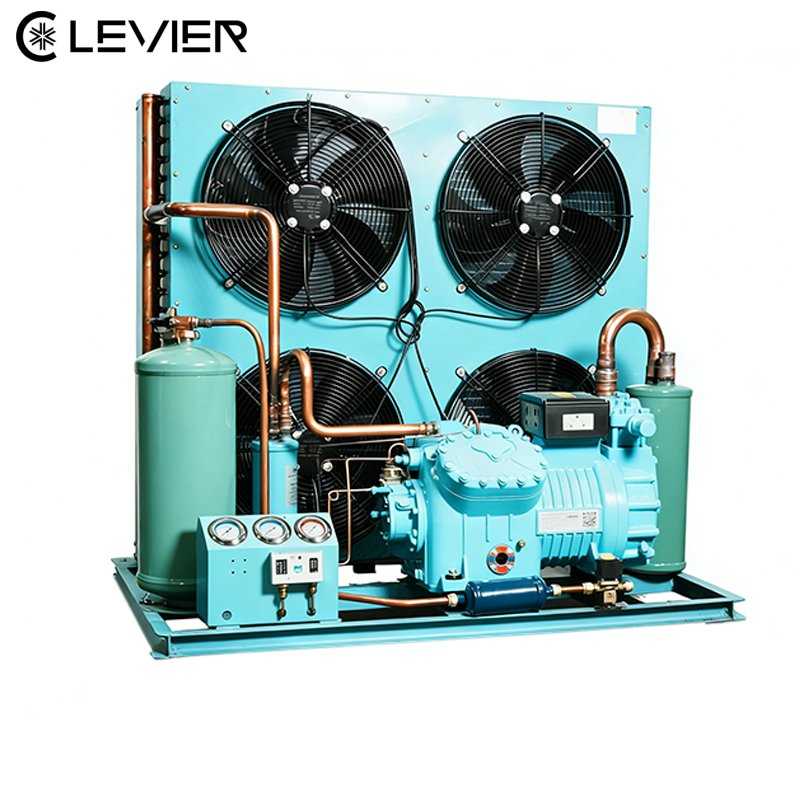
- Condensing Unit — air-cooled, water-cooled, box type, and open type configurations, suitable for 3HP–30HP applications, with optional Copeland or Bitzer compressors.
- Air Cooled Condenser — H type, V type, and U type structures with copper tube and aluminum fin coils.
The company supports OEM/ODM customization covering cooling capacity, temperature range, voltage, refrigerant, compressor selection, panel structure, and complete system matching. Its production capabilities include a monthly output of 8,000 to 15,000 units across mixed products, a lead time of 15 to 30 days depending on the order quantity, and a minimum order quantity of one set for sample or system orders. Quality control includes 100% testing before shipment, with performance testing and pressure testing.
For contractors and distributors, factory-direct supply and a single supplier for multiple system components simplify procurement and reduce coordination risk. The stated application list is broad: food processing, cold chain logistics, supermarkets, restaurants, agriculture, seafood, and meat storage.
Technical explanation: how the matching works
Selecting the cold room air cooler by temperature
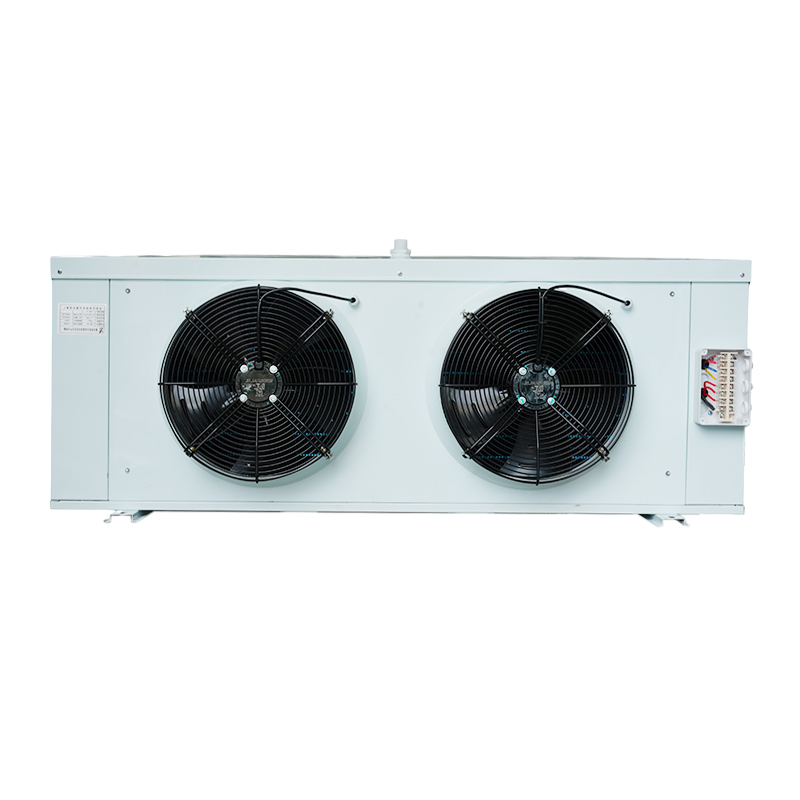
The air cooler, or evaporator, is the component that directly removes heat from the room. Clevier categorizes its air coolers into three series that correspond to practical temperature bands:
| Series | Application | Temperature range |
|---|---|---|
| DL | Fresh keeping / chiller room | Around 0°C to +10°C |
| DD | Freezer room | Around -18°C |
| DJ | Low temperature / blast freezer | -25°C and below |
Cooling capacity for these unit coolers spans 2.1 kW to 56.2 kW depending on the model. Fan quantity ranges from 1 to 4 fans, with fan diameters from 300 mm to 600 mm and air volumes from 1,680 m³/h to 11,800 m³/h. Defrost options include air defrost, electric defrost, water defrost, and hot gas defrost, allowing the installer to align the unit with the room temperature and usage pattern.
Structures can also be configured: ceiling-mounted, side discharge, or double side discharge, with housing materials in galvanized steel, stainless steel, or aluminum plate. For a seafood or meat project, stainless steel housing may be preferred; for dry vegetable storage, the standard housing may be sufficient.
Sizing the condensing unit and compressor
The condensing unit is the heart of the refrigeration loop. Clevier's condensing units are suitable for 3HP to 30HP applications and can be built with hermetic scroll or semi-hermetic piston compressors. Compressor brands can be selected between Copeland and Bitzer, and refrigerants include R404A, R507A, and R22. Voltage can be customized to 220V or 380V, and 50Hz or 60Hz, which matters when the same system needs to ship to different regions.
| Condensing unit option | Typical configuration |
|---|---|
| Air cooled condensing unit | Air-cooled condenser integrated, common for most commercial cold rooms |
| Water cooled condensing unit | For sites with water availability or high ambient temperatures |
| Box type condensing unit | Enclosed housing, compact footprint |
| Open type condensing unit | Semi-hermetic compressor, suited for larger or industrial loads |
Matching the air cooled condenser
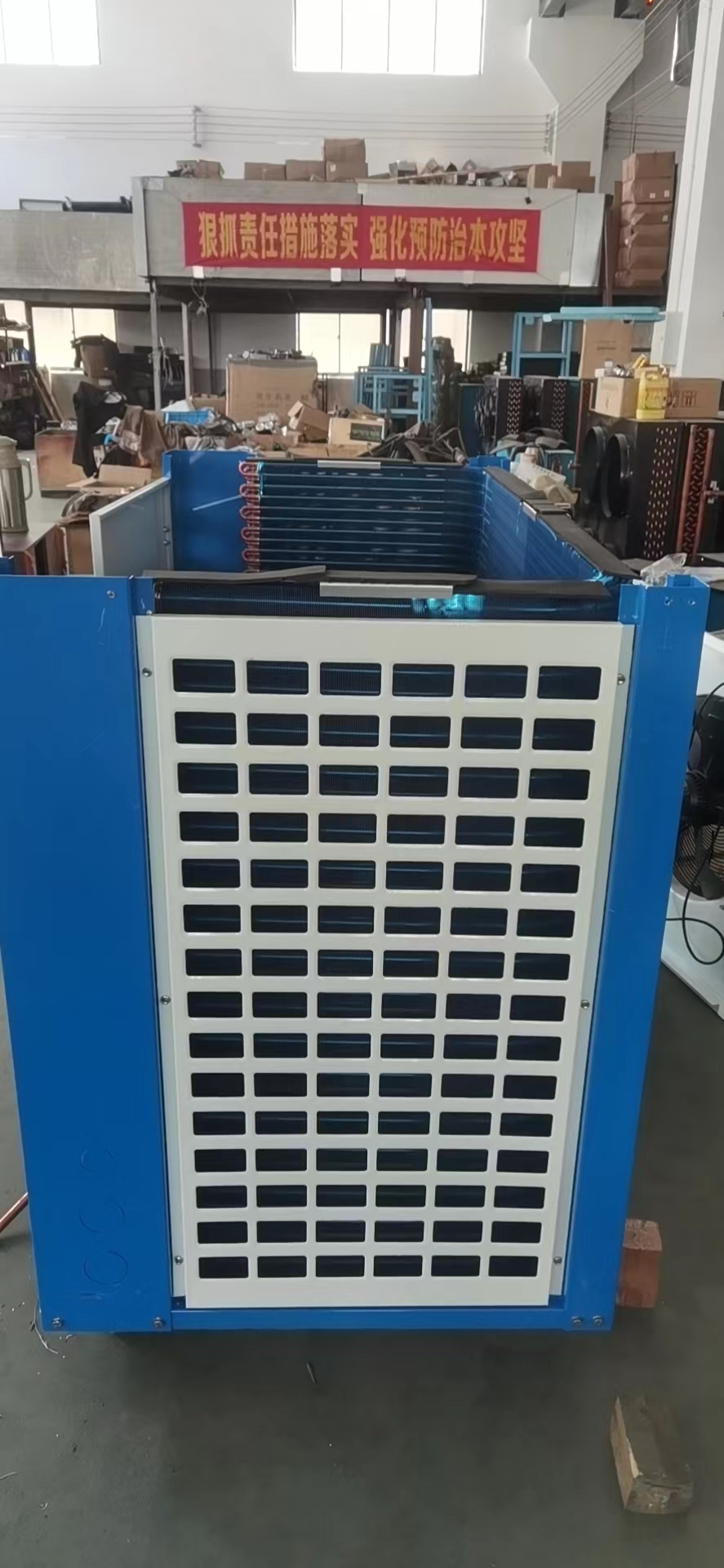
Condenser heat rejection must match the combined heat load of the refrigeration capacity. Clevier's air cooled condenser series are available in H type, V type, and U type structures. The H, V, and U configurations mainly address installation space and airflow layout. Heat transfer areas range from approximately 22 m² to 400 m² depending on the model, with 1 to 4 fans and fan diameters from 300 mm to 600 mm. The coil is copper tube with aluminum fins, and both voltage and casing color can be customized.
In practice, the selection logic is: define the room temperature and size; calculate the cooling load; select an air cooler with adequate capacity; then choose a condensing unit whose compressor matches the evaporator and a condenser whose heat rejection matches the system.
Application scenarios in cold chain and food storage
The product system is used in the cold chain logistics and food cold storage industry. In these settings, its role in the scenario is to provide cooling and refrigeration for food preservation. The system requires supporting equipment such as cold room panels, a refrigeration unit, an evaporator, and a condensing unit — meaning a complete project usually draws from several categories of the manufacturer's catalog.
Typical installations include meat storage, seafood storage, vegetable preservation, and frozen food warehouses. For a frozen food warehouse, the DD series unit cooler is a common evaporator choice. For a blast freezing line, the DJ series is designed for lower temperatures. For produce packing houses, the DL series fits the +5°C to +10°C range. Cold storage contractors, food processing factories, and cold chain logistics companies are the main project owners. According to Clevier's case record, system matching solutions are typically supplied at a scale of 1 to 20 sets per project, with reported stable operation of 2 to 5 years. The recurring highlights are complete cold room solutions, custom design availability, factory-direct supply, easy installation, and OEM/ODM support.
Market trends affecting cold room refrigeration choice
Several published data points help explain why cold room refrigeration buyers are increasingly thinking in systems rather than components:
- The frozen temperature range (-18°C to -25°C) held approximately 63% of the cold storage market in 2025, according to Grand View Research. Freezer projects dominate procurement.
- Walk-in cold rooms were projected to hold a 58.7% share of the cold room market by 2025, according to Dataintelo, reinforcing that modular, project-matched rooms are the mainstream format.
- Asia Pacific led the global condensing unit market with a 70.22% revenue share in 2023, according to Grand View Research — a region that also hosts a large portion of equipment manufacturing and cold storage construction.
- Food and beverages accounted for more than 76.8% of global cold chain market revenue in 2025, showing that cold storage investment is tied directly to food supply chains.
- China's total cold storage capacity reached 237 million cubic meters by June 2024, an 8% increase year over year, according to the China Federation of Logistics & Purchasing and IIR.
- China was the leading exporter of industrial evaporative air coolers in 2024, with exports valued at USD 577 million, according to the Observatory of Economic Complexity.
In the condensing unit market, Emerson Electric, Carrier, Danfoss, and Bitzer SE are identified by Grand View Research as key major players. This mix of global brands and specialized Chinese manufacturers gives buyers more configuration choices, but also makes the project-fit question more important. Standards matter as well: IEC 60335-2-89:2019 covers safety requirements for commercial refrigerating appliances, and EN 378:2016 is the mandatory European safety and environmental standard for refrigerating systems and heat pumps. Buyers exporting into Europe or operating under international retail standards should confirm that system components meet the applicable compliance framework.
Traditional procurement vs. system-matched supply
The traditional route for cold storage projects is piecemeal procurement: buy panels from one supplier, a condensing unit from another, evaporators from a third, and then coordinate installation and trouble-shooting on site. The buyer or contractor carries the matching risk. If the evaporator is oversized relative to the compressor, the room may short-cycle. If the condenser is undersized, high ambient days raise head pressure and energy use. If the defrost method does not fit the room's humidity, the coil will ice up.
The system-matched approach shifts the responsibility to the manufacturer. A supplier like Clevier can combine condensing units, cold room air coolers, air cooled condensers, panels, and doors into one project-based solution, with customization at the factory and a single responsible party for system coherence. For buyers, this reduces engineering workload and potentially shortens the procurement cycle.
A realistic boundary: a system-matched solution is only as accurate as the project information provided. The manufacturer needs the target temperature range, room dimensions, insulation panel specification, ambient conditions, voltage, and refrigerant preference to deliver a complete configuration. For retrofit projects, an on-site assessment remains necessary because existing panels, floors, and door openings may impose constraints. Lead times of 15 to 30 days also need to be built into the project schedule.
Future outlook
Several longer-term forces are likely to shape cold room refrigeration procurement. First, energy efficiency will keep moving up the priority list. A 24/7 operation that is even modestly more efficient produces meaningful annual savings, so buyers will continue to compare full-system efficiency, not just purchase price. Second, the system supply model will continue to gain ground. Contractors and distributors in emerging markets often prefer a single supplier that can design, test, and ship a matched set of components. Third, the extension of cold chain infrastructure in developing regions will create new demand for medium-capacity cold rooms rather than only large industrial warehouses.
Regulation and refrigerant policy will also push changes. As safety and environmental standards evolve, manufacturers that can adapt component design — coil materials, charge limits, refrigerant compatibility — will be better positioned for cross-border projects. For buyers, the practical takeaway is to evaluate suppliers on their ability to match the system to the project, and to use verifiable capacity, testing routines, and application references as evidence.
FAQ: cold room refrigeration system project fit
What is the role of a cold room refrigeration system in a cold storage project?
The product's role is to provide cooling and refrigeration for food preservation. It is used in the cold chain logistics and food cold storage industry.
What temperature range is a cold room refrigeration system suitable for?
A cold room refrigeration system is suitable for cold room refrigeration projects with a temperature range of -40°C to +10°C.
What supporting equipment does a cold room refrigeration system require?
The system requires supporting equipment such as cold room panels, a refrigeration unit, an evaporator, and a condensing unit.
What operating conditions apply to cold room projects?
A condensing unit used in cold room projects operates in 24/7 continuous operation mode. This application scenario is common in global cold chain and food storage markets.
What are the typical special requirements in cold chain applications?
Special requirements for this application include energy saving and stable performance.
Can a cold room refrigeration system be customized for a specific project?
Yes. The system matching solution offers a complete cold room solution, custom design availability, factory-direct supply, and OEM/ODM support. It is typically supplied at a scale of 1 to 20 sets per project and has been in stable operation for 2 to 5 years.
Further reference
For buyers and contractors who need more detail on configurations, Clevier's 2026 product catalog in English provides specifications for condensing units, air coolers, condensers, and complete cold room systems. It can be accessed here: Clevier Product Catalog 2026 (English).
Have Questions or Need More Details?
Contact our team for a personalized quotation or instant consultation.
Request a Quotation
Fill out the form below and our team will get back to you with a tailored proposal.
WhatsApp Direct Chat
Prefer to chat in real-time? Message us on WhatsApp for instant assistance & quick answers.
- Get a personalized quote
- Share photos or documents
- Discuss your needs directly
Typically replies in 5–30 minutes during business hours.