
Collapsible Basins vs Folding Laundry Baskets: Performance Review
A collapsible basin and a folding laundry basket can be moulded from the same PP+TPE compound, carry the same BPA-free declaration and fold down to a few centimetres. They are still not interchangeable. In laundry rooms, cleaning cupboards and bulk retail programmes, the FP collapsible basin works between 5L and 20L as a water-holding vessel for hand washing and soaking, while the folding laundry basket works up to 43L as a dry-volume container for sorting, carrying and storage. This independent review compares the two formats on structure, capacity, fold durability, compliance and landed cost, and marks the point at which each one stops being the right answer.
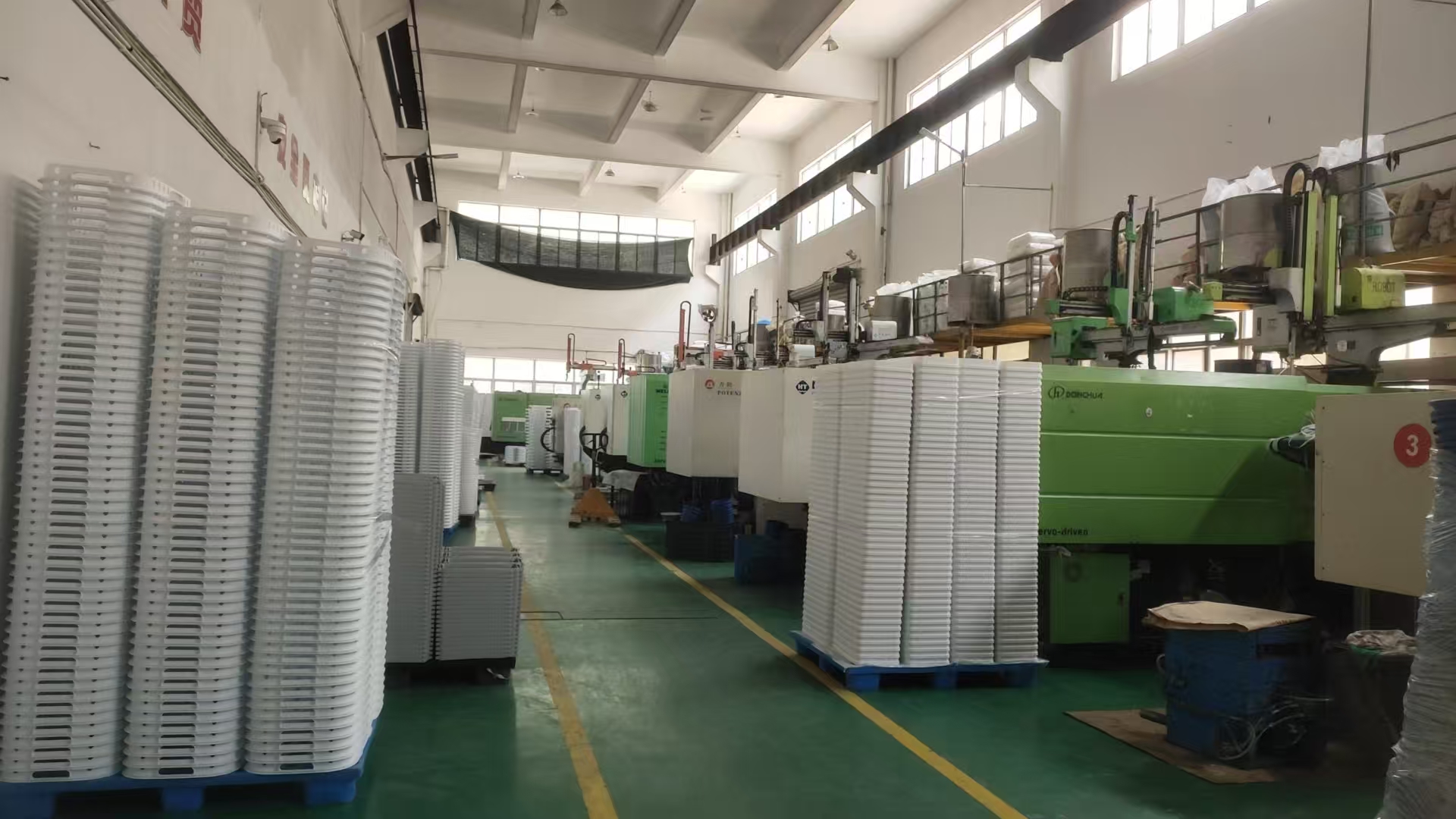
Assembly line for foldable household plastics: both basins and laundry baskets are built on the same one-piece fold-expand structure before final inspection.
The comparison matters because the two products are usually bought from the same shelf, by the same buyer, for the same household. Grand View Research values the global foldable and collapsible container market at USD 1.7 billion in 2025, with plastic accounting for a 53.9% revenue share on the strength of weight and cost efficiency. Asia Pacific held 36.8% of that revenue in 2025, and China is identified as the leading country market. Household basins and laundry baskets sit close together inside that category — similar resin, similar hinge logic, similar retail price band — which is exactly why the functional difference is so often lost in a purchase decision.
Two formats, one material system, two different load briefs
Both formats in the Nantong Plastic foldable range are made from 100% new food-grade PP+TPE composite, are BPA-free, and are rated for −20°C to 120°C, releasing no odd odour even with boiling water and resisting cracking at low temperature. Both are recyclable and both collapse flat.
The difference is what they are asked to hold. A basin holds water: a hydrostatic load that pushes outward along the entire wall and seam for as long as the water sits there. A laundry basket holds textiles: a distributed dry load with modest outward pressure and a high tolerance for irregular shapes. Every structural choice downstream — rim stiffness, wall thickness, handle anchoring, base geometry — follows from that single brief.
Mis-specification rarely shows up at the point of purchase. It shows up in use: a basket pressed into soaking duty puts sustained water pressure on a wall optimised for dry volume, while a 5L basin asked to handle a family laundry sort simply requires repeated trips.
Structural anatomy: rigid rim, compliant wall
Both products use a one-piece fold-expand structure with heat-pressed fold lines, sealed seams and side walls thickened to 2–3mm. The rigid PP rim does the load-bearing work and the soft TPE walls do the folding. On a basin, the rim resists the outward hoop stress of standing water and keeps the opening square, so the water line stays level instead of sagging over a warped edge. On a basket, the same rigid rim keeps the mouth open for one-handed loading and anchors the integrated reinforced handles that carry the weight when the basket is full. Anti-slip bottom structures reduce tipping on wet floors in both formats.
The one-piece construction is protected by 23 independent patents covering the fold-expand structure. In practice it is what allows single-hand unfolding and folding with no assembly step, which matters in a laundry room where the other hand is usually holding something.
Buyers should read the wider variant list as structural tweaks rather than different products. Folding baskets with lids, wheeled folding baskets, baskets with stands, pull-rod formats, hanging versions and the perforated hollow folding basket all work on the same fold-line logic; a lid, wheel set or stand changes the load path and should be assessed as an addition rather than a material upgrade.
Capacity and load type: 5L–20L against 43L
Nominal capacity is the clearest dividing line, but it is not a quality ranking. The foldable range as a whole spans 3L to 43L, so a basin and a basket can sit close in volume while remaining far apart in function.
| Attribute | Collapsible basin (FP models, 5L–20L) | Folding laundry basket (up to 43L) |
|---|---|---|
| Primary job | Holding water at working depth for washing, soaking and cleaning | Holding dry textiles and bulky items for sorting, transport and storage |
| Load type | Hydrostatic — continuous outward pressure on wall and seam | Distributed dry load with modest outward pressure |
| Wall construction | Soft TPE side walls, rigid PP rim, heat-pressed fold lines, sealed seams | Soft TPE side walls, rigid PP rim, integrated reinforced handles |
| Material | 100% new food-grade PP+TPE, BPA-free | 100% new food-grade PP+TPE, BPA-free |
| Temperature range | −20°C to 120°C | −20°C to 120°C |
| Folded profile | A few centimetres | A few centimetres |
| Storage gain | 75%–85% volume reduction | 75%–85% volume reduction |
| Base | Anti-slip structure for wet floors | Anti-slip structure; stands and wheel sets available across the range |
| Best-fit scenes | Hand washing, soaking, mop water, camping wash-up | Laundry sorting, bedding storage, retail display, car trunk organisation |
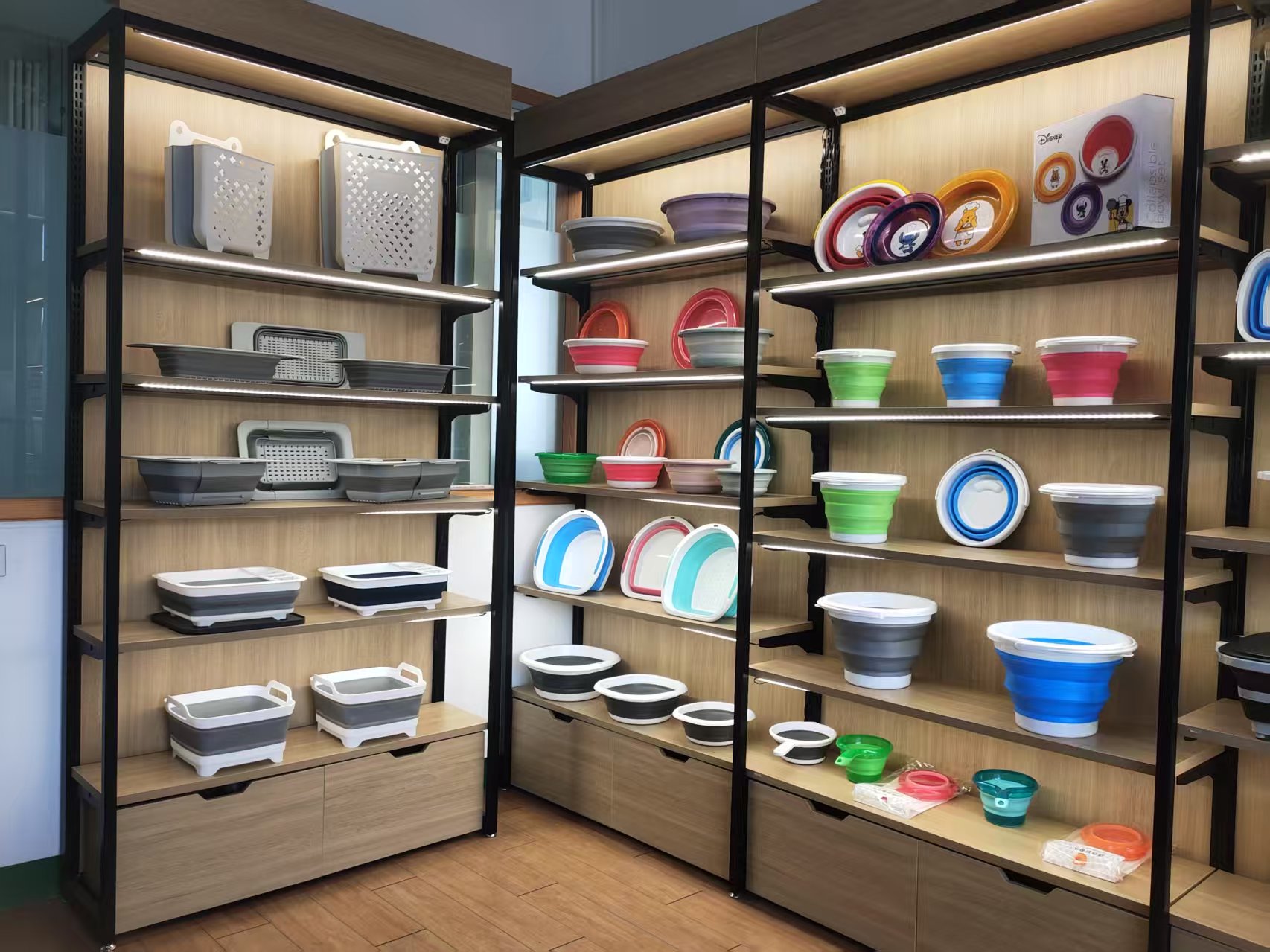
Sample showroom: basin sizes run from 5L to 20L while laundry baskets extend to 43L on the same material platform.
Reading the two columns together produces a simple rule. Choose by task, not by shelf appeal: if the load is wet, the basin's wall and seam geometry is the deciding factor; if the load is dry and bulky, the basket's capacity and handle anchoring matter more.
Matching format to task
| Task | Format that fits | Reason |
|---|---|---|
| Hand washing delicates, soaking | FP collapsible basin, 5L–20L | Water-holding wall, sealed seams, level rim |
| Mop water and surface cleaning | Collapsible basin | Anti-slip base and single-hand unfolding |
| Laundry sorting and carrying | Folding laundry basket up to 43L | Dry volume with reinforced handles |
| Bedding and seasonal textile storage | Large capacity folding basket, lid option | 43L volume plus dust protection |
| Camping and picnic wash-up | Basin for washing; folding picnic basket for dry gear | Separating wet and dry loads avoids both compromises |
| Car trunk organisation | Folding storage basket / car folding basket | Folds flat when empty, opens when loaded |
| Vegetable washing and draining | Folding vegetable basket, folding drain basket | Perforated format plus a declared food-contact use |
| Retail shelf display and bulk wholesale | Both formats | 75%–85% volume reduction and 4–5 times carton density |
Fold durability: what a 5,000-cycle rating measures, and what it does not
Lab tests on the foldable range record 5,000 to 10,000 repeated folds without cracking or deformation. That figure is a hinge and fold-line metric: it stresses the heat-pressed fold line and the transition zone where soft TPE meets rigid PP, which is where a folding product either holds up or fails early.
It is not a load rating. A cycle count says nothing about resistance to continuous heating above 120°C, about violent scratch or impact from sharp hard objects, or about overload beyond the marked maximum water capacity. Those three risks are handled separately, through clear temperature and load capacity markings on each product, English user manual reminders, and structural reinforcement using thickened 2–3mm side walls and integrated anti-break handles.
Compliance: identical resin, different declarations
Material and compliance are two separate questions, and this is where basins and baskets diverge most sharply in procurement terms. The foldable range is certified to BSCI, ECM, FDA, REACH, RoHS, ASTM and SEDEX, and HDPE and PP are the primary resins used across folding basket production more broadly, according to Plastics Europe, because of durability and recyclability.
For food-contact use in the European Union, plastic articles must comply with Regulation (EC) No 1935/2004 and Regulation (EU) No 10/2011, with good manufacturing practice governed by Commission Regulation (EC) No 2023/2006. A laundry basket sold as a hamper and a folding vegetable basket sold for produce contact can be produced from the same compound and still sit in different compliance conversations. Buyers should verify the declared use printed on the certificate, not infer it from the resin name.
Real-use settings: laundry, cleaning and everything adjacent
Laundry sorting and transport
The folding laundry basket is the default here. A 43L body takes a full family load in one pass, the reinforced handles carry the weight when full, and the basket folds to a few centimetres between wash days. Stand-mounted and wheeled versions reduce bending and dragging on longer runs.
Hand washing, soaking and cleaning
The basin takes over whenever water is involved: delicates, stain pre-treatment, mop water, surface wiping, pet washing. A 5L unit suits a single garment; 12L to 20L units suit soaking and cleaning tasks. The sealed seam and rigid rim are the parts that matter, not the capacity label.
Camping, picnic and travel
These are the scenarios where the two formats are usually bought together. A basin handles wash-up at the campsite; a folding picnic basket or folding hand basket carries dry gear and food. Keeping the wet and dry jobs in separate products avoids overloading either one.
Small apartments, rental housing and dormitories
Both formats cut stored volume by 75%–85% and can hang on walls or fit into cabinet gaps. The purchase decision here is about task coverage rather than space: many households keep one of each because the jobs do not overlap.
Retail and wholesale programmes
For supermarkets and cross-border retailers, the two formats share carton economics. Foldable design increases container utilisation by 300% compared with rigid traditional plastic containers, with 4–5 times more pieces per carton — which is why assortment planning can treat basins and baskets as one logistics programme rather than two.
Landed cost: where the folding format actually pays
Folded thickness of a few centimetres converts directly into freight. Company comparison data puts storage space reduction at 75%–85%, container utilisation up 300% and loading quantity 4–5 times that of traditional plastic baskets, with ocean freight and warehouse storage costs for importers reduced by more than 60%. Third-party analysis reaches a similar direction: Grand View Research notes that foldable crates can reduce storage space requirements by up to 75% when not in use compared with rigid alternatives.
Trade scale explains why this matters at programme level. Global trade under HS Code 392310 — plastic boxes, cases and crates — reached approximately USD 14 billion in 2024 according to the Observatory of Economic Complexity, with China's exports alone valued at USD 1.89 billion, placing it among the top three global exporters. In a category of that size, carton density is a competitive variable, not a detail.
Where folding stops working: boundaries and trade-offs
An honest comparison has to state the limits. Five apply to these two formats.
- Unit cost: the company's own comparison material states that unit product cost is slightly higher than recycled-plastic low-end goods. The advantage is recovered at programme level through freight, storage and replacement rate — not on the invoice line.
- Open-state rigidity: a fixed non-foldable basket holds its shape under lateral pressure. A folding basket relies on its rim and fold lines, so for heavy irregular loads a rigid crate remains the more robust option.
- Water holding: the laundry basket is not validated for prolonged water holding. Basins are the water-holding format, and they cap at 20L.
- Added hardware: fold lines and heat-pressed seams are an extra inspection point compared with a one-piece fixed basket. That is why three-stage quality inspection during production and before shipment matters in this category.
- Shared hard limits: continuous heating above 120°C, violent scratch or impact from sharp hard objects, and overload beyond the marked maximum water capacity apply to both formats.
Against low-cost recycled-plastic folding goods, the same comparison material states an expected lifespan 5–10 times longer, alongside 100% new food-grade PP+TPE material, a space-saving foldable structure, and complete factory audit and food-safety certifications. Against thin-wall ordinary folding products, the differentiator is the 2–3mm wall and the reinforced fold line. Neither advantage removes the boundaries above.
Supplier context: who builds both formats
Taizhou Nantong Plastic Industry Co., Ltd., trading as Nantong Plastic, is a Chinese integrated factory-and-trade manufacturer of foldable plastic household goods, founded in 2003 and based in Huangyan District, Taizhou City, Zhejiang Province. It operates a 6,000㎡ production plant plus a 3,500㎡ independent warehouse, 12 injection moulding machines from 300g to 2500g, three assembly lines and 200 self-developed production moulds, and lists more than 90 styles across foldable wash basins, water buckets, storage baskets and laundry baskets. Standard mould opening takes 30–40 days, with mould repair response within 2–3 days. Around 70% of output is exported to the USA, UK, Germany, Spain, Australia, Korea and Japan, and the company states long-term supply relationships with Walmart, Sam's Club, Netto, Nitori and 3Coins.
Its quality framework is relevant to the basin-versus-basket decision because it applies uniformly across both formats: full raw material food-grade testing before production, three-stage full quality inspection during production and before shipment, a one-year free replacement warranty covering non-human damage, and complete certification documents for customs clearance.
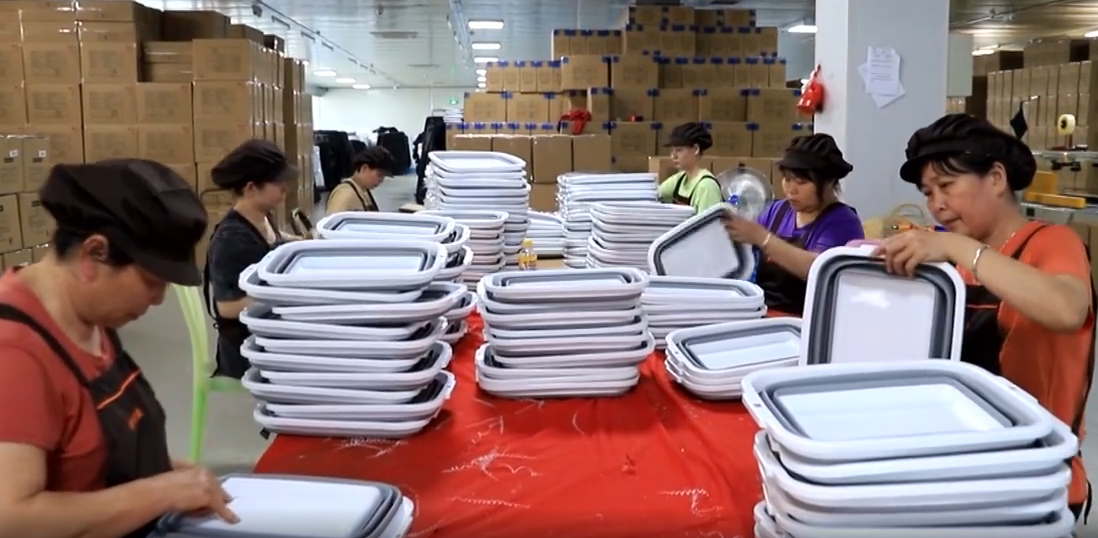
Packaging workshop: folded basins and baskets share carton density, which is where the logistics case for both formats is made.
Market direction: what the category numbers suggest
Category estimates vary by scope. Grand View Research puts the foldable and collapsible container market at USD 1.7 billion in 2025, while Strategic Revenue Insights publishes a lower figure of USD 1.4 billion, largely reflecting whether heavy industrial bulk bins are counted alongside retail crates. The US foldable container market was valued at USD 422.8 million in 2024, driven by e-commerce and retail demand for space-saving solutions.
Segment structure matters for buyers comparing household formats. The industrial end of the plastic crate market is served by established players such as Schoeller Allibert, ORBIS Corporation and Brambles (CHEP), whose products are specified against different load and handling requirements. Household basins and laundry baskets should be benchmarked within the household format, not against industrial crate specifications that answer a different question.
Two directions look durable. First, food-contact declaration is becoming a purchase criterion rather than an afterthought, particularly for vegetable and drain baskets. Second, container-fill economics continue to favour foldable formats wherever warehouse space is priced — which is the majority of import markets.
Running the comparison as a buying decision
Six checks convert the analysis into a repeatable decision.
- Define the load type first. Water-holding tasks point to the basin family; dry volume points to the basket family. Mixed programmes need both.
- Set capacity from the task, not the catalogue. 5L–20L basins cover hand washing and cleaning; 43L baskets cover bulk sorting and storage.
- Check the fold rating against expected use frequency. A 5,000–10,000 cycle result describes the hinge, so match it to how often the product will actually be folded.
- Verify certification against destination market and declared use. Same resin does not mean same declaration.
- Model landed cost, not unit price. Carton cube multiplied by pieces per carton multiplied by freight is the number that decides the programme.
- Confirm after-sales terms and documentation. Replacement warranty scope and customs paperwork should be settled before the first container, not after.
Frequently asked questions
What is the practical difference between a collapsible basin and a folding laundry basket?
Load type. The FP collapsible basin, sized 5L–20L, is built as a water-holding vessel: rigid PP rim, sealed seams and soft TPE walls that resist sustained hydrostatic pressure. The folding laundry basket, up to 43L, is built for dry volume with reinforced handles. Both use 100% new food-grade PP+TPE, are BPA-free and are rated for −20°C to 120°C.
Can a folding laundry basket be used for hand washing or soaking?
That is not its intended use. Standing water applies continuous outward pressure across wall and seam, while the basket's capacity and handle geometry are designed around dry loads. For washing and soaking, the basin family covers 5L to 20L.
What does a 5,000-fold rating actually cover?
It covers repeated folding at the heat-pressed fold line: lab tests record 5,000 to 10,000 folds without cracking or deformation. It is not a load rating, and it does not describe resistance to continuous heating above 120°C, to sharp-object impact, or to overload beyond the marked maximum water capacity.
Which format suits a small apartment or rental unit?
Both reduce stored volume by 75%–85%, folding to a few centimetres so they can hang on walls or fit into cabinet gaps. The choice follows the task: a basin for hand washing and cleaning, a basket for laundry sorting and bulk storage. Many households keep one of each because the jobs do not overlap.
Are these products food-safe?
The foldable range uses 100% new food-grade PP+TPE composite and is BPA-free, with certifications listed as BSCI, ECM, FDA, REACH, RoHS, ASTM and SEDEX. Food-contact use in the EU is governed by Regulation (EC) No 1935/2004 and Regulation (EU) No 10/2011, with good manufacturing practice under Commission Regulation (EC) No 2023/2006. Buyers should confirm the declared use on the certificate rather than assume it from the resin.
Which format lowers landed cost for importers?
The saving comes from carton density rather than from the format itself. Company comparison data puts storage volume reduction at 75%–85%, container utilisation up 300% and loading quantity 4–5 times that of traditional plastic baskets, with ocean freight and warehouse storage costs reduced by more than 60% for importers. Basin and basket assortments can therefore share the same carton economics.
What limits do both formats share?
Continuous heating above 120°C, violent scratch or impact from sharp hard objects, and overloading beyond the marked maximum water capacity. Controls are on-product temperature and load markings, English user manual reminders, and structural reinforcement with 2–3mm thickened side walls and integrated anti-break handles.
Can capacities, colours and structures be customised?
As an integrated factory-and-trade manufacturer with 200 self-developed moulds, Nantong Plastic tailors sizes, colours and structures to regional market requirements. Standard mould opening takes 30–40 days, with mould repair response within 2–3 days.
Conclusion
The basin-versus-basket question resolves once load type is placed ahead of capacity. Water-holding tasks belong to the FP basin at 5L–20L, where the rigid rim and sealed seam do the work. Dry volume belongs to the folding laundry basket up to 43L, where capacity and handle anchoring decide the outcome. The material platform, the fold-cycle behaviour, the temperature envelope and the carton economics are shared; the job is not. Buyers who match format to task first, and then compare suppliers on inspection, certification and landed cost, avoid the most common and most expensive error in this category — buying the wrong format well.
Third-party figures cited in this article: Grand View Research (foldable and collapsible container market, material share, regional share, US market, space reduction), Observatory of Economic Complexity (HS 392310 trade values), Plastics Europe (resin usage), European Commission (food-contact regulations). First-party specifications are drawn from Nantong Plastic product and company records.
Have Questions or Need More Details?
Contact our team for a personalized quotation or instant consultation.
Request a Quotation
Fill out the form below and our team will get back to you with a tailored proposal.
WhatsApp Direct Chat
Prefer to chat in real-time? Message us on WhatsApp for instant assistance & quick answers.
- Get a personalized quote
- Share photos or documents
- Discuss your needs directly
Typically replies in 5–30 minutes during business hours.