
Commercial Scenting Compliance: Power, Noise and Materials
Commercial Scenting Compliance: Power, Noise and Materials
Why three specification families carry most of the verification risk in commercial scent diffuser procurement — and how to read them without inventing certificates.
Commercial scenting has shifted from an optional upgrade to a specified line item in hotel FF&E schedules, retail design briefs and office fit-out documents. That shift changes the questions buyers ask. During shortlisting, the conversation is about coverage area and fragrance character. Once a project moves into execution, the discussion narrows quickly to three facts that can be checked on paper: how the equipment is powered, how loud it operates, and what it is made of.
Those three parameters are not the whole of compliance. They are, however, the part of compliance a buyer can begin to assess before a purchase order is released — and they are the part that most often fails to match what arrives in the shipping carton.
The commercial stakes are visible in the market itself. The global scent marketing market is valued at approximately USD 4.1 billion in 2026 (Cognitive Market Research) and is projected to reach USD 7.28 billion by 2035 at a CAGR of 6.6% (industry forecast data). A market of that size supports a large number of hardware suppliers, and specification sheets from that supplier base are not written to a single documentation standard.
This article reads power architecture, noise output and housing material as compliance-relevant specification families, using published parameters from SCENTSEA commercial scent diffusers — the floor-standing H5000 (DC 12V, aluminium housing) and the compact 4705 (5V, Type-C or battery power) among them — to show what a green flag and a red flag look like at datasheet level. It does not assert certificates that have not been issued, and it does not treat any specification as a legal guarantee.
Why compliance questions surface late in scenting projects
Compliance in commercial scenting is rarely a single certificate. It is a chain of documents and design decisions — power supply, control module, wireless module, housing, fragrance formulation — and each link is documented separately, often by different parties.
Certificates are issued against a configuration, not against a brand. A Bluetooth or Wi-Fi variant of a diffuser is not the same configuration as the non-wireless version. A battery-operated unit differs from the plug-in version of the same family. A unit supplied with an external adapter differs again, because the mains-side component may hold its own approval. This is why certification requirements depend on destination market, product model and wireless functions, and why buyers should confirm that certificates and test reports apply to the exact production model being purchased.
In practice, the documentation problem buyers report most often is not a missing certificate. It is a certificate that cannot be matched to the delivered model or configuration. Spec-level reading is the defence against that: the datasheet tells you which documents should exist, so the request list can be precise instead of generic.
Power architecture: what DC 12V and 5V actually tell a buyer
Power input is the first specification to reconcile, because it determines which compliance track applies, who holds the approval for the mains-side component, and whether the installation needs permanent wiring at all.
The SCENTSEA H5000 is a floor-standing commercial scent diffuser intended for hotels, shopping malls and office building lobbies. It is rated at DC 12V with a plug-in power supply mode and a power draw of 20 W, paired with a 1000 ml oil capacity and coverage of 800–1300 m². Its voltage figure is single-valued and its power supply mode is explicit, which is what a specifier needs in order to know that the unit will be permanently installed and fed from a low-voltage supply.
The 4705 sits at the opposite end of the architecture spectrum. It is rated at 5V with a power consumption of 2.5 W, and it can be powered by D-cell batteries or by a Type-C connection. That combination places it in locations where running mains wiring is disruptive — washrooms, corridors, elevator lobbies and small shops — and it keeps the electrical question away from the building's fixed installation entirely.
The compliance logic behind these two examples is straightforward. With a low-voltage DC input, the mains-side electrical question moves upstream to the adapter, which must itself carry the appropriate approvals for the destination market, or disappears altogether when batteries are used. With a mains-input product — the SC19 advertising scent machine runs on 110–240 V AC at 30 W — the electrical safety scope sits inside the product, and the destination market's mains-side requirements apply directly. Two products can look similar on a showroom table and sit in completely different documentation categories.
Green flags at the power line of a specification sheet
- Rated voltage stated as a single, unambiguous figure — DC 12V for the H5000, 5V for the 4705 — rather than an unexplained range.
- Power consumption stated in watts: 20 W for the H5000, 2.5 W for the 4705. A watt figure is what allows energy budgeting and circuit planning.
- Power supply mode declared explicitly: plug-in, battery, or both, as the 4705 does with D-cell batteries and Type-C.
- For battery-capable units, the battery type is named rather than described generically.
Red flags at the same line
- Voltage absent, or expressed only as "110–240 V" without clarifying whether that describes the product input or an external adapter.
- No power figure at all — without it, energy cost and circuit requirements cannot be modelled.
- A single certificate presented for a family that ships in both corded and battery-operated versions.
- A mains-powered model proposed for a humid or wet-adjacent location with no additional installation information.
This section is a procurement reading guide, not legal or regulatory advice. Applicable requirements depend on the destination market, the installed configuration and the building itself. Buyers should confirm the applicable documents with the supplier and, where the project requires it, with a qualified compliance professional.
Noise: the parameter occupants test before buyers do
Noise is the specification that the people using the space will evaluate directly, which makes it a long-term service issue rather than a one-off purchase detail. It is also the specification most easily misread, because acoustic output scales with diffusion output.
In the SCENTSEA range, the H5000 operates below 45 dB and the 4705 below 35 dB. The pattern across the range follows output: the S02 tower diffuser and the P02 electric diffuser are rated below 30 dB, the A300 commercial diffuser below 40 dB, the T2 and AC-MAX below 45 dB, the T3 below 55 dB, and the SC19 advertising scent machine at 30 dB or less.
Taken together, those figures make one point clear: a unit rated below 35 dB for a 100–150 m² room and a unit rated below 55 dB for a 1000–1600 m² space are not competing products with a quality difference — they are different tools for different acoustic environments. Comparing noise figures without matching coverage and output is not a like-for-like comparison.
For hotels, offices and other quiet environments, buyers should check model-specific noise data and test samples rather than relying on a general statement across a product family. In the SCENTSEA range, this is feasible because noise is measured per model and included in pre-shipment quality control: the documented control sequence covers 100% functional testing, atomization testing, leakage inspection, noise testing, APP or control testing, a 48-hour aging test, and final appearance inspection before shipment.
Noise also has a service-side function. Abnormal noise appears in the documented troubleshooting chain for commercial scent diffusers, and loose pumps are a listed cause, with re-securing or replacing the pump as the documented remedy. A published noise rating therefore gives a maintenance technician a baseline against which to judge whether a unit is behaving normally — which is exactly the kind of reference point that keeps a multi-year scenting contract from generating avoidable service calls.
Housing material: an installation and durability decision first
Housing material determines where a unit can be installed and how well it holds its appearance in a public area, before it says anything about compliance.
The H5000 uses an aluminium housing in gunmetal, and its construction reflects its role as a floor-standing unit for lobby-scale spaces. The 4705 uses plastic, which keeps a battery-powered unit light and compact enough for wall or shelf placement where a heavier enclosure would be impractical.
The broader pattern in the SCENTSEA range is consistent with the application. Higher-output commercial models use metal: the A300 and T2 use steel, the T3 pairs an acrylic panel with a steel casing, and the AC-MAX HVAC diffuser uses an aluminium body with a plastic oil bottle. Compact and battery-powered models use plastic. Aluminium and steel support the structural rigidity and finish retention that public areas demand — a lobby unit will be leaned on, trolley-brushed and cleaned regularly — while plastic reduces weight and cost where mechanical loads are low.
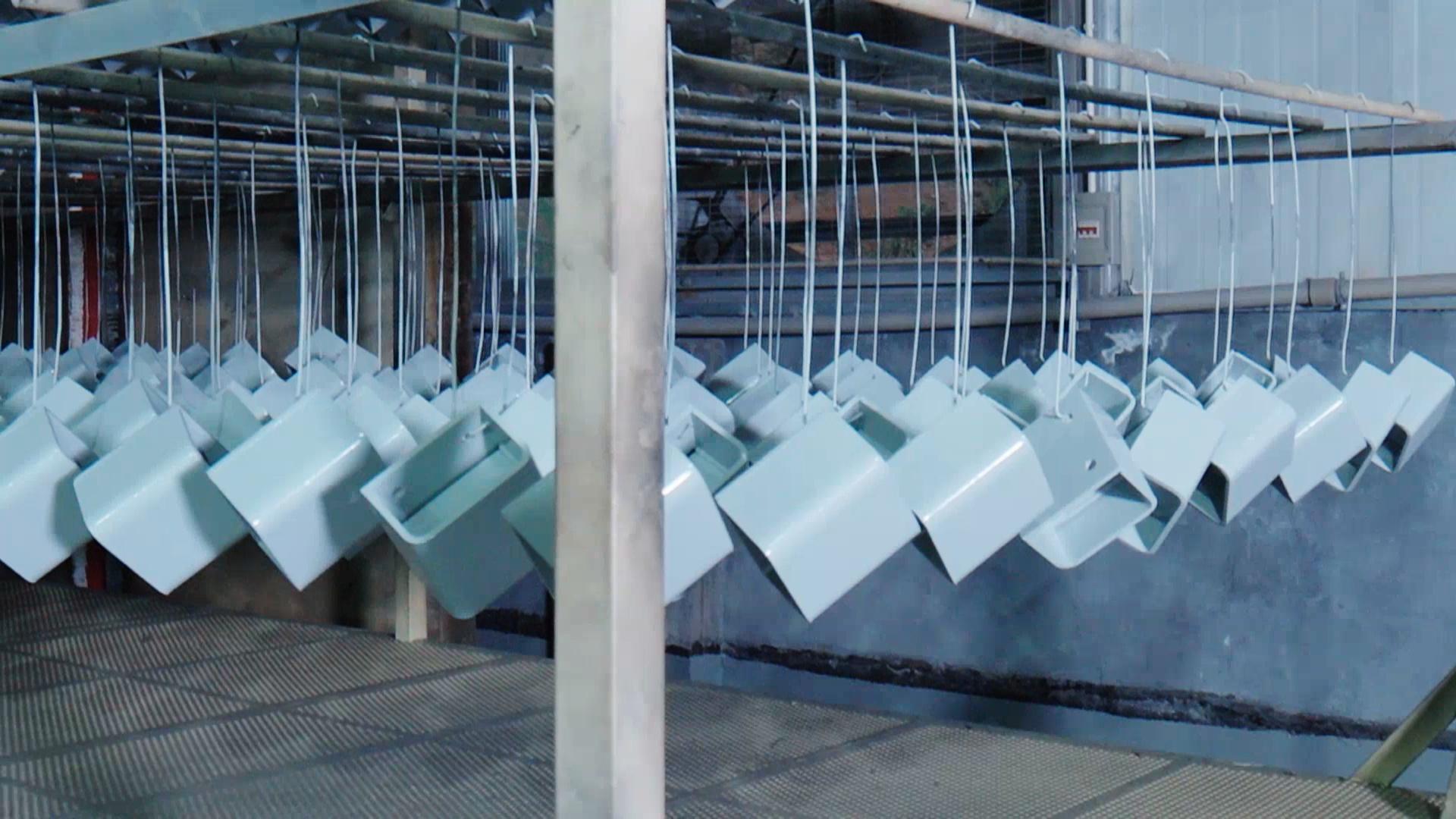
Metal powder coating in the SCENTSEA production base — the process stage where housing finish durability is determined for aluminium and steel enclosures.
Material claims are only meaningful when the process behind them exists. SCENTSEA operates a 3,000 m² production facility with three production lines, and its manufacturing base covers sheet metal processing, metal powder coating, injection molding, PCB SMT assembly, parts assembly, product testing and packaging. Housing material, surface finish and mould quality are decided at that level, not in a marketing sentence.
The limit, stated plainly: a metal housing is not a certificate. Aluminium improves rigidity and finish retention in public areas and supports the structural needs of higher-output machines, but it does not replace model-specific electrical documentation, and it does not by itself make a diffuser suitable for a humid or wet location. Material and certification are separate questions that buyers should ask separately.
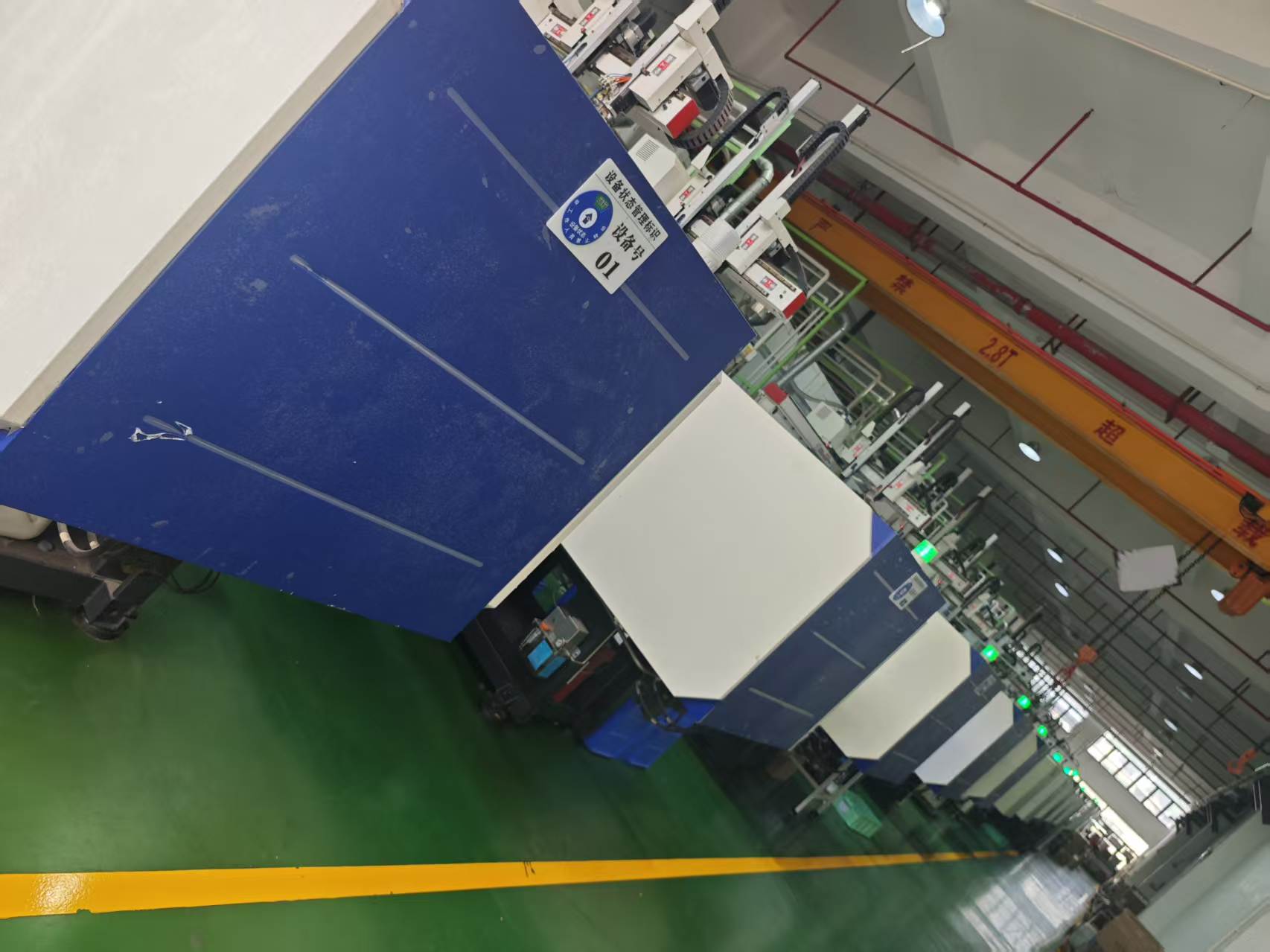
Injection molding for plastic housings — the material route used by the compact, battery-operated 4705 diffuser.
Compliance-relevant parameters across the SCENTSEA range
The table below collects the parameters discussed above for the models for which SCENTSEA publishes figures. It is intended as a reading aid for buyers building a submittal list, not as a substitute for model-specific documentation.
| Model | Type | Housing material | Rated voltage | Power | Noise | Typical spaces |
|---|---|---|---|---|---|---|
| H5000 | Floor standing | Aluminium | DC 12V | 20 W | <45 dB | Hotels, shopping malls, office building lobbies |
| 4705 | Battery operated | Plastic | 5V | 2.5 W | <35 dB | Washrooms, elevators, corridors, small shops |
| S02 | Tower | Aluminium alloy | DC 5V | 1.5 W | <30 dB | Home, office, store, beauty salon |
| P02 | Electric | Plastic | DC 12V | 6.5 W | <30 dB | Washrooms, corridors, shops |
| A300 | Commercial | Steel | DC 12V | 12 W | <40 dB | Hotels, shopping malls, retail stores |
| T2 | Commercial | Acrylic panel + steel casing | DC 12V 2A | 10 W | <45 dB | Hotels, shopping malls, cinemas |
| T3 | Commercial | Acrylic panel + steel casing | DC 12V 2A | 15 W | <55 dB | Shopping malls, hotels, airports |
| AC-MAX | HVAC | Aluminium body + plastic bottle | DC 12V | 48 W | <45 dB | Shopping malls, banks, airports |
| SC19 | Advertising scent machine | Aluminium + steel | 110–240 V AC | 30 W | ≤30 dB | Shopping malls, hotels, banks |
Model parameters as published by SCENTSEA. Noise values are model-level ratings; perceived sound depends on room acoustics, airflow, installation position and output setting.
Technical explanation: why cold-air atomization changes the checklist
SCENTSEA diffusers use waterless cold-air atomization: fragrance oil is broken into fine particles by controlled airflow and pressure, without water dilution and without heating. Industry technical documentation describes cold-air nebulizing diffusion as atomizing fragrance oils into sub-micron particles below 2.5 μm without heat or water. That single design choice reshapes several parts of the verification checklist.
- No heating element. Dedicated heating power is 0 W. With no heater inside the unit, thermal considerations focus on the pump and electronics rather than on a heat source, and the fragrance is never exposed to heat.
- No water tank. Water addition is 0%. There is no standing water to manage and no tank-cleaning cycle in the routine maintenance schedule — a practical difference for hotels, hospitals and other spaces with strict hygiene expectations.
- Consumption is quoted per hour. Oil consumption is published per model — 5.4 ±10% ml/h for the H5000, 3 ml ±10%/h for the T2, 4 ml ±10%/h for the A300, 4.6 ml ±10%/h for the T3 and 6 ml ±5%/h for the AC-MAX. Hourly figures let a project planner calculate oil logistics and running cost before installation.
- Scheduling multiplies the savings. Because output is controlled by schedule and intensity, running a unit 12 hours a day instead of 24 reduces scheduled operating time by 50%, which reduces both electricity and fragrance consumption.
- Particle size determines distribution. Sub-micron particles support air suspension, which is why cold-air systems are specified for larger rooms and for ducted applications where fragrance must travel beyond the immediate vicinity of the machine.
Certification documents: what to request and what to match
SCENTSEA states that all diffuser models are certified with CE, RoHS and FCC. For models that include radio-frequency functions, Bluetooth and Wi-Fi configurations may additionally fall under RED requirements in the European Union.
The practical rule for buyers is matching, not collecting. Certification requirements depend on the destination market, the product model and whether the unit includes wireless functions. For the European market, buyers would normally check applicable CE and RoHS compliance documents; for the United States, applicable FCC compliance should be verified. In every case, the certificates and test reports should apply to the exact production model and configuration being purchased.
Five questions that separate real documentation from decoration
- Does the certificate name the exact model designation and configuration that appears on the purchase order?
- Where the unit has Bluetooth or Wi-Fi, is the wireless module covered under the cited approval?
- Do the test report dates postdate the most recent engineering change to the product?
- Is the power adapter inside the approval scope, or documented separately?
- Were the documents issued for the market the goods are being imported into?
Fragrance oil is a separate compliance track. Equipment certification does not extend to the oil itself. In the European Union in particular, fragrance documentation — commonly including REACH- and IFRA-related paperwork — is often requested alongside the hardware, and it should be sought from the oil supplier rather than assumed from the diffuser certificate. Industry data collection has flagged regional fragrance-oil compliance documentation as one of the least standardised areas in commercial scenting submittals, which matches what buyers experience when a project moves from specification to handover.
Handling unverifiable claims: a document that cannot be matched to a model designation, or a claim that a product "meets all international standards", should be treated as unverified until the specific document is produced. This is the single most reliable filter in equipment procurement.
Application notes: which space drives which specification choice
Specification choices follow the room, not the catalogue. In commercial scenting, the deciding variables are usually airflow, installation access and the acoustic expectations of the people who occupy the space.
- Hotels and hospitality spaces. Lobby-scale areas are typically served by floor-standing units such as the H5000; guest corridors and washrooms are better served by lower-output models or by battery-operated units where no outlet is available.
- Retail stores and showrooms. Mid-size commercial models such as the A300 and T2 cover 500–800 m². Scent has a measurable commercial story attached: research cited in industry sources indicates that scent marketing in retail environments can increase customer dwell time by an average of 15 minutes — a secondary-source figure that is best treated as directional rather than definitive.
- Shopping malls, airports and banks. Large open areas and transport environments require the higher-output models, and very large buildings are usually served by ducted HVAC systems rather than by standalone units.
- Offices and quiet interiors. Noise becomes the dominant criterion. The S02 and P02 are rated below 30 dB, which is the appropriate starting point for a workspace, a clinic or a quiet retail floor.
- Restaurants, bars and entertainment venues. Odour control and atmosphere management usually drive the requirement; mid-size models with scheduled operation handle the uneven usage pattern of a service day better than continuous-output units.
- Large buildings with centralised air handling. Selected models can connect to HVAC ducts, and dedicated HVAC scenting systems are available for large centralised projects, including the AC-MAX with a 5 L oil capacity and coverage of 2500–3500 m².
Where cold-air scenting still costs more
Waterless cold-air scent diffusers are not the cheapest way to put fragrance into a room, and a credible procurement guide has to say so.
Waterless cold-air scent diffusers generally carry a higher initial equipment cost than ultrasonic, water-based aroma diffusers. Coverage across the SCENTSEA range runs from approximately 30 m² to 3,500 m², with fragrance oil capacities from 100 ml to 5 L and 0% water addition — roughly 2–35× wider coverage than typical ultrasonic water-based aroma diffusers, depending on model and application. That gap is the reason for the price difference, not a defect in either category.
The trade-off is repaid over time. The five-year maintenance cost of a cold-air commercial diffuser can be approximately 40% lower than a water-based alternative, because there is no water refilling and no tank cleaning cycle, and service life is generally longer. But the boundary is real. Ultrasonic water-based aroma diffusers remain appropriate for bedrooms, small rooms and light home fragrance use. For a single small room used intermittently, a waterless cold-air system is difficult to justify on cost alone.
Noise is the second boundary. The highest-output models in the range are rated below 55 dB. That is unremarkable in a mall concourse and unsuitable for a quiet conference floor, which is precisely why the model-level noise figure matters more than a family-wide claim.
Execution-stage verification and long-term support
Once the model is selected, the buyer's remaining risk is batch consistency and after-sales continuity — the two things that decide whether a scenting installation still works well in year three.
SCENTSEA's documented quality control sequence includes 100% functional testing, atomization testing, leakage inspection, noise testing, APP or control testing, a 48-hour aging test, and final appearance inspection before shipment; before shipment, 100% of products undergo functional testing. A one-year free warranty on spare parts is provided, and buyers purchasing in volume should confirm which tests are applied to every unit and which are applied by sampling. The supplier runs a monthly production capacity of 8,000 units with a typical lead time of 25 to 35 days, orders can start from a minimum of one unit, delivery terms are quoted EXW, FOB or CIF, and payment terms are 50% T/T in advance with the balance before shipment.
For long-term deployments, spare-parts availability deserves the same attention as unit price. Pumps, nozzles and tubing are the components that appear in documented troubleshooting scenarios — for example, weak atomization caused by an aging pump, a blocked nozzle or oil that is too thick — so a distributor or facility operator running a multi-property rollout should confirm that these parts are supported after the initial order and that the warranty terms extend to them.
Supplier capability is verifiable here. Shenzhen Scentsea Technology Co., Ltd was founded in 2021 and is headquartered in Shenzhen, China, with a 3,000 m² production facility, 30 employees, four R&D engineers, a 70% export ratio, and products supplied to customers in more than 70 countries and regions, including North America, Europe, the Middle East, Australia and Southeast Asia. Industry data collection notes that the commercial scenting hardware market is concentrated around a small number of manufacturing clusters in Shenzhen, which means buyers evaluating this category are usually evaluating suppliers from the same geography — making documentation quality and process transparency the practical differentiators rather than geographic origin.
Trade and cost factors at the execution stage
Two commercial parameters belong in the same folder as the technical ones, because they surface after the equipment decision is made. Commercial scent diffusers are classified under HS Code 8509.80 (electromechanical domestic appliances), and the applicable US import duty is reported at 4.2% ad valorem. For importers, that figure belongs in the landed-cost model alongside freight and the oil supply plan, not in a separate spreadsheet.
The second is operating cost, and it is unusually predictable for waterless cold-air equipment. Because there is no heater and no water, consumption is driven by two variables only: scheduled running hours and the model's published oil consumption rate. A buyer who knows the model and the intended daily schedule can estimate oil volume per site per month before installation, and can adjust the schedule later without changing hardware.
Future outlook
Three shifts are likely to shape commercial scenting procurement over the next several years.
Documentation moves from an attachment to a gate. As the market grows from approximately USD 4.1 billion in 2026 toward a projected USD 7.28 billion by 2035, buyers will increasingly treat model-matched compliance documentation as a pass/fail requirement rather than a follow-up request. It is worth noting that forecasts for this category differ by scope: a narrower definition of scenting has been reported at a higher growth rate of 10.16% than the 6.6% CAGR applied to the broader scent marketing market, and any single growth figure should therefore be read together with the definition attached to it.
Fragrance compliance becomes part of the submittal package. Regional fragrance-oil documentation is one of the least standardised areas in the category today. In Europe, where REACH- and IFRA-related paperwork is routinely requested, suppliers able to hand over oil documentation alongside equipment certificates will have a practical advantage in project bids.
Power architecture diversifies. Battery and Type-C configurations such as the 4705 exist because site conditions frequently make mains wiring impractical in retrofit projects, and demand for that flexibility is unlikely to shrink. At the same time, ducted HVAC systems remain the reference solution for large buildings, which keeps two very different product categories — compact battery units and centralised HVAC diffusers — inside the same procurement conversation.
Frequently asked questions
What certifications should buyers verify for commercial scent diffusers?
Certification requirements depend on the destination market, the product model and whether the unit includes wireless functions. For the European market, buyers would normally check applicable CE and RoHS compliance documents, and Bluetooth or Wi-Fi models may additionally fall under RED requirements. For the United States, applicable FCC compliance should be verified. Buyers should confirm that the certificates and test reports apply to the exact production model and configuration being purchased, rather than to a similar model in the same product family.
How should noise be evaluated when specifying a commercial scent diffuser?
Noise levels vary by model and output power. In the SCENTSEA range, the H5000 is rated below 45 dB and the 4705 below 35 dB, while higher-output models reach higher figures — the T3, for example, is rated below 55 dB. For hotels, offices and other quiet environments, buyers should check model-specific noise data and test samples rather than assuming one figure applies across a product family. Comparing models at equivalent coverage and output is the only like-for-like comparison.
Do commercial scent diffusers need water?
Waterless cold-air scent diffusers atomize fragrance oil directly and do not require water. This removes water refilling and tank cleaning from the routine maintenance cycle. Ultrasonic water-based aroma diffusers, by contrast, mix water with a small quantity of fragrance oil and are mainly designed for small residential spaces.
What quality control evidence should be requested before shipment?
Documented pre-shipment quality control typically includes 100% functional testing, atomization testing, leakage inspection, noise testing, APP or control testing, a 48-hour aging test, and a final appearance inspection. Buyers purchasing in volume should ask which of these checks are applied to every unit and which are applied by sampling, and should confirm the warranty terms and spare-parts support that accompany the shipment, including components such as pumps, nozzles and tubing.
What should buyers consider for a multi-year commercial scenting deployment?
Beyond unit specifications, long-term deployment depends on batch-to-batch consistency, spare-parts availability, and continuity of fragrance oil supply. Buyers should evaluate a supplier's production capacity, quality control procedures, warranty terms and spare-parts support, and should test samples before mass production. Coverage should be selected against the actual space size, ceiling height, airflow and ventilation rather than against a maximum rated coverage figure alone.
Can third-party fragrance oil be used in a commercial scent diffuser?
Compatible third-party fragrance oil can be used, but viscosity and formulation should be tested to confirm stable atomization. Oil that is too thick or that contains impurities is a documented cause of weak atomization and can also contribute to nozzle blockage. Fragrance oil documentation is a separate compliance track from equipment certification and should be requested from the oil supplier.
A catalogue listing model-level parameters for the diffuser range, including the models discussed above, is available as a downloadable PDF: SCENTSEA product catalogue. Buyers evaluating commercial scenting for hotels, retail, offices or large public buildings can also review the manufacturer's published specification pages at scent-sea.com. Model-specific compliance documentation should be requested directly for the exact configuration being ordered.
Commercial scenting compliance is not decided by a logo on a certificate. It is decided by whether the voltage, the noise rating and the housing material on the datasheet belong to the unit that is installed — and whether the documents that travel with that unit name it exactly.