
Commercial Scenting: Systems, Applications and Market Outlook
Commercial scenting is the deliberate use of fragrance in public and business environments to improve atmosphere, support brand recognition and address odor control. Buyers evaluating commercial scenting solutions must understand the technology differences between equipment types, the way venue conditions influence performance, and the measurable market direction behind the category.
Commercial scenting has moved beyond hotel lobbies and spa reception areas. It is now specified by retail chains, shopping mall operators, airports, banks, office landlords and restaurant groups that treat scent as part of the physical brand experience. For buyers new to the category, the wider technology landscape can be difficult to interpret: equipment is sold under labels such as scent diffusers, commercial scent machines, HVAC scenting systems and scent marketing solutions, with coverage claims ranging from small rooms to thousands of square meters.
This article explains what commercial scenting is, why businesses invest in it, how different diffuser systems work, how equipment should be matched to different venue types, and what procurement considerations matter when evaluating suppliers. The analysis focuses on the manufacturer SCENTSEA (Shenzhen Scentsea Technology Co., Ltd) as an example of a hardware and fragrance oil supplier serving the export market.
Why Commercial Scenting Has Become a Brand Investment
Odor control used to be the main reason businesses installed air freshening devices. Commercial scenting serves a broader function. It is designed to create a consistent, recognizable scent profile that guests and customers associate with a specific venue or brand. For a hotel, a signature scent can be part of the arrival experience. For a retailer, the goal is often a pleasant shopping atmosphere and a subtle emotional cue rather than a strong perfume effect.
Market research supports continued category growth. The global scent marketing market was valued at approximately USD 4.1 billion in 2026, with forecasts projecting around USD 7.28 billion by 2035 at a compound annual growth rate of 6.6% (Cognitive Market Research, 2026). It should be noted that different research firms define the market differently: one narrower analysis focused specifically on commercial “scenting” reports a higher CAGR of approximately 10.16%. Buyers should therefore compare like-for-like definitions when using market figures for business planning.
Industry statistic roundups also frequently cite average customer dwell-time increases in scented retail environments — commonly reported around 15 minutes in compiled industry sources. However, actual results depend on store size, airflow, scent intensity, product category and local customer tolerance. Scenting is best understood as an atmospheric tool that supports longer visits and stronger brand recall, not as a standalone sales driver.
What Is Commercial Scenting?
Commercial scenting refers to the equipment, fragrance oils and installation strategies used to deliver a controlled scent experience across a business environment. In practice, it involves three components:
- Fragrance oil — the liquid scent source, typically a waterless oil formulation.
- Diffusion hardware — the device that atomizes the oil and distributes it into the air.
- Control and management — scheduling, intensity adjustment and remote operation tools, often via smartphone applications.
Shenzhen Scentsea Technology Co., Ltd (SCENTSEA), established in 2021, is a manufacturer that supplies both hardware and fragrance oil under this model. The company operates from Shenzhen, China, and describes itself as a one-stop supplier for home, commercial and HVAC aroma solutions. Its product family includes wall plug-in diffusers, battery-operated units, floor-standing machines and HVAC scent systems. Around 70% of its output is exported, mainly to the European Union and the United States.
For buyers, this type of integrated supply structure matters because scent consistency depends on the pairing of diffuser technology and oil formulation. A hardware-focused procurement strategy may work well for simple standalone units, but large commercial scenting projects usually require coordination between equipment coverage, oil output rates and maintenance planning.
Core Technology: Waterless Cold-Air Atomization
The dominant professional method in commercial scenting is waterless cold-air atomization. Unlike heat-based or water-based systems, a cold-air atomization diffuser uses controlled airflow and pressure to break fragrance oil directly into fine particles without adding water or applying heat. This is why commercial devices are often described as waterless scent diffusers.
Industry technical documentation describes cold-air nebulizing technology as capable of atomizing fragrance oils into particles smaller than 2.5 micrometers (SCENTA, 2026). The advantage for commercial spaces is efficient suspension in air, allowing the fragrance to travel through a lobby, retail floor or HVAC duct system without the dilution effect caused by water mixing or the scent degradation that can occur with heated evaporation.
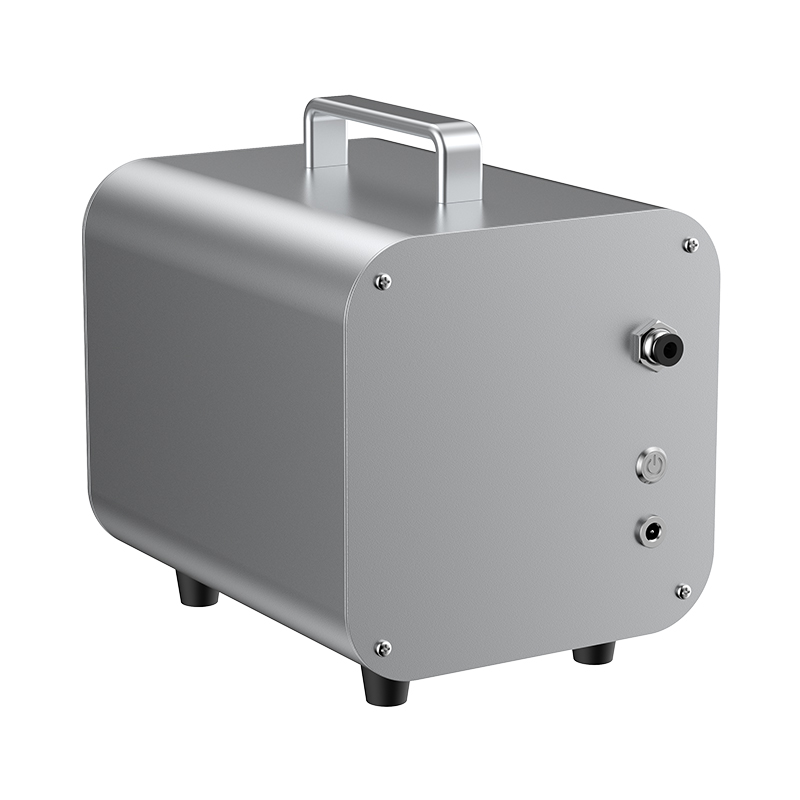
SCENTSEA’s commercial product line uses this waterless cold-air diffusion method across multiple models. For example, the T2 model is a commercial scent diffuser that operates with a steel casing and acrylic panel, delivers consistent atomization by a built-in air pump system, and is rated for hotel, shopping mall and cinema use. The T3 model is positioned for larger commercial spaces of roughly 1,000–1,600 square meters and is intended for shopping malls, hotels and airports. Both models support smart APP control for scheduling and scent intensity adjustment.
Commercial Scenting System Types and Equipment Architecture
Not every commercial space needs the same hardware architecture. The main variable is the relationship between the diffuser and the building’s air movement. Equipment can be divided into five practical categories:
1. Compact plug-in and battery-operated diffusers
These are small, wall-mountable devices for washrooms, elevators, corridors, small shops and other contained areas. SCENTSEA’s P01, P02 and P03 models belong to this category. P01 and P03 are battery-operated units with Type-C power options, making them practical where electrical outlets are inconvenient. P02 is a plug-in model with a 300 ml oil capacity, designed for 150–350 square meters, and supports Bluetooth APP control. These units do not replace large-area scenting; they create controlled scent zones where HVAC integration is impractical.
2. Medium-output standalone commercial diffusers
The A300 and T2 models represent this tier. The A300 has a steel body, a 500 ml oil capacity and coverage of 500–800 square meters, with a TFT color touch screen and smart APP control. The T2 has similar coverage, a 500 ml capacity, and is suited to hotels, shopping malls and cinemas. Both can operate standalone or with HVAC duct connections, offering installation flexibility for retail stores, hotel lobbies, offices and showrooms.
3. High-output standalone diffusers for large open spaces
Larger standalone machines are specified for lobbies, atrium areas, event venues and open-plan commercial floors. SCENTSEA’s H5000 is a floor standing aluminum diffuser covering 800–1,300 square meters with a 1,000 ml oil capacity, suitable for hotel lobbies, shopping mall common areas and office building lobbies. The T3, with a 1,000 ml reservoir and 1,000–1,600 square meter coverage, can serve similar environments where higher output is required.
4. HVAC-integrated scenting systems
For large buildings with centralized air handling, HVAC scenting systems connect directly to the duct network and distribute fragrance through existing airflow. The SCENTSEA AC-MAX is a dedicated HVAC scent diffuser with a split-type structure: the control unit and a 5-liter oil tank are separated for easier installation. Its coverage range is approximately 2,500–3,500 square meters, positioning it for shopping malls, banks, airports and commercial complexes. The AC-MAX includes Wi-Fi and Bluetooth control, scheduling functions and optional airflow-sensor synchronization so the scenting system can run in step with HVAC operation.
5. Multi-function digital advertising scent machines
SCENTSEA’s SC19 is an example of a converging device category: it combines an 18.5-inch digital advertising screen with a scent diffusion unit. With a coverage range of 150–250 square meters and a 500 ml oil capacity, it is intended for high-traffic commercial settings such as shopping malls, banks, hotel lobbies and retail stores. This system type suits environments where businesses want to combine visual promotions with a dedicated brand scent in a single footprint.
| System category | Representative models | Typical coverage | Best suited to |
|---|---|---|---|
| Compact / battery / plug-in diffusers | P01, P02, P03 | 100–350 m² | Elevators, washrooms, corridors, small retail outlets |
| Medium commercial diffusers | A300, T2 | 500–800 m² | Hotel lobbies, retail stores, showrooms, offices |
| Large-area standalone diffusers | H5000, T3 | 800–1,600 m² | Hotel lobbies, shopping malls, airports, event venues |
| HVAC-integrated scenting systems | AC-MAX | 2,500–3,500 m² | Large buildings, malls, airports, banks, commercial complexes |
| Advertising + scent hybrid | SC19 | 150–250 m² | Malls, banks, hotels, retail promotions |
Commercial Scenting by Venue Type
Different venue types create different scenting problems. The location of the diffuser, the oil release rate, the noise level and the maintenance schedule must all be adjusted to expected traffic and air movement. Below is a venue-by-venue interpretation of how commercial scenting is typically approached.
Commercial Scenting for Hotels
Hotels usually need separate scent plans for the entrance lobby, corridors, meeting rooms, guest floors and upper executive areas. A lobby with high ceiling and open airflow often benefits from a floor-standing unit such as the H5000 or a wall-mounted commercial diffuser such as the T2 or A300. Quiet operation is important. The T2’s noise level is below 45 dB, while the A300 is rated below 40 dB, allowing placement near reception and lounge areas. Corridors and back-of-house zones may be better served by compact diffusers such as the P02 or battery-operated P03 where wiring is difficult.
Commercial Scenting for Retail Stores
Retail environments tend to have moderate ceiling height but high customer turnover. Fragrance needs to be noticeable enough to affect atmosphere without creating a heavy perfume wall. Medium commercial diffusers such as the A300 or T2, with coverage of 500–800 square meters, suit mid-size stores. For smaller flagship shops or changing areas, the P02 with 150–350 square meters of coverage and silent operation below 30 dB can create a more localized scent envelope. Retailers planning multi-store rollouts should standardize on a single diffuser platform so scent intensity can be synchronized across locations.
Commercial Scenting for Shopping Malls
Shopping malls are structurally difficult to scent because they contain large atrium volumes, mixed tenant operations and continuous HVAC movement. A single standalone diffuser is rarely enough. Malls typically need distributed standalone units across corridors and public zones — such as the T3 for large concourses — combined with HVAC-integrated systems like the AC-MAX for central air handling. The AC-MAX’s 5-liter oil capacity reduces the frequency of refilling in large installations. Where mall operators want to monetize the scenting hardware, hybrid advertising scent machines such as the SC19 can serve as digital signage while delivering fragrance.
Commercial Scenting for Offices
Office scenting is usually subtle, focused on reception areas, meeting rooms, washrooms and corridors rather than open-plan workstations. Compact plug-in units such as the P02 can maintain a light scent in restrooms and corridors without distracting staff. For corporate headquarters with a double-height lobby, the H5000 provides an elegant floor-standing option that does not require wall modification. Noise is a major selection factor in office environments. Diffusers rated below 40 dB are typically preferred for quiet areas.
Commercial Scenting for Banks
Banks value discretion and a professional, welcoming atmosphere. Scenting is often used in branch lobbies, waiting areas and ATM or self-service zones. The A300’s steel body and 500–800 square meter coverage make it appropriate for bank branches, while the SC19 can be used in flagship locations where digital communications are displayed simultaneously. The AC-MAX is more relevant for head-office buildings and central branch networks where scent must be delivered through the building HVAC system.
Commercial Scenting for Airports
Airports require robust equipment with high oil capacity and low maintenance frequency. The dominant approach is HVAC-integrated scenting because terminal spaces are highly dependent on centralized air handling. The AC-MAX, with coverage of 2,500–3,500 square meters, split-type design and optional airflow-sensor synchronization, is designed for this scale. Sensitive areas such as premium lounges can add T3 standalone units for stronger scent presence. Certifications and air-safety compliance become more important in airport tenders.
Commercial Scenting for Restaurants
Restaurants have particular needs because the brand environment competes with cooking odors and because humidity levels in dining areas can be high. Waterless cold-air diffusion avoids the added humidity that water-based systems produce. Medium units such as the T2 or A300 can scent a dining room while the kitchen and washrooms use compact P03 or P02 diffusers for targeted odor control. Scent protocols should normally avoid interfering with food aromas in the dining area.
Commercial Scenting for Large Spaces and Brand Environments
For large public buildings, dealerships, flagship stores and brand experience centers, the term “commercial scent branding” is often used. These projects tend to require custom scent selection, calibrated diffusion rates and ongoing oil supply. SCENTSEA supports this through OEM/ODM services that include logo, color and packaging customization; for fragrance oil, the company can assist with scent selection, bottle labeling and private-label packaging, allowing a brand to create its own proprietary scent line.
What to Evaluate in a Commercial Scenting Manufacturer
Because commercial scenting involves continuous operation hardware, ongoing fragrance oil refills and multi-site installation, supplier evaluation should cover more than unit price. Buyers typically assess production capability, quality control, certifications, engineering responsiveness and after-sales support.
Shenzhen Scentsea Technology Co., Ltd was founded in 2021 and is based in Shenzhen, China. The company reports:
- A 3,000-square-meter production facility with 3 production lines;
- Approximately 30 employees and 4 R&D engineers;
- 20 patents;
- Annual production capacity of roughly 100,000 units;
- CE, RoHS and FCC certification across all diffuser models;
- Pre-shipment checks including functional testing, aging tests and leakage inspection;
- Diffuser MOQ from 1 piece for sample verification;
- Export supply to more than 70 countries, principally North America and Europe.
Quality control and failure risk
Commercial scent diffusers operate for long hours, so component quality matters. Common risks in poorly-tested equipment include unstable atomization, oil leakage, excessive noise, unreliable APP control and inconsistent performance between batches. Buyers should look for evidence of functional inspection, atomization testing, leakage checks and aging tests before mass production. They should also request sample validation rather than relying only on datasheets.
Certifications
The required certifications for commercial scent diffusers depend on destination market and product configuration. For the European market, CE and RoHS compliance documents are normally expected, while models with Bluetooth or Wi-Fi may also require compliance with RED. For the US market, FCC compliance should be verified. Buyers should confirm that the certificates and test reports apply to the exact production model being ordered, not merely to a similar product.
OEM/ODM flexibility
The commercial scenting market has a strong private-label segment. Importers and distributors often want their own branding on the hardware and fragrance oil bottles. SCENTSEA supports logo customization, color options, exclusive mold development, app interface customization, user manual customization and private-label packaging. For fragrance oils, it also supports bottle labeling and private packaging, which helps downstream customers build a proprietary scent brand rather than reselling an unbranded commodity product.
Commercial Scenting vs Traditional Air Care Alternatives
Buyers considering commercial scenting for the first time often ask how it compares to simpler alternatives such as plug-in air fresheners, manual sprays, heat-based fragrance devices or ultrasonic water-based aroma diffusers. The comparison is not only about cost; it is about consistency, coverage, maintenance and brand outcome.
| Approach | Typical coverage | Consistency | Key limitations |
|---|---|---|---|
| Manual sprays / aerosol fresheners | Very small | Low | Short-lived; requires frequent staff intervention; does not create a consistent brand scent experience. |
| Heat-based plug-in fragrance devices | Small room | Medium | Scent profile may change with heating; generally limited to small spaces. |
| Ultrasonic water-based aroma diffusers | Small room | Low–Medium | Requires water refilling; dilutes fragrance; needs frequent cleaning; not practical for large commercial areas. |
| Standalone waterless cold-air commercial diffusers | Tens to ~1,600 m² depending on model | High | Requires proper model selection, regular oil refills and occasional nozzle/pump maintenance. |
| HVAC-integrated commercial scenting systems | 2,500–3,500 m² and above | High | Requires access to ductwork for installation; needs oil formulation compatible with air-handling conditions. |
The professional advantage of waterless cold-air systems is consistent oil delivery without water dilution. However, they are not a “set and forget” technology. Diffusion hardware needs routine checks — oil levels, nozzle blockage, tubing condition and pump function. It is also important to use compatible fragrance oil. Users can sometimes run third-party oil, but if it is too thick or contains impurities, atomization performance may become unstable. Buyers should confirm oil viscosity and formulation during sample testing.
Another boundary condition applies to HVAC scenting: because the diffuser is connected into a building’s air network, the effect is dependent on HVAC fan schedules, duct condition and filter cycling. The AC-MAX addresses this with an optional airflow sensor that can synchronize scenting with HVAC operation. Without that synchronization, scent delivery may not match the actual periods of air movement.
Market Trends Reshaping Commercial Scenting
Several structural trends are shaping how commercial scenting solutions are purchased:
From odor elimination to brand signature. Businesses increasingly treat scent as an identity asset rather than as a hygiene product. This has increased demand for custom scent selection, private-label fragrance oil packaging and repeatable multi-site installation. It also shifts the purchasing decision from a one-time hardware purchase to an ongoing supply relationship.
From standalone units to building-integrated systems. Airports, malls and large offices prefer solutions that can be integrated with the building management framework. HVAC-integrated diffusers with larger oil reservoirs, airflow sensors and centralized control are becoming more common in project tenders.
From manual control to intelligent management. Wi-Fi, Bluetooth and APP-enabled controls now allow facility teams to schedule scent intensity by time of day, zone or operational activity. SCENTSEA’s AromaOS app, which supports scheduling and intensity adjustment across supported models, is one example of this approach for distributors managing multiple customer sites.
From generic import to OEM/ODM partnerships. Downstream buyers in the US, Europe and Australia often do not want to sell an unbranded Chinese device. They prefer exclusive design, branded packaging and customized app interfaces. This creates room for manufacturers that can deliver complete private-label programs instead of only white-box hardware.
Future Outlook
The commercial scenting category is likely to continue converging with smart building systems. Hardware will become quieter, more energy-efficient and easier to maintain. Oil reservoirs will grow where buildings demand lower refill frequency. Software control will become more important than hardware differentiation, especially for distributors managing hundreds of installations across multiple countries.
At the same time, buyers will need stronger supply-chain diligence. The category depends heavily on hardware production clusters in Shenzhen and the availability of certified, well-tested equipment. Direct relationships with manufacturers such as SCENTSEA — rather than trading through multiple intermediaries — give importers better access to quality control, OEM design, documentation and spare-parts support.
Frequently Asked Questions
A commercial scent diffuser is a device designed to distribute fragrance consistently in business environments such as hotels, retail stores, offices, shopping malls and other public venues. Waterless commercial diffusers atomize fragrance oil directly into airborne particles, allowing controlled scenting across large spaces.
Waterless cold-air scent diffusers atomize fragrance oil directly and do not require water. This distinguishes them from ultrasonic water-based aroma diffusers, which mix oil with water and are generally better suited to small residential spaces. Waterless systems are more practical for commercial environments because they avoid water refilling, dilution and frequent tank cleaning.
Buyers should consider actual room size, ceiling height, ventilation, airflow and partitions rather than relying only on the maximum rated coverage printed in the datasheet. A space with open architecture and high ceilings may require more output than a partitioned space of the same square-meter area. For large centralized buildings, HVAC-integrated scenting is usually preferred.
Compatible third-party fragrance oil can generally be used, but the oil’s viscosity and formulation should be tested to ensure stable atomization. Oil that is too thick or contains impurities can cause weak atomization, nozzle blockage or tubing problems. Many manufacturers recommend using their own validated oil formulas to maintain consistent performance.
Yes. Selected standalone models can connect to HVAC ducts, and dedicated HVAC scenting systems are available for large centralized projects. A dedicated HVAC diffuser such as the SCENTSEA AC-MAX is designed to deliver fragrance through the building’s existing air distribution network, with large oil capacity and optional airflow-sensor synchronization.
Noise levels vary by model and output power. Compact models such as the P02 can operate below 30 dB, while more powerful standalone units may range from roughly 40 dB to 55 dB. For hotels, offices and other quiet environments, buyers should examine model-specific noise data and test physical samples before installation.
Certification requirements depend on the destination market, product model and wireless functions. For Europe, applicable CE and RoHS documents should normally be provided; Bluetooth or Wi-Fi models may also require RED compliance. For the United States, applicable FCC compliance should be verified. Buyers must confirm that certificates and test reports match the exact model and configuration being purchased.
Common problems include failure to start, no atomization, abnormal noise and weak atomization. Most issues can be traced to incorrect power supply, incorrect working-hour settings, loose pump connections, blocked nozzles, detached or damaged tubing, aging pumps, internal loose parts, or fragrance oil that is too thick or contains impurities. Most faults can be identified by checking these areas before replacing components.
Maintenance frequency depends on daily usage and fragrance oil type. Regular oil-level checks and atomizer cleaning help maintain stable performance. Commercial operators usually schedule monthly checks for oil refills and quick nozzle inspection, with deeper cleaning or component checks on a quarterly basis depending on the environment.
Depending on the model and quantity, customization can include logo, color, packaging, user manual, plug type, APP interface and selected product functions. For fragrance oil, private-label packaging, bottle labeling and custom scent selection are also possible. Buyers should discuss quantity requirements early because some customization options involve exclusive mold development or minimum order conditions.
For buyers evaluating commercial scenting equipment, SCENTSEA publishes an open product catalog covering its diffuser models, fragrance oil options and technical specifications: SCENTSEA Catalog (PDF). Supplier directory: www.scent-sea.com.
Have Questions or Need More Details?
Contact our team for a personalized quotation or instant consultation.
Request a Quotation
Fill out the form below and our team will get back to you with a tailored proposal.
WhatsApp Direct Chat
Prefer to chat in real-time? Message us on WhatsApp for instant assistance & quick answers.
- Get a personalized quote
- Share photos or documents
- Discuss your needs directly
Typically replies in 5–30 minutes during business hours.