
Commercial Tile Solutions: 60x120cm Marble vs Travertine
Commercial Tile Solutions: 60x120cm Marble vs Travertine
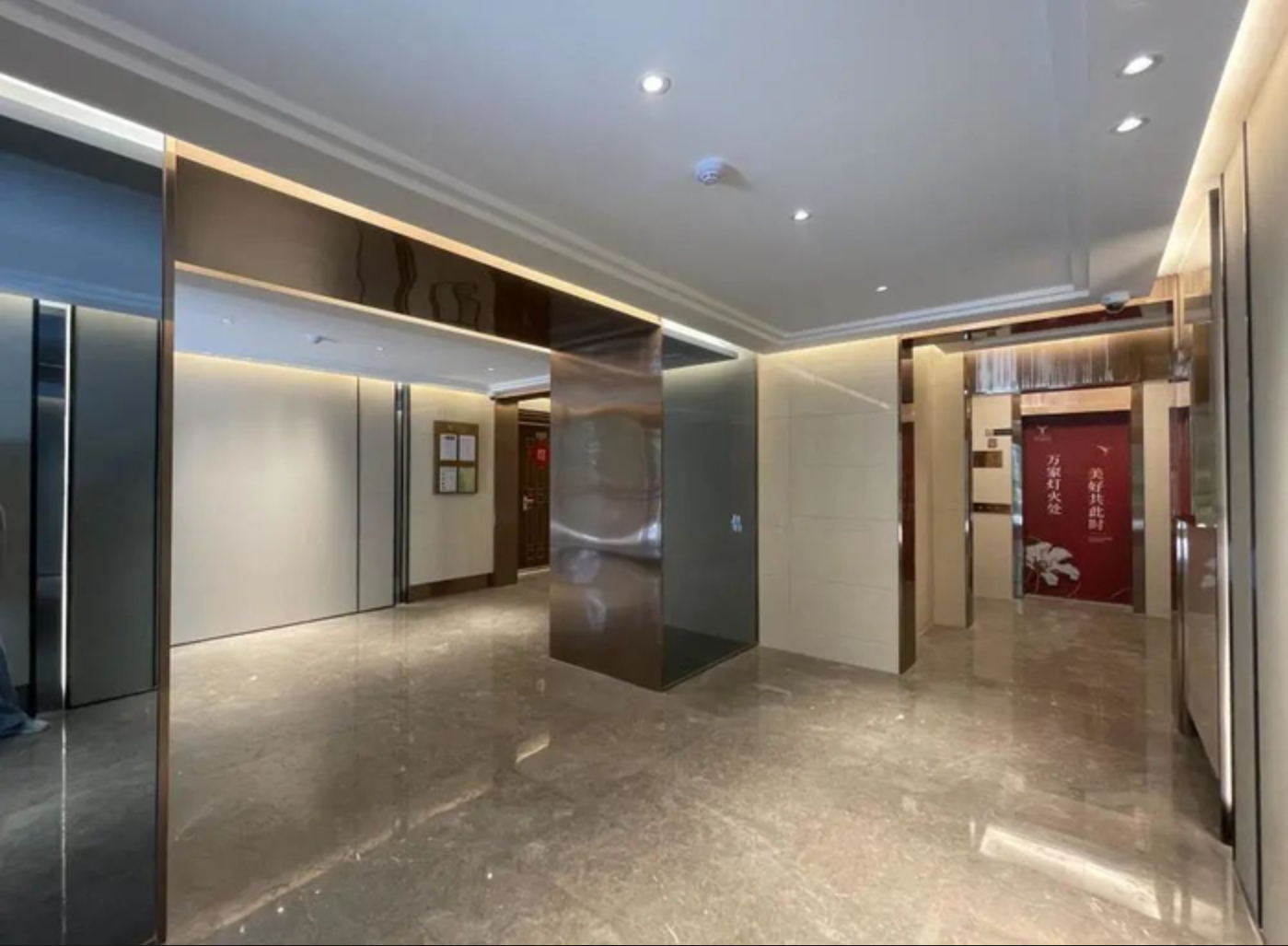
Commercial tile procurement is constrained less by the availability of large-format porcelain than by the quality of the documentation attached to it. A specifier comparing two series from the same manufacturer usually arrives at a simple question: when the technical numbers are identical, what actually separates the products — and which parts of the specification still need to be confirmed before a purchase order is issued?
This article addresses that question for two 60x120cm porcelain tiles in the All-King Ceramics Commercial Tile Solutions range: the Marble Series and Travertine. Both are published on the same technical platform. The differences that matter to a buyer sit in surface specification, SKU-level confirmation and certificate scope — three areas where commercial projects most often discover a gap late.
ZIBO ALL-KING CERAMICS CO., LTD (brand: All-King Ceramics) is a porcelain tile manufacturer and direct exporter based in Zibo, Shandong, China. Founded in 2011, the company operates a 60,000 m² facility with 320 employees and a 25-engineer technical team, reports annual output of 12–16 million m², and exports roughly 70% of production to markets that include Australia, New Zealand, Russia, Belarus, South Korea, Vietnam, Malaysia, the Philippines, Central Asia, the Middle East and Latin America.
The comparison below uses only published product specifications, certificate data and application data for these two series. Where a common commercial requirement is not evidenced in the available documentation, this article says so rather than assuming compliance.
The shared specification platform
Both series are listed with identical published parameters. That is the starting point of any honest comparison, and it removes core performance from the list of deciding factors.
| Parameter | Published value (both series) | What it constrains |
|---|---|---|
| Format | 60x120 cm | Cutting plan, substrate flatness, weight planning |
| Body material | Porcelain clay, vitrified structure | Moisture behaviour, stain resistance, frost suitability preconditions |
| Water absorption | Below 0.5% | Porcelain classification threshold; wet-area behaviour |
| Thickness | 9.0–10.5 mm | Weight per m², lippage risk, substrate tolerance |
| Abrasion resistance | PEI 4 / PEI 5 | Traffic intensity the surface is rated for |
| Mohs hardness | 6–7 | Scratch resistance against abrasive grit and furniture movement |
| Modulus of rupture | ≥35 MPa | Bending strength of the fired body |
| Breaking strength | ≥1300 N | Point-load and handling resilience |
| Packing | 2 pcs per box = 1.44 m² per box | Order quantity conversion, pallet planning |
| Certification | ISO 9001:2015 (XQCC 0350521Q30166R1M); CE (TUV AC 50163816 0001, EEC standard) | Management system and EU internal-flooring declaration |
The 1.44 m² per box figure follows from the format: a 60x120cm tile covers 0.72 m², and two pieces per box give 1.44 m².
Reading the shared numbers as a buyer
Water absorption below 0.5%
ISO 13006 and ANSI A137.1 define porcelain as ceramic tile with water absorption of 0.5% or less, and both series sit inside that definition. In practice a vitrified body limits moisture penetration, which supports stain resistance and dimensional stability in wet conditions. Low absorption is also a precondition for frost resistance — but a precondition is not proof. Frost resistance is a separate test result and should be requested for the specific SKU rather than inferred from the absorption figure.
Modulus of rupture ≥35 MPa and breaking strength ≥1300 N
These are minimum declared values, not measured maxima. Modulus of rupture describes the bending strength of the fired body; breaking strength describes the load at which a test piece fails. On a commercial floor both matter for point loads, rolling traffic and handling losses. Neither value is a structural design calculation for a given substrate, so projects with racking, vehicles or unusually heavy point loads should treat ≥1300 N as a floor rather than a ceiling and ask for project-specific verification.
Mohs hardness 6–7
Mohs hardness describes resistance to scratching by mineral grit; it does not describe slip resistance or impact resistance. For retail concourses and entrance zones, where sand and grit are tracked in continuously, this is a relevant but partial indicator — appearance retention also depends on the abrasion class and on the cleaning regime.
PEI 4 / PEI 5
The abrasion resistance is published as a band rather than a single class. PEI 4 and PEI 5 correspond to different traffic intensities, and because the specification states a range, the buyer should confirm which class applies to the ordered SKU and request the test reference behind it. For shopping mall circulation and transit terminals, confirm the higher class; for hotel guestrooms and office interiors, the lower class may be acceptable.
Thickness 9.0–10.5 mm
This is a 1.5 mm spread inside one published range. Thickness affects weight per square metre, substrate tolerance and lippage risk on large format, so the nominal value should be fixed per SKU before ordering — and a multi-phase project should confirm that one shipment does not mix thicknesses across phases.
Where the two series genuinely diverge
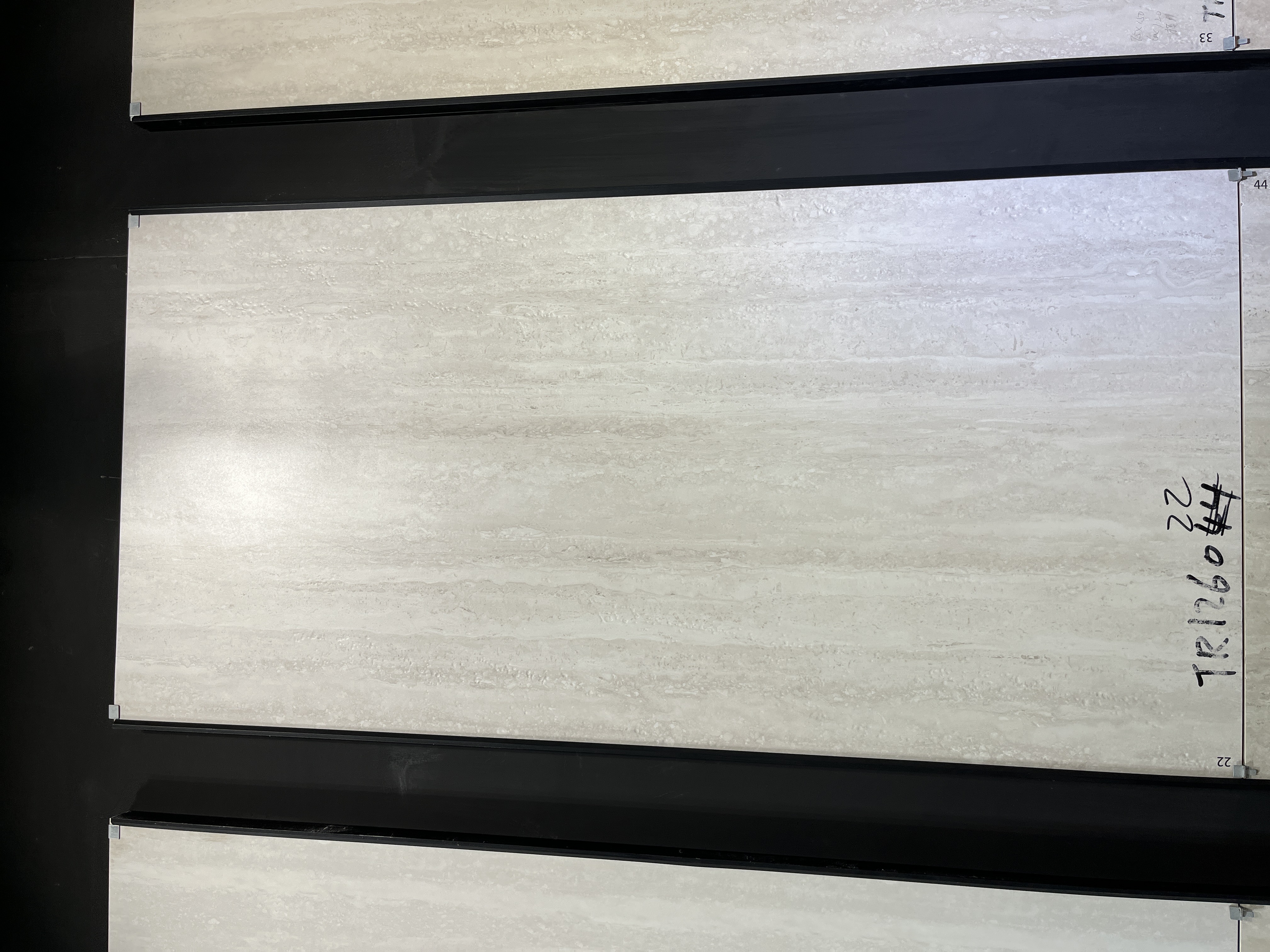
With performance equalised, what remains is surface language and design intent. Neither series name is a performance grade: Marble Series and Travertine do not by themselves indicate an abrasion class, a slip rating or a certificate scope. A buyer who selects on appearance alone has not yet made a specification decision.
Marble Series
Marble Series is a marble-effect porcelain, positioned for interiors where the floor is part of the design statement — hotel lobbies, corporate reception areas, high-end residential living spaces. Because the visual character is the product, batch variation matters: buyers should review a physical sample set from the production batch and confirm how much vein variation the design brief allows.

Travertine
Travertine is a travertine-effect porcelain, reproducing the banded appearance of travertine stone in a vitrified body that typically does not require the sealing regime associated with the natural material. It suits hospitality interiors, retail and wellness areas, and residential projects that want texture rather than high polish.
Certification coverage and its boundaries
Two certificates are published for these products. They do different jobs, and conflating them is the most common documentation error in commercial tile procurement.
ISO 9001:2015 — XQCC certificate 0350521Q30166R1M
The scope covers the production and service of ceramic tile (except as required by 3C), for global markets. This is a quality management system certification: it indicates a documented production and service process. It does not certify the performance of an individual tile, so buyers who need product performance evidence must ask for test reports rather than accept the ISO certificate as a substitute.
CE — TUV certificate AC 50163816 0001, EEC standard
This is the product-related document in the set, valid for the EU market, and its scope definition is the detail that matters most: dry-pressed ceramic tiles for internal flooring. Internal flooring is a boundary, not a formality. A project that intends to use the same tile on an external façade, a balcony or a terrace falls outside the declared scope and needs separate evidence for that application. The certificate confirms CE marking for the declared use; it does not confirm slip classification, fire classification or frost resistance for a named SKU.
Packing, handling and shipment constraints
Packing is 2 pieces per box, 1.44 m² per box. At the stated minimum order quantity of 400 m² per design, that corresponds to approximately 278 boxes before cutting waste and breakage allowance — a useful figure when converting a bill of quantities into a purchase order. Trial orders are accepted, which matters for a first evaluation before a full phase is committed.
Large-format 60x120cm tiles change site logistics more than product selection does. The equipment set associated with this format includes a tile adhesive and grout system, a leveling system, tile spacers, diamond cutting tools and a subfloor preparation system. Substrate flatness becomes the controlling variable, and on refurbishment projects the cost of achieving it can exceed the price difference between the two series. That is a planning constraint rather than a product defect, but it belongs in the evaluation.
Supply parameters published for the range include monthly capacity of 1.2 million m², a lead time of 7–10 days, and a quality control routine of 100% flatness and sizing auto-check, piece-by-piece visual inspection and random lab testing per batch. Export packing uses fumigated wooden pallets.
For landlocked destinations, freight mode is part of the constraint set rather than an afterthought. Rail freight from China to Central Asia — including Kazakhstan and Uzbekistan — typically takes 10 to 14 days for FCL according to one commercial logistics source. That is materially shorter than sea routing on the same corridor, but schedule variability should still be buffered in the project programme.
Matching each series to building types
Because the technical platform is shared, application matching reduces to two questions: what the space needs to look like, and what the space will do to the floor. The published application data for commercial real estate covers high traffic, frost and freeze-thaw exposure, wet and slippery conditions, thermal shock and heavy surface load, across flooring and wall cladding, commercial fit-out, interior decoration, façade engineering and hotel renovation.
| Application | Dominant constraint | Series starting point | Must be confirmed |
|---|---|---|---|
| Shopping mall concourse and retail flooring | Sustained foot traffic, trolley traffic, cleaning chemicals | Either, by design intent | Abrasion class per SKU; acid and alkali resistance report |
| Luxury hotel lobby | Visual continuity across large areas; furniture point loads | Marble Series | Vein variation across batch; flatness tolerance |
| Hotel guestrooms and corridors | Maintenance, stain resistance, silent operation | Travertine or Marble Series | Slip rating for bathroom floors |
| Railway station and airport terminal | Highest traffic intensity, cleaning regimes, slip safety | Either; confirm higher abrasion class | Slip classification per SKU; fire classification if required |
| Corporate office reception and circulation | Appearance retention, scratch resistance | Marble Series | Abrasion and Mohs test reference |
| High-end residential living areas | Design continuity, low maintenance | Marble Series or Travertine | Batch consistency; cutting plan |
| Logistics warehouse, heavy duty | Point loads, racking, pallet trucks | Porcelain body suits heavy duty use | Subfloor structural assessment; nominal thickness |
| Hospital and healthcare interiors | Hygiene, aggressive chemical cleaning | Confirm before specifying | Antibacterial and chemical resistance test reports |
| Educational facility flooring | Impact, abrasion, frequent cleaning | Confirm abrasion class | Slip rating; impact behaviour |
| Outdoor and frost-exposed areas | Freeze-thaw cycles | Confirm before specifying | Frost resistance test per SKU; CE scope excludes external flooring |
Two rows carry a warning rather than a recommendation: the published documentation does not evidence antibacterial performance, and the CE scope is internal flooring. Both are common commercial requirements, and both need a separate document before they can be specified.
Comparison with natural stone and low-grade ceramic
The two alternatives buyers most often weigh against these products are the natural materials the series imitate and lower-cost ceramic tile.
Against natural marble and travertine
Natural stone is porous relative to vitrified porcelain, typically requires sealing and periodic re-treatment, and varies geologically rather than by design. Porcelain in this range offers absorption below 0.5%, a declared breaking strength of ≥1300 N and a repeatable format, which simplifies both specification and future replacement. The trade-off is authenticity: a porcelain surface is a reproduction, and close inspection will reveal repetition that quarried stone does not have. Projects where the natural origin of the material is part of the design narrative will not be satisfied by either series.
Against low-grade ceramic
Low-grade ceramic generally sits in a different performance band: higher absorption, lower breaking strength and abrasion performance that may not reach PEI 4. On a commercial floor the practical consequence is appearance loss in circulation zones and earlier replacement. The counter-argument is real — low-grade ceramic carries a lower unit price — but the comparison is only valid if the lower-cost option meets the same declared constraints. Where it does not, the two are not substitutes.
Limitations that remain with these products
- Large format increases installation sensitivity. Lippage, hollow spots and cracked corners on 60x120cm tiles are usually substrate and installation issues, and they are expensive to correct after handover.
- Cutting waste is higher than on small formats, particularly on projects with many small rooms and irregular perimeters.
- The published specification is a range in two places — thickness 9.0–10.5 mm and abrasion PEI 4 / PEI 5 — and a range has to be converted into a fixed value at purchase order stage.
Market context
Constraint-led buying is growing for a structural reason: the markets absorbing large volumes of commercial tile are building quickly, and building quickly puts pressure on documentation.
Kazakhstan's construction output grew 15.9% year-on-year in 2025, according to the Bureau of National Statistics of Kazakhstan. Growth at that rate compresses specification timelines, which is precisely when certificate scope and SKU-level confirmation get skipped.
Russia's ceramic tile market was estimated at USD 2.90 billion in 2025 by Mordor Intelligence, a commercial research source. Published forecasts for that market diverge — one research house projects modest growth to 2031, another projects contraction under geopolitical constraints — so single-source growth assumptions should be treated as uncertain rather than settled.
Globally, Custom Market Insights projects the ceramic and porcelain tile market at USD 449.86 billion in 2025. Figures of this kind are useful for context and should not be used on their own to justify a specific procurement decision.
Future outlook
Three developments are likely to shape how these two series are bought rather than what they are.
First, documentation is becoming the screening gate. As more public and commercial projects require evidence of certificate scope rather than a copy of a certificate, the practical difference between suppliers will be the speed at which they can produce a SKU-specific test report.
Second, large-format porcelain continues to displace stone in lobbies and transit interiors, which pushes more of the risk into installation quality and substrate preparation. Buyers who assess the installer with the same rigour as the tile supplier tend to see fewer handover problems.
Third, the constraint set is widening. Frost resistance, slip classification, fire classification and indoor air quality requirements are being written into commercial specifications across Central Asia, Russia, Southeast Asia and Europe. A series that meets today's requirements without a documented answer for those four items will be harder to specify in 2027 than it is in 2026.
A procurement verification checklist
- Confirm the exact series and SKU code for each area, and specify Marble Series or Travertine by area rather than by project.
- Request the abrasion test reference confirming PEI 4 or PEI 5 for that SKU.
- Request slip resistance classification where the area is wet, external or part of a public circulation route.
- Request frost resistance data where the tile will see freeze-thaw cycles; note that the CE scope covers internal flooring.
- Request fire classification where the project has a fire-rated compartment requirement.
- Fix the nominal thickness inside the 9.0–10.5 mm range and confirm consistency across the shipment.
- Convert square metres to boxes at 1.44 m² per box, add cutting waste, then check the 400 m² per design MOQ against the phase plan.
- Verify that the ISO 9001 certificate is current and that the CE certificate number AC 50163816 0001 matches the document supplied with the shipment.
FAQ
Do the Marble Series and Travertine 60x120cm tiles differ in technical performance?
No. Both are published with the same parameters: porcelain clay body, vitrified structure with water absorption below 0.5%, thickness 9.0–10.5 mm, abrasion resistance PEI 4 / PEI 5, Mohs hardness 6–7, modulus of rupture ≥35 MPa, breaking strength ≥1300 N, and packing of 2 pieces per box covering 1.44 m². The difference between the series is the surface design, not the published performance platform.
What does water absorption below 0.5% actually mean for a commercial floor?
It places the tile inside the porcelain definition used by ISO 13006 and ANSI A137.1, which set 0.5% or less as the threshold. A vitrified body limits moisture penetration, which supports stain resistance and dimensional stability in wet conditions. It is a precondition for frost resistance rather than proof of it; frost resistance is a separate test result and should be requested for the specific SKU.
Does the CE certificate allow these tiles to be used on external façades?
The CE certificate, TUV AC 50163816 0001 under the EEC standard, is scoped to dry-pressed ceramic tiles for internal flooring in the EU market. External flooring, balconies, terraces and façade applications fall outside that declared scope and require separate evidence for the intended use.
Is ISO 9001:2015 a product performance certificate?
No. ISO 9001:2015, certified here by XQCC under certificate 0350521Q30166R1M with a scope covering the production and service of ceramic tile (except as required by 3C), certifies the quality management system. It indicates a documented production and service process. Product performance must be evidenced separately through test reports and the CE declaration.
How much area is in a box, and what is the minimum order quantity?
Packing is 2 pieces per box, covering 1.44 m². The stated minimum order quantity is 400 m² per design, and trial orders are accepted. At 1.44 m² per box, 400 m² corresponds to approximately 278 boxes before cutting waste and breakage allowance.
Which series is the better fit for a shopping mall versus a hotel lobby?
Both series share the same performance platform, so the choice is primarily a design decision. Marble Series is the natural starting point where the floor is a visual centrepiece, such as a luxury hotel lobby or corporate reception. Travertine suits interiors where a warmer, textured appearance is required. In both cases the abrasion class, slip rating and certificate scope must be confirmed at SKU level before the specification is fixed.
Can these tiles be specified for hospitals or fire-rated zones?
Only with additional documentation. The published material for these series does not include antibacterial test data or a reaction-to-fire classification. Where a hospital or a fire-rated compartment requires either, the specific test report for the SKU should be requested before the product enters the specification.
Reference material
The All-King Ceramics product catalog, including format and series information, is available as a downloadable PDF: https://cdn.socialarks.com/sbsp/24953/common/2026/0625/ALLKING%20Ceramics%20Catalog.pdf. Company information is published at www.all-king.com. Buyers evaluating the Marble Series or Travertine for a commercial project should pair the catalog with the SKU-level test reports described in the checklist above, since the catalog describes the range while the reports define what a specific order will be accepted against.
Have Questions or Need More Details?
Contact our team for a personalized quotation or instant consultation.
Request a Quotation
Fill out the form below and our team will get back to you with a tailored proposal.
WhatsApp Direct Chat
Prefer to chat in real-time? Message us on WhatsApp for instant assistance & quick answers.
- Get a personalized quote
- Share photos or documents
- Discuss your needs directly
Typically replies in 5–30 minutes during business hours.