
Commercial Tile Supplier Capability: 60,000 m² Factory
Commercial Tile Supplier Capability: 60,000 m² Factory
Supplier capability is useful to a commercial tile buyer only when the evidence connects a stated resource to the project requirement—and its scope can be checked. ALL KING CERAMICS reports a 60,000 m² manufacturing facility, 320 staff, 25 R&D engineers and annual production capacity of 12–16 million m². Its supplied company information also lists ISO 9001:2015 and CE certificates, OEM/ODM options, export-market coverage and a 70% export ratio. These are practical starting points for evaluating a commercial porcelain tile supplier, not independent proof of available production time, a project-specific performance result or compliance in every destination market.
For buyers evaluating Commercial Tile Solutions during supplier qualification and project execution, the useful question is not simply whether a supplier reports a large factory. It is whether the facility, people, production planning, product scope, certificates and export arrangements can be matched to the specific order. The distinction matters for projects in Central Asia, Kazakhstan, Uzbekistan, Russia and other markets named in the company’s materials, where buyers may need to assess both manufacturing fit and documentation before committing to a project schedule.
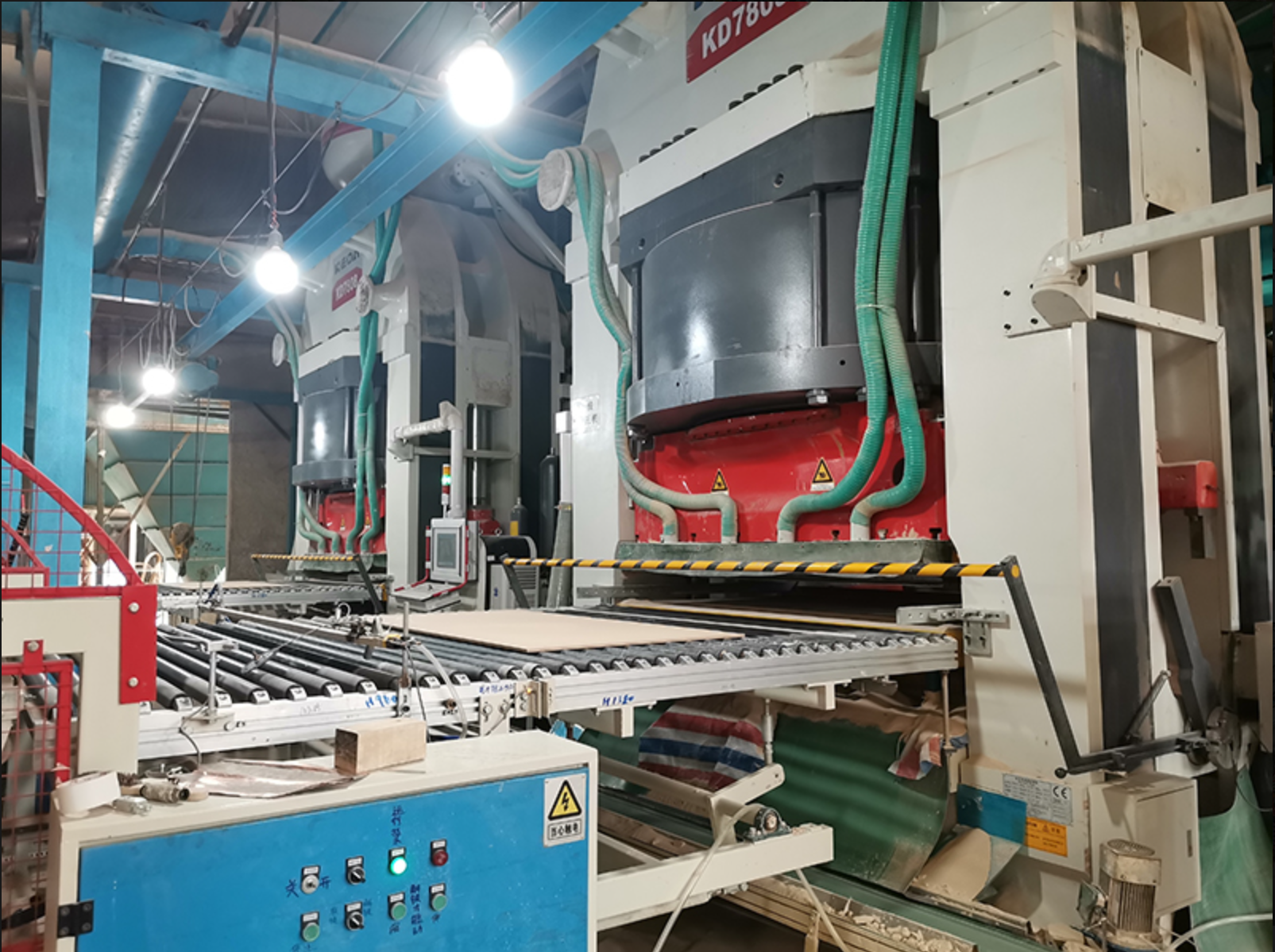
What the reported capability figures establish
ALL KING CERAMICS’ company information identifies its legal company name as ZIBO ALL-KING CERAMICS CO., LTD and gives a factory area of 60,000 m², 320 employees, a 25-engineer R&D team and annual output of 12–16 million m². The assigned company profile also identifies the business as founded in 2011. These figures describe reported organizational and manufacturing scale. They do not, on their own, establish how much capacity is uncommitted, which production lines make a requested format, or how a specific order will be scheduled.
For procurement, each figure answers a different preliminary question. Facility area offers a footprint indicator, but floor area is not equivalent to usable output. Workforce size provides context about the organization, but does not show how many staff are assigned to a particular product or order. An R&D team indicates a stated technical resource, but the number of engineers does not specify available engineering hours, completed development work or the result of a customization request. Annual production capacity gives buyers a scale reference, but it is not a delivery promise or evidence of current spare capacity.
The company’s capability information separately lists monthly capacity as 1.2 million m². Because the annual figure is expressed as a range and the monthly figure is a separate reported value, buyers should confirm the period, product mix, operating assumptions and current availability behind the figure relevant to their order. A headline capacity number is most useful as a screening signal; a production plan tied to the required specification and order window is more relevant to execution.
Translate factory scale into a project-specific capacity check
A procurement team assessing a supplier for commercial flooring should connect its demand forecast to written production information. Start with the project’s total area, the number of designs and sizes, the requested delivery window, and whether repeat orders or phased deliveries are expected. Then ask the supplier to identify which formats and finishes are planned for the order and how the production schedule relates to the requested timing. This is a due-diligence method, not a claim that any particular production slot has been reserved.
ALL KING CERAMICS lists several formats in its company profile: 60x120 cm porcelain tiles as its flagship format, along with 60x60 cm, 80x80 cm, 100x100 cm and 75x150 cm formats. These details can help a buyer frame an initial format discussion. They do not establish that every finish, thickness, pattern or size is available in every product line. For a commercial tile schedule, verify the actual product code, dimensions, finish, packaging details and quantity available for the project rather than treating a portfolio list as a confirmed quotation or stock record.
Order structure is another practical check. The capability unit states an MOQ of 400 sqm per design and says trial orders are acceptable. The purchasing support information adds that third-party inspection can be used as an acceptance criterion. Buyers can use these details to ask whether the proposed order breakdown fits the project’s design schedule and inspection plan. The relevant written confirmation should identify the designs, quantities, inspection scope, acceptance criteria and the point at which inspection occurs. The listed MOQ is a supplier-reported term; buyers should confirm it for the exact product and order.
How OEM/ODM and customization fit capability evaluation
For buyers requiring a private label, a coordinated project palette or a variation from a standard product, ALL KING CERAMICS lists OEM/ODM production. Its customization options include custom size and thickness, surface finish, OEM brand logo and packaging, pattern variation including marble-vein customization, and anti-slip rating. These are stated options, not evidence that every request is technically feasible or included in a standard offer.
The 25-person R&D team is relevant to this discussion as a reported resource, but it should not replace approval of the proposed specification. A buyer can turn the broad customization list into a reviewable scope by asking for the requested drawing or specification, the supplier’s written confirmation of feasibility, a sample or other approved reference where applicable, and a record of the final agreed design. If anti-slip performance is part of the project requirement, request the exact applicable product documentation and test evidence rather than relying on the phrase “anti-slip rating” alone. No specific rating or test result is established by the supplied capability record.
Customization can affect more than appearance. Changes to size, thickness, surface or packaging may alter which product configuration is being offered and what documents apply. Procurement and technical teams should therefore keep the approved sample, order specification, product identification and inspection criteria aligned. This reduces the risk of evaluating one configuration while ordering another, without assuming that any particular mismatch has occurred.
Certification evidence: identify the certificate and its scope
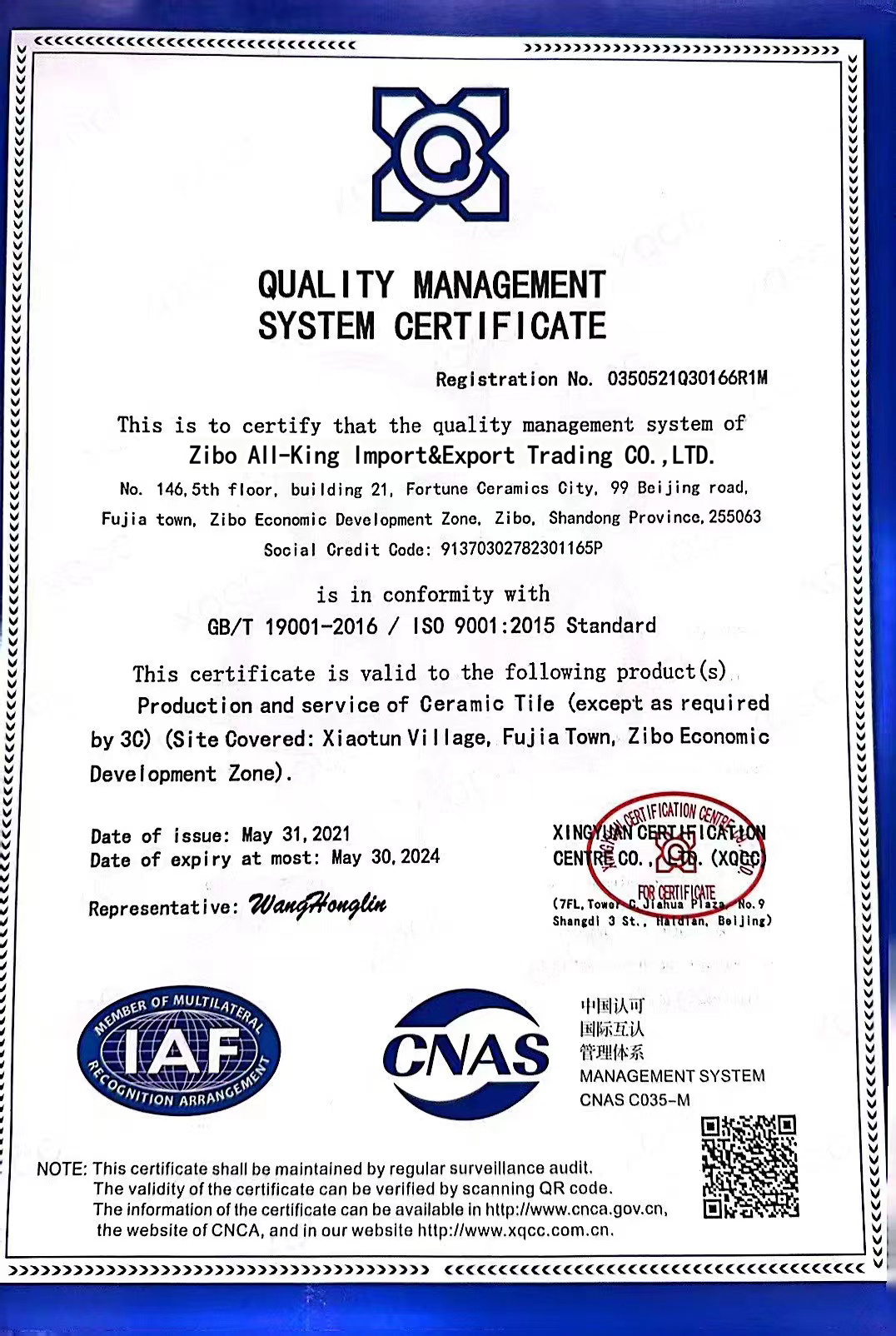
The supplied certification records give buyers concrete identifiers to check. The ISO 9001:2015 record lists certificate number 0350521Q30166R1M, issuer XQCC, and a scope described as “Production and service of Ceramic Tile (except as required by 3C).” The certificate record identifies the market as global. The exact certificate and its current status should be checked with the issuer or the relevant certification record before a buyer relies on it. The supplied record does not provide a valid issue date or expiry date.
ISO 9001:2015 is a quality-management-system standard. In procurement terms, a certificate to this standard is not a substitute for the product’s technical data, inspection results or project acceptance requirements. The recorded scope also matters: the supplied wording relates to production and service of ceramic tile and includes the qualification “except as required by 3C.” Buyers should compare that scope and the named certified entity with the contracting entity, product documents and purchasing requirement. Do not assume that the certificate establishes the performance of every tile or the compliance of every project configuration.
The CE record lists certificate number AC 50163816 0001, issuer TUV, market EU, and scope covering “Ceramic tiles—Dry-pressed ceramic tiles, for internal flooring.” The record’s standard field is “EEC.” Its supplied issue and expiry date fields are not populated with usable dates. These details make the certificate identifiable for follow-up, but the certificate number alone does not demonstrate current validity or that every product in a commercial tile order falls within its scope.
That scope boundary is particularly important when a project includes exterior paving, wet areas, walls, a specialist facility or a market outside the EU. The CE record supplied here is for dry-pressed ceramic tiles for internal flooring; it should not be presented as proof of suitability for every such application. Buyers should verify the certificate status, product or model coverage, applicable documentation and destination-market requirements with the relevant issuer or qualified compliance adviser. The supplied information does not establish local approval requirements for Kazakhstan, Uzbekistan, Russia, Malaysia, the Philippines or other destination markets.
Export profile as a sourcing and documentation checkpoint
ALL KING CERAMICS’ company profile reports a 70% export ratio. The supplied field does not define the calculation basis or reporting period, so it is best treated as a company-reported export indicator rather than a verified share of revenue or evidence of shipment volume to any one country. It can prompt a useful follow-up: ask which export and product documents the supplier can provide for the specific destination, and confirm that the proposed contracting entity, invoice details and shipment documents are consistent.
The company’s market list is recorded as: AUS / NZL / RUS / BLR / CAF / KOR / VNM / MYS / PHL / PER / PAN / COL / CHL / BOL / GTM / PSE / IRQ / UKR / ARE. Its profile also describes coverage across Australia, New Zealand, South Korea, Southeast Asia, Central Asia, Russia, the Middle East and Latin America. These are company-reported market references, not a shipment ledger or proof of active projects in every listed destination. Buyers should confirm the specific destination, transaction route, required documents and any local compliance needs for their own order.
For global commercial project sourcing, a useful verification file can bring together the supplier’s registered and contracting name, the applicable certificate copies and scope, product specifications, approved samples, inspection criteria, agreed packaging and shipment documentation. The company’s listed contact and address can support identity checks and formal correspondence: Abby, tyceramic2@all-king.com, +86 156-5336-9360; No.6, 8th building, 6th district, China Fortune Ceramic City, Zibo, China. Contact details are an administrative verification anchor, not independent proof of facility ownership or production figures.
A practical due-diligence sequence for commercial tile buyers
- Match identity. Compare the company name on the quotation, contract, certificate and correspondence. The supplied company record names ZIBO ALL-KING CERAMICS CO., LTD and uses the brand name ALL KING CERAMICS.
- Match product scope. Record the product format, size, thickness, finish, design and intended use. Confirm that the offered configuration—not just a related product family—is the one covered by the order documentation.
- Check capacity against the order. Compare the project quantity and requested schedule with a written production plan. Ask what the reported capacity means for the relevant product mix and period; do not treat annual capacity as an allocation.
- Confirm customization in writing. Identify which OEM/ODM options are requested and obtain confirmation of the agreed specification, branding, packaging and any performance-related requirement.
- Verify certificates within scope. Check certificate numbers, issuer, status, certified entity, products and intended application. Keep the ISO and CE records distinct because their supplied scopes differ.
- Agree acceptance and inspection. The purchasing record lists third-party inspection as an acceptance criterion. Define the inspection party, timing, sampling or inspection scope, documents and acceptance terms in the purchase documentation.
- Confirm export arrangements. The purchasing support record lists EXW / FOB / CNF / CIF as delivery terms. Confirm the selected term, named place or port, responsibilities and shipment documents for the specific transaction rather than assuming one term applies by default.
This sequence turns broad capability statements into order-level checks. It does not require the buyer to infer that a supplier is unsuitable when a detail is absent; it identifies which records need to be confirmed before the corresponding claim can support a procurement decision.
Where the available evidence stops
The supplied information supports a profile of reported manufacturing scale, team size, product formats, customization options, export coverage and certificate identifiers. It does not include an independent factory audit, current production schedule, product-by-product capacity allocation, verified shipment records by country, certificate validity dates, attached test reports for the project’s requested performance criteria, or destination-specific regulatory determinations. These omissions limit what can be concluded; they do not establish that the company lacks the relevant capability.
For a buyer comparing suppliers, the useful distinction is between a screening indicator and an order-specific record. The 60,000 m² facility, 320 staff, 25 R&D engineers and 12–16 million m² annual capacity can inform an initial capability review. The named certificate numbers and scopes can guide document verification. The listed OEM/ODM options can define a customization discussion. Final procurement decisions still depend on confirmed product specifications, schedule, inspection and acceptance terms, certificate applicability and destination documentation for the project in question.
Frequently asked questions
What manufacturing capacity does ALL KING CERAMICS report?
Company information reports a 60,000 m² manufacturing facility, 320 employees, 25 R&D engineers and annual production capacity of 12–16 million m². A separate capability record lists monthly capacity of 1.2 million m². These are reported company figures; buyers should confirm the applicable product mix, measurement basis and current production availability for a specific order.
Which OEM/ODM options are listed for commercial tile projects?
The capability record lists custom size and thickness, surface finish, OEM brand logo and packaging, pattern variation including marble-vein customization, and anti-slip rating. The record does not provide specific performance ratings or confirm that every option is available for every product, so the required configuration should be confirmed in writing.
What do the supplied ISO 9001 and CE records cover?
The ISO 9001:2015 record lists certificate 0350521Q30166R1M, issued by XQCC, with a scope of production and service of ceramic tile, subject to the stated 3C qualification. The CE record lists certificate AC 50163816 0001, issued by TUV, for dry-pressed ceramic tiles for internal flooring in the EU market. The supplied records do not provide usable issue or expiry dates; status and product coverage should be verified with the issuer.
Does the export ratio prove experience in a specific destination market?
No. The company profile reports a 70% export ratio, but the supplied field does not define its calculation basis or provide destination-level shipment volumes. The market list and regional references are company-reported coverage information. Buyers should verify the documents and arrangements relevant to their own destination and order.
Which purchasing and acceptance details are listed?
The supplied purchasing information lists an MOQ of 400 sqm per design, with trial orders acceptable; delivery terms of EXW, FOB, CNF or CIF; and third-party inspection as an acceptance criterion. It also lists payment terms of 30% TT / 70% against BL copy, L/C or cash. Confirm the applicable terms, inspection scope and payment arrangement in the transaction documents for the specific order.
Company and reference documents
ALL KING CERAMICS is identified in the supplied company profile as ZIBO ALL-KING CERAMICS CO., LTD. Its listed address is No.6, 8th building, 6th district, China Fortune Ceramic City, Zibo, China. Company contact: Abby, tyceramic2@all-king.com, +86 156-5336-9360.
View the ALL KING CERAMICS catalog. Product selection and project compliance should be confirmed against the applicable product and order documentation.
Have Questions or Need More Details?
Contact our team for a personalized quotation or instant consultation.
Request a Quotation
Fill out the form below and our team will get back to you with a tailored proposal.
WhatsApp Direct Chat
Prefer to chat in real-time? Message us on WhatsApp for instant assistance & quick answers.
- Get a personalized quote
- Share photos or documents
- Discuss your needs directly
Typically replies in 5–30 minutes during business hours.