
Commodity Mould Procurement FAQ: Cycle Times, Tolerances, Customization
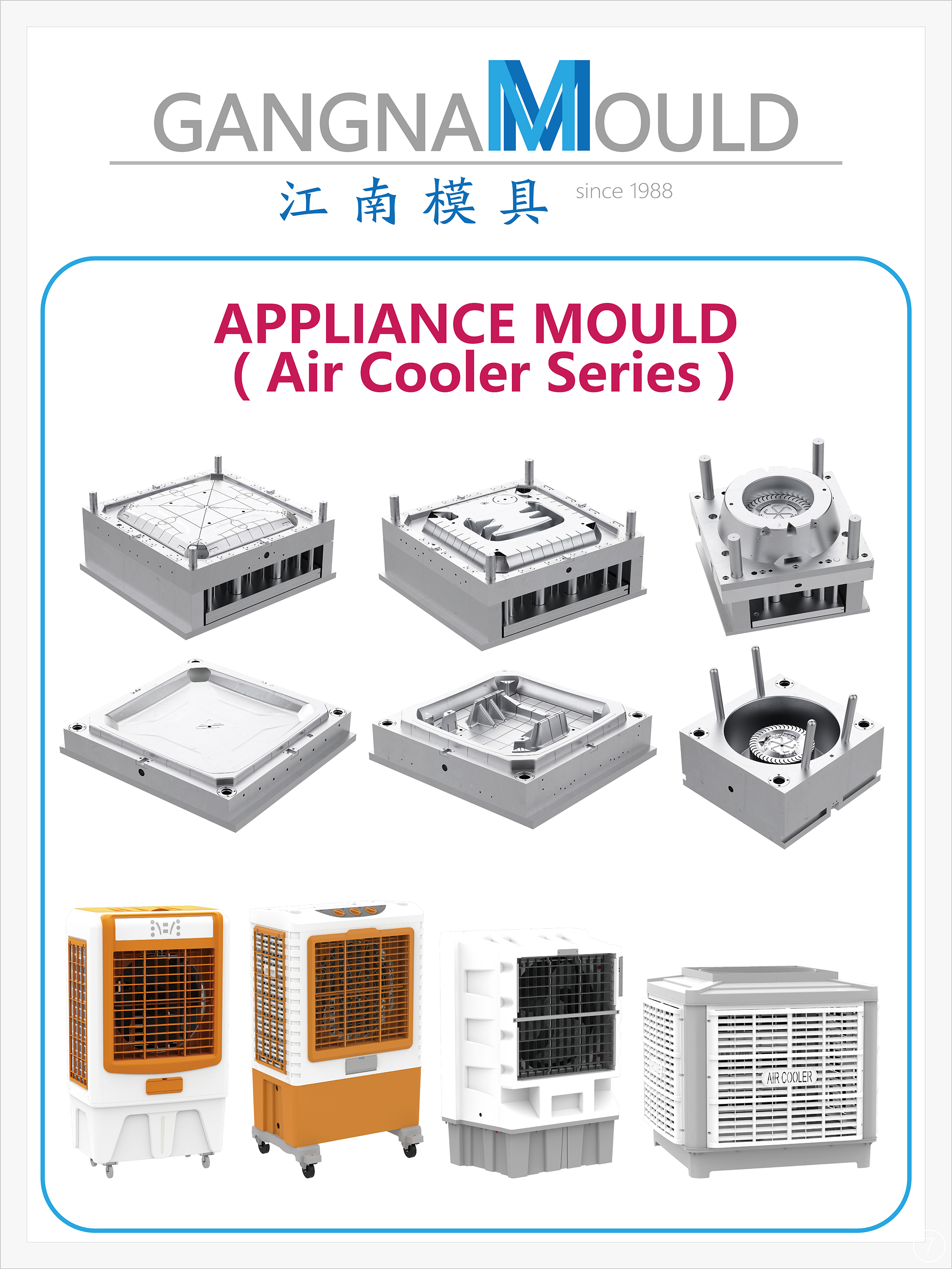
Home appliance and daily-use parts sit inside the same commodity mould category as seating, storage and logistics items. Image: air cooler series mould, Gangnam Mould commodity mould range.
A commodity mould is a plastic mould built for high-volume daily-use, retail and logistics products — chairs, tables, stools, sofas, storage boxes, basins, buckets, trash bins, garden planters, crates and pallets — rather than for a single engineered component. In procurement, these tools are judged on three things long before the commercial terms are discussed: how fast the mould runs, how tightly the parts hold their dimensions, and how much of the tool can be customized to a specific product line.
This FAQ collects the technical and commercial questions that buyers raise while they are still researching commodity mould suppliers and have not yet committed to a tool shop. It is written for importers, brand owners, OEM buyers and procurement managers who need to compare tooling offers on engineering substance — cooling design, gating, wall thickness, tolerance control and customization scope — rather than on claims that cannot be checked.
Each answer below is intended to stand on its own, so a single question can be read and used in isolation during an internal review.
Why cycle time, tolerance and customization decide a commodity mould project
Cycle time sets machine throughput and therefore unit cost. Tolerance sets whether parts still assemble and stack after the tenth container shipment. Customization determines whether one tool can serve one SKU or a family of products. Everything else in a commodity mould quotation — steel grade, cavity count, surface finish, automation interface — is downstream of those three decisions.
The Commodity Mould product category covers a broad type range: garden planter molds, trash bin molds, bucket molds, basin molds, storage box molds, sofa molds, table molds and chair molds, with adjacent categories such as stool molds, table molds, storage cabinet molds, kitchen utensil molds, bathroom accessory molds, basket, tray and box molds, pallet molds, crate molds, home appliance molds and thin-wall injection molds.
| Procurement variable | What it actually controls | The question a buyer should be able to answer |
|---|---|---|
| Cycle time | Machine hours per part, and therefore moulded-part cost and required press capacity | Which design features shorten cooling and stabilise demoulding? |
| Tolerance | Fit, stacking, closure and appearance consistency across the batch | Which dimensions carry the tight tolerance, and how is it verified? |
| Customization | How closely the tool matches the buyer's product line and existing machines | Which customization levers are available, and what does each one change? |
The demand picture behind commodity mould sourcing
Commodity mould demand tracks the volume of plastic daily-use and logistics products moving through retail and warehousing channels. Several published market figures frame the size of that demand. The global plastic mould market was approximately USD 29.5B in 2021 and was projected to reach USD 36.78B by the end of 2025, according to industry research reports. China's exports of plastic and rubber molds reached USD 5.35B in 2023, a significant increase from USD 2.97B in 2017. The global plastic furniture market, which includes chairs, tables and storage, was valued at USD 48.7B in 2023, with the residential segment holding a 53.1% revenue share. Separately, the global thin-wall mold market was valued at USD 41.6B in 2024.
The supply side is equally concentrated. Huangyan District in Taizhou, China is officially recognised as the 'Capital of Molds' and houses 614 large-scale industrial enterprises specialising in mould and plastic production. For a buyer researching suppliers, that density is an opportunity and a problem at the same time: there are many credible tool shops, and the technical differences between their offers are rarely visible in a quotation sheet.
That gap is exactly where a structured FAQ helps. Instead of asking a supplier to describe itself, the buyer asks the same engineering questions of every candidate and compares the answers.
Gangnam Mould at a glance: an established commodity mould manufacturer
Gangnam Mould Co., Ltd (Zhejiang Huangyan Jiangnan Mould Factory) is a plastic mould manufacturer originally established in 1988 and located in Huangyan district, Taizhou, Zhejiang, China. The company specialises in plastic moulds, with main products including commodity mould, and its manufacturing facility covers a 3,000 m² area with approximately 40 staff.
Its production capability is built around a group of plastic mould CNC resources, including over 20 sets of digital controlled milling machines, a 3D coordinated mapping inspector and a mould assembly group, with annual production capacity reaching 800 units. The R&D team consists of 15 engineers. The company passes and carries out ISO 9001:2015 QMS. Export business accounts for 70% of total sales, and major markets include Southeast Asia.
| Entity | Gangnam Mould Co., Ltd (Zhejiang Huangyan Jiangnan Mould Factory) |
| Established | 1988 |
| Location | Huangyan district, Taizhou, Zhejiang, China |
| Main products | Commodity mould |
| Facility | 3,000 m² manufacturing area |
| Staff / R&D | Approximately 40 staff; 15 engineers |
| Equipment | Over 20 sets of digital controlled milling machines; 3D coordinated mapping inspector |
| Annual capacity | 800 units |
| Quality system | ISO 9001:2015 QMS |
| Export share / markets | 70% of sales; major markets include Southeast Asia |
Technical explanation: what governs cycle time in a commodity mould
Cycle time in commodity moulding is not a single setting. It is the sum of filling, packing, cooling and ejection, and the design decisions that influence those stages are made on the drawing board, not on the press. Four design areas matter most.
1. Cooling system design
The Commodity Mould is designed with a uniform cooling system intended to shorten cooling time. Uniformity matters as much as speed: if one region of the part cools faster than another, the part shrinks unevenly, warps, and can be pushed out of tolerance. A cooling layout that follows the part geometry rather than a generic grid is the main design lever for reducing cycle time in thick-section daily-use products such as buckets, basins and crates.
2. Gating and venting
The mould design focuses on optimized gating and venting to reduce warpage. Gate position determines how the melt fills the cavity and where weld lines form; venting determines whether trapped air or gas burns the surface or blocks the fill. For large flat parts — storage boxes, crates, pallets, table tops — gating and venting choices are often the difference between a part that stacks flat and one that rocks.
3. Wall thickness and thin-wall design
Thin-wall injection moulds are part of the commodity mould type range, and thin-wall part design is a recognised area where commodity moulds need special design attention, particularly for large parts. Reducing wall thickness lowers material consumption per part and shortens the cooling portion of the cycle, but it also requires higher injection pressure, more rigid mould construction and tighter process control on the press.
4. Tolerance control
Tolerance control is applied for batch consistency, with a tolerance of -0.02 mm used on the dimensions that decide fit and function. The practical point for a buyer is that a commodity mould does not carry the same tolerance on every surface: sealing faces, stacking features, hinge or lid interfaces and assembly points are the ones that need tight control, while non-functional surfaces are governed by appearance and demoulding requirements instead.
ISO 20457:2018 is the primary international standard for manufacturing tolerances and acceptance conditions of plastic molded parts, and it is a useful reference when a buyer and a supplier need a common vocabulary for what 'in tolerance' means at inspection.
Decision rule for buyers:
Ask the supplier to identify, in writing, which dimensions carry the tight tolerance and which do not. A quotation that claims uniform tight tolerance across the whole part is describing something that commodity moulding does not normally deliver; a quotation that names the critical dimensions is describing a controlled process.
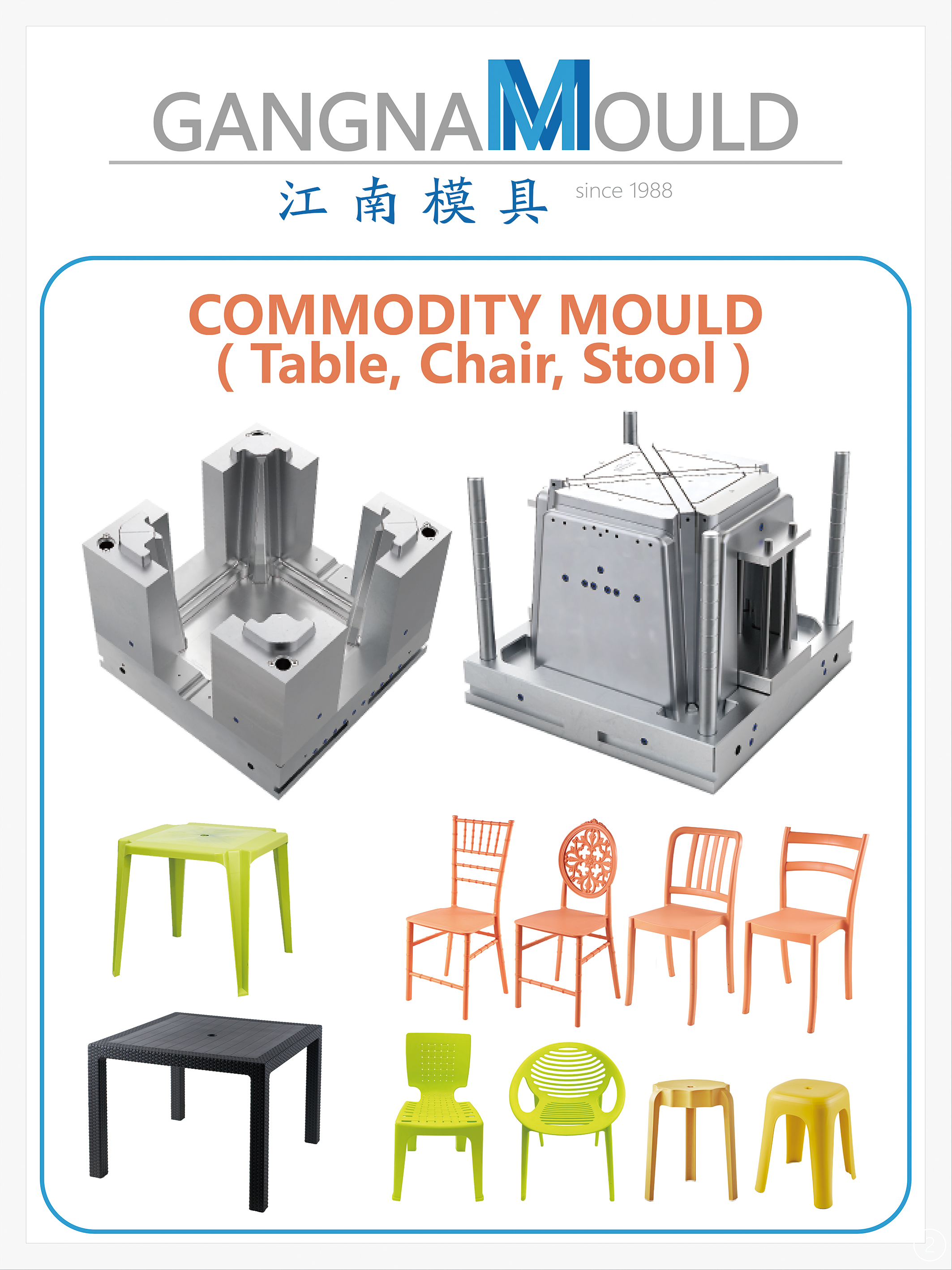
Seating and table moulds illustrate where cooling uniformity, gating and tolerance control meet: large flat surfaces, load-bearing joints and stacking features. Image: table, chair and stool mould set.
Customization: what can be changed, and what it changes
The Commodity Mould can be customized to customer requirements across several levers: cavity count and size, surface treatment, inserts and multi-component mold design. Specific technical parameters should be confirmed during requirement communication, because each lever interacts with the others and with the buyer's press.
| Customization lever | What it changes on the tool | What the buyer must confirm |
|---|---|---|
| Cavity count | Parts per shot, mould size, runner layout | Available machine tonnage and shot capacity; whether cycle time per part or total output is the priority |
| Cavity size | Part envelope and shrink allowance | Final part drawing, resin family and expected wall thickness |
| Surface treatment | Surface finish, wear resistance, demoulding behaviour | Whether the visible surface is aesthetic or purely functional; texture requirements |
| Inserts | Replaceable zones for wear, threads, undercuts or rapid design changes | Maintenance plan and whether insert replacement should be possible on-site |
| Multi-component design | Combination of materials or colours in one moulding cycle | Whether the press supports multi-component injection and how assemblies will be handled |
Two practical boundaries are worth stating plainly. First, increasing cavity count raises output per cycle but also increases mould size, required clamping force and tooling cost — at some point the press, not the mould, becomes the constraint. Second, inserts and multi-component designs add alignment and maintenance requirements; they solve real production problems, but they also add points that must be checked during routine mould maintenance.
Application fit: where commodity moulds actually run
Commodity moulds are used in packaging, retail, daily necessities, logistics and warehousing, home appliance manufacturing, and industrial component production. The mould itself operates on injection or blow molding machines for mass production, and the operation mode depends on the customer's production lines and the mould design — multi-cavity or single-cavity.
Typical project types include OEM/ODM custom mold projects, large-volume mold production, home appliance component mold development and logistics packaging mold development. The moulds are designed for mass injection and blow molding production lines, with emphasis on durability, short cycle times and dimensional stability.
Required supporting equipment includes injection or blow molding machines, cooling systems, and automation for loading and unloading. Buyers planning thin-wall or large-part projects should also confirm that the press can deliver the injection pressure and clamp force the tool design assumes.
Gangnam Mould provides end-to-end mould manufacturing from samples or drawings through trial molding and delivery, including installation and operation training. This type of application is common in countries including India, Italy, Jordan, Nigeria, Algeria, Zambia, South Africa, Tanzania, Turkey, Tunisia, Singapore, Saudi Arabia and Russia.
Market trends shaping commodity mould procurement
Three trends are visible in the available data, and each has a procurement consequence.
Thin-wall tooling is expanding. The global thin-wall mold market was valued at USD 41.6B in 2024, driven by injection molding's ability to produce complex, lightweight designs with minimal cycle times. For buyers of storage boxes, crates and packaging items, this shifts the evaluation focus towards mould rigidity, cooling design and press compatibility rather than cavity count alone.
Tooling supply is concentrating in established clusters. China's exports of plastic and rubber molds reached USD 5.35B in 2023, up from USD 2.97B in 2017, and Huangyan District alone houses 614 large-scale industrial enterprises in mould and plastic production. Buyers therefore have more options, but also more need for objective comparison criteria.
End-market demand is steady but residential-weighted. The global plastic furniture market was valued at USD 48.7B in 2023, with residential applications holding a 53.1% share. Residential demand is sensitive to retail cycles, which puts a premium on suppliers whose capacity and delivery commitments remain predictable across those cycles.
On the material side, key participants in the global plastic injection molding material market include BASF SE (11% share) and SABIC (9% share), which indicates that resin selection is concentrated among a small number of large suppliers. For mould buyers, this reinforces a simple point: material choice is often fixed before the mould is specified, so the mould must be designed around the resin, not the other way around.
Where a commodity mould is not the right answer
A commodity mould is a volume tool, and it is worth being explicit about the boundaries.
- Low-volume or short-run products. When annual quantities are small, the tooling investment per part is harder to justify, and buyers commonly compare it against alternative processes such as sheet fabrication, rotational moulding or thermoforming, or against purchasing an existing tool. A commodity mould is designed for mass injection and blow molding production lines; that is its operating assumption.
- Uniform tight tolerance across the entire part. The -0.02 mm tolerance is a controlled tolerance applied to functional dimensions for batch consistency. Expecting that level of control on every surface of a large, thin-wall daily-use part is not realistic in commodity moulding, and a supplier who promises it should be asked how it will be measured.
- Machine mismatch. A mould designed around one press tonnage, platens and automation interface may not transfer efficiently to a different machine. Buyers with multiple plants should confirm machine compatibility before the design is frozen.
- Recycled and variable polymers. Commodity moulds process PP, engineering-grade plastics and recycled polymers. Recycled feedstocks can vary in shrinkage behaviour between lots, so dimensional consistency should be validated through trial molding rather than assumed from the drawing.
None of these boundaries make commodity moulding a weak option. They define where it is the efficient option, and they are precisely the points that separate a well-specified project from an expensive surprise.
Future outlook
Three developments are likely to shape commodity mould procurement over the next planning cycle. First, thin-wall and lightweight part design will continue to spread from packaging into storage, logistics and home appliance components, pushing cooling design and mould rigidity higher up the specification list. Second, as recycled polymer content increases, trial molding and acceptance testing will carry more weight than paper specifications, because dimensional behaviour depends on the actual feedstock. Third, as tooling supply density in established clusters remains high, buyers will rely more on structured, comparable engineering questions — the kind collected in this FAQ — to differentiate suppliers.
For buyers, the practical implication is that a commodity mould specification should be written around measurable behaviour: cycle time expectations tied to cooling and wall thickness, named critical dimensions tied to tolerance, and a documented customization scope tied to the buyer's own presses.
FAQ: commodity mould cycle times, tolerances and customization
What exactly is a commodity mould, and which products does it cover?
A commodity mould is a plastic mould built for mass production of daily-use, retail and logistics products rather than for a single engineered component. The category includes chair molds, table molds, stool molds, sofa molds, storage cabinet and storage box molds, kitchen utensil molds, bathroom accessory molds, basket, tray and box molds, basin and bucket molds, trash bin molds, garden planter molds, pallet molds, crate molds, home appliance molds and thin-wall injection molds. The mould is made of quality mold steel and processes plastics such as PP, engineering-grade plastics and recycled polymers. It is intended for packaging, retail, consumer goods, logistics and warehousing, and home appliance manufacturing.
What determines the cycle time of a commodity mould?
Four design areas dominate. The cooling system is designed for uniformity in order to shorten cooling time. Gating and venting are optimized to reduce warpage and to allow a clean fill. Wall thickness matters, because thin-wall designs reduce material mass and cooling load while demanding higher injection pressure and rigid mould construction. Finally, the part's own geometry sets a floor that no mould design can go below. Cycle time is therefore a design outcome that must be reviewed together with the press, the resin and the part drawing — not a standalone figure.
What tolerance can a commodity mould hold?
Tolerance control in commodity moulds is applied for batch consistency, with a tolerance of -0.02 mm used on the dimensions that determine fit and function. Tight control is normally concentrated on functional features — interfaces, stacking features and assembly points — rather than distributed uniformly across all surfaces. ISO 20457:2018, the primary international standard for manufacturing tolerances and acceptance conditions of plastic molded parts, provides a common reference for defining and inspecting those tolerances.
Which parts of a commodity mould can be customized?
Customization options include adjustable cavity count and cavity size, surface treatment, inserts, and multi-component mold design. Cavity count and size affect parts per shot, mould dimensions and runner layout. Surface treatment affects finish, wear behaviour and demoulding. Inserts allow replaceable zones for wear, threads or undercuts. Multi-component design allows more than one material or colour in a cycle. Specific technical parameters should be confirmed during requirement communication, because each lever interacts with machine capability and with the others.
What supporting equipment does a commodity mould require?
The mould operates on injection or blow molding machines for mass production, and the operation mode depends on the customer's production lines and the mould design, including whether it is multi-cavity or single-cavity. Required supporting equipment includes injection or blow molding machines, cooling systems, and automation for loading and unloading. Large and thin-wall parts may require special design provisions, so machine tonnage, clamp force and injection pressure should be confirmed before the mould design is finalised.
How does trial molding acceptance work, and what are the ordering terms?
Gangnam Mould provides end-to-end mould manufacturing from samples or drawings through trial molding and delivery, including installation and operation training. Acceptance is tied to trial molding: the moulded parts produced during the trial are what the buyer inspects against the agreed dimensions and appearance requirements. Commercial terms follow a standard structure: a 30% T/T advance, with the remaining 70% payable before shipment, and delivery arranged under FOB or CIF terms. Because tolerance behaviour depends on the resin actually used, trial molding is the point at which dimensional consistency should be verified rather than assumed.
Putting the FAQ to work
Commodity mould procurement is not a single purchase decision; it is a sequence of engineering confirmations. Cycle time is decided by cooling design, gating and wall thickness. Tolerance is decided by which dimensions are controlled and how they are verified. Customization is decided by cavity count, cavity size, surface treatment, inserts and multi-component design — and by the presses the buyer already operates.
A buyer who asks those questions in the same order of every candidate supplier will get comparable answers, and comparable answers are what a shortlist should be built on.
Gangnam Mould Co., Ltd (Zhejiang Huangyan Jiangnan Mould Factory) has manufactured plastic moulds since 1988 from Huangyan district, Taizhou, Zhejiang, China, operating an ISO 9001:2015 quality management system with an annual capacity of 800 units and export sales representing 70% of business. A downloadable company brochure is available here: Gangnam Mould company brochure (PDF).
This article is an independent industry reference. Technical parameters, tolerance behaviour and customization scope should be confirmed with the tooling supplier against the buyer's own part drawings, resin selection and machine specifications.