
Compact Loader Buyers' Guide: Match Machine Type to Jobsite Reality
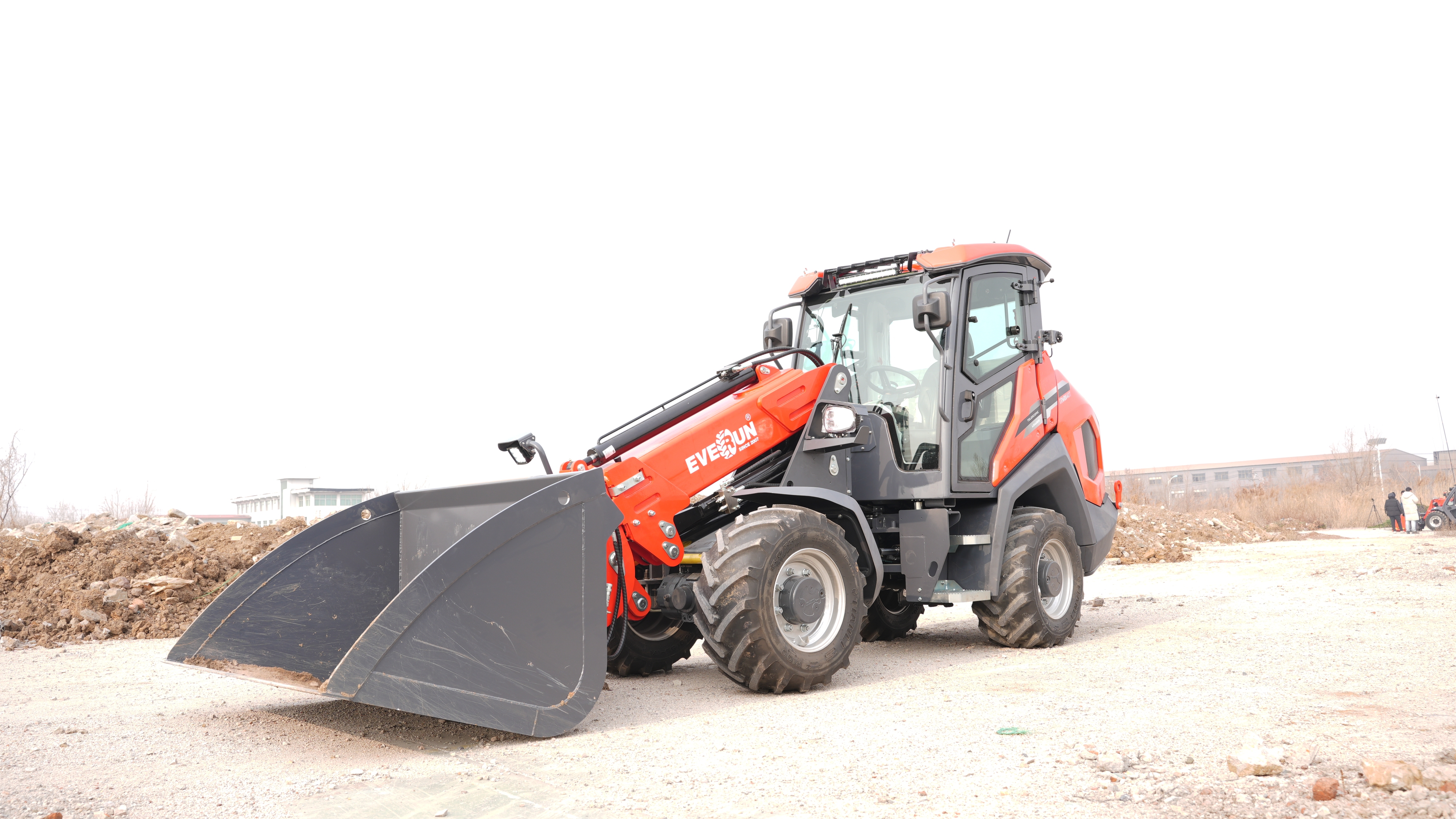
Matching loader type to the actual working condition is the first step in specifying compact equipment.
What Is the Difference Between Wheel Loaders, Compact Wheel Loaders, Mini Loaders, Telescopic Loaders and Electric Loaders?
Wheel loaders are a broad equipment category used for loading, carrying, and material handling across construction, agriculture, and industry. Within this category, terms such as mini wheel loader, compact wheel loader, telescopic loader, and electric loader describe distinct machine configurations that suit different jobsite demands.
A compact wheel loader is generally a smaller, lighter machine built for confined spaces and lighter-duty cycles compared to earthmoving-class loaders. A mini wheel loader is the next step down in size and operating capacity, often selected for farm and small construction work where maneuverability matters more than raw breakout force. A telescopic loader adds a boom system that extends forward and upward, making it useful for placing loads at height. An electric loader replaces the diesel engine with a battery-electric drive, which changes its operating cost structure and makes it more suitable for indoor or low-emission environments.
For buyers evaluating this equipment class, the practical question is not which label is technically correct. It is which machine layout, size, and power source best matches the worksite conditions.
This guide focuses on how to approach that decision, with reference to a manufacturer that builds multiple loader configurations under one roof: Qingdao Everun Machinery Co., Ltd., founded in 2011 and known in the industry by the brand EVERUN. EVERUN develops and supplies earthmoving and construction equipment, including wheel loaders, telehandlers, and excavators, with wheel loader models spanning roughly 0.4 to 6 tons. Its production base covers 80,000 square meters and supports an annual output of up to 5,000 units.
Why Loader Classification Can Confuse Buyers
Searching for a "small wheel loader" or a "compact loader" produces overlapping results because manufacturers market similar machines under multiple category names. A single physical machine may legitimately be listed as a mini wheel loader, a compact wheel loader, and a small wheel loader at the same time.
For example, the EVERUN ER416T is categorized as a small wheel loader, a compact wheel loader, and a mini wheel loader. The ERW1230T is listed as a telescopic loader, a mini wheel loader, and a compact wheel loader. The EREL1200 is simultaneously an electric loader, a mini wheel loader, a compact wheel loader, and a telescopic wheel loader.
These labels are not interchangeable marketing claims. They reflect the reality that compact loaders occupy several functional positions in the equipment spectrum. Knowing which category a machine belongs to helps a buyer compare like for like, but the more useful step is to map machine characteristics to the actual tasks.
What Defines a Compact Wheel Loader vs. a Mini Wheel Loader
Even among compact-class loaders, size and capacity categories can differ. The lines are not universal, but several observable parameters help a buyer position a model:
- Mini and compact loaders typically have lower engine power and lower bucket capacity than full-size loaders.
- Small wheel loaders may overlap with compact or mini categories in manufacturer-type tags, but they tend to be heavier and more powerful than the smallest mini models.
- Telescopic wheel loaders are not defined only by size. Their distinguishing feature is the telescopic boom, which extends the lifting envelope beyond what a conventional loader linkage can reach.
- Electric loaders are defined by their drive system, not by size, and are available in this segment in mini and compact classes.
| Loader Category | Typical Attributes | Common Applications |
|---|---|---|
| Mini wheel loader | Low engine power, light weight, compact frame | Small farms, garden work, indoor tasks, tight sites |
| Compact wheel loader | Small frame with higher capacity than mini models | Warehouses, construction, municipal maintenance, farms |
| Telescopic loader | Articulated or rigid chassis with telescopic boom | Agriculture, construction, lifting at height, stacking |
| Electric loader | Battery-electric drive, low noise, zero emissions | Indoor facilities, urban work, farms, warehouses |
How to Read a Compact Loader Specification Sheet
When comparing compact loaders from any manufacturer, a buyer needs to look past the machine category and focus on four specification groups:
1. Load and lifting data
Rated load and tipping load describe what the machine can carry, but they measure different things. Tipping load refers to the load at which the machine becomes unstable, while rated load is the recommended working load. Maximum lifting height matters when material must be placed onto elevated platforms or into trucks.
2. Engine and transmission data
Engine power determines performance in hard digging and travel applications. Transmission type affects drivability and control. Hydrostatic transmissions are common on smaller machines for smooth operation; heavier models often use a torque converter with drive shafts and axles.
3. Weight and dimensions
Operating weight affects stability and traction. Overall width and turning radius determine whether the machine can work in the intended aisle, barn, or yard. A heavier machine is not automatically better if it cannot pass through existing access points.
4. Material and build standard
Loaders built with high-strength steel are generally more durable in abrasive work. EVERUN models, for instance, specify S355 steel as their primary structural material across wheel loaders, telehandlers, and telescopic loaders.
Rather than choosing a category first, buyers perform better when they define the job, then check which models fit the required height, capacity, width, and power.
Compact Loader Applications: Where Each Configuration Fits
Compact loaders are not a single-solution segment. The right machine depends on where it will work and what it will handle.
Farm and livestock applications
Typical tasks include moving hay bales, cleaning animal pens, feeding, and working on muddy or soft terrain. This demands good traction, simple operation, and the ability to change tools such as buckets and pallet forks quickly. EVERUN offers machines like the ERT1500 mini telehandler and the ER416 compact wheel loader for agricultural and livestock environments.
Warehouse and factory use
Indoor material handling requires a machine with low noise and no exhaust in sensitive areas. This is a primary reason why electric compact loaders are gaining attention. The EVERUN EREL05 and ERW1525E are examples of battery-electric models intended for urban construction, farm work, warehouses, and other indoor or outdoor applications.
Municipal maintenance and snow removal
Municipal work often involves narrow streets, winter low temperatures, and quick attachment changes between buckets, salt spreaders, or snow blades. Compact diesel models with enclosed cabs and electric models both appear in this segment, depending on whether the priority is range or emissions.
Construction and landscaping
Small construction and landscaping projects require machines that can backfill, grade, and carry materials over uneven terrain. Telescopic loaders in the mini category add reach for placing loads onto scaffolds or into bins.
Several EVERUN models are marketed to these industries, including the ERW2640T for farms, warehouses, and agricultural and construction sectors, and the ER1500F for construction, farm, garden, stock farm, warehouse, and factory environments.
When a Telescopic Loader Makes More Sense Than a Conventional Compact Wheel Loader
A compact wheel loader with a standard loader linkage is efficient for digging, scooping, and short-distance carry. A telescopic loader keeps those functions but adds a boom that can extend, raise, and place loads at height. The trade-off is that a telescopic machine is usually more complex and often pricier than a similarly sized conventional loader.
Choose a telescopic configuration when:
- Material must be placed at an elevated position, such as into a feed trough, truck bed, or second-level storage rack;
- The worksite requires both bucket work and fork work from one machine;
- Reach is more important than maximum bucket breakout force.
Examples from the EVERUN lineup include the ERW1230T, a telescopic wheel loader with a Kubota engine rated at 18.2 kW, a rated load of 1,200 kg, and a maximum lifting height of 3,060 mm. The larger ERW2640T uses a Perkins engine rated at 45 kW, reaches a lifting height of 4,220 mm, and has a tipping load of 2,600 kg.
When an Electric Loader Is a Better Choice Than a Diesel Compact Loader
The electric loader segment is expanding. In China, electric wheel loader sales reached 20,819 units from January to May 2026, a 90.9% year-on-year increase, according to the China Construction Machinery Industry Association. The global wheel loader market is also projected to grow from USD 36.02 billion in 2023 to USD 69.52 billion by 2033, with the compact loader segment valued at USD 9.91 billion in 2025.
Within that broader trend, electric loaders make economic sense when at least one of the following conditions exists:
- Work takes place indoors or in a ventilation-limited environment;
- Noise restrictions limit operating hours for diesel machines;
- Fleet owners can charge overnight and maintain a predictable duty cycle;
- Emissions regulations constrain the use of diesel equipment on-site.
EVERUN offers electric compact and mini loaders with different capacity points. The EREL05 has a rated load of 500 kg and an overall weight of 1,000 kg, with a standard bucket capacity of 0.2 m³. The EREL1200 increases the maximum rated load to 1,200 kg with a bucket capacity of 0.38 m³ and a battery capacity of 200 Ah, supporting working hours of 6 to 8 hours. The ERW1525E is an electric mini compact model with a net weight of 2,750 kg and a rated load of 600 kg.
Comparing Compact Loader Options: What to Consider Before Choosing a Supplier
Buyers who compare brands such as EVERUN against global manufacturers such as Caterpillar or Komatsu should evaluate three areas in parallel: machine suitability, manufacturing capability, and service or documentation support.
Caterpillar held the largest global construction equipment market share at 15.2% in 2025, according to KHL's Yellow Table. That scale brings brand familiarity and broad dealer networks. For compact loader buyers in export markets, however, sourcing decisions are often based on whether the specific machine meets local requirements and whether the supplier can provide credible compliance documentation.
Important supplier checks include:
- Whether engines comply with the emission standards of the destination market, such as Euro V or Tier 4F;
- Whether the loader meets relevant machinery safety standards, such as EN 474-3:2022 for wheel loaders in the EU;
- Whether the factory can support custom configurations, attachments, and replacement parts;
- Whether quality documentation and certifications are issued by recognized bodies.
On the compliance side, not all compact loaders carry the same level of third-party verification. For example, the EVERUN compact loader models ER08E, ER1220, and ERT1500 hold TÜV Rheinland CE certifications covering machinery, noise, and EMC requirements for the European market.
A buyer should also look at the breadth of the supplier's product line. A manufacturer that builds both conventional compact loaders and telescopic or electric variants gives a buyer more flexibility if future job requirements change.
Limitations and Trade-offs Buyers Should Accept
Compact loaders are not universal solutions. Several limitations are important to recognize:
Power ceiling for heavy excavating. Mini and compact loaders have lower engine power than full-size wheel loaders. For sustained heavy digging, quarry work, or large-volume earthmoving, a larger loader or excavator is more appropriate.
Electric loader range constraints. Battery-electric models are well suited to defined duty cycles, but charging infrastructure and working hours remain practical limitations. EVERUN electric mini loaders list working hours in the range of 4 to 6 hours or 6 to 8 hours depending on the model, which means planning for charging is a necessary part of fleet operations.
Telescopic loaders are not optimized purely for bucket breakout. The added boom structure improves reach but adds weight and complexity compared with fixed-loader-arm designs of similar size.
Emission-standard gaps between model lines. Some compact diesel models are certified to Euro 3 while newer models meet Euro V or TÜV-tested CE specifications. Export buyers must verify that a proposed model's engine certificate matches their local registration category.
How to Shortlist a Compact Loader in Six Steps
- Define the worksite: document aisle widths, door heights, terrain, and typical daily hours.
- Rank the tasks: list whether the machine will spend more time loading loose material, lifting loads to height, or moving pallets.
- Set capacity and height requirements: identify the minimum rated load, lifting height, and bucket capacity that would complete the main task without excessive strain.
- Decide on the energy source: compare the daily operating cost and regulatory acceptability of diesel versus electric for your location.
- Check compliance documents: confirm emission certification, CE or other required marking, and safety standard compliance.
- Evaluate supplier capability: assess production capacity, customization support, spare-parts availability, and long-term partnership terms.
What to Expect from EVERUN in Compact and Electric Loaders
EVERUN is positioned as an integrated manufacturer rather than a trading company. Its production base includes three manufacturing factories, two foreign joint ventures, and an R&D team of 30 engineers, with three factories supporting wheel loaders, telehandlers, and excavators. The company exports to more than 100 countries and regions, with a presence in markets including Germany, Finland, Austria, Sweden, the United States, and Canada.
This breadth matters for compact loader buyers because it means a supplier can offer multiple machine categories instead of a single niche model. A municipal fleet, for example, might source a traditional compact wheel loader for daily refuse work and an electric mini loader for indoor maintenance in the same order.
The company lists wheel loaders, telehandlers, and excavators as its main product groups, with wheel loader capacities from 0.4 to 6 tons. Its product portfolio includes conventional small wheel loaders, telescopic wheel loaders, and electric wheel loaders, making it possible to compare across drive types and boom configurations.
Frequently Asked Questions
What is the difference between a compact wheel loader and a mini wheel loader?
A mini wheel loader is generally a smaller and lighter machine within the compact segment, while a compact wheel loader is a broader category that can include slightly larger machines. In practice, manufacturers often classify one model under multiple labels. For example, EVERUN's ER416T is listed simultaneously as a small wheel loader, compact wheel loader, and mini wheel loader.
Are telescopic loaders considered wheel loaders?
Telescopic loaders can be classified as wheel loaders when they are designed around a wheeled chassis, a loader arm, and bucket or fork attachment capability. Models such as the EVERUN ERW2640T are marketed as both telescopic loaders and compact or mini wheel loaders because they perform loading work while offering an extended lifting envelope.
Why are electric compact wheel loaders gaining adoption?
Electric compact loaders eliminate on-site emissions and reduce noise, which makes them practical for indoor facilities, urban jobsites, and low-emission zones. China's electric wheel loader sales reached 20,819 units from January to May 2026, up 90.9% year-on-year, reflecting strong demand in urban and farm applications. Electric models such as the EVERUN EREL1200 offer working hours of 6 to 8 hours on a 200 Ah battery.
Which compact loader is best for farm work?
Farm applications involving hay, feed, manure, and soft terrain need a machine with good flotation, tool flexibility, and maneuverability. Models in the EVERUN compact range intended for agricultural use include the ERT1500 mini telehandler, the ER416 compact wheel loader, and the ERW2640T telescopic wheel loader, which are specified for farms, stock farms, and agricultural environments.
Can a compact loader lift palletized loads?
Yes, when equipped with pallet forks. Many compact and mini wheel loaders, as well as mini telehandlers, can accept pallet forks as an attachment. The choice between a conventional loader and a telescopic loader depends on whether the pallet needs to be lifted beyond the maximum height of a standard loader linkage. EVERUN lists quick hitch, bucket, and pallet forks as supporting equipment for its loader configurations.
Download the EVERUN corporate brochure to review product specifications and company capabilities
Have Questions or Need More Details?
Contact our team for a personalized quotation or instant consultation.
Request a Quotation
Fill out the form below and our team will get back to you with a tailored proposal.
WhatsApp Direct Chat
Prefer to chat in real-time? Message us on WhatsApp for instant assistance & quick answers.
- Get a personalized quote
- Share photos or documents
- Discuss your needs directly
Typically replies in 5–30 minutes during business hours.