
Comparing AGV Drive Wheel Models PLT-120 and PLT-210
Selecting a drive wheel for an automated guided vehicle (AGV), autonomous mobile robot (AMR), or automated forklift often comes down to matching the drive unit to the vehicle's load class, chassis layout, and operating environment. Two Plutools models that illustrate this trade-off are the PLT-120 differential drive wheel and the PLT-210 parallel horizontal drive wheel with steering. This article provides a third-party comparison of these two AGV drive wheel units, focusing on verified specifications and the application logic that should guide a buyer's decision.
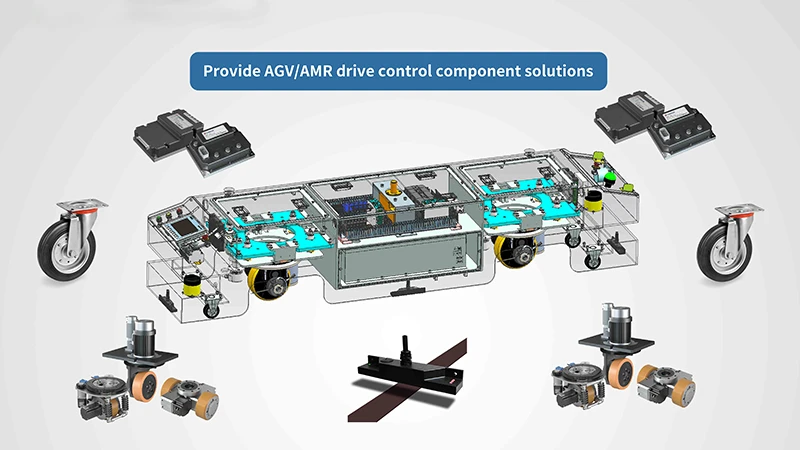
What Is the PLT-120 Differential Drive Wheel?
The PLT-120 is a differential drive wheel manufactured by Plutools, a Shanghai-based company that specializes in AGV and AMR drive systems. It is a compact drive unit rated for a 150 kg drive wheel load and 400 W rated power at 48 V. Its low weight of 5 ± 2 kg and its IP65 protection level make it suitable for lighter mobile robots that may operate in dusty or damp indoor environments.
Key verified parameters of the PLT-120 include:
- Rated Power: 400 W
- Rated Voltage: 48 V
- Rated Current: 11.2 A
- Rated Speed: 3000 rpm
- Rated Torque: 1.28 Nm
- IP Protection Level: IP65
- Drive Wheel Load: 150 kg
- Total Weight of Drive Wheel: 5 ± 2 kg
- Transmission Ratio: 9, 20
- Rated Output Torque: 10, 21 Nm
- Maximum Acceleration and Braking Torque: 20, 42 Nm
- Material: Carbon steel
What Is the PLT-210 Parallel Horizontal Drive Wheel with Steering?
The PLT-210 is a parallel horizontal drive wheel with steering, designed for heavier material-handling equipment. It is classified as a forklift drive wheel and carries a maximum load rating of 1200 kg. With 3000 W rated power at 48 V and an output torque of 260 Nm, it is substantially more powerful than the PLT-120 and is intended for vehicles that need to move heavy payloads while maintaining steering capability.
Key verified parameters of the PLT-210 include:
- Rated Voltage: 48 V
- Power: 3000 W
- Rated Current: 68 A
- Speed: 3000 RPM
- Rated Torque: 9.55 Nm
- Reduction Ratio: 32
- Output Torque: 260 Nm
- Max Torque: 576 Nm
- Max Load: 1200 kg
- Material: Carbon steel
PLT-120 vs PLT-210: Specification Comparison
The two models differ most clearly in power, load capacity, torque, and mechanical configuration. The PLT-120 is a differential drive wheel, while the PLT-210 is a parallel horizontal drive wheel with steering capability. These are not interchangeable parts; they serve different vehicle architectures and payload classes.
| Parameter | PLT-120 | PLT-210 |
|---|---|---|
| Product Type | Differential Drive Wheel | Parallel Horizontal Drive Wheel with Steering |
| Rated Power | 400 W | 3000 W |
| Rated Voltage | 48 V | 48 V |
| Rated Current | 11.2 A | 68 A |
| Rated Speed | 3000 rpm | 3000 RPM |
| Rated Torque | 1.28 Nm | 9.55 Nm |
| Reduction Ratio | 9, 20 | 32 |
| Rated Output Torque | 10, 21 Nm | 260 Nm |
| Max Torque | 20, 42 Nm (acceleration/braking) | 576 Nm |
| Max Load | 150 kg (drive wheel load) | 1200 kg |
| IP Protection | IP65 | Not specified in verified unit data |
| Material | Carbon steel | Carbon steel |
When reviewing these specifications, buyers should note that the PLT-120 is rated with a drive wheel load of 150 kg, whereas the PLT-210 is rated with a maximum load of 1200 kg. The PLT-210 also delivers a significantly higher rated output torque of 260 Nm compared with 10 or 21 Nm for the PLT-120, reflecting its intended use in heavier forklift-type applications.
Design and Configuration Differences
The PLT-120 is a differential drive wheel, which means it is typically used in pairs to drive a vehicle by varying the relative speed of the left and right wheels. Differential drive configurations allow for turning by speed differential and are common in smaller logistics robots and AMRs. The PLT-120's compact design and low weight of 5 ± 2 kg make it easier to integrate into chassis with limited space.
The PLT-210 is a parallel horizontal drive wheel with steering. In this configuration, the wheel is mounted horizontally and the drive module includes a steering mechanism. This type of drive wheel is often used in automated forklifts and heavy AGVs where the vehicle must combine traction with active steering in a single drive unit. The parallel horizontal layout also helps maintain a low vehicle profile and a low center of gravity, which can improve stability during travel.
Which Applications Suit the PLT-120?
Given its 150 kg drive wheel load, 400 W power, and IP65 rating, the PLT-120 is appropriate for lighter AMRs, small AGVs, and other compact mobile robots operating in indoor logistics or warehouse environments. Its IP65 protection level means it is protected against dust ingress and low-pressure water jets, so it can tolerate dusty workshops or areas where floors are occasionally washed.
Typical roles for a 150 kg-class differential drive wheel include:
- Small warehouse AMRs transporting components or bins
- Latent lifting robots with relatively light payloads
- Compact inspection or delivery robots
- AGVs operating on relatively smooth indoor floors
Which Applications Suit the PLT-210?
The PLT-210 is designed for heavier duty cycles. With a 1200 kg max load and 3000 W rated power, it suits automated forklifts, heavy AGVs, narrow-aisle transport vehicles, and other material-handling equipment that must carry palletized loads. The steering function makes it suitable for vehicles that need to change direction frequently in confined aisles.
- Automated forklifts
- Heavy-load AGVs
- Narrow-aisle transport vehicles
- Other mobile platforms requiring high torque and steering integration
Trade-offs and Limitations
Although the PLT-210 has a much higher load and torque capacity, it is not inherently a better drive wheel for every project. A 1200 kg-class drive wheel is larger and heavier than a 150 kg-class unit, which can complicate integration into compact vehicle chassis. It also requires more electrical current (68 A versus 11.2 A), meaning the vehicle's battery and motor controller must be sized accordingly.
Conversely, the PLT-120's lower load capacity means it is not suitable for heavy pallet transport or forklift applications. Buyers who need to move loads approaching or exceeding 1 tonne should not attempt to use the PLT-120 simply because it is lighter or less expensive. The correct choice depends on the vehicle's total mass, payload, floor conditions, duty cycle, and required maneuverability.
Long-Term Supply and Integration Considerations
The PLT-120 and PLT-210 are manufactured by Shanghai Plutools Automation Corporation Co., Ltd., a company founded in 2017 and headquartered in Shanghai, China. Plutools specializes in AGV/AMR mobile robots and core motion control technologies. Its manufacturing facility covers 10,000 square meters, employs approximately 100 staff, and has an annual production capacity of 10,000 units. The R&D team consists of 60 engineers, and the company has obtained more than 200 patent technology certifications.
For buyers evaluating these components as part of a long-term AGV or AMR program, supplier reliability matters as much as the component specification. Plutools exports to the EU, USA, Southeast Asia, South America, Middle East, Japan, and South Korea, with exports accounting for 70% of total sales. The company also publishes a selection handbook that can help engineers match drive wheel models to vehicle requirements.
Market Context
The demand for AGV drive wheels is growing alongside the broader mobile robot market. According to Reports and Data, the global AGV Wheel Drives market was valued at approximately USD 1.2 billion in 2024 and is projected to reach USD 3.5 billion by 2034, growing at a CAGR of 11.5%. This growth is driven by logistics and warehouse automation, as well as by the increasing adoption of electric and automated forklifts. In this context, understanding the difference between a 150 kg-class differential drive wheel and a 1200 kg-class horizontal steering drive wheel helps buyers specify the correct component for each vehicle program.
Decision Framework for Buyers
When choosing between the PLT-120 and PLT-210, buyers should ask the following questions:
- What is the total vehicle weight plus maximum payload?
- Does the vehicle require differential drive or steering drive?
- What is the available chassis space and mounting geometry?
- What voltage and current can the vehicle's electrical system provide?
- What IP rating is required by the operating environment?
- What is the expected duty cycle and required service life?
If the application is a lightweight AMR with a 150 kg-class wheel load and IP65 protection is needed, the PLT-120 is the relevant candidate. If the application is an automated forklift or heavy AGV carrying up to 1200 kg, the PLT-210 is the appropriate model to evaluate. Selecting a drive wheel is not about choosing the highest specification; it is about matching the drive unit to the vehicle's architecture and mission profile.
FAQ
What is the difference between a differential drive wheel and a horizontal drive wheel with steering?
A differential drive wheel is used in pairs to drive a vehicle by speed difference, while a horizontal drive wheel with steering integrates both traction and steering into one unit. The PLT-120 is a differential drive wheel, whereas the PLT-210 is a parallel horizontal drive wheel with steering.
Can the PLT-120 be used in a heavy-load AGV?
The PLT-120 has a drive wheel load rating of 150 kg and 400 W rated power. It is not designed for heavy loads up to 1200 kg; the PLT-210 is the model intended for that load class.
Which Plutools drive wheel is suitable for an automated forklift?
The PLT-210 is classified as a forklift drive wheel and has a max load of 1200 kg, with 3000 W rated power and 260 Nm rated output torque. It is the model to evaluate for automated forklift applications.
What IP rating does the PLT-120 have?
The PLT-120 has an IP65 protection level, which means it is protected against dust and low-pressure water jets. The verified product data for the PLT-210 does not include an IP rating.
Are the PLT-120 and PLT-210 interchangeable?
No. They differ in load capacity, power, torque, and mechanical configuration. The PLT-120 is a differential drive wheel for lighter robots, and the PLT-210 is a parallel horizontal drive wheel with steering for heavier material-handling vehicles.
For further product selection guidance, Plutools provides a public selection handbook that lists drive wheel specifications and mounting options: PLT Selection Handbook 2026.03.26.
Have Questions or Need More Details?
Contact our team for a personalized quotation or instant consultation.
Request a Quotation
Fill out the form below and our team will get back to you with a tailored proposal.
WhatsApp Direct Chat
Prefer to chat in real-time? Message us on WhatsApp for instant assistance & quick answers.
- Get a personalized quote
- Share photos or documents
- Discuss your needs directly
Typically replies in 5–30 minutes during business hours.