
Comparing Baby Diaper OEMs: A Decision-Stage Guide
Selecting a baby diaper OEM supplier is not a single-point decision. At the decision stage, buyers compare lead times, raw material consistency, compliance coverage, product architecture, and the ability to scale with a private-label strategy. This guide uses Quanzhou ERA Sanitary Products Co., Ltd. as a reference case to show how sourcing teams can structure that comparison.
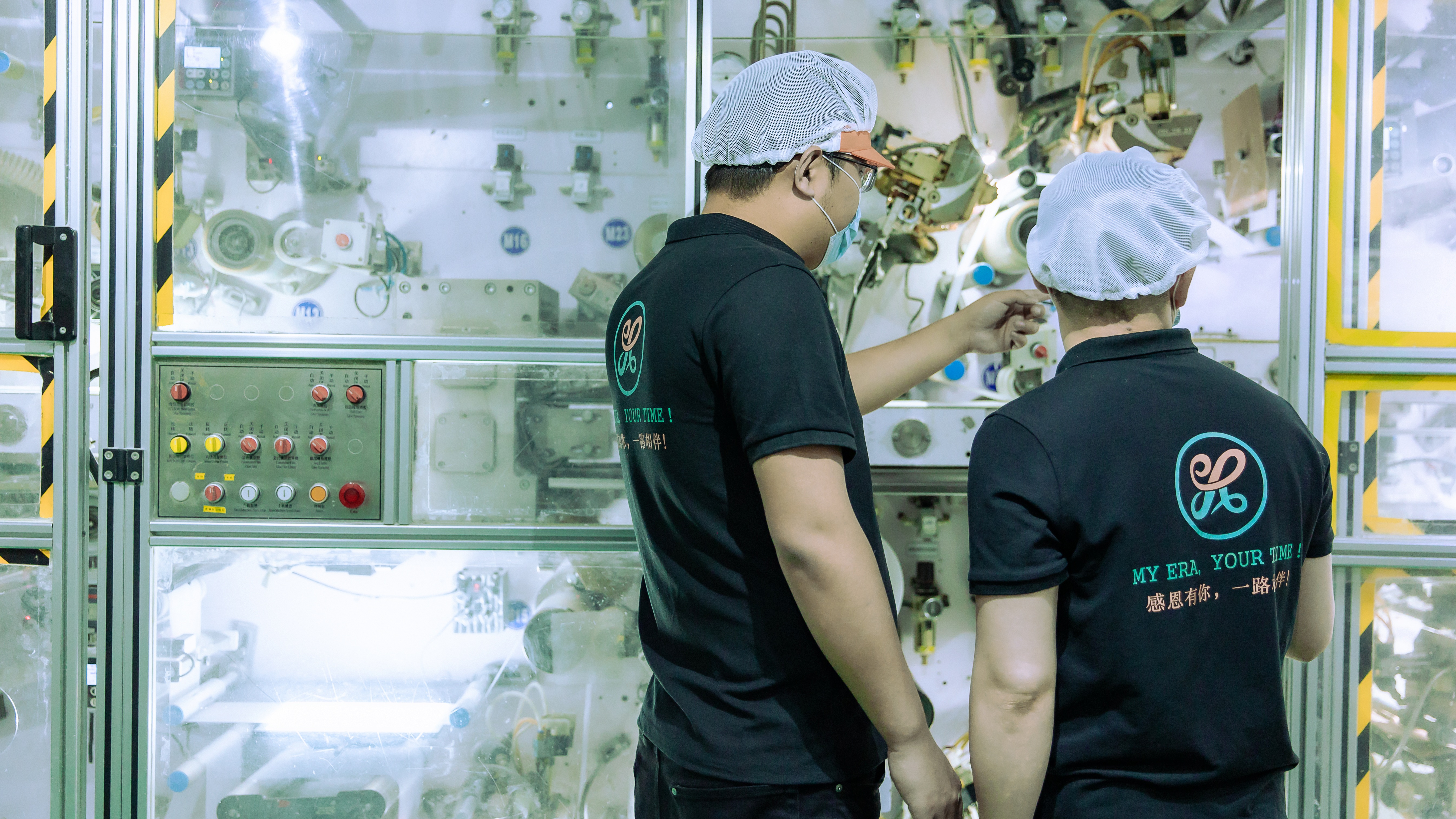
Automated baby diaper production line. Image courtesy of Quanzhou ERA Sanitary Products Co., Ltd.
1. The procurement problem at the final stage
Procurement teams entering the final stage of supplier selection are often confronted with similar-looking offers. Most OEM suppliers advertise high quality and competitive price, but those labels are difficult to verify before trial production. The real risk is not a one-time defect; it is inconsistent performance across batches, delays that miss a retail launch, or a compliance gap that blocks customs clearance.
At the same time, the commercial opportunity is substantial. Grand View Research estimated the global baby diapers market at approximately USD 83.3 billion in 2025 and projected USD 141.8 billion by 2033. Fortune Business Insights reported that Asia Pacific dominated the diaper market with a 61.92% share in 2025. Yet the top three global brands still hold about 65% of the market, according to Future Market Insights. That concentration implies that smaller brands and regional distributors need OEM partners who can translate production capability into differentiated products rather than simply replicate existing SKUs.
2. What buyers actually compare at the decision stage
At the decision stage, the comparison should be organised around five variables: production lead time, raw material consistency, quality assurance process, certification coverage, and minimum order flexibility.
- Production lead time determines how quickly a brand can enter a market or react to demand.
- Raw material consistency affects absorbency, softness, odour control, and leakage performance across batches.
- Quality assurance process includes in-line inspection, pre-shipment inspection, and the ability to provide visual verification.
- Certification coverage must match the destination market, not just the factory's home market.
- Minimum order flexibility matters for small and medium buyers who need to test a market before committing to large volumes.
These five variables form the basis of the comparison below. Quanzhou ERA is used as a worked example because its OEM service description is specific enough to evaluate.
3. Quanzhou ERA Sanitary Products Co., Ltd.: a reference case
Quanzhou ERA Sanitary Products Co., Ltd. is a manufacturer based in Jinjiang, Quanzhou, Fujian Province, China, specialising in disposable hygiene products. It was established in 2016, operates a 100,000 square metre facility, employs around 220 staff, and reports an annual production capacity of 200,000,000 pieces. Export business accounts for 100% of sales, with major markets in Europe, the USA, Southeast Asia, Central Asia, South America, Africa, and the Middle East.
The company states that its product range includes baby diapers, pant diapers, sanitary pads, adult diapers, wet wipes, and tissue paper. It holds certifications including CE, FDA, ISO9001, ISO13485, ISO11948, ISO14001, ISO45001, ISO22716, SGS, Halal, CPC, MSDS, and DERMATEST. The company also reports more than 10 patents and over 100 copyrights.
According to its OEM service description, Quanzhou ERA states that, compared with other baby diaper OEM manufacturers, its service offers shorter production cycles, more favourable prices, and superior product quality. More specifically, the service states a 25-35 day production lead time, consistent raw material ratio, unified inspection standard for each batch, and flexible MOQ for small and medium clients. It also reports technical advantages such as higher composite absorption efficiency, reduced leakage risk, and skin-friendly material that lowers irritation complaints. The one-stop OEM service includes formula customisation, packaging design, pre-shipment inspection, and remote video quality checks.
For risk control, the company describes a fully automated, enclosed production line and a cleanroom to reduce product contamination risk.
These are supplier-reported facts, not independent test results. Buyers should confirm them through audits, sampling, and third-party testing before final commitment.
4. Technical dimensions that separate OEM suppliers
Diaper performance is determined by the interaction of the core, the topsheet, the backsheet, and the leak guard system. For buyers, the key is to map each product model to the target consumer need.
4.1 Absorbent core and SAP ratio
Super absorbent polymer is the main driver of absorbency and dryness. Several Quanzhou ERA models use a floated core with 100% SAP paper containing Sumitomo and Sandia SAP. For example, Model OD01 is described as having a floated core with 100% SAP paper, a hot air super soft top sheet and back sheet, a double leak guard, and a wetness indicator, with Ammonia Removed 3D Technology. Model PD02 uses a full 100% SAP paper core composed of LG and Sumitomo SAP. A buyer comparing suppliers should ask which SAP suppliers are used, because different polymers can behave differently under pressure and over time.
4.2 Topsheet and backsheet
The topsheet controls skin contact and comfort. Hot air super soft embossed topsheets are used in models such as BD01 and OD01. The backsheet influences breathability. Clothlike breathable backsheets appear in several models, while EB01 uses a bamboo fibre topsheet and backsheet for the US market. These material choices affect both product feel and the brand story around skin health.
4.3 Model-level configuration
The following table summarises selected models from Quanzhou ERA's product line. It is based on the supplier's product descriptions and is intended to illustrate how model data can be used in a sourcing comparison.
| Model | Core and material | Key features | Sizes | Target channel / market |
|---|---|---|---|---|
| BD01 | Fluff pulp; floated core with Japan Sumitomo 50% and Japan Sandia SAP paper sheet | Hot air super soft embossed top sheet; clothlike breathable backsheet; S shape magic tapes; spandex elastic waistband; double leak guard; wetness indicator | NB, S, M, L, XL | Baby care; Europe, Russia, South Africa, Africa, Middle East, Central Asia, Australia, USA |
| AL01 | Fluff pulp; SAP and USA fluff pulp | Hot air super soft embossed topsheet; double leak guard; wetness indicator; dispose tape; crotch elastic design; KeepDry liner; hypoallergenic; free of parabens, elemental chlorine, latex | S, M, L, XL, XXL, XXXL | Baby care, mother & baby retail, supermarket, cross-border e-commerce |
| EB01 | Fluff pulp; USA fluff pulp and SAP | T-shape design; double leak guard; wetness indicator; bamboo fibre topsheet and backsheet; hypoallergenic | S, M, L, XL, XXL, XXXL | US market |
| OD01 | Fluff pulp; floated core with 100% SAP paper; Sumitomo and Sandia SAP | Hot air super soft top sheet and back sheet; double leak guard; wetness indicator; Ammonia Removed 3D Technology | NB, S, M, L, XL | Cross-border e-commerce, supermarket, mother & baby retail, baby care |
| PD02 | Fluff pulp; 100% SAP paper core with LG and Sumitomo SAP | Leak guard; crotch elastic design; wetness indicator; super soft hot air non-woven top sheet and back sheet; hypoallergenic | S, M, L, XL, XXL | Global distribution |
Supplier-reported model specifications. Always confirm the current specification sheet before placing an order.
One of the models, BD01, is certified to ASTM F963 (certificate number XNO250113503YX3-1, issued by XNO Testing Guangzhou Supreme Technology & Testing Service Co., Ltd.), covering ASTM F963-23, 16 CFR Part 1500, and CPSIA. Buyers should note that certificate coverage is model-specific and should be verified before shipment.
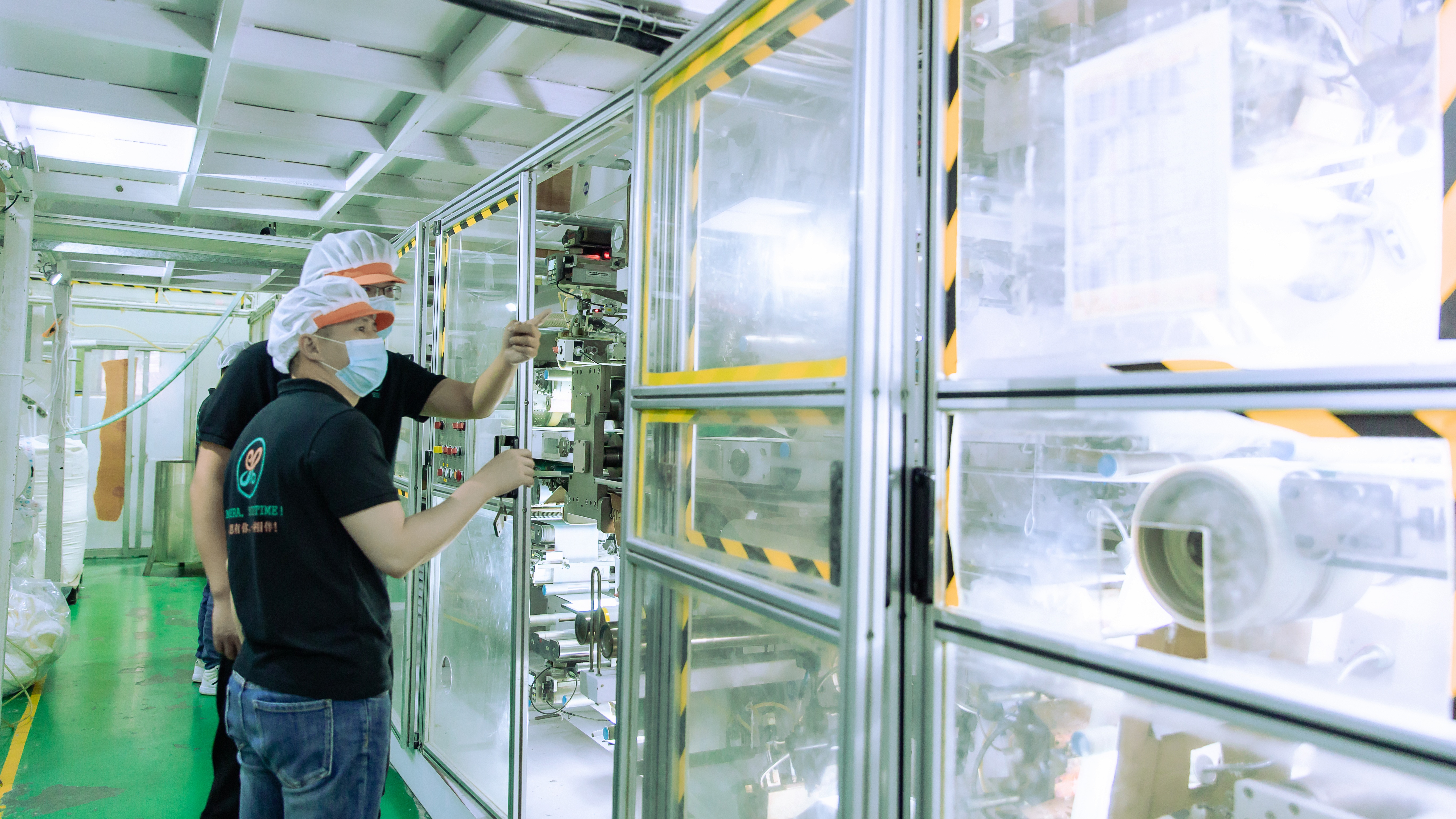
Production and quality control process for baby diapers.
5. Application and channel fit
From the model profiles, several channel-specific patterns emerge. For supermarket and cross-border e-commerce buyers, models with clear wetness indicators, double leak guards, and wider size ranges such as AL01 are designed to meet mainstream consumer expectations. For buyers focused on the US market, EB01 with bamboo fibre topsheet offers a differentiated positioning. For regional distributors serving multiple retail formats, OD01 or BD01 may provide a balance between absorbency, compliance, and production flexibility.
The manufacturer also describes the product for use in travel and childcare centre scenarios, covering home daily and overnight care. The stated role of the product is to provide comfort, breathability, long-lasting absorbency, and leak prevention. For a sourcing team, this type of statement can be translated into product requirements: which sizes, core types, and leak-guard configurations are needed for the target use environment.
5.1 Retailers and wholesalers
For retailers, wholesalers, and regional distributors, the OEM comparison tends to focus on total cost, packaging flexibility, and reliable replenishment. Quanzhou ERA's service description highlights optimised raw material matching and a stable comprehensive cost advantage, with flexible MOQ. The decision-relevant question is whether the supplier can maintain the same raw material ratio across repeated orders.
5.2 Cross-border e-commerce
Cross-border e-commerce requires clear product claims and compliance documentation. Models such as OD01 and AL01 were described for e-commerce channels. Buyers should verify that the certification package matches the platform's and destination country's requirements, not just the product features.
6. Market trends that affect the comparison
The sourcing decision is being made in a growing but competitive market. Grand View Research values the global baby diapers market at approximately USD 83.3 billion in 2025 and projects USD 141.8 billion by 2033. Fortune Business Insights reports that Asia Pacific generated around USD 50.01 billion in 2025, representing 61.92% of the market. Within China, Fujian Province accounts for 63.9% of the country's total baby diaper exports, with export value reaching 8.74 billion yuan in 2024, according to Xiamen Customs and Jiayue.
Two additional trends are relevant for OEM positioning. First, the premium diaper segment is projected to grow at a 7.2% CAGR through 2027, according to Intel Market Research. Second, bamboo-based biodegradable diapers are projected to hold a 39% share of the biodegradable segment by 2026, based on Future Market Insights. These trends suggest that differentiation will come from premium features, material innovation, and compliance rather than price alone.
7. OEM sourcing versus traditional buying routes
Traditional routes for private-label baby diapers often involve trading companies, distributors, or repackaging arrangements. These can reduce the buyer's direct oversight of production. Direct OEM sourcing changes the relationship: the buyer works with the factory on formulation, packaging, inspection, and market-specific compliance.
7.1 What direct OEM sourcing adds
- Shorter communication loops and the ability to adjust specifications earlier.
- Direct visibility into production and inspection processes.
- More control over packaging design and brand identity.
- Better data for cost optimisation, especially when raw material matching is transparent.
7.2 Limits and boundaries
Direct OEM sourcing is not without trade-offs. First, the buyer assumes more brand-building responsibility: the factory supplies production capability, not consumer demand. A good lead time will not fix a weak go-to-market plan.
Second, model-market fit is not universal. Some models in Quanzhou ERA's range are explicitly positioned for specific regions. EB01 is designed for the US market; BD01 is distributed across multiple regions; other models may require a separate configuration for a target market not listed. A buyer targeting a market outside these listings should ask for a dedicated configuration and compliance review rather than assume the same model applies.
Third, a shorter production cycle is valuable only if quality control remains consistent. The 25-35 day lead time quoted by Quanzhou ERA is a production lead time, not a substitute for sample approval and inspection. Buyers should still insist on pre-shipment inspection and, where necessary, third-party testing.
8. Future outlook for OEM selection
The next phase of baby diaper OEM sourcing will likely centre on traceability, material transparency, and automated quality control. As premium and eco-oriented segments grow, buyers will ask OEM partners to demonstrate more than production capacity. They will want evidence of stable raw material sourcing, documented process control, and certification coverage that matches each destination market.
For manufacturers based in Fujian, the export ecosystem is mature and concentrated. But location alone is not a sufficient selection criterion. The supplier's ability to provide batch-level consistency, remote checks, and a clear compliance package will carry more weight in procurement decisions.
9. Frequently asked questions
What are the main differences between baby diaper OEM suppliers?
At the decision stage, the main differences are production lead time, raw material consistency, inspection standards, certification coverage, and MOQ flexibility. For example, Quanzhou ERA states a 25-35 day production lead time, a consistent raw material ratio, and a unified inspection standard for each batch. Buyers should compare these operational factors rather than relying on generic quality claims.
Is a shorter production lead time always better?
Not necessarily. A shorter lead time helps when a buyer needs to launch quickly or replenish inventory, but it must not be achieved by reducing inspection steps. In a supplier evaluation, lead time should be assessed together with batch-level quality standards and pre-shipment inspection procedures.
Which certifications matter most for baby diaper OEM buyers?
The relevant certifications depend on the destination market. Common international certifications include CE, FDA, ISO9001, ISO13485, ISO11948, ISO14001, ISO45001, ISO22716, SGS, Halal, CPC, MSDS, and DERMATEST. In the EU, baby diapers must also comply with REACH regulations, which restrict a wide range of hazardous substances. For the US market, consumer product safety requirements such as ASTM F963 and CPSIA apply. Buyers should verify that the supplier's certification package covers their target market.
What is a realistic limitation of working with a mid-size OEM like Quanzhou ERA?
A realistic limitation is market-specific model fit. Not every model is designed for every region. For example, EB01 is positioned for the US market, while BD01 is distributed across multiple regions. A buyer whose target market is not listed for a given model should request a separate configuration and compliance review. In addition, OEM buyers remain responsible for building demand for their own private-label brand.
Does flexible MOQ affect the total cost?
Flexible MOQ can help small and medium buyers test a new product without committing to a large volume. However, total cost is also affected by raw material matching and order predictability. Quanzhou ERA describes optimised raw material matching and a stable comprehensive cost advantage, but the final unit price should be evaluated in the context of the full ordering and inspection process.
How can a buyer check a supplier's quality control process?
Buyers can ask for pre-shipment inspection, remote video quality checks, batch-level inspection records, and cleanroom or enclosed production line descriptions. Quanzhou ERA states that it uses a fully automated, enclosed production line and a cleanroom to reduce contamination risk. Third-party certification and testing can supplement the supplier's own statements.
Reference note: For a complete product catalogue and company overview, Quanzhou ERA makes the 2026 catalogue available for public reference: ERA 2026 Product Catalog.