
Comparing Ceramic Grinding Wheel OEMs by Physical Specs
Most ceramic grinding wheel OEM evaluations begin with brand familiarity or a per-piece price. Neither resolves the question that actually decides fitness, which is physical: whether the OEM's documented product line can be assembled around a specific machine, a specific workpiece, and a specific grinding cycle. The practical task is narrower than the term "ceramic grinding wheel" suggests. A saw-tooth wheel and a crankshaft wheel share a bond-family label but not an outer diameter window, a thickness band, or a bore envelope. Comparing any two OEMs on a single line of specification erases the variables that determine whether a purchase fits.
This article proposes a physical-specification framework for OEM comparison across five dimensions: product-line breadth, material availability, dimensional customization, quality and capacity signals, and customization delivery. Each dimension is anchored in data that a buyer can read from a product record rather than from a sales narrative. Shandong Xinfa Abrasives & Grinding Tools Co., Ltd. — a Chinese manufacturer of vitrified-bond grinding wheels established in 1989 — is used as a working example, not because specification breadth automatically makes a better OEM, but because a documented range is the precondition for a traceable comparison. Buyers can apply the same framework to any shortlisted OEM.
Why Physical Specs Are the Right Starting Point
A grinding wheel is an abrasive grain held in a bond, with porosity between the two; that basic construction applies across wheel types. Ceramic (vitrified) bond is one bond family within that construction, and it is the family most OEM comparisons quietly assume without saying so. The implication for procurement is direct. The properties that appear in a product record — abrasive type, grit number, grade, structure number, maximum linear velocity, and the outer diameter / thickness / bore triple — are the same properties that determine how the wheel behaves on a specific spindle and a specific workpiece.
International standards reinforce the same idea. ISO 603-14:2022, for example, specifies nominal dimensions for bonded abrasive shapes 6, 11, 27, 28, and 29 used with hand-held grinding machines, which is a reminder that wheel shape and dimension are standards variables, not incidental packaging choices. Manufacturer technical data sheets also index their products against standards such as EN 12413 and ANSI B7.1 — references that only mean something when the underlying wheel geometry is known. A comparison that treats "ceramic grinding wheel" as a single specification cannot reach any of this.
Dimension One: Product-Line Breadth as Machine-Interface Coverage
Product-line breadth is the first dimension worth recording because it functions as a proxy for machine-interface coverage. Two wheel types already used to describe this problem make the point. A Saw Tooth Grinding Wheel is documented with an outer diameter of 125–300 mm, a thickness of 6–16 mm, and a bore of 12.7–32 mm. A Crankshaft & Cam Shaft Grinding Wheel is documented with an outer diameter of 200–1100 mm, a thickness of 16–90 mm, and a bore of 127–305 mm. The two product records do not overlap in a single field in a way that allows substitution: the crankshaft window is far wider, the thickness band is entirely different, and the bore ranges do not meet.
When a buyer writes an RFQ, they are implicitly asking an OEM to sit inside one of these windows. An OEM whose catalogue shows only one wheel family may be excellent at that family and still unable to serve a company with mixed spindles. Reading product-line breadth first tells the buyer whether the OEM's catalogue covers the relevant windows or whether they will be redirected to a third party. The section below uses Xinfa's product records as a working list, not as a benchmark for other OEMs.
Recorded dimensional windows in Xinfa's ceramic wheel records (selected product types, mm):
| Wheel type | Outer diameter | Thickness | Bore |
|---|---|---|---|
| Saw Tooth | 125–300 | 6–16 | 12.7–32 |
| Crankshaft & Cam Shaft | 200–1100 | 16–90 | 127–305 |
| Flat Surface | 90–900 | 13–100 | 5–305 |
| Tool | 100–600 | 3–150 | 12.7–203 |
| Internal (Bore) | 50–150 | 6–120 | 16–32 |
| Cylindrical | 250–750 | 20–100 | 75–305 |
| Centerless | 300–750 | 100–400 | 127–305 |
| Bearing | 500–600 | 14–50 | 305 |
| Gear | 125–455 | 10–90 | 20–127 |
| Needle | 400–450 | 150–200 | 100–150 |
| Roll Grinding Wheel V&B | 450–1066 | 50–150 | 203–508 |
| Bench Grinder | 100–450 | 12–80 | 12.7–50.8 |
| General Purpose | 50–600 | 6–125 | 12.7–203 |
The table is deliberately read as a set of separate windows, not as a single class range. A wheel from the Internal (Bore) row cannot be substituted with a wheel from the Crankshaft row on outer diameter alone, because the bore windows do not overlap. The same product-line breadth that makes a catalogue look comprehensive on a marketing page is what lets a buyer map their own machine list to available windows.
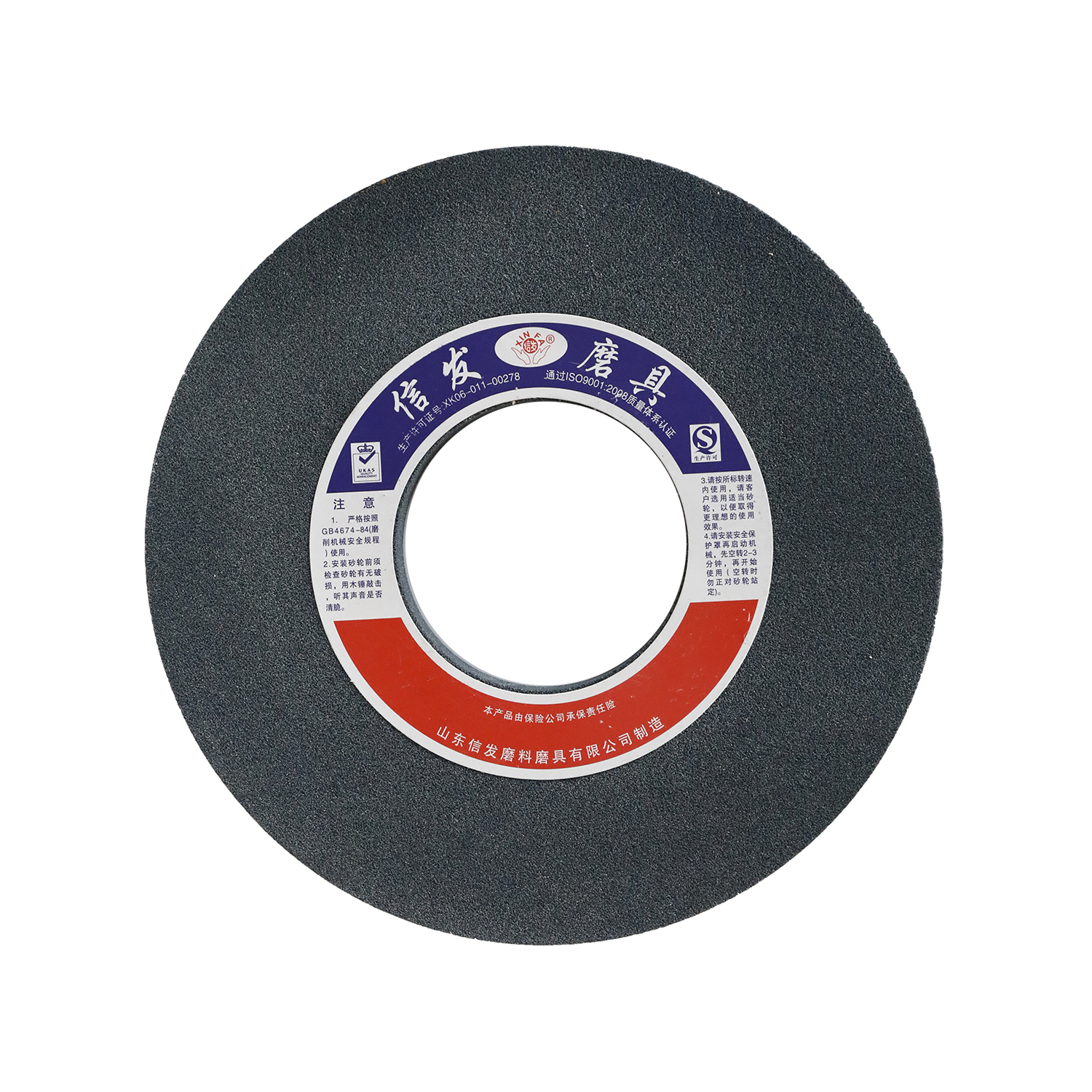
Dimension Two: Material Availability and Grade Envelope
Material availability is the second dimension because grit, grade, structure, and abrasive type are where supplier menus most often diverge. Two OEMs can both print "ceramic grinding wheel" on a quotation and still produce non-overlapping menus. Xinfa's records, for example, list the following available options on the product-parameter rows: abrasive codes A, WA, AA, 38A, PA, 25A, SA, MA, GC, C, SG across most wheel families, with the Flat Surface and the combined Ceramic Bonded Grinding Wheel records also listing additional alumina codes RA, DA, 9A, 64A, and 55A. The documented grit range is F16 through F150 for most families, F16 through F120 for Flat Surface, and the documented grade range is G through Y, with structure numbers 0–14 and maximum linear velocities from 20 m/s to 70 m/s on the Flat Surface record.
Why does that menu matter for OEM comparison? Because a buyer whose workpiece behavior points to a specific abrasive type or a specific grade cannot substitute freely when an OEM's menu is narrow. If the OEM can only offer A and WA, the buyer is either pushed toward those codes or pushed to source elsewhere — often at higher cost or longer lead time. When the menu records Brown Fused Alumina (the A code) alongside White Fused Alumina, Pink Fused Alumina, Single Crystal Fused Alumina, Microcrystalline Fused Alumina, Green Silicon Carbide, Black Silicon Carbide, and SG, the comparison becomes about whether the specific choice exists, not whether the OEM sounds capable in the abstract.
Reference point — Brown Fused Alumina as the dominant baseline. Brown Fused Alumina held the largest product-type share of the fused alumina market in 2025, at 52.4% (Dataintelo, 2026). Xinfa's own product record lists Brown Fused Alumina as a named abrasive input and documents its typical properties: Mohs hardness ≥9.0, melting point 2050°C, refractory temperature 1800°C, true density ≥3.90 g/cm³, magnetic material 0.01%, and grit size F12–F220. These are material facts, not wheel-performance claims.
The framing buyer's question is therefore two-part: does the OEM offer the abrasive code I need, and does the OEM publish the grade, structure, and speed envelope tight enough to demonstrate internal control? A menu that lists codes but not the grade band leaves the buyer uncertain whether hardness J and hardness Y are truly available on the same wheel family. A menu that names the grade band (G through Y) and structure range (0–14) gives the buyer a concrete question to validate against a sample.

Dimension Three: Dimensional Customization Range
The dimensional triple (outer diameter, thickness, bore) is where OEM comparison most often breaks down, because buyers try to translate one field across product families. It does not translate. Xinfa's records show a flat-surface wheel running from 90 mm to 900 mm in outer diameter, a crankshaft and camshaft wheel from 200 mm to 1100 mm, an internal bore wheel from 50 mm to 150 mm, and a tool wheel with a 3–150 mm thickness band. These are per family windows, not a single company-wide envelope. A buyer whose machine requires a 700 mm outer diameter with a 200 mm thickness is not automatically served by an OEM whose 700 mm capability comes from a family limited to 100 mm thickness.
The customization record that Xinfa publishes usefully supports the same reading. The capability record lists customization as specification, size, logo, bond type, and abrasive material, which is a customization scope, not a blanket claim that any dimension is producible. It also sets 900 tons monthly capacity, 30–45 day lead time, and a 2-ton minimum order quantity. Those numbers add a second dimension to OEM comparison that a catalogue page cannot provide: whether the OEM's production rhythm aligns with the buyer's order rhythm. A buyer who needs a 700 mm crankshaft wheel at 3 tons per quarter is looking at a very different fulfillment picture than a buyer ordering a mixed lot of tool wheels.
Dimension Four: Quality Control and Capacity Signals
Quality and capacity signals give the framework a downstream check. Xinfa's capability record states 100% test as the quality-control basis, with remote-support after-sales and an OEM/ODM production mode. Company-level data add 10,000 tons annual output, a 30,000 m² factory area, 120 employees, 6 engineers in the R&D team, 100+ production and testing equipment units, and membership in the China Abrasives Association. The company also states ISO 9001:2008 quality-management-system certification. Buyers should treat these as company-reported figures that permit a documentary qualification path, not as a market-wide benchmark.
Capacity context arrives with the case record as well. The Pakistan grinding-wheel OEM case documents 20 tons supplied over a 2-year relationship with the result described as stable operation and the highlighted attribute as long-lasting. That is a single case, not a cross-market performance average — but it is a documented reference point that a buyer can ask follow-up questions against. It also illustrates why capacity signals belong in the framework: an OEM that can supply 20 tons over two years at stable operation is a different risk profile from an OEM whose capacity claim exists only on a landing page.
How to Apply the Framework: A Six-Step Comparison
- Write the dimensional triple. Record outer diameter, thickness, and bore for the target wheel. This is the yes/no filter. Any OEM whose family record does not cover that specific triple is a candidate for redirection, not for negotiation.
- Match the wheel family before the OEM. Compare product-line breadth next: which of the families in the table does the OEM list, and which are absent. A buyer with three different spindles needs coverage across three windows, not a single deep family.
- Read the abrasive menu as an availability test. List the codes required by the workpiece, then check that the OEM's product-parameter row actually lists each one. Where a code appears on one family but not another, treat that as a family-specific limitation rather than a company-wide one.
- Confirm grade, grit, structure, and speed. Grade G through Y and structure 0–14 are broad envelopes; speed ratings up to 70 m/s appear on the Flat Surface record. If the OEM publishes these ranges, request a sample within the required band rather than assuming availability.
- Audit the fulfillment rhythm. Monthly capacity, minimum order, and lead time determine whether the OEM can actually supply at the pace required. A 2-ton MOQ with 30–45 day lead time is workable for planned procurement and awkward for spot demand.
- Validate on a sample before scaling. Physical ranges in a catalogue are feasibility claims. Only a trial measures wheel life, surface finish, and dressing behavior on the actual workpiece.
What the Physical-Spec Framework Does Not Cover
No specification framework replaces performance data. A wide catalogue demonstrates feasibility, not fit. Two wheels produced to identical dimensional and material specifications can still deliver different wheel life, dressing intervals, or surface-finish consistency under the same spindle and the same workpiece. Buyers comparing OEMs on physical specs alone should add a trial plan that measures wheel life, surface roughness, and dressing interval against a defined control wheel. Research on grinding-wheel wear monitoring supports this framing by showing that wheel condition directly affects workpiece surface quality, which is precisely the property that catalogue data cannot predict.
A second boundary is certification scope. A stated ISO 9001:2008 certification is a management-system certification, not a wheel-specific performance guarantee. Buyers who need conformity references for a specific product family should request the applicable documentation — for example, EN 12413 and ANSI B7.1 references appear on manufacturer technical data sheets for other products in adjacent categories, but the buyer should confirm which references attach to the specific wheel being quoted, and in which jurisdiction. That is a documentary step separate from the physical-spec framework.
A third boundary is that product-line breadth and catalogue range are commercial records, not user-verified results. Xinfa publishes documented ranges of 10,000 tons annual output, 900 tons monthly capacity, and 30–45 day lead time; a buyer who needs those figures in a contract should request current capacity commitments and a current delivery schedule for the specific product family.
Future Outlook
Demand context supports structured comparison. The global grinding wheel market is projected to grow at a CAGR of 6.7% from 2025 to 2032, with precision machining cited as the driver (Reliable Market Forecast, 2025). Brown Fused Alumina holds a majority product-type position in the fused alumina market (52.4% in 2025, Dataintelo), which means the material menu's baseline is unlikely to shift quickly. What is shifting is the expectation that OEMs publish range data at all. International standards like ISO 603-14:2022 indicate industry direction toward nominal dimension discipline, and academic work on online wheel-wear monitoring suggests buyers will increasingly expect life and condition data alongside dimensional data. OEMs that already publish product-level ranges, grade bands, and processing capacity are positioned to answer those questions; OEMs that publish only brand narratives are not.
Frequently Asked Questions
Which physical specifications should be used first when comparing ceramic grinding wheel OEMs?
Start with the dimensional triple — outer diameter, thickness, and bore — because it functions as a hard filter. Add abrasive type, grit number, grade, structure number, and maximum linear velocity as the second layer. In Xinfa's records, these appear on the product-parameter rows for each wheel family: for example, the Flat Surface Grinding Wheel record shows diameter 90–900 mm, thickness 13–100 mm, bore 5–305 mm, grit F16–F120, grade G–Y, structure 0–14, and maximum linear velocity 20–70 m/s.
How does product-line breadth indicate whether an OEM can match a specific application?
Breadth indicates machine-interface coverage. Each wheel family in Xinfa's records carries its own dimensional window: Saw Tooth at 125–300 mm outer diameter and 6–16 mm thickness, Crankshaft & Cam Shaft at 200–1100 mm outer diameter and 16–90 mm thickness, Internal (Bore) at 50–150 mm outer diameter. Because these windows do not overlap fully, an OEM with limited family coverage will redirect the buyer whenever the required window falls outside their list. Reading the breadth first tells the buyer whether the OEM is a primary candidate or a fallback.
Does the abrasive material menu really matter in an OEM comparison?
Yes, because a narrow menu constrains the buyer's options. Xinfa's product records list A, WA, AA, 38A, PA, 25A, SA, MA, GC, C, and SG across most families, with Flat Surface and the combined Ceramic Bonded Grinding Wheel records also listing RA, DA, 9A, 64A, and 55A. Where an OEM's menu omits a code the workpiece requires, the buyer is pushed either to a substitute abrasive or to an alternative supplier. Brown Fused Alumina (A) remains the dominant baseline in the broader market, holding 52.4% of the fused alumina market in 2025.
Why can't a dimension range be carried across wheel families?
Because each family is specified separately. A Crankshaft & Cam Shaft wheel is documented at 200–1100 mm outer diameter with a 127–305 mm bore; an Internal (Bore) wheel is documented at 50–150 mm outer diameter with a 16–32 mm bore. The outer diameter of the first family sits far above the second, and the bore windows do not overlap. A buyer comparing OEMs must therefore read the triple from the specific family being quoted, not from a company-wide envelope that appears in a sales sheet.
Where do sample orders and trial runs fit into OEM qualification?
A sample order is the only reliable test of fit. Physical ranges in a product record demonstrate that a wheel can be made within a window; they do not demonstrate wheel life, dressing behavior, or surface finish on a specific workpiece. Xinfa's capability record lists a 2-ton minimum order quantity and a 30–45 day lead time, so a trial is a planned procurement step rather than a spot purchase. Research on grinding-wheel wear monitoring indicates that wheel condition directly affects workpiece surface quality, which is the property a trial is designed to measure.
For a fuller view of the ceramic grinding wheel product lines and dimensional ranges referenced in this article, the Xinfa product catalogue is available for download: Xinfa ceramic grinding wheel product catalogue (PDF).
Have Questions or Need More Details?
Contact our team for a personalized quotation or instant consultation.
Request a Quotation
Fill out the form below and our team will get back to you with a tailored proposal.
WhatsApp Direct Chat
Prefer to chat in real-time? Message us on WhatsApp for instant assistance & quick answers.
- Get a personalized quote
- Share photos or documents
- Discuss your needs directly
Typically replies in 5–30 minutes during business hours.