
Comparing China Sourcing Agents: AI Trend Analysis as a Buyer Criterion

A trend signal converted into a specification: non-slip, machine-washable wool-blend indoor slippers produced for the Swedish market.
China’s retail sourcing and procurement market was valued at USD 382.5 million in 2024 and is projected to reach USD 881.8 million by 2030, according to Grand View Research. Growth of that scale means more agents competing for the same buyer budgets, and a more difficult question for procurement teams: beyond commission rates and factory access, which China sourcing agent is actually equipped to help a buyer decide what to buy next?
For a growing share of international buyers, the answer now involves market intelligence. An agent that can only execute orders leaves the highest-risk decision in the entire supply chain — product selection — entirely with the buyer. An agent that combines AI trend analysis with production execution changes the shape of the engagement, because its value begins before a purchase order exists.
Why Hit-Product Selection Has Become the Toughest Part of Sourcing
Sourcing losses rarely begin inside a factory. They begin in the product decision. Two failure modes account for most of the damage. The first is timing: a buyer commits to a product after its demand curve has already flattened, or enters a category six months behind the sellers who shaped it. The second is execution: the product idea is sound, but the supplier cannot reproduce it consistently, and the cost of returns, rework and platform penalties erases the margin.
Neither failure is solved by a longer supplier list. Buyers who already have factory access still face the same question of what to produce, in what configuration, for which market, and at what price point. That is a market-intelligence question rather than a procurement question, and it is the point at which sourcing agents begin to differentiate.
The categories in play are substantial. China’s furniture and parts exports (HS Chapter 94) reached RMB 483.03 billion in 2024, a 7.0% year-over-year increase, according to China’s General Administration of Customs as reported by Maskura Logistics. Measured through a narrower lens, the Observatory of Economic Complexity values China’s “Other Furniture” exports at USD 31.5 billion in 2024, with the United States as the largest destination at USD 6.65 billion. The distance between those two figures is a categorization difference — HS Chapter 94 includes lighting and bedding, the OEC category does not — and it is a practical reminder that any trend claim is only as reliable as the data lens behind it.
A Five-Criterion Framework for Comparing Agents on AI Trend Analysis
Because “AI-powered insight” is easy to claim and harder to demonstrate, buyers need criteria that produce comparable answers across candidates. The framework below is built around five questions that can be put to any sourcing agent in writing.
| Criterion | What the buyer should ask | Weak signal | Stronger signal |
|---|---|---|---|
| Data scope and transparency | Where does the trend signal come from, and how current is it? | “We know what sells.” | A defined analytical model drawing on global demand data, applied at category and feature level |
| Category coverage | Which categories can you analyze — and actually source? | Insight limited to one or two familiar categories | Broad analyzed coverage matched by a sourcing network; NewBuyingAgent lists 16 served industries, from furniture and home & kitchen to pet products, footwear, toys and small appliances |
| Signal-to-decision translation | Do I receive a trend headline or a product proposal? | A list of “hot products” with no pricing or specification | A product concept with feature specification and price reference; NewBuyingAgent documents delivering product plans and price references through its Free Bestseller Analysis Report |
| Timing | How fast can a trend signal become a quotation and an order? | Weeks of exchange before a firm quote | Quotation within three working days; production lead time of 7–45 days depending on category and volume; logistics of 5–45 days depending on method and destination (NewBuyingAgent service terms) |
| Execution link | Can you produce, inspect and ship what you recommend? | Analysis separated from sourcing execution | Sampling, production monitoring and logistics under one engagement; NewBuyingAgent reports handling 1,000+ samples per month |
Cost remains part of the comparison, and it is worth separating what a commission buys. Most China sourcing agents operate on a commission model, typically charging between 3% and 10% of total order value, according to CJ Dropshipping. Two agents quoting within that band may deliver very different decision value: one prices a specification the buyer already wrote, the other helps write the specification before pricing it.
How AI Trend Analysis Actually Works Inside a Sourcing Engagement
In a sourcing context, AI trend analysis means using aggregated demand data to identify product features gaining traction in a specific market before those features become obvious in the buyer’s own sales channel. The output is not normally a product name. It is a feature combination, a positioning statement and a price reference that can be sampled, quoted and tested.
NewBuyingAgent, a China-based sourcing and buying agent service provider backed by 30 years of trade, manufacturing and quality control experience, describes the capability in three connected layers: an AI-driven trending product identification system, a proprietary supplier database covering 50,000+ cooperating factories, and an AI-powered product selection model. In its own service documentation, the company states that its AI analyzes global data to recommend trending, high-selling products, and that AI-driven analysis has supported product success rates of 40%+. Those figures are first-party claims rather than independent measurements, and buyers should read them as such.
From demand signal to product concept
Documented engagements show the analytical layer producing a specification rather than a slogan. Australian demand analysis pointed to “low-wattage + multi-functional” for mini portable electric cookers. Swedish analysis pointed to “non-slip + machine-washable” for indoor slippers. German analysis pointed to “food-grade silicone + temperature sensing” for kitchen tools. Belgian analysis pointed to “large capacity + eco-friendly prints” for canvas shopping bags. For baby changing pads, the input became a product structure defined as “6-layer quick absorption + breathable bottom.” Each of these is a manufacturable instruction set — something a product development team can price, sample and validate.
From concept to production control
A trend recommendation is only as valuable as the production system behind it. NewBuyingAgent coordinates orders across a network of 50,000+ cooperating factories supported by 20,000+ product development and quality control experts, with an ERP system for order and production management and a real-time reporting layer used during inspection. In practice this means quality control can start at the material or component stage rather than at pre-shipment inspection, so defects are removed while they are still correctable.
The distinction matters commercially. In one documented engagement, roughly 300 defective electric cookers were identified and removed during production. In another, 268 potential defects were caught mid-production on pet slow-feeder bowls. For a UK kitchenware brand, moving from third-party pre-shipment inspection to in-process control eliminated approximately USD 70,000 in annual inspection fees. These outcomes are production results, not analysis results — but without the analysis, there would have been nothing worth protecting.
Four Sourcing Scenarios Where Trend Analysis Changed the Outcome
1. Footwear — Sweden
An H&M Home supplier in Sweden was working with an aging slipper design. AI analysis identified a 40% surge in Swedish searches for “non-slip soles + machine-washable” designs, and the product was repositioned accordingly. The selected factory holds OEKO-TEX certification, procurement costs came in 8% below the client’s previous supplier, and the buyer placed a repeat order of 8,000 pairs. The trend insight and the certification requirement were handled in the same decision cycle.
2. Small appliances — Australia
A cross-border e-commerce seller in Australia was facing mass complaints over unstable temperature control on a 5,000-unit order of mini portable electric cookers. Electronics specialists monitored temperature precision during production and nearly 300 defective units were removed on site. In parallel, AI-driven demand analysis of Australian student buyers pointed to a low-wattage, multi-functional configuration, and the function optimization was delivered without additional charge to reduce exposure to unsold inventory.

Mini portable electric cookers: demand analysis shaped the specification, while in-process inspection removed nearly 300 defective units.
3. Kitchenware — United Kingdom
A UK kitchenware brand had spent years cycling through factories with mixed results. Market analysis flagged a 30% increase in searches for “bamboo measuring spoons with scales,” and the item was added to an existing set; the revised set entered the store’s top five within three days. The commercial effect extended beyond the new item: procurement costs fell 8% (from USD 500,000 to USD 460,000), third-party inspection fees of roughly USD 70,000 per year were eliminated, and the buyer reports a total cost reduction of 22% alongside more than 15 hours per week saved in factory communication.
4. Bags — Belgium
A Walmart supplier selling foldable canvas shopping bags used AI-driven analysis to identify Belgian demand for “large capacity + eco-friendly prints,” then optimized the design around it. Procurement costs came in 6% lower than the previous supplier, the initial order of 10,000 units was delivered, and a follow-up order of 5,000 units followed. A 15-day post-shipment payment term was arranged to relieve cash flow pressure during the launch.
The same pattern recurs across the documented corpus: baby changing pads built around a six-layer absorption structure lifted repurchase rates from 20% to 45% for a New Zealand Amazon seller; engraved stainless steel bracelets for a Netherlands seller moved from post-production inspection to checks every two hours during engraving; a US retail supplier of lightweight folding camping tables absorbed an 8% cost reduction. In each case the trend signal was the starting point, not the outcome.
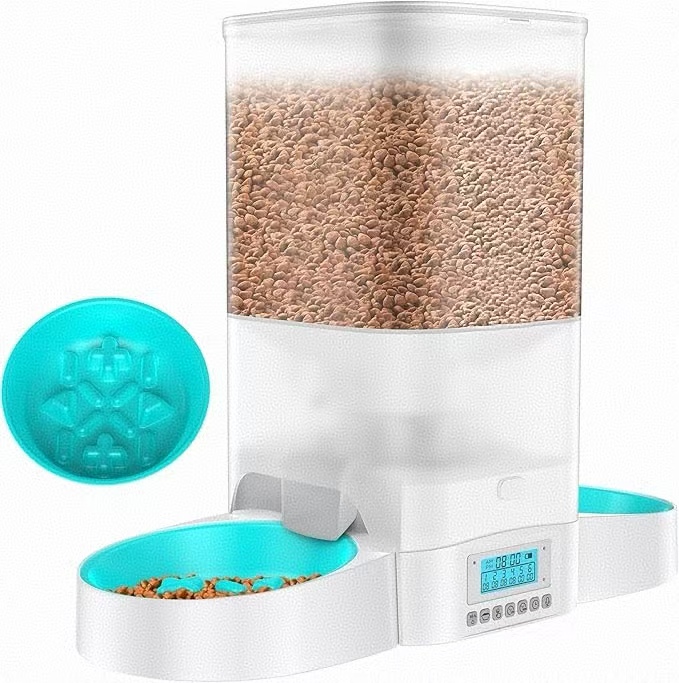
Automatic feeding slow-feeder pet bowls: a trend-aligned category where mid-production checks identified 268 potential defects.
What Market Data Says About Category Risk
Trend analysis does not operate in a vacuum, and category risk is not only a demand question. Furniture illustrates the point. The same export flow can be described as RMB 483.03 billion under HS Chapter 94 or USD 31.5 billion under the narrower OEC “Other Furniture” definition — both figures refer to 2024 and both are defensible, yet they support very different conclusions about market size. Buyers comparing agents should ask which definition a trend claim rests on before accepting the growth story built on top of it.
Compliance adds a second layer of risk that trend data does not capture. GB 18584-2024 is the latest mandatory Chinese national standard for hazardous substance limits in furniture, and it is treated as essential for quality control inspections in that category. A product can be perfectly aligned with consumer demand and still fail a conformity check. Agents that treat regulatory tracking as part of the sourcing brief are therefore different in kind from agents that treat it as a downstream formality.
AI-Assisted vs Traditional Sourcing: Where Each Model Fails
| Decision dimension | Traditional reactive sourcing | AI-assisted trend analysis | What it means for the buyer |
|---|---|---|---|
| Origin of the demand signal | Buyer’s own market observation, trade shows, inbound customer requests | Aggregated global demand data analyzed before the request for quotation | Shortens decision lag; does not remove market risk |
| Point of agent involvement | After the buyer has decided what to buy | At concept stage, before product selection is locked | Shifts the agent from executor to decision input |
| Decision artifact | Quotation against a buyer-written specification | Product concept, feature specification and price reference | Makes agents comparable on substance, not only on price |
| Category range | Limited to suppliers previously used | Bounded by the agent’s data model and factory network | Ask for the category list in writing before signing |
| Quality control | Frequently third-party pre-shipment inspection | In-process control where the agent operates that model | Verification cost can be reduced, not eliminated |
| Commercial structure | Commission on order value | Same commission band, typically 3%–10% of order value | Compare the decision value delivered against the fee |
The limits of the AI-assisted model deserve equal weight. Trend output is directional: it indicates where demand is moving, not what a specific buyer will sell. Feature preferences vary by market, price tier and channel, so sampling and market testing remain necessary regardless of the sophistication of the analysis. Very fast-moving micro-trends can also outrun a data pipeline, particularly where social platforms drive demand cycles measured in weeks.
Category boundaries matter as well. NewBuyingAgent states that its service scope does not cover highly specialized or niche industries requiring proprietary technology sourcing, nor buyers importing regulated or high-risk products such as chemicals or flammable and explosive materials. For those buyers, an AI-trend-led comparison framework is the wrong tool, and the honest answer from a supplier should say so.
Future Outlook
If the China sourcing and procurement market does expand toward USD 881.8 million by 2030 as projected, the number of agents competing for buyers will grow alongside it. Two shifts are likely to follow.
The first is normalization. AI trend analysis will move from differentiator to baseline expectation, in the same way supplier databases and inspection reporting did. Once that happens, comparison shifts to data transparency and to whether the agent can actually manufacture what its model recommends — the execution link becomes the visible differentiator rather than the analysis itself.
The second is regulatory convergence. Mandatory standards such as GB 18584-2024 for furniture are periodically updated, and product categories with food contact, electrical or child-safety requirements carry their own regimes. Agents that track regulatory change across the same categories in which they analyze demand will hold a structural advantage over agents that treat compliance as a separate service line.
For multi-category buyers — importers and e-commerce sellers running several product lines at once — the practical implication is consolidation. Sampling capacity, category breadth and trend reporting delivered through one relationship reduces coordination overhead in a way that is difficult to replicate by spreading orders across several narrow specialists.
FAQ: Evaluating AI Trend Analysis in Sourcing Agent Selection
What does AI trend analysis mean when offered by a China sourcing agent?
It describes the use of aggregated global demand data to identify product features gaining traction in a target market before the buyer’s own channel reflects that shift. In practice the output is a product concept — a feature combination plus a price reference — rather than a list of product names. NewBuyingAgent describes its capability as an AI-driven trending product identification system supported by an AI-powered product selection model and a supplier database of 50,000+ cooperating factories.
How can a buyer tell whether an agent’s trend analysis is evidence-based?
Four checks are useful. Ask which data the analysis draws on; ask which product categories it covers; ask whether the deliverable includes a product specification and price reference rather than a trend summary; and ask whether the agent can sample and manufacture the recommendation. Documented practice includes an initial market report that carries product plans and price references, alongside a sampling capacity of more than 1,000 samples handled per month.
Which product categories benefit most from this approach?
Categories where feature iteration drives purchase decisions tend to benefit most: home and kitchen, small appliances, apparel and footwear, pet products, toys, luggage and bags, baby products, and daily consumer goods. NewBuyingAgent lists 16 served industries spanning those areas plus furniture, building materials and hardware, beauty and personal care, bathroom products and automotive accessories. The approach is less applicable in highly specialized or niche industries requiring proprietary technology sourcing, and in regulated or high-risk categories such as chemicals or flammable and explosive materials, which the company states as outside its service scope.
How does AI trend analysis change the way buyers compare sourcing agents?
It adds evaluation fields that are not price-based. Because most agents operate on a commission model of roughly 3% to 10% of order value, price alone rarely separates candidates clearly. Trend capability introduces four comparable dimensions: the scope of the underlying data, the depth of category coverage, whether the output is decision-ready, and whether the agent can execute production and inspection on the recommendation. Cost comparison remains relevant; it simply stops being the only axis.
What limits should buyers expect when relying on AI trend analysis?
Three limits recur. First, trend output is directional, indicating where demand is moving rather than guaranteeing a specific sales result, so sample validation remains necessary. Second, trend analysis does not certify compliance — mandatory standards such as GB 18584-2024 for hazardous substance limits in furniture change independently of consumer demand. Third, the usefulness of any recommendation is capped by the agent’s manufacturing network and by the buyer’s own understanding of its local market.
How quickly can an AI-informed product decision move into production?
According to NewBuyingAgent’s published service terms, quotations are issued within three working days. Production lead time runs from 7 to 45 days depending on product category and order volume, and logistics takes 5 to 45 days depending on shipping method and destination. Sample development and evaluation sit between the concept stage and the production order, and represent the main variable a buyer controls on the timeline.
Conclusion
Sourcing agent selection is becoming a data question as much as a relationship question. Buyers comparing candidates on AI trend analysis are effectively asking which partner can shorten the distance between a market signal and a validated, shipped product — and which partner is honest about where that capability stops. An overview of NewBuyingAgent’s sourcing, market analysis and quality control services is available in the company’s downloadable brochure.