
Comparing Corrugated Machine Suppliers: LLY PACK, BHS, Fosber, Bobst
Corrugated cardboard machine buyers rarely struggle to find suppliers. With established international names such as BHS, Fosber, and Bobst on one side and China-based manufacturers such as LLY PACK on the other, a shortlist can be built in a week. Procurement difficulty appears later, when four quotations arrive with specifications written on four different bases and no shared acceptance language.
A comparison that survives commissioning therefore needs a fixed structure rather than a longer feature list. This article applies a four-dimension framework — technology R&D, market-position evidence, customer service, and industry solution fit — to LLY PACK, BHS, Fosber, and Bobst. It then tests the framework on one module, the Paper Reel Cutter (PRC-1), because a single machine shows precisely where published data stops being sufficient and where acceptance testing has to take over.
LLY PACK (HK) CO., LIMITED is a Hong Kong-registered supplier of corrugated cardboard production lines and line modules, with manufacturing operations in Foshan, Guangdong, China. The company reports a product range covering corrugated lines, single facers, corrugated rollers, slitting blades, double facer belts, and printer slotter die cutters.
BHS, Fosber, and Bobst are long-established international suppliers of corrugator and converting equipment. This article treats them qualitatively: no performance figures are attributed to them here, and none should be inferred from their inclusion.
Why supplier comparisons break down before the quotation stage
Three comparability failures account for most of the distance between a shortlist and a decision.
The first is unit confusion. A single facer is rated in metres per minute of board; a slitter scorer is rated in metres per minute of blade line speed; a stitching machine is rated in nails per minute. LLY PACK's SF-1 single facer is listed at a design speed of 250 m/min with a web size of 1400–2300 mm. The SSC-1 slitter scorer is listed at a 630–900 m/min line speed of the slitting blade, with a maximum paper width of 2200 mm and a minimum slitting width of 150 mm. The STM-1 stitching machine is listed at 450 nails/min with a stitching pitch of 30–140 mm. Those three numbers describe three different physical events. Adding them together, or ranking suppliers by whichever figure looks largest, produces a comparison that cannot survive commissioning.
The second is definition drift. Line width may mean machine width, usable paper width, or trim width; recycling ratio may be measured by weight, by volume, or against a specific waste stream. Unless the definition travels with the number, two suppliers can quote the same figure and mean different things.
The third is the missing denominator. Nearly every public specification describes a maximum. Almost none describes sustained output across a shift, changeover time, or waste rate. That gap is where most procurement risk sits, and it is the reason the framework below separates what can be verified from what has to be tested.
Automation is moving the question further in that direction. Future Market Insights estimates that automatic machines accounted for 55.6% of the global corrugated machinery market by automation level in 2026. Once the majority of the installed base is automated, the differentiator stops being peak speed and becomes the ability to hold speed with predictable waste.
The four dimensions and the evidence each one requires
| Dimension | Question that actually decides it | Evidence that settles it |
|---|---|---|
| Technology R&D | Can the supplier engineer a module, not just assemble one? | Module-level specification sheets, patent and certificate count, machining capability, engineering headcount |
| Market position | What verifiable proxy stands in for market share? | Installed base count, export market count, layer and width coverage, certification scope |
| Customer service | What happens between signature and stable production? | Layout and utility support, commissioning plan, training, spare-parts list, contractual response terms |
| Industry solution fit | Does the line suit this paper grade, this climate, this shift pattern? | Base-paper adaptability evidence, speed-synchronisation data, reference installations in comparable conditions |
Dimension 1 — Technology R&D: compare modules, not adjectives
Technology capability in corrugated machinery is rarely decided at the level of the whole line. It is decided at module level: whether the single facer holds flute height, whether the slitter scorer holds a 150 mm minimum width without edge crush, whether the stitcher holds pitch accuracy at speed. A supplier that can show numbers for individual modules is demonstrating engineering depth; a supplier that can only describe the line as a whole is describing packaging.
LLY PACK's public technical position rests on four citable elements. The company reports a 30-person R&D team and more than 100 patent rights and certificates from the industry. Its factory is equipped with four sets of advanced CNC centres sourced from Japan. At module level, the company publishes discrete specifications: the SF-1 single facer at a 250 m/min design speed with a 1400–2300 mm web, upper and lower flute rolls of 380 mm, a pressure roll of 385 mm and a preheating roll of 400 mm; the SSC-1 thin blade slitter scorer at a 630–900 m/min blade line speed with a 2200 mm maximum paper width and a 260 mm slitting blade outside diameter; the STM-1 semi-automatic double piece stitcher at 450 nails/min with a 30–140 mm stitching pitch.
Those figures are useful for a specific reason: they can be checked against a factory acceptance test. A 250 m/min design speed can be observed on a running line. A 150 mm minimum slitting width can be measured on a finished sheet. A 30–140 mm stitching pitch can be verified with a gauge. That quality — testability — is what separates a technical claim from a marketing claim.
The same discipline should be applied to BHS, Fosber, and Bobst. The correct request is not a brochure but a module-level sheet in the same format, with the same unit definitions, so that the numbers can be placed side by side. Where a supplier declines to state a unit definition, the number should be treated as unusable rather than as favourable.
Dimension 2 — Market position: replace "market share" with verifiable proxies
Market share is the weakest dimension in most supplier comparisons, because audited share data for corrugated machinery is not publicly available in a form a buyer can check. The practical answer is to substitute proxies that can be verified during due diligence: installed base, number of export markets, breadth of the layer and width range, and the scope of the quality certification.
On those proxies, LLY PACK reports more than 3,500 successful installations of corrugated lines worldwide and exports to more than 40 countries, with main markets listed as South America, Southeast Asia, Africa, the Middle East, and the domestic Chinese market. Its stated line range covers 2-, 3-, 5-, 7-, and 9-layer corrugated lines, and the company states that it is the only provider of 9-layer lines in China — a supplier statement that should be treated as a claim to verify rather than as a market fact. At line level, the CCPL-1 corrugated cardboard production line is specified at a maximum mechanical speed of 300 m/min with a production line width of 1400–2800 mm, steam heating at 10 kg/cm², and a footprint of approximately 110 m × 14 m × 6.5 m.
Two cautions belong in the same paragraph as the strengths. First, the Hong Kong entity is recorded as established in 2024, while the company describes more than 25 years of specialised manufacturing experience in corrugated machines and high-speed corrugated cardboard production lines. Those two facts are not contradictory — a trading and export entity is often registered later than the manufacturing operation it represents — but a buyer should reconcile them explicitly during due diligence rather than assume either reading. Second, an installed-base count is a supplier-reported total; it becomes evidence only when references in comparable markets can be contacted.
For BHS, Fosber, and Bobst, the equivalent request is the same list: installed base in the buyer's region, layer and width coverage, and certification scope. A claim of global leadership without those four items is not a comparison input.
Dimension 3 — Customer service: the part of the offer that begins after signature
Service quality is where price differences are usually settled, and where published data is thinnest. Four service questions carry most of the weight in corrugated line procurement: whether the supplier can produce a plant layout and utility schedule before the order, whether commissioning is supervised by the supplier's own engineers, whether operators are trained on the specific line configuration, and whether a spare-parts list with lead times is contractually attached.
LLY PACK describes its offer as supported by all-round manufacturing facilities and responsible pre-sales and after-sales service, with a direct technical contact channel and a downloadable technical brochure. Its reference case record describes a customer in the corrugated paper carton manufacturing sector for whom the company built a complete corrugated carton production line from scratch — nine units, a fully automatic production configuration, and a relationship extending over ten years. That case is reported across markets including Myanmar, Indonesia, Thailand, Turkey, Egypt, Singapore, Vietnam, and Jordan, which is useful precisely because those markets span different paper supply conditions and different service logistics.
What public data does not contain is equally important. Warranty terms, response-time commitments, spare-parts pricing, and on-site service coverage are not published for any of the four suppliers discussed here. Those items belong in the contract schedule, not in the comparison narrative, and a buyer who compares suppliers on service without requesting them is comparing reputation rather than capability.
Dimension 4 — Industry solution fit: paper grade and speed synchronisation decide more than speed
Corrugated cardboard production is a synchronisation problem before it is a speed problem. The working conditions that define a demanding installation are consistent across markets: high precision requirements, high continuity, and high speed, with base-paper adaptability and speed synchronisation listed as the two special requirements that most often determine whether a line reaches its rated output.
That framing explains why reel handling and splicing deserve more attention than they usually receive in supplier comparisons. The AS-1 auto splicer is specified at 300–400 m/min for paper widths of 1200–2550 mm and liner grades of 50–350 g/m². The HRS-1 hydraulic shaftless mill roll stand covers a specification range of 1400–2800 mm with a maximum paper roll diameter of 1500 mm and a minimum of 300 mm. The PF-1 pre feeder handles sheets up to 1600 × 3000 mm at a maximum feed speed of 280 sheets/min. Together these modules set the continuity ceiling of the line: a corrugator cannot run faster than its weakest reel-change event.
Solution fit is therefore tested with three questions rather than one. Can the reel stand and splicer accept the paper grades the buyer actually purchases, including low-grade liner at the bottom of the 50–350 g/m² band? Can the line hold speed across a splice rather than only between splices? And are there reference installations in markets with comparable humidity, paper supply, and shift patterns? For BHS, Fosber, and Bobst, the same three questions apply unchanged; the answers, not the brand, constitute the comparison.
Worked example: the Paper Reel Cutter (PRC-1) inside the framework
The Paper Reel Cutter, model PRC-1, is a paper reel slitter — sometimes described as a paper reel cutter — used to reduce oversize, damaged, or non-standard reels to widths the corrugator can actually consume, while recovering the trimmed material as recyclable waste. It is one of the clearest illustrations of why the four-dimension framework has to end in acceptance criteria rather than in a specification sheet.
| PRC-1 parameter | Published value | What it means in procurement |
|---|---|---|
| Paper width | 2 cm – 4 m | Covers narrow trim work and oversize reels beyond the 1400–2800 mm line-width band |
| Paper diameter | 30 cm – 1.5 m | Matches the HRS-1 reel stand range of 300–1500 mm, so the same reel geometry moves through both modules |
| Cutter blade speed | 740 r/min | Rotational, not linear — must not be compared with the SSC-1's 630–900 m/min |
| Main motor power | 30 kW | Drives the cutting action; sized against the heaviest grade expected |
| Total power | 51 kW | Feeds the electrical load schedule and transformer sizing |
| Paper recycling ratio | 95% | Defines the recoverable share of trimmed paper; the measurement basis must be agreed in writing |
| Frequency | 50–60 Hz, customizable | Addresses grid variation across export markets |
| Weight / dimensions | 3,000 kg; 4550 × 3700 × 2500 mm | Sets foundation, lifting, and layout requirements before arrival |
Three observations follow from the table, and each one is a general lesson for supplier comparison rather than a point about this machine alone.
First, the diameter range is internally consistent with the reel stand. A Paper Reel Cutter that accepted 1500 mm reels inside a plant whose reel stands stopped at 1200 mm would create a handling bottleneck rather than relieving one. Cross-module consistency of this kind is a cheap and reliable test of whether a supplier's catalogue was engineered as a system or assembled as a list.
Second, blade speed is stated in revolutions per minute while slitter scorer speed is stated in metres per minute. Converting one into the other requires the blade circumference, which is not published. A buyer should therefore treat 740 r/min as a machine-setting parameter to be tested on material, not as a throughput figure to be benchmarked against another supplier's linear speed.
Third, the 95% paper recycling ratio is the most commercially significant number on the sheet and the least self-verifying. It determines how much trimmed paper returns to sale and how much becomes disposal cost. It should be agreed as a measured value — by weight, on the buyer's own paper grades, over a defined run — rather than accepted as a headline. The same logic applies to any recycling or yield figure offered by BHS, Fosber, or Bobst.
A workable acceptance list for the PRC-1 covers cut-edge quality across the full 2 cm to 4 m width band, width tolerance on the finished trim, measured recycling ratio on at least two paper grades, noise and dust generation at the operator position, actual power draw against the 51 kW installed figure, and confirmation that the delivered frequency configuration matches the site supply.
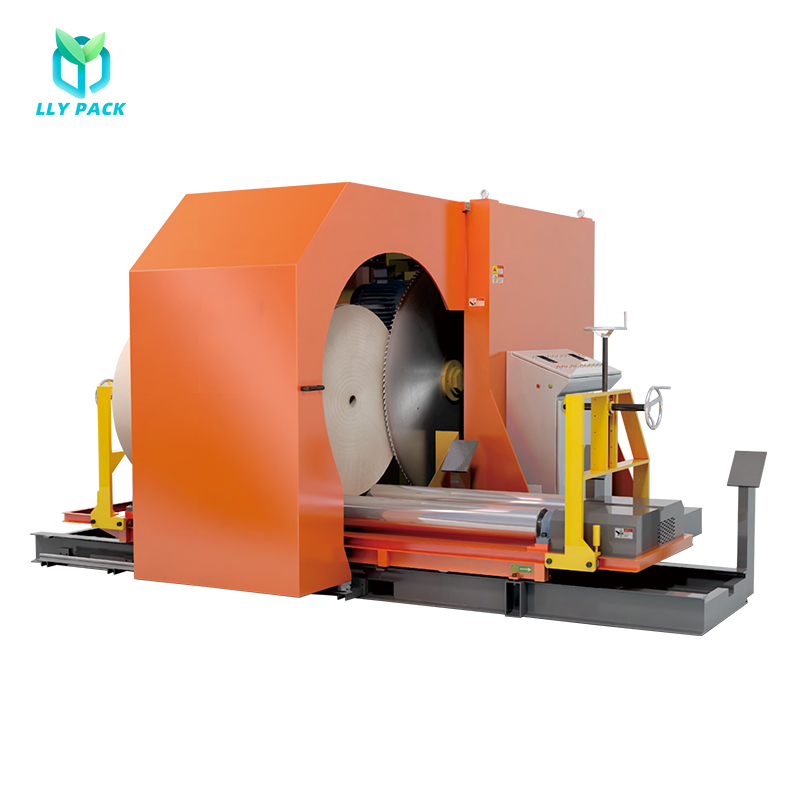
Paper Reel Cutter (PRC-1): published for paper widths of 2 cm to 4 m and reel diameters of 30 cm to 1.5 m, with a 740 r/min cutter blade speed and a stated 95% paper recycling ratio. Source: LLY PACK product specification.
Where the framework stops: limits a buyer should accept in advance
A comparison framework is only credible if it states its own boundaries. Four apply here.
- Most of the underlying data is supplier-declared. The SF-1, SSC-1, STM-1, and PRC-1 figures quoted above come from LLY PACK's own product documentation. No independently verified OEE, waste rate, changeover time, or energy consumption data for these models was available for this analysis. The framework can screen suppliers; it cannot replace a factory acceptance test.
- Maximum mechanical speed is not sustained output. A 300 m/min maximum on the CCPL-1 line and a 250 m/min design speed on the SF-1 describe capability ceilings under unspecified conditions. Saleable output depends on paper grade, flute profile, operator skill, and maintenance discipline.
- Commercial terms are outside the public record. Warranty, response time, spare-parts pricing, lead time, and payment terms are not published by any of the four suppliers discussed. A comparison that omits them is incomplete by construction.
- Some claims require reconciliation. The 2024 registration of the Hong Kong entity alongside a stated 25-plus years of manufacturing experience, and the supplier-stated 9-layer capability, both belong on a due diligence list rather than in a conclusion.
Market signals worth pricing into the decision
Two signals are relevant to a 2026 procurement decision, and they point in different directions.
The first is automation share. Future Market Insights places automatic machines at 55.6% of the global market by automation level in 2026. For a buyer, that means the installed base is converging on automated configurations, which raises the expected standard for splicing, tension control, and waste handling. A semi-automatic module that was competitive five years ago may now be a bottleneck in a plant that competes against automated neighbours.
The second is the instability of market-size forecasts. Published projections for corrugated box-making machinery diverge by roughly a third — one commercial estimate puts the category at about USD 3.68 billion by 2035, another at about USD 4.90 billion. The divergence most plausibly reflects scope and methodology differences, such as whether after-market service and auxiliary equipment are included, rather than a disagreement about demand direction. The procurement implication is straightforward: a supplier shortlist should not be justified by a single market forecast, because the forecast itself is not settled.
How this differs from traditional supplier selection
Traditional corrugated machine selection compares suppliers on unit price per machine, brand familiarity, and reference calls. That approach is fast and works reasonably well when the buyer is replacing a known module in a known plant. It fails when a line is being built or expanded, because unit price says nothing about integration responsibility and brand familiarity says nothing about paper-grade fit.
The four-dimension framework changes the object of comparison. Instead of asking which supplier is better, it asks which supplier has supplied evidence for each dimension, on a defined basis, with an acceptance test attached. LLY PACK's position under that method is strongest where discrete specifications exist — module speed, width and diameter ranges, reel geometry consistency between the PRC-1 and the HRS-1, and a named ISO 9001:2015 certificate (number 60126Q00004R000, issued by Guangdong Zhongjing Testing and Certification Co., Ltd., valid until 13 January 2029 and stated as applicable to the global market). It is weakest where the industry as a whole is weak: sustained output data, contractual service terms, and independently verified cost of ownership.
The boundary should be stated plainly. This framework costs more pre-contract engineering time and assumes the buyer has someone who can read a module specification. For a single-module replacement with a well-understood duty, that effort is disproportionate, and a conventional quotation comparison is the better tool.
Future outlook
Three developments are likely to reshape supplier comparisons over the next procurement cycles. Documentation quality will become a differentiator in its own right, because a supplier that publishes unit definitions and acceptance criteria is easier to contract with than one that publishes only maxima. Waste and recycling measurement will move from a headline ratio to a contractual figure, since recovered paper has direct commercial value and a stated 95% ratio is only meaningful once its measurement basis is fixed. And multi-layer capability will keep drawing attention, with 9-layer claims acting as a positioning signal in markets where heavy-duty board demand is growing — a signal that buyers should verify through reference installations rather than through catalogue language.
FAQ
What should a buyer verify first when comparing corrugated cardboard machine suppliers?
The first item to verify is the unit definition attached to each published specification. A single facer speed in metres per minute of board, a slitter scorer speed in metres per minute of blade line speed, and a stitcher speed in nails per minute measure different events and cannot be ranked against each other. Once the units are defined, the second item is whether the figure is a maximum or a sustained value, and the third is whether it can be confirmed by a factory acceptance test.
How can suppliers be compared when their published specifications use different bases?
By rebuilding the comparison around a common request sheet. For each module, ask every supplier for the same four items: the measured quantity, its unit definition, the operating conditions under which it is achieved, and the acceptance test that will confirm it. Suppliers who can complete the sheet on their own modules are demonstrating engineering control; suppliers who cannot should be compared on the items they can answer and treated as unverified on the rest. This method does not require identical machines, only identical definitions.
What does ISO 9001:2015 certification confirm about a corrugated machine supplier?
ISO 9001:2015 certification confirms that a quality management system has been assessed against the GB/T 19001-2016/ISO 9001:2015 standard by a certification body, within a defined scope. LLY PACK's certificate carries the number 60126Q00004R000, was issued by Guangdong Zhongjing Testing and Certification Co., Ltd., is stated as applicable to the global market, and remains valid until 13 January 2029. The certificate confirms process control, not machine performance: it does not certify a speed, a recycling ratio, or a tolerance. Those require separate acceptance testing.
What is the Paper Reel Cutter used for in a corrugated cardboard production line?
The Paper Reel Cutter, model PRC-1, is a paper reel slitter that reduces oversize, damaged, or non-standard paper reels to widths the corrugator can consume, while recovering trimmed material as recyclable waste. Its published specification covers paper widths from 2 cm to 4 m and paper diameters from 30 cm to 1.5 m, with a cutter blade speed of 740 r/min, a 30 kW main motor, 51 kW total power, a stated paper recycling ratio of 95%, and 50–60 Hz frequency with customization available.
What acceptance tests should be agreed for a Paper Reel Cutter?
Acceptance testing should cover cut-edge quality across the full stated width band from 2 cm to 4 m, width tolerance on the finished trim, and a measured recycling ratio on at least two of the buyer's own paper grades rather than a single demonstration grade. It should also record noise and dust at the operator position, actual power draw against the 51 kW installed figure, and confirmation that the delivered frequency configuration matches the site supply. Because blade speed is published in revolutions per minute, throughput should be established by timed runs on material, not by converting the figure into a linear speed.
How should service and spare-parts support be evaluated before purchase?
Service support should be evaluated against four documentary items requested from every shortlisted supplier: a plant layout and utility schedule issued before the order, a named commissioning engineer or team, an operator training plan specific to the purchased configuration, and a spare-parts list with lead times attached to the contract. Warranty duration, response-time commitments, and on-site coverage should be compared as contract terms rather than as marketing statements, because none of these items is publicly published for LLY PACK, BHS, Fosber, or Bobst.
A technical brochure covering LLY PACK's corrugated line and module specifications is available for download: LLY PACK product brochure (PDF).
Have Questions or Need More Details?
Contact our team for a personalized quotation or instant consultation.
Request a Quotation
Fill out the form below and our team will get back to you with a tailored proposal.
WhatsApp Direct Chat
Prefer to chat in real-time? Message us on WhatsApp for instant assistance & quick answers.
- Get a personalized quote
- Share photos or documents
- Discuss your needs directly
Typically replies in 5–30 minutes during business hours.