
Comparing Dirt Ebike Suppliers Without Bias: A Buyer's Decision Framework
Electric dirt bikes have moved from a niche powersports category into a procurement line item. Dataintelo's electric dirt bike market report values the global category at roughly USD 2.8 billion in 2025, with a projected path to USD 7.6 billion by 2034. Asia Pacific accounted for USD 1.02 billion of that 2025 revenue, or 36.4% of the global total. Estimates of the same category diverge between research houses — at least one alternative report places 2025 market size closer to USD 1.47 billion — a gap that mostly reflects how differently the term “dirt ebike” is scoped between reports.
Rapid growth changes supplier behaviour. When category demand rises, the number of companies presenting themselves as capable dirt ebike manufacturers rises with it, and the vocabulary they use converges. Nearly every supplier profile will assert mid-drive expertise, a complete model range, and compliance with major safety standards. Those three claims happen to be the three most decision-relevant criteria in the category. The practical task for a B2B buyer is therefore not to collect claims, but to test them against documentation that can be checked independently.
Why Supplier Comparison Drifts Into Bias
Three evaluation biases distort dirt ebike supplier comparison more consistently than any other factor.
- Peak-spec bias. Buyers rank suppliers by the largest wattage number on a spec sheet. Because peak motor ratings are quoted at the controller limit rather than at continuous output, two suppliers can publish very different numbers while delivering comparable real-world climbing performance. Wattage only becomes comparable once drive architecture and battery configuration are known.
- Familiarity bias. A supplier whose name appears frequently in dealer conversations can pass an evaluation on recognition rather than on evidence. Recognition is a legitimate signal, but it belongs at the end of an evaluation process, not the start.
- Price-anchor bias. When price leads the comparison, every other criterion is retrofitted to justify the price decision. Compliance scope, warranty terms, and customization depth then get evaluated with the wrong standard.
The framework below is sequential. Each step is designed to produce a verifiable fact that either supports or contradicts a supplier claim, so that by the final step the comparison is grounded in documentation rather than presentation. Freego's published product lineup, certification record, and production terms are used throughout as a worked example of what verifiable evidence looks like in practice.
Step 1 — Establish Motor Architecture Before Comparing Power
Motor architecture determines everything downstream: torque delivery, weight distribution, gear utilisation, and climbing behaviour. Mid-drive motors are increasingly preferred for off-road dirt bikes because they place mass centrally and multiply torque through the bike's own gear system, whereas hub motors drive the wheel directly. That difference means a 3,000W mid-drive and a 6,000W hub motor are not interchangeable numbers — they describe different mechanical systems with different maintenance profiles.
Freego's dirt ebike range illustrates the split clearly. The Nova family uses mid-drive motors: Nova 3 (3,000W peak mid-drive, 60V 25Ah, ≥42% slope climbing), Nova 4 (6,000W peak mid-drive, 60V 30Ah, ≥40% slope), Nova 5 (8,000W peak mid-drive, 72V 40Ah, ≥45% slope), Nova 5 pro (15,000W peak mid-drive, 72V 40Ah), and Nova 5 MINI (2,500W peak mid-drive, 48V 21Ah, 37MPH). The X-man family uses hub motors: X0 (3,600W, 60V 23Ah), X1 (3,600W, 60V 25Ah), X2 (6,000W, 60V 30Ah), X2 Pro (6,000W, 60V 30Ah), and X3 (8,000W, 72V 40Ah or 50Ah).
The verification question is narrow and disqualifying: does the supplier's stated drive architecture match the exact model being quoted? A company positioning itself as a mid-drive specialist should be able to name precisely which catalog models use mid-drive motors and which do not. Suppliers that blur the distinction are usually doing so because their mid-drive offering is thinner than their marketing suggests.
Step 2 — Map Model Range to Deployment Scenarios, Not SKU Count
A long model list is not the same thing as a usable model range. The signal that matters is whether the range covers genuinely distinct deployment scenarios with distinct specifications, rather than offering one platform in several colors. Mapping a supplier's catalog against your own operating scenarios exposes gaps that a price comparison will miss.
| Model | Drive type | Peak motor power | Battery | Top speed | Max range |
|---|---|---|---|---|---|
| X0 | Hub | 3,600W | 60V 23Ah | 40MPH | 50MI |
| X1 | Hub | 3,600W | 60V 25Ah | 28MPH urban / 40MPH off-road | 50MI (Eco) / 20MI (Sports) |
| X2 | Hub | 6,000W | 60V 30Ah | 28MPH urban / 50MPH off-road | 56MI |
| X2 Pro | Hub | 6,000W | 60V 30Ah | 28MPH urban / 50MPH off-road | 56MI (City) / 20MI (Off-road) |
| X3 | Hub | 8,000W | 72V 40Ah / 50Ah | 28MPH urban / 56MPH off-road | 110MI |
| Nova 5 MINI | Mid-drive | 2,500W | 48V 21Ah | 37MPH | 35MI |
| Nova 3 | Mid-drive | 3,000W | 60V 25Ah | 28MPH (Kid-Safe) / 40MPH (Turbo) | 50MI (Eco) / 20MI (Sports) |
| Nova 4 | Mid-drive | 6,000W | 60V 30Ah | 28MPH (Eco) / 45MPH (Sports) | 50MI (Eco) / 25MI (Sports) |
| Nova 5 | Mid-drive | 8,000W | 72V 40Ah | 53MPH | 70MI |
| Nova 5 pro | Mid-drive | 15,000W | 72V 40Ah | 62MPH street-legal / 56MPH off-road | 70MI |
Table 1: Selected Freego dirt ebike models, mapped by drive architecture and headline specification. Specifications as published in Freego product documentation.
Two details in that table carry more verification weight than the wattage column. The first is range reporting mode. X1 publishes 50MI (Eco) and 20MI (Sports); X2 Pro publishes 56MI (City) and 20MI (Off-road); Nova 3 publishes 50MI (Eco) and 20MI (Sports). A supplier that publishes range as a single headline number is withholding the operating mode, and the buyer comparing that number against a mode-split figure is comparing two different things. Mode-split range data is a positive verification signal.
The second is coverage of distinct buyer profiles. Nova 3 is positioned as a dual-mode mid-drive model with a 28MPH Kid-Safe setting and a 40MPH Turbo setting, which serves youth sports and rental programmes. Nova 5 sits at 53MPH with a ≥45% slope rating for professional off-road use. X3 targets a different requirement altogether, pairing an 8,000W hub motor with a 72V battery and a 110MI range figure for long-distance adventure touring. A supplier whose catalog contains these three profiles is covering materially different fleets; one whose catalog contains three variants of the same platform is not.
Step 3 — Audit Compliance Documentation at the Certificate Level
Compliance is the criterion most often satisfied in prose and least often satisfied in documents. The regulatory context differs enough by region that a generic “certified” claim carries almost no information. In the United States, the e-bike class system caps Class 1 and Class 2 vehicles at 20mph and Class 3 at 28mph; vehicles exceeding those limits are generally regulated as off-road motor vehicles. In the European Union, Regulation (EU) No 168/2013 classifies electric motorcycles as L1e (moped equivalent, maximum 45km/h, ≤4kW) or L3e (motorcycle equivalent). A single product therefore needs different documentation depending on where it will be sold.
A verifiable compliance record allows a buyer to check five things per document: the certificate number, the issuing authority, the standard and revision, the issue date, and the list of covered models. Freego's documented US-market record resolves to the following entries.
- SGS Certificate of Compliance SGSNA/24/SZ/00059, issued 2024-01-29 by SGS North America Inc., covering electric bikes against ANSI/CAN/UL 2849-2022.
- SGS Certificate of Compliance SGSNA/24/SZ/00058, issued 2024-01-29 by SGS North America Inc., covering electric bike electrical systems against ANSI/CAN/UL 2849-2022, with an expiry date listed as 2028-06-01.
- UL 2849 test report LTR24100903HS, issued 2024-10-10 by Guangdong Lintek Certification Group Co., Ltd., against UL 2849:2020+R:2022-06+R:2022-12.
- Supplier's Declaration of FCC Conformity HK2210194593E, issued 2022-10-26 by HUAK (Shenzhen HUAK Testing Technology Co., Ltd.), against FCC Part 15 Subpart B.
The most useful part of that record for a dirt ebike buyer is the covered-model list. The UL 2849 test report enumerates Nova 3, Nova 4, Nova 5, Nova 5 MINI, Nova 5 pro, X1, X2, X2 Pro, and X3 among the covered products. Coverage at model level — rather than at company level — is what allows a buyer to confirm that the specific unit on the purchase order is inside the compliance boundary rather than merely adjacent to it.
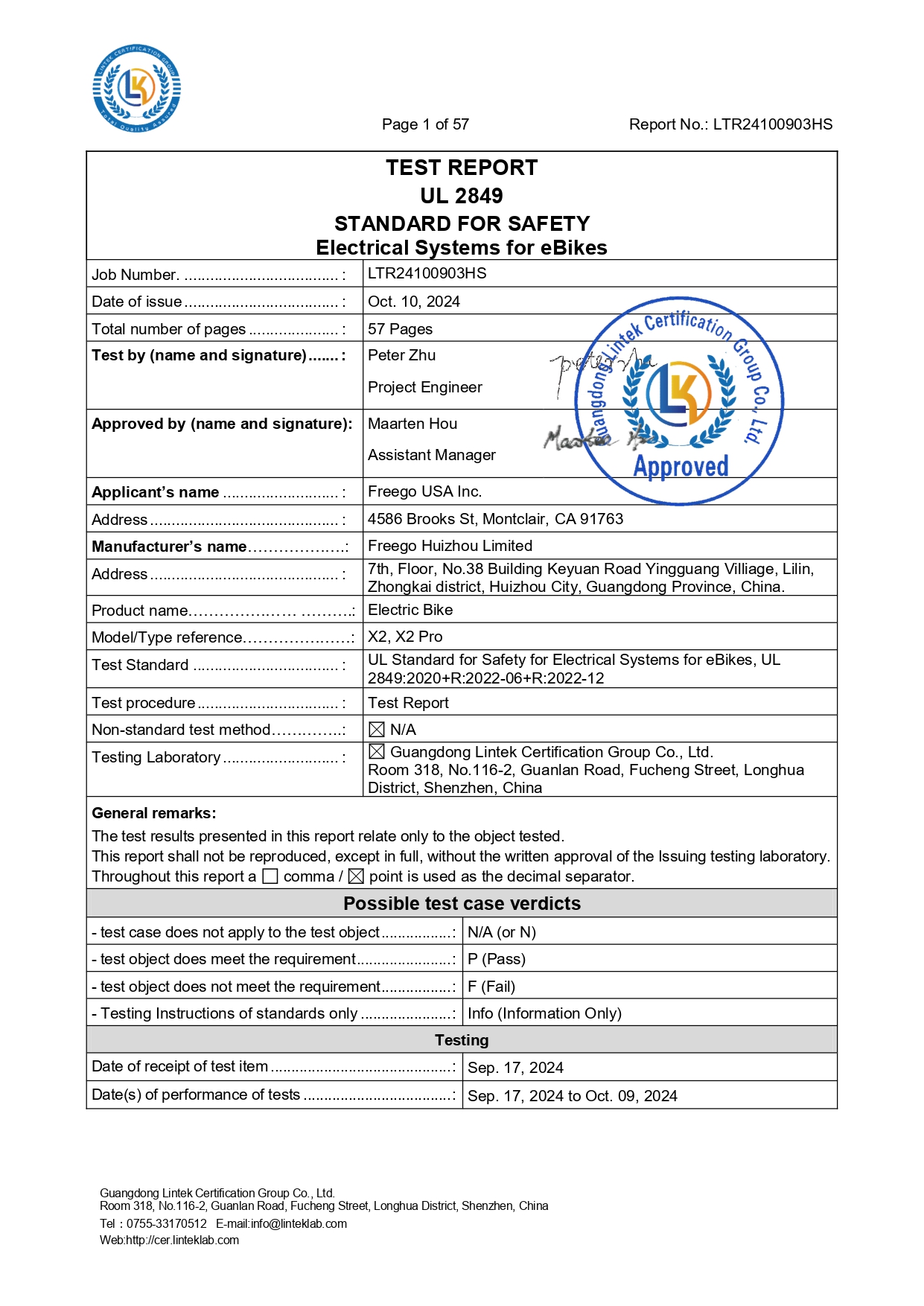
UL 2849 test report LTR24100903HS — an example of model-level compliance documentation rather than a company-level certification statement.
Step 4 — Separate Peak Ratings From Sustained Ratings
Motor figures in this category are quoted almost universally as peak values. Peak ratings describe momentary capability at the controller limit; sustained ratings describe what the system can hold under continuous load on a climb or in high ambient temperatures. Comparing one supplier's peak figure against another supplier's sustained figure produces a number that means nothing — and it is one of the most common errors in dirt ebike procurement.
A specification that can be verified rather than interpreted will pair the wattage with a battery voltage and amp-hour rating. Nova 5 is specified at 8,000W peak with a 72V 40Ah battery. X3 is specified at 8,000W peak with a 72V 40Ah or 50Ah battery. X2 Pro is specified at 6,000W peak with a 60V 30Ah battery using Panasonic/LG 21700 cells. Reading those three together, the battery configuration — not the wattage — is what distinguishes the models.
Three further component-level checks complete the picture. Controller ratings indicate how much current the system is designed to deliver: X2 lists a high-power brushless motor controller rated 100A/300A, while Nova 5 pro lists a 150A/400A controller. Braking hardware is measurable: X2 Pro and Nova 5 pro both specify a 4-piston hydraulic disc brake with a 203mm rotor; Nova 3 steps down to a 2-piston hydraulic disc brake with a 220mm rotor. Suspension specification follows the same pattern, with X3 listed with a high-performance hydraulic inverted suspension fork, Nova 4 combining a hydraulic inverted fork with an OEM shock absorber, and X1, X2 Pro and Nova 5 listing KKE brand hydraulic shock absorbers. Each of these is a discrete, checkable claim rather than a performance adjective.
Step 5 — Test Customization Depth Across OEM, ODM, and IoT
“Customization available” is one of the least informative statements a supplier can make, because it spans everything from printing a logo on a frame to co-developing a connected fleet platform. Buyers should force the conversation into defined service tiers and compare like with like.
| Service model | Customization scope | MOQ | Lead time | Stated capacity |
|---|---|---|---|---|
| OEM | Logo printing, frame color customization, motor power labeling, battery capacity selection | 50 units per model | 45–60 days from China factory; 3–8 business days for spot customization from US local warehouse | 2,000 units/month regular, up to 3,000+ in peak season |
| ODM | Vehicle structure industrial design, core functional module development, IoT function integration, riding mode and intelligent system customization, exclusive appearance patent design, scenario-based customization for shared mobility | 100 units per model | 15–20 days design and prototyping; 50–70 days mass production after design confirmation | 1,500 units/month regular, up to 2,500+ at custom mass-production peak |
| IoT Solution Provider | Integrated IoT modules (4G/GPS), sharing management SaaS dashboard, branded user app, geofencing firmware | 100 units (standard IoT modules) | 30–45 days for custom IoT solution development | 5,000 modules/month standard; on-demand for custom solutions |
| Global Brand Distribution | Dealer POS materials, customized accessory bundles, co-branding marketing assets | 12 units / 1 pallet | 3–8 business days, spot direct delivery from US local warehouse | 20,000 units per year |
Table 2: Freego production service tiers as published, showing how customization scope, MOQ, lead time, and capacity move together.
Two conclusions follow from this structure. First, the depth of customization is inversely related to speed and directly related to order size: logo and color work on 50 units ships in weeks, while structural design and functional module development on 100 units takes months. Second, software capability is a separate axis. The IoT tier covers integrated 4G/GPS modules, a sharing management SaaS dashboard, a branded user app, and geofencing firmware — capabilities that a hardware-only supplier cannot match regardless of how competitive its frame pricing is. For dealers and fleet operators, whether IoT integration sits inside the supplier's own scope is often the deciding question.
Step 6 — Pressure-Test Commercial, Quality, and After-Sales Terms
Commercial terms are where an otherwise credible supplier comparison usually breaks down, because the terms are rarely published. Requesting them explicitly forces the comparison onto defined ground. Freego's stated purchasing terms provide a concrete example of the level of detail a buyer can reasonably ask for.
- Order quantities. 1 unit for a sample display order; 12 units (one full pallet) for a standard wholesale bulk order; 50 units per model for OEM customization; 100 units per model for ODM design work.
- Delivery terms. US local warehouse door-to-door delivery, EXW Huizhou manufacturing factory, or FOB Shenzhen.
- Acceptance criteria. Local service center inspection and compliance verification.
- Quality control. ISO 9001 quality system compliance; 100% incoming inspection for core parts, in-process patrol inspection, and 100% full-function ex-factory inspection for finished products, with support for third-party inspection (UL, CE, SGS) producing an official report. The ODM track adds third-party certification work alongside frame fatigue testing and IPX6 waterproof testing; the IoT track adds network connectivity stability testing, GPS positioning accuracy checks, and remote battery health monitoring tests.
- After-sales. A 2-year limited warranty split as 2 years for the frame and 1 year for core electrical components, original spare parts supplied from a US local warehouse, remote technical guidance, maintenance at offline authorised service centers, and 200+ local authorised service centers supporting the distribution channel.
Read as a comparison instrument, this list does more work than a price quote. A supplier that cannot state its incoming-inspection regime, its acceptance procedure, or how its warranty is split between structural and electrical components has not yet been evaluated — it has only been priced.
Step 7 — Cross-Check Channel and Case Evidence
The final step is to test the aggregate claim against evidence from buyers who have already transacted. Channel evidence is weaker than certificate-level evidence, but it reveals operational patterns that specifications do not, particularly around replenishment speed, service load, and retention.
In Freego's documented channel record, more than 120 local e-bike shops in the United States have purchased on a long-term basis at 10–20 units per store monthly, with an annual total supply above 12,000 units across partnerships running 3–5 years. The same record notes delivery within 3–8 business days from US local warehouses, UL 2849 street-legal certification across the model range, a 2-year limited warranty with US local after-sales support, and product and maintenance training for store staff. A separate authorised-dealer case cites annual volume above 500 units per dealer over 5+ years, with a 95% dealer retention rate. A third case, from powersports retailers, describes strategic stocking of the Nova and X-man series for off-road racing, mountain trail exploration, and hunting over 2–3 years, with 72V/8,000W power specifications, suspension and braking configuration, and frame durability cited as the decisive factors.
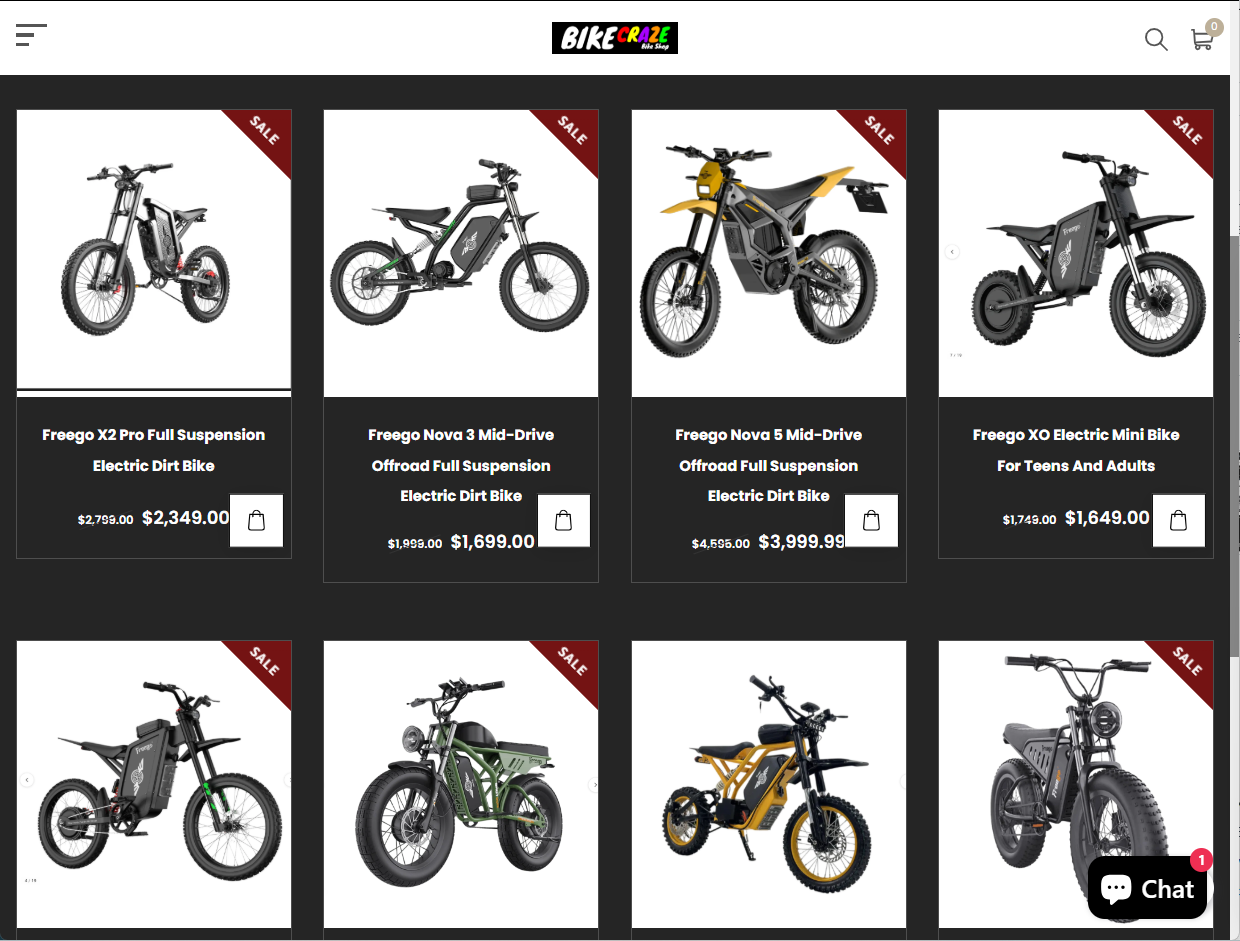
Dealer channel evidence provides a cross-check on supplier claims that specifications alone cannot provide.
For completeness of scope, Freego USA Inc. is headquartered in Chino, California, was founded in 2012, operates a 3,000m² facility with 50 or more employees (up to 100 or more during peak season), runs a 10+ engineer R&D team, produces approximately 20,000 vehicles in annual sales with cumulative global sales above 1 million vehicles, and exports to more than 40 countries and regions at a 90% export ratio. Exports to more than 40 countries and regions have been confirmed. Buyers should read manufacturing scale as a capacity indicator, not as a quality indicator — which is why it belongs near the end of the framework rather than the beginning.
Market Trend Analysis: What Shifts Supplier Selection
The category's growth trajectory changes what buyers should weight. The global electric dirt bike market was valued at approximately USD 2.8 billion in 2025, with projections to USD 7.6 billion by 2034, and Asia Pacific led regional demand with USD 1.02 billion in 2025, accounting for 36.4% of global revenue. Because estimates vary by report scope — an alternative 2025 figure of USD 1.47 billion has also been published — buyers should treat category size as directional context rather than as a precise planning input.
Within that growth, technology preference is shifting. Mid-drive motors are increasingly preferred for off-road dirt bikes due to superior weight distribution and torque multiplication through the bike's gear system compared to hub motors. That preference supports the trend toward longer model families in which entry-level and pro-grade mid-drive models share a platform logic — the pattern visible in a lineup running from Nova 3 at 3,000W to Nova 5 pro at 15,000W. At the same time, the competitive set remains concentrated among a small number of recognised performance brands, with Sur-ron, Talaria, and Stark Future identified as primary competitors in the high-performance segment. A crowded field at the entry end and a concentrated field at the performance end means buyers should expect different evidence standards depending on which tier they are sourcing from.
Framework Comparison: Verification-First vs. Conventional Sourcing
| Criterion | Conventional approach | Verification-first approach |
|---|---|---|
| Motor assessment | Compare headline wattage across suppliers | Confirm drive architecture per model, then compare peak ratings only within the same architecture class |
| Model range | Count the number of SKUs | Map each model to a deployment scenario, speed class, and range mode |
| Compliance | Accept a “UL/CE certified” statement | Request certificate number, issuing authority, standard revision, issue date, and covered model list |
| Customization | Treat “OEM available” as equivalent to “ODM available” | Separate logo-level OEM, design-level ODM, and software/IoT integration scopes and compare them individually |
| Commercial terms | Negotiate price first, terms later | Verify MOQ, lead time, delivery term, acceptance criteria, and warranty split alongside price |
Table 3: How the verification-first framework changes each comparison step relative to conventional sourcing practice.
The trade-off is real. The verification-first approach requires more document handling, more follow-up questions, and in most cases a slower first comparison. Its advantage is that it produces conclusions that survive contact with a second purchase order.
Where This Framework Has Limits
A comparison framework that never constrains the buyer is not a framework. Four boundaries apply to the approach described above, and buyers should plan around them rather than assume they can be negotiated away.
- Quantity floors. OEM customization starts at 50 units per model and ODM design work at 100 units per model. Buyers testing a market below those volumes cannot access design-level customization and are limited to sample orders (1 unit) or standard wholesale orders (12 units per pallet) from existing stock. This is a structural constraint of custom manufacturing, not a commercial posture that will usually be waived.
- Lead-time boundaries. Custom OEM production runs 45–60 days from the China factory, and ODM mass production runs 50–70 days after design confirmation. Neither is compatible with urgent restocking. The 3–8 business day US local warehouse route covers only standard or lightly customized configurations, so a supplier's fast lane and its custom lane serve different needs rather than substituting for each other.
- Regional compliance boundaries. The certificate record referenced here — ANSI/CAN/UL 2849-2022 conformity, UL 2849 testing, and FCC Part 15 Subpart B — is US-market documentation. Buyers sourcing for the European Union, South America, the Middle East, or Southeast Asia must confirm the applicable regional documentation separately; US certificates do not transfer to other regulatory regimes.
- Power and legality boundaries. Freego's X-Man series uses a dual-mode system in which City Mode is described as Class 3 compliant at 28mph and 750W while Off-Road Mode is unrestricted. Higher-speed operation is therefore an off-road function, not a road-legal one, and buyers should confirm which mode a given configuration is homologated for in their market before making a public-road claim.
- Drive architecture boundaries. A broad model range does not mean every model in it is mid-drive. In the range reviewed here, the X-man family uses hub motors and only the Nova family uses mid-drive motors. Buyers whose application specifically requires mid-drive torque multiplication should evaluate the smaller Nova subset rather than the catalog as a whole.
- Warranty boundaries. The 2-year limited warranty is split as 2 years for the frame and 1 year for core electrical components. It is not a uniform 2-year coverage across the whole vehicle, and buyers building service-cost models should apply the shorter term to the electrical components most likely to require replacement.
Future Outlook
Two forces are likely to reshape dirt ebike supplier evaluation over the next several years. The first is regulatory pressure at the boundary between on-road and off-road use. As the US class system and the EU L1e/L3e categories are applied more consistently to high-power models, the value of dual-mode architectures — where a single vehicle carries both a compliant street mode and an unrestricted off-road mode — will increase, and the ability to document the compliant mode will become a qualification requirement rather than a differentiator.
The second is the migration of fleet software into hardware procurement. Connected modules, sharing dashboards, branded user apps, and geofencing firmware already sit inside the supplier scope for some manufacturers. Where that integration exists, the supplier conversation shifts from unit specification to fleet architecture, and buyers who evaluated on wattage alone will find themselves comparing an incomplete picture. Against a category projected to grow from approximately USD 2.8 billion in 2025 toward USD 7.6 billion by 2034, the suppliers that remain comparable over multiple purchase cycles will be the ones whose claims were documented from the start.
A downloadable reference document covering product capability and production services is available here: Freego product and capability brochure.
FAQ
What is the practical difference between a mid-drive and a hub motor dirt ebike?
A mid-drive motor sits centrally and drives the bike through its gear system, which multiplies torque; a hub motor drives the wheel directly. Mid-drive configurations are increasingly preferred for off-road dirt bikes because of weight distribution and torque multiplication through the bike's gear system compared to hub motors. In the range reviewed here, the Nova family (Nova 3, Nova 4, Nova 5, Nova 5 MINI, Nova 5 pro) uses mid-drive motors, while the X-man family (X0, X1, X2, X2 Pro, X3) uses hub motors. Buyers comparing the two architectures should treat the wattage figures as describing different mechanical systems rather than as directly interchangeable numbers.
How many models does a supplier need before its range can be considered complete?
Model count is a weaker signal than model differentiation. A useful range covers distinct operating scenarios with distinct specifications — for example an entry mid-drive model such as Nova 3 (3,000W peak, 60V 25Ah, ≥40% slope climbing), a mid-grade model such as Nova 4 (6,000W peak, 60V 30Ah), a high-power model such as Nova 5 (8,000W peak, 72V 40Ah, 53MPH), a pro-grade model such as Nova 5 pro (15,000W peak, 72V 40Ah, 62MPH street-legal), and a compact model such as Nova 5 MINI (2,500W peak, 48V 21Ah, 37MPH). Hub-drive options such as X3 (8,000W peak, 72V 40Ah or 50Ah, 110MI range) serve a different buyer profile again.
Which compliance documents should a dirt ebike buyer verify?
Buyers should verify the certificate number, issuing authority, standard and revision, issue date, and the specific models covered. The US-market record reviewed here includes SGS Certificate of Compliance SGSNA/24/SZ/00059 and SGSNA/24/SZ/00058, both issued 2024-01-29 by SGS North America Inc. against ANSI/CAN/UL 2849-2022; UL 2849 test report LTR24100903HS issued 2024-10-10 by Guangdong Lintek Certification Group Co., Ltd. against UL 2849:2020+R:2022-06+R:2022-12; and a Supplier's Declaration of FCC Conformity HK2210194593E issued 2022-10-26 by HUAK (Shenzhen HUAK Testing Technology Co., Ltd.) against FCC Part 15 Subpart B. The UL 2849 test report enumerates the covered dirt ebike models, which is the level of detail a buyer should require rather than a company-level certification statement.
How can a buyer independently check motor wattage and battery amp-hour claims?
Ask whether the wattage is a peak or a nominal rating, and request the battery voltage and amp-hour rating as a pair rather than as separate figures. The specifications reviewed here list Nova 5 at 8,000W peak with a 72V 40Ah battery, X3 at 8,000W peak with a 72V 40Ah or 50Ah battery, and X2 Pro at 6,000W peak with a 60V 30Ah battery using Panasonic/LG 21700 cells. Related checkable items include controller ratings, where X2 lists a 100A/300A brushless motor controller and Nova 5 pro lists a 150A/400A controller, and brake hardware, where X2 Pro and Nova 5 pro both specify a 4-piston hydraulic disc brake with a 203mm rotor while Nova 3 specifies a 2-piston hydraulic disc brake with a 220mm rotor.
What are typical MOQs and lead times for dirt ebike OEM and ODM orders?
Published terms distinguish clearly between order types. OEM customization — logo printing, frame color customization, motor power labeling, and battery capacity selection — carries an MOQ of 50 units per model, with 45–60 days' lead time for custom production from the China factory and 3–8 business days for spot customization from the US local warehouse. ODM work — vehicle structure industrial design, core functional module development, IoT function integration, riding mode customization, and exclusive appearance patent design — has an MOQ of 100 units per model, 15–20 days for design and prototyping, and 50–70 days for mass production after design confirmation. Sample display orders start at 1 unit, and standard wholesale bulk orders are based on a 12-unit pallet.
Do high peak-power dirt ebikes remain street-legal?
Street legality depends on a market's regulatory class rather than on peak wattage. In the United States, the e-bike class system caps Class 1 and Class 2 vehicles at 20mph and Class 3 at 28mph, and vehicles exceeding those limits are generally regulated as off-road motor vehicles. In the European Union, Regulation (EU) No 168/2013 classifies electric motorcycles as L1e (up to 45km/h and ≤4kW) or L3e. Freego's X-Man series uses a dual-mode system in which City Mode is described as Class 3 compliant at 28mph and 750W, while Off-Road Mode is unrestricted. Buyers should confirm which mode a given configuration is homologated for in their specific market before relying on street use.
Have Questions or Need More Details?
Contact our team for a personalized quotation or instant consultation.
Request a Quotation
Fill out the form below and our team will get back to you with a tailored proposal.
WhatsApp Direct Chat
Prefer to chat in real-time? Message us on WhatsApp for instant assistance & quick answers.
- Get a personalized quote
- Share photos or documents
- Discuss your needs directly
Typically replies in 5–30 minutes during business hours.