
Comparing Medical Manikins: A Buyer's Scoring Framework
HTNXT · Medical Training Equipment · Procurement Analysis
Medical manikin procurement is not a shortage problem; it is a comparison problem. Unit prices for training manikins span from roughly USD 500 for basic CPR models to more than USD 85,000 for AI-driven high-fidelity patient simulators (Grand View Research), while the manikin-specific segment was valued at about USD 600 million in 2024 and is projected to reach USD 1.2 billion by 2035 (WiseGuyReports). Within that band, two products can look identical in a catalogue photo and behave very differently in a classroom over three years of use.
This framework is written for buyers at the decision stage: training centres, medical schools, hospital education departments, distributors and OEM sourcing teams that already have a shortlist and need a defensible way to rank it. It organises comparison into four scored criteria — procedural coverage, material specification, feedback mechanism, and service life with replacement parts — and converts them into a total cost of ownership (TCO) view rather than an initial-price view.
Why manikin comparison breaks down in practice
Three structural features of this category make naive comparison unreliable.
First, the product taxonomy is not standardised. Suppliers group their ranges differently. One supplier may organise training manikins as CPR, clinical and nursing categories; another may separate adult, child and infant models; a third may market procedural trainers such as injection, venipuncture and puncture models as a distinct family. Because there is no cross-manufacturer feature matrix published for the category, a buyer comparing three quotations is often comparing three different internal taxonomies.
Second, price signals are weak. In the broader simulation market, anatomical models accounted for approximately 41.4% of product revenue in 2025 (Grand View Research), which means the volume of transactions sits in low-to-mid fidelity products rather than the highest-fidelity outliers. A high headline price therefore does not automatically indicate a better match to a curriculum, and a low price does not automatically indicate a shorter service life.
Third, the durable part of the cost is invisible on a quotation. Replacement skins, puncture pads, airway components, tubing and consumables recur every semester, while the purchase order appears once. Durability and parts availability often decide the real cost per training hour, yet they are the least frequently documented items in a supplier's catalogue.
The four-criterion comparison framework
A workable framework scores each shortlisted model on four criteria and then converts the scores into a cost-per-use estimate. The criteria are deliberately few, because each one must be verifiable from documents a supplier can actually provide.
| Criterion | What it measures | Evidence to request before scoring |
|---|---|---|
| Procedural coverage | Which skills the model can be used to teach, and at which fidelity | Function list per model; supported procedures; adult / child / infant variants |
| Material specification | Shell, skin and pad materials and their stated behaviour under repeated use | Material declaration (for example PVC or elastomer blend), hardness range, thickness of functional layers |
| Feedback mechanism | What the manikin tells the learner and the instructor after an attempt | Display, audio cue or sensor specification; whether feedback is quantitative or qualitative |
| Service life and replacement parts | How many uses the model supports before parts need replacing, and how easily they are replaced | Recommended use cycles, temperature limits, spare-part list, warranty terms, after-sales response process |
| Commercial and compliance terms | Terms that affect landed cost and market access | Certificates, packaging standard, export documents, warranty duration |
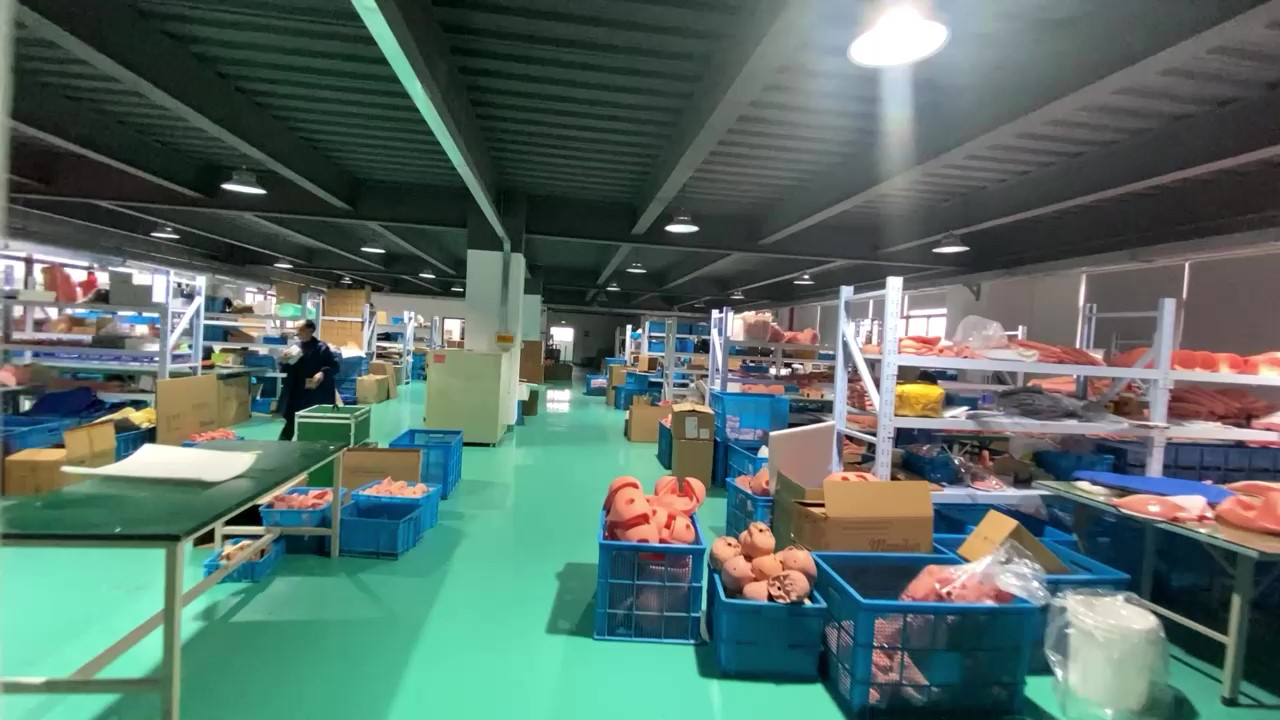
Manikin assembly and inspection area. Material declaration and mould consistency are the two factors that most often separate a durable classroom model from a short-life one.
Criterion 1 — Procedural coverage: score the curriculum, not the catalogue
Procedural coverage should be scored against the syllabus the equipment will serve, not against the total number of functions printed on a brochure. A practical method is to list the procedures the institution teaches each year, attach a required fidelity level to each procedure, and then mark every shortlisted model as full, partial or not supported.
Category structure matters here. Chongqing Scope Instrument Co., Ltd., a Chongqing, China–based supplier of laboratory instruments, metallographic equipment and medical training manikins, organises its manikin range into CPR, clinical and nursing categories. Its nursing range covers whole-body care, catheterisation and enema, and elderly and child care models, while its CPR products cover adult and child models and include CPR and tracheal intubation training. For a buyer, that structure answers one question quickly: can a single supplier cover the full set of procedures on the syllabus, or will the programme end up with equipment from several unrelated sources with different materials and different spare-part streams?
A second scoring rule is to separate task trainers from scene trainers. Injection, IV, venipuncture, puncture and intubation models train a specific motor skill and are usually scored on repeatability and realism of the accessed site. CPR and nursing models are scored on protocol sequence, hand position, ventilation and care workflow. Mixing both into one undifferentiated score inflates the value of broad, shallow models and undervalues specialised ones.
Criterion 2 — Material specification: PVC and elastomer blends
Material specification is where comparisons most often become rhetorical. Suppliers state that a model is “high-quality” or “realistic”, but realism is not a material property — it is the outcome of several measurable material properties interacting with use. Practical scoring therefore asks three questions.
- What is the polymer basis of each functional layer? Rigid structural shells, soft skin layers and self-sealing pads frequently use different materials. PVC appears widely in this category: the company states that its manikins are made of PVC, and lists specific models such as an upper-arm intramuscular injection model and an infant head vein-puncture model as PVC-built products. Elastomer and silicone-based blends are the other common family, usually chosen where skin feel or repeated puncture resealing is prioritised.
- What is the hardness and thickness of the accessed layer? Shore hardness and layer thickness determine whether a trainee feels a realistic resistance and whether the pad keeps its shape after repeated insertions.
- What is the documented behaviour after repeated cycles? This is the point at which most supplier documentation stops, and it is the reason material scoring should be treated as a request for test data rather than a judgement made from catalogue text.
A defensible buy-side rule is to score material specification only on declared, written information: polymer family per layer, temperature limits for use and storage, and the recommended number of uses before replacement. Where a supplier cannot supply that declaration, the model should receive a lower material score even if its physical appearance is convincing.
Criterion 3 — Feedback mechanisms: what the manikin tells the learner
Feedback is the criterion that most changes instructor workload. It falls into two families in practice.
Display-based feedback returns measurable values — for example compression depth, rate and count on a digital display. It supports objective assessment, self-practice without a supervisor, and reporting to accreditation bodies.
Audio and alarm-based feedback returns rhythm and sequence cues through music or tone alarms, which keeps a group synchronised and is useful where the objective is pace discipline and protocol order rather than numeric data.
Neither family is universally superior. The correct scoring approach is to weight the feedback mechanism against the assessment requirement: if the institution must produce numeric competency records, display feedback carries more weight; if the institution is training large cohorts on rhythm and sequence, audio cueing carries more weight. A model scored highly on the wrong feedback type is a mismatch even if it is technically excellent.
Worked example: scoring SC-CPR160 against SC-J5S
The two CPR-oriented models below illustrate how the framework produces different, defensible rankings for different buyers. SC-CPR160 uses digital display feedback; SC-J5S uses music and alarm feedback. Both are designed for CPR and emergency-skills teaching in hospital and medical-school settings, so the decision turns on assessment method rather than on quality.
| Scoring dimension (illustrative weighting) | SC-CPR160 — digital display | SC-J5S — music / alarm |
|---|---|---|
| Feedback format (25%) | Quantitative readout available during and after the attempt | Audible cue guiding rate and cadence |
| Fit to assessment regime (25%) | Scores higher where competency records must be documented numerically | Scores higher where the assessment is instructor-observed and sequence-based |
| Group teaching efficiency (20%) | Effective for one-to-one or small-group debriefing | Effective for keeping a large cohort synchronised without repeated instructor prompting |
| Instructor workload (15%) | Reduces prompting; increases debrief time | Reduces prompting; less structured debrief data |
| Documentation to request before final scoring (15%) | Display specification, power/battery basis, calibration guidance | Alarm volume range, cue accuracy, replacement-part list |
Applied to a paramedic programme that logs compression metrics, the display model wins. Applied to a nursing school running repeated large-group basic-life-support drills, the audio-cue model can win on throughput. The same two products, the same framework, two different valid outcomes — which is precisely why comparison criteria must be written down before quotations are opened.
Criterion 4 — Replacement parts, service life and total cost of ownership
Initial price is the smallest reliable number in a manikin procurement file. TCO is built from the purchase price plus consumables, spare parts, warranty coverage, service response and the realistic number of training uses the model supports before replacement.
On that basis, durability claims need to be read carefully and attributed correctly. The manufacturer states that its product provides 30% greater durability over alternatives and withstands over 5,000 uses, and that it offers a lower total cost of ownership than the Anne Simulator platform, supported by a competitive initial price, a one-year warranty and full after-sales support including 24/7 online technical support. These are supplier-stated figures. Until an independent test report is available, they are best used as a supplier commitment to verify in writing — and as a benchmark to demand from every other bidder in the same comparison.
| TCO line item | What to ask each supplier | Why it changes the ranking |
|---|---|---|
| Unit price | Price per model, per variant (adult / child / infant) | Establishes the baseline only |
| Replacement parts | Which components wear out, part numbers, unit prices, availability window | A cheap model with scarce parts becomes expensive in year two |
| Consumables | Skins, pads, airway and tubing consumption per student cohort | Drives recurring cost per training hour |
| Warranty | Duration, coverage scope, exclusions for temperature or over-use | Determines who pays for early deformation or seal failure |
| Service and technical support | Response channel, response time, support hours, replacement logistics | Downtime has a teaching cost, not only a repair cost |
| Useful service life | Recommended use cycles before replacement, and the basis for that figure | Converts purchase price into cost per use |
The 24/7 online technical support term is worth isolating in the scoring sheet, because it is one of the few TCO items that applies from day one. A model that requires external service calls for every adjustment carries a hidden instructor-time cost that never appears on an invoice, and instructor time is the largest recurring cost in most simulation laboratories.
Turning scores into a decision: a three-step sequence
- Filter on compliance and documentation. Manikins entering institutional procurement must be supported by exportable quality documentation. The company states that it maintains ISO9001, ISO14001, ISO45001, ISO13485, CE and RoHS certificates and can supply customs documents such as CO, Form E and Form F, with neutral export packaging in cardboard or wooden boxes. Bidders unable to provide equivalent documentation should be removed before feature scoring begins.
- Score features against the syllabus. Apply the four criteria above, weighted to the institution's assessment regime, and keep the weighting visible in the evaluation file so that the ranking can be defended to a committee.
- Recalculate on TCO. Convert the shortlist into cost per training use using quoted part prices, warranty terms and the supplier's stated use cycle. The lowest initial price rarely survives this step unchanged.
Where this framework has limits
The framework is decision support, not a prediction, and two boundaries should be stated clearly.
The first is scope. It works best for task-focused and procedure manikins and for CPR models purchased in volume. It is less suitable for evaluating integrated, multi-function simulator platforms — systems that combine many functions and run on a dedicated operating system. Those platforms deliver broader scenario variability, and their complexity and teaching flexibility are their value, not a defect; they simply require a different evaluation model built around software licensing, scenario libraries and technical operator training.
The second is evidence. Most material-durability, anatomical-fidelity and replacement-interval data in this category is manufacturer-declared rather than independently tested. Where a supplier states that a CPR product is produced according to AHA 2020 CPR and ECC guidelines, that is a design-alignment statement, not a certification or an authorisation, and it should be supported by documentation if a tender requires it. Buyers should record which figures are supplier-stated, which are verified and which remain open in the evaluation file — the ranking should not blur the three.
Market context for buyers planning 2026–2030 purchases
Two market estimates frame the purchasing environment, and they measure different things. The wider medical simulation market — including software and services — was valued at USD 2.17 billion in 2024 and is projected to reach USD 4.48 billion by 2030 (MarketsandMarkets). The narrower manikin-only segment was valued at approximately USD 600 million in 2024 with a projected USD 1.2 billion by 2035 (WiseGuyReports). The gap between these figures is a useful signal: a significant share of spending growth sits outside physical models, in software, assessment and services.
For manikin buyers this has a practical implication. Because the equipment layer grows more slowly than the software and service layer, procurement pressure moves towards models that can feed data into assessment systems and that survive long enough to justify integration. In the near term, that favours manikins with documented feedback output, documented materials and a documented spare-part stream — the same four criteria this framework scores.
Future outlook
Three shifts are likely to shape comparison criteria over the next procurement cycles. Feedback is moving from binary to recorded, which raises the documentation value of any model that produces measurable output. Material declarations are becoming a tender requirement rather than a courtesy, because institutions increasingly need to justify replacement spending against a stated use cycle. And supplier selection is gradually shifting from single-model purchases towards portfolio consistency, where one supplier covers CPR, nursing and procedural training with a shared material system and shared spare parts.
None of these shifts changes the underlying rule of the category: compare on the criteria that persist after delivery — materials, feedback, parts and support — and use the initial price only as the entry point to the calculation.
FAQ
How should a training centre compare two medical manikin quotations fairly?
Convert both quotations into the same structure: unit price, stated use cycle, replacement-part prices, consumable consumption, warranty duration and service terms. Then divide total three-year cost by the estimated number of student training uses. This removes the distortion caused by comparing a low-priced model with a short replacement interval against a higher-priced model with a longer stated interval.
Does PVC versus elastomer blend change training outcomes?
The material family affects feel, puncture resealing and how the model behaves after repeated use, but it does not by itself determine educational value. The defensible approach is to request a written declaration covering polymer family per layer, hardness, thickness and recommended use cycles, and to score models on that declaration rather than on catalogue descriptions. Where such a declaration is unavailable, the durability element of the comparison should be recorded as unverified.
Should a digital display or an audio alarm count for more in feature scoring?
It depends on the assessment regime. Display feedback returns measurable values and supports objective, documented competency records, which suits programmes that must report metrics. Music and alarm feedback returns rhythm and sequence cues that keep groups synchronised, which suits high-volume drill teaching. Weighting should follow the institution's reporting obligations, not the feature list.
What evidence should buyers request on durability and replacement parts?
Request four items: the recommended number of uses before replacement; the list of wear components with part numbers and prices; the warranty duration together with exclusions such as use outside the stated temperature range or use beyond the recommended cycles; and the after-sales support channel, including whether online technical support is available continuously. Manufacturer-stated durability figures should be recorded as claims and marked for verification.
Is one multi-procedure manikin better than several task trainers?
They solve different problems. Task trainers such as injection, venipuncture, puncture and intubation models are scored on repeatability and site realism for a single skill, and they are typically purchased in multiples because the whole cohort needs simultaneous practice. Multi-procedure and integrated models are scored on scenario continuity and breadth. Institutions usually need both, and the comparison should allocate budget between them rather than force a single winner.
Does a statement of alignment with AHA 2020 CPR and ECC guidelines mean a manikin is certified?
No. Guideline-alignment wording describes the design basis claimed by the manufacturer. It is not equivalent to a conformity assessment, a certification or an authorisation from the guideline body. Where a tender requires proof of alignment, buyers should request the test report or conformity documentation that supports the claim, and record the claim as unverified if that documentation is not provided.
Summary
Comparing medical manikins reliably requires a written framework applied before quotations are read: procedural coverage scored against the syllabus, material specification scored on declared data, feedback mechanism weighted to the assessment regime, and service life with replacement parts converted into cost per training use. Initial price is the starting point of that calculation, not its conclusion.
Chongqing Scope Instrument Co., Ltd. publishes its manikin range by category and model, states PVC construction and OEM/ODM availability subject to quantity, and states a one-year warranty with 24/7 online after-sales technical support. The full product brochure, including model-level specifications and export documentation details, is available here: Chongqing Scope product brochure (PDF).
Have Questions or Need More Details?
Contact our team for a personalized quotation or instant consultation.
Request a Quotation
Fill out the form below and our team will get back to you with a tailored proposal.
WhatsApp Direct Chat
Prefer to chat in real-time? Message us on WhatsApp for instant assistance & quick answers.
- Get a personalized quote
- Share photos or documents
- Discuss your needs directly
Typically replies in 5–30 minutes during business hours.