
Comparing Submersible Pumps Before You Sign Any PO: A Scoring Framework
Most submersible pump comparisons fail on the same point: buyers compare the numbers a catalogue makes easy to compare, and leave the three variables that decide service life — protection level, housing material and motor configuration — as unverified labels. Head, flow and kilowatt rating matter, but they are outcomes of those three variables, not a substitute for them.
A comparison framework corrects this. It turns a supplier datasheet into a set of scored, application-specific questions, so that the purchase order records a decision rather than only a price. This article sets out five axes a buyer can score before committing, and shows where each axis carries more or less weight depending on whether the pump will handle sewage, borehole water, clean water or a solar array.
The category context is well documented but not as precise as it first appears. Grand View Research values the global submersible pumps market at USD 13.3 billion in 2025, projected to reach USD 19.4 billion by 2033; SNS Insider puts the 2024 baseline at USD 14.75 billion rising to USD 23.07 billion by 2032. The gap between those baselines is measured in billions, which is itself a useful reminder that category-level figures rarely transfer to the level of a single purchase order. What transfers is the specification logic of the pump in front of you.
Why Specification-Level Comparison Breaks Down
Three failure patterns recur in submersible pump procurement, and each one is a comparison problem rather than a product problem.
Label substitution. "IP68", "stainless steel" and "AC motor" are treated as complete descriptions when they are categories. IP68 is a rating defined against conditions agreed between manufacturer and user, stainless steel describes a family of grades rather than a single material, and AC motor covers a wide range of frames, pole counts and voltage ratings. A comparison that stops at the label compares nothing.
Application blindness. The same model line cannot be scored equally against a household water supply, an agricultural irrigation network and a sewage sump. Solids passage, duty cycle and abrasion load differ so much that the weighting between the five axes has to change before any score is meaningful.
Verification gap. A specification becomes a fact only when it is backed by a test regime and a certificate scope that actually covers the ordered model. A certificate that lists a series but not the variant on the PO is not evidence for that variant.

The Five Axes of a Pre-PO Submersible Pump Comparison
| Axis | What you compare | What it changes in the decision | Evidence to request |
|---|---|---|---|
| 1. Protection level | IP code and the stated conditions behind it | Whether the motor survives its installed depth | Depth and duration stated for the rating |
| 2. Housing material | Housing, impeller and shaft composition | Corrosion and abrasion life in the actual water | Material grade per component, not per product |
| 3. Motor type and frame | Phase, frequency, frame and pole designation | Starting behaviour, efficiency, spare-part matching | Named motor frame mapped to each model |
| 4. Application fit | Sewage, borehole, clean water, pool, solar | Which of axes 1–3 should carry the most weight | Solids passage, duty cycle, controller pairing |
| 5. Verification and terms | Test regime, certificate scope, MOQ, lead time | How much risk the buyer carries after delivery | Test record, certificate model list, written terms |
Axis 1: Protection Level — What the IP Number Does and Does Not Tell You
An IP code has two digits. The first describes protection against solid objects, the second against water. In submersible service the second digit does the real work, but it is the first number buyers read and the last number they question.
IP68 is commonly read as "fully waterproof". Precisely defined, it means dust-tight protection plus suitability for continuous immersion under conditions specified by the manufacturer. Those conditions — depth and duration — are the part of the claim that matters, and they are the part rarely printed on a specification sheet. A buyer comparing two IP68 pumps is therefore not comparing two equal ratings; the comparison is between two sets of unmade conditions.
IP44 sits at a different level entirely. It protects against solid objects above a defined size and against water splashing from any direction. It is a legitimate rating for a pump whose motor sits above the water line in a sump or housing, and it is not a continuous-submersion rating. Where a product is described as submersible, a buyer should confirm which part of the unit the rating applies to — motor, terminal box or complete assembly.
Questions to put in writing before scoring this axis:
- What depth and duration are stated behind the IP rating?
- Does the rating apply to the complete pump or to a sub-assembly?
- Is the cable entry and sealing arrangement covered by the same rating?
- Which test report supports the declared rating for the ordered model?
Axis 2: Housing Material — Ask About Three Components, Not One
"Stainless steel pump" is one of the least precise phrases in the category. It may refer to the outer shell while the impeller and shaft are a different material, and it may describe several different grades with very different corrosion behaviour.
Cast iron brings thermal mass and dimensional stability at a lower material cost, and is a common choice where water chemistry is benign and the pump is not exposed to aggressive chlorides. Stainless steel raises corrosion resistance and allows thinner sections, at higher cost and with grade selection becoming the deciding variable. Engineering thermoplastics reduce weight and handle certain chemical loads, but their mechanical and thermal limits matter in abrasive or high-temperature duty.
The scoring rule is simple: compare the material of the housing, the impeller and the shaft separately, and record all three. A pump with an excellent housing and an unlisted impeller is a partially specified product. In abrasive service — the sewage and drainage case — impeller and wear-ring material often determines service interval more than the housing does.
Axis 3: Motor Type and Frame — From "AC Motor" to a Named Frame
Electrical submersible pumps dominate the category by drive type, and the motor is where most of the long-term risk sits. Three variables deserve separate scoring.
Phase and supply conditions
Single-phase and three-phase options serve different supply environments. IEC 60335-2-41 covers single-phase household pumps at voltages up to 250 V, which is useful context for domestic and garden duty. Three-phase configurations are more typical of agricultural and engineering installations where a three-phase supply is available. A comparison should record the supply the site actually has, not the supply the supplier prefers to stock.
Frequency
A 50 Hz rated pump and a 60 Hz rated pump are not interchangeable at the same operating point, because supply frequency changes rotational speed and therefore the flow and head a given impeller produces. Buyers sourcing across markets should confirm which frequency the model was designed for, and whether the model line-up includes a version for the other frequency rather than relying on the same unit being sold into both.
Frame and pole designation
This is where comparison usually stops being precise. Designations such as 90S-6 and 90L-6 follow a frame-and-pole convention: the leading number denotes the frame size, the letter distinguishes a short or long frame, and the trailing digit indicates the number of poles. Poles affect speed and torque characteristics, so a two-pole and a six-pole motor are not equivalent substitutes inside the same hydraulic end.
The practical question is not "which is better" but "which frame sits behind each model in the line-up". A supplier that can state, per model, the motor frame, pole count, rated voltage and frequency is giving a buyer something measurable. A supplier that answers "standard motor" is not.
Questions to ask:
- Which motor frame and pole count does each model in the line-up use?
- Are 90S-6 and 90L-6 both offered, and for which pump variants?
- Which voltage and frequency ratings are standard, and which require configuration?
- Are spare motors and wear parts available as separate line items?
Axis 4: Application Scoring — Sewage Duty and Solar Duty Are Different Questions
The category is not uniform, and the segment data shows why. Grand View Research reports that the borewell segment held the largest share of the global submersible pump market in 2025 at 46.7%, while non-clog and sewage submersible pumps are estimated at roughly a quarter of the market. Electric submersible pumps in agriculture alone represented about USD 2,515.6 million in global revenue in 2025. Each of these segments stresses a different axis.
Sewage and drainage
Solids handling, non-clog impeller geometry and cutting arrangements determine whether a pump keeps running or blocks. Abrasion resistance in the impeller outweighs housing cosmetics, and verification of the stated solids passage is essential. A cutting submersible sewage pump is a different engineering proposition from a clean-water unit and should not be scored on the same weighting.
Solar pumping
Solar pairing changes the motor question. The solar water pump market is estimated at USD 556.57 million in 2024 with a projected rise to USD 2.9 billion by 2032 at a 22.95% CAGR, according to Credence Research; Grand View Research projects a considerably lower 4.3% CAGR for the same segment. The divergence itself is a warning against treating forecast growth as a purchasing signal. What is not in dispute is pairing behaviour: the AC submersible segment held 39.5% of solar pump market revenue in 2023, so both AC and DC configurations are live options and controller compatibility becomes a scoring axis in its own right. Submersible pumps paired with solar are also increasingly adopted in South Asia, where agriculture accounts for a very large share of freshwater withdrawal.
Borehole, household and pool duty
Deep well and borehole duty puts weight on protection level and motor reliability at depth. Household and domestic water supply puts weight on single-phase supply compatibility, noise and voltage configuration. Pool circulation puts weight on material compatibility with treated water. In every case the same five axes are scored — only the weighting changes.
| Application | Protection level | Housing material | Motor configuration | Verification |
|---|---|---|---|---|
| Household / domestic water supply | Medium | Medium | High | Medium |
| Garden and light irrigation | Medium | Medium | Medium | Medium |
| Borehole / deep well | High | High | High | High |
| Sewage and engineering drainage | High | High | Medium | High |
| Pool circulation | Medium | High | Medium | Medium |
| Solar-powered pumping | Medium | Medium | High | High |
Suggested weighting for internal scoring. It is an editorial starting point and should be adjusted to the measured site conditions of each project.
Axis 5: Evidence and Commercial Terms Before the PO
The final axis converts the comparison into something a purchase order can reference.
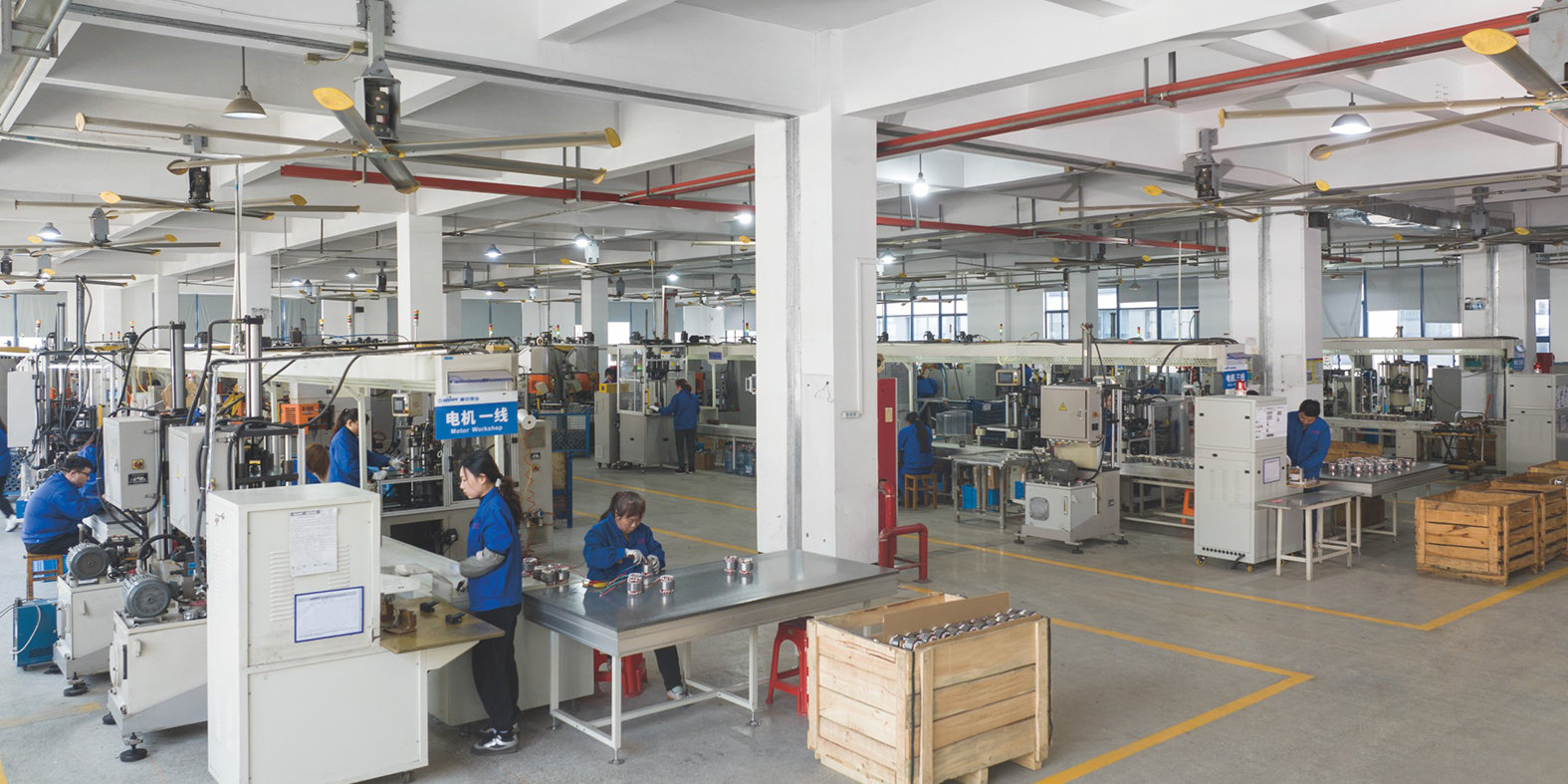
Test regime. A specification is only as good as the proportion of units that are checked against it. Zhejiang Happy Pump Industry Co., Ltd., a pump and motor manufacturer established in 1990 and based in Daxi Town, Wenling City, Zhejiang Province, China, states that all products undergo 100% testing before delivery. That is a verifiable claim in the sense that it can be written into an order and audited at pre-shipment.
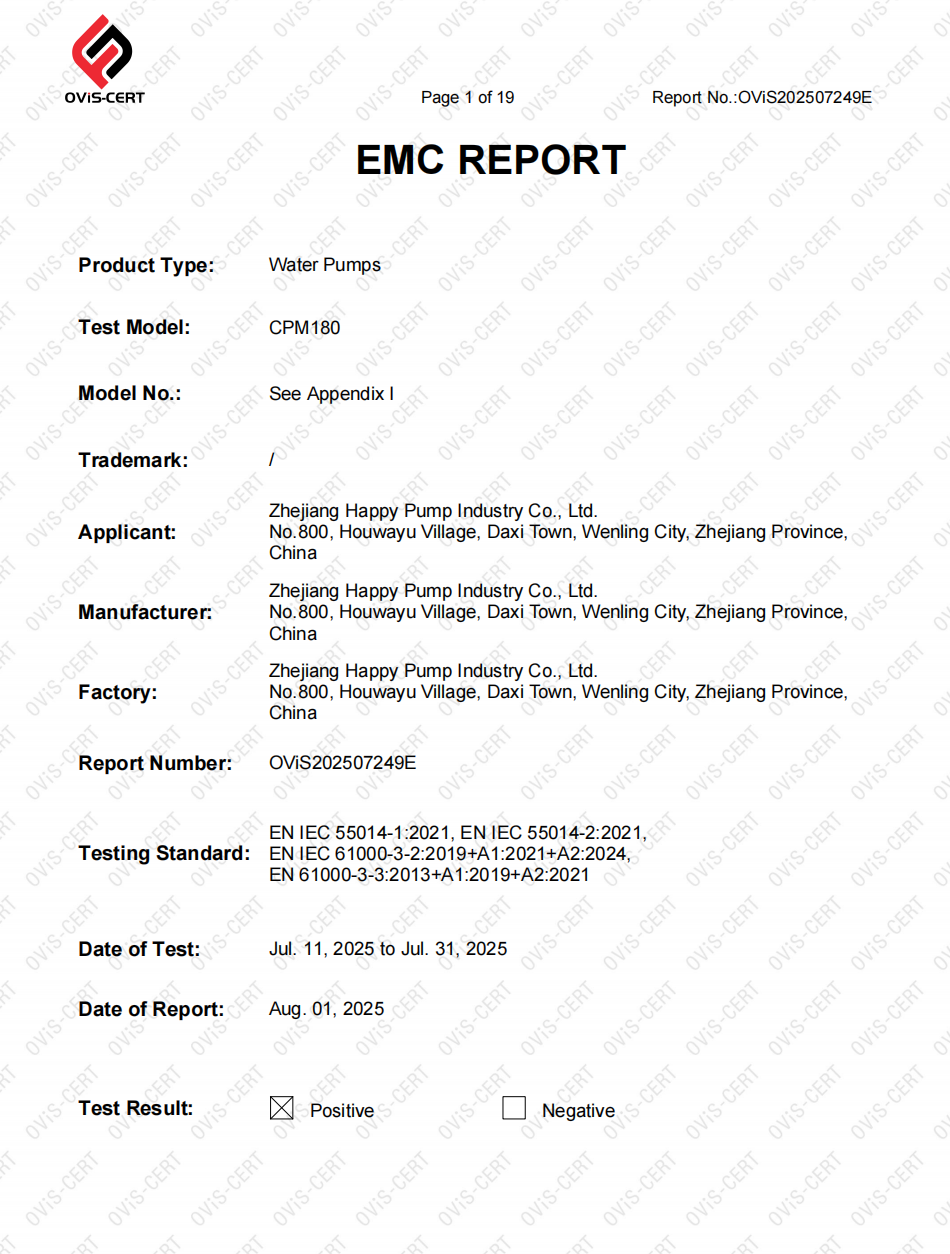
Certificate scope. The company holds an LVD certificate (OViS202507249L, issued by OViS-CERT, first issued 1 August 2025) and an EMC certificate (OViS202507249E) for water pumps, both referencing EN 60335-1, EN IEC 60335-2-41 and related standards, plus a CE Attestation of Conformity (CE-5072-160326, issued by ECES, valid 16 March 2026 to 16 March 2031) citing the Low Voltage, EMC and Machinery Directives. The scope lists specific product families — HQBm, QB60, IDB35, HPSm-AX, HRSm-A, QDP and QDX series among them. A buyer should check that the model on the PO appears in that list, because a certificate is evidence for its named scope and nothing wider.
Commercial terms. Written terms are part of the comparison, not an afterthought. For this manufacturer, OEM and ODM production is offered with voltage and logo customisation, monthly capacity is stated at 400,000 units, lead time is 30–45 days, and minimum order quantities are 100 pieces below 3 HP and 50 pieces above 3 HP. After-sales support is described as remote support. Each of these is scoreable: a buyer can rank options by how closely the terms match the project rather than by price alone.
A Public Reference Set, and What It Cannot Tell You
Buyers often want a fixed list of names to compare against. Public sources support a limited version of that, but only at the level of attributed statements — not at the level of the five axes above.
| Company | What public sources attribute | Basis |
|---|---|---|
| Grundfos, Xylem, KSB | Recognised as top global leaders in the industrial pump market | MarketsandMarkets, 2024 |
| Zhejiang LEO Group | Identified as a key competitor and leading manufacturer in the global submersible pump industry | Grand View Research, 2025 |
| Tsurumi Manufacturing Co. Ltd | Noted for producing 15,000+ units annually for distribution in 60+ countries | Secondary industry compilation, 2025 — single source, indicative only |
| Zhejiang Happy Pump Industry Co., Ltd. | Company-reported: founded 1990; 11 product series and 500+ specifications; approximately 4,000,000 units per year; 99% export ratio across 150+ countries and regions | Company data |
None of the third-party sources above scores these companies on protection level, material composition or motor configuration, and this table is not a quality ranking. It exists to separate two kinds of information a buyer receives: attributed third-party statements and company-reported capability. Both are useful; neither substitutes for the five-axis scoring, which has to be done against a specific model and a specific site.
Where the Framework Stops: Limits Buyers Should Plan Around
A comparison framework improves decisions; it does not remove every constraint, and it is more useful when the limits are stated plainly.
- Order size. Minimum order quantities of 100 pieces below 3 HP and 50 pieces above 3 HP mean this supply model is built for programme buyers, distributors and OEM customers, not for single-unit replacement purchases.
- Lead time. A 30–45 day lead time is production-based rather than stock-based. Buyers planning around an installation date need that window in the schedule, and buyers needing immediate replacement stock should look at local inventory instead.
- Service model. After-sales support described as remote support does not include on-site intervention. Projects that require on-site service contracts should confirm coverage before ordering rather than assume it.
- Warranty horizon. In its OEM and agent programme the manufacturer states a normal service expectation of around 10 years with a 1-year warranty. Buyers should treat the warranty period, not the service expectation, as the contractual baseline and plan spare-parts provision accordingly.
- Certification geography. The available certificates are EU-scoped. For North America, UL 778 is the primary safety standard for motor-operated water pumps, and CE documentation does not stand in for it.
- Site data. No framework can validate a pump curve against a duty point that has never been measured. Flow, head, water chemistry and duty cycle remain the buyer's input.
What Is Changing in the Category
Three structural signals are worth carrying into a comparison, all of them visible in published third-party data.
Manufacturing concentration. Asia Pacific held 39.72% of the submersible pump market in 2025, valued at USD 7.05 billion according to Fortune Business Insights. China alone accounted for 18.5% of global liquid pump exports in 2024, valued at approximately USD 14.3 billion, per OEC. For buyers, this means supplier shortlists will increasingly include Chinese manufacturers, which raises the value of a consistent scoring method rather than lowering it.
Drive-type consolidation. Electric drive accounted for around 80% of global submersible pump installations in 2024, and electrical submersible pumps account for a large majority of the market by drive type in 2026 estimates. Motor specification therefore deserves more comparison weight than its one-line treatment in most datasheets suggests.
Segment growth in sewage and solar. The sewage pump market is projected to reach USD 24.5 billion by 2034 at a 6.5% CAGR according to Custom Market Insights, while solar pumping forecasts diverge sharply between research houses. Divergent forecasts are not a purchasing signal; they are a reason to score the specific configuration rather than the segment narrative.
Future Outlook
The direction of travel is towards more explicit specification disclosure, because buyers increasingly compare across borders and cannot rely on local familiarity with a supplier. Certificate scopes are already public documents; frame and pole designations are already standardised conventions; IP ratings already require stated conditions. The gap is not missing standards but missing disclosure practice.
For buyers, the practical consequence is that a written, five-axis scoring sheet will keep its value even as models and prices change. For manufacturers, the consequence is that suppliers able to answer frame-level and scope-level questions in writing will be easier to score — and therefore easier to shortlist — than those who answer at the level of the brochure.
For readers who want the underlying specification and configuration data referenced in this framework, the manufacturer's product brochure is available for public download: Zhejiang Happy Pump Industry product brochure (PDF).
FAQ
Which comparison axis matters most when selecting a submersible pump?
No single axis dominates; the weighting depends on the application. In borehole duty, protection level and motor reliability carry the most weight. In sewage duty, impeller and wear-part material outweigh the housing. In solar duty, motor and controller pairing decide whether the system operates at all. The method stays constant while the weighting changes.
What should a buyer verify behind an IP68 claim?
IP68 means dust-tight protection plus suitability for continuous immersion under conditions specified by the manufacturer. The verifiable elements are the stated depth, the stated duration, whether the rating covers the complete pump or a sub-assembly, and whether a test report supports the rating for the ordered model.
How should motor frame designations such as 90S-6 and 90L-6 be compared?
Compare them as configuration data, not as quality tiers. The leading number denotes frame size, the letter distinguishes a short or long frame, and the trailing digit indicates pole count, which affects speed and torque characteristics. The useful question is which frame and pole count sits behind each pump model in the line-up, and whether spare motors are available as separate items.
Can the same pump model be scored for both sewage and solar applications?
It can be listed against both, but the scores are not transferable. Sewage duty stresses solids passage and abrasion resistance; solar duty stresses motor and controller compatibility under variable input. The same five axes apply, with substantially different weighting and different evidence requirements.
Does a CE certificate cover every model a supplier offers?
No. A certificate is evidence for its named scope. The CE Attestation of Conformity held by Zhejiang Happy Pump Industry Co., Ltd. (CE-5072-160326, valid 16 March 2026 to 16 March 2031) lists specific product families such as HQBm, QB60, IDB35, HPSm-AX, HRSm-A, QDP and QDX series. Buyers should confirm that the model on the purchase order appears within that list.
What documentation should be requested before a purchase order is issued?
At minimum: the test regime applied before delivery, the certificate scope matched to the ordered model, the motor frame and pole count per model, voltage and frequency ratings, minimum order quantity, lead time, warranty period and the service model. For this manufacturer the stated figures are 100% testing before delivery, MOQ of 100 pieces below 3 HP and 50 pieces above 3 HP, a 30–45 day lead time, and a 1-year warranty with remote after-sales support.
Have Questions or Need More Details?
Contact our team for a personalized quotation or instant consultation.
Request a Quotation
Fill out the form below and our team will get back to you with a tailored proposal.
WhatsApp Direct Chat
Prefer to chat in real-time? Message us on WhatsApp for instant assistance & quick answers.
- Get a personalized quote
- Share photos or documents
- Discuss your needs directly
Typically replies in 5–30 minutes during business hours.