
Comparing Tile Suppliers for Commercial Projects: A Decision Matrix for Procurement Leaders
Commercial tile procurement rarely fails at the negotiation table. It fails later, when the specification that won the order cannot be installed at the assumed labour rate, when the maintenance line in the asset model was built on the wrong material class, or when a supplier cannot repeat the same batch six months after handover. A decision matrix exists to move those risks forward into the evaluation stage, where they can still be priced.
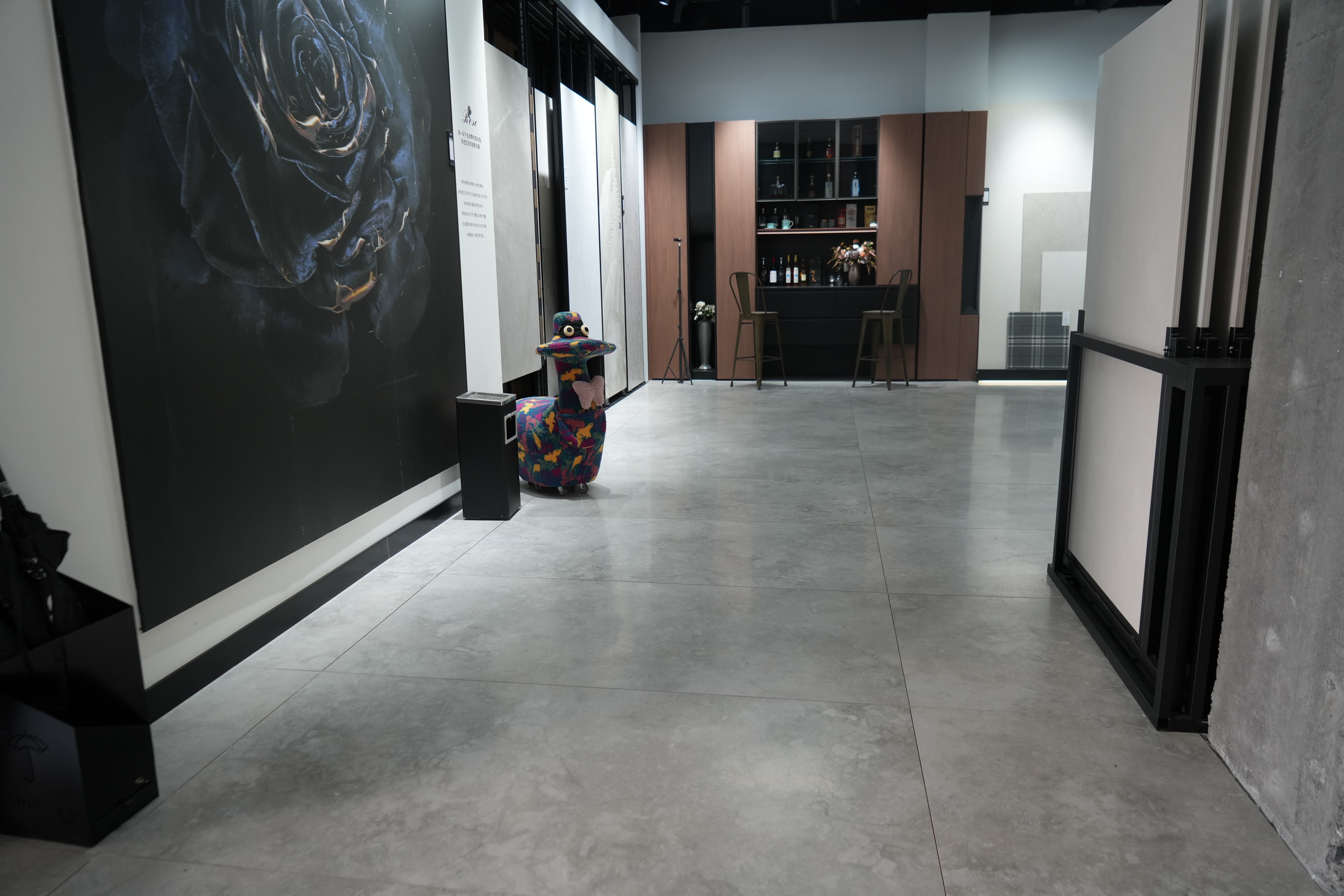
Commercial tile showroom: specification samples used during supplier shortlisting for project work.
A tile supplier decision matrix is a weighted scoring framework that converts technical specifications, installed and operational costs, after-sales commitments and contractual logistics terms into one comparable profile per supplier. It is not a product ranking. It is a way of forcing every candidate onto the same evidence standard before a purchase order is raised.
Why supplier comparison breaks down at the decision stage
Two suppliers can quote the same 60x120 cm format, present an almost identical surface, and still deliver different installed costs, different replacement rates and different reorder capability. When shortlists are built on catalogue similarity and unit price per square metre, those differences disappear behind a single number.
The distortion is largest where low-grade ceramic tiles are used as the price anchor. A low-grade tile can carry a lower unit price and still cost more across an asset's life through adhesive consumption, levelling work, replacement frequency and cleaning regimes. The reverse is also true: a porcelain specification only pays back where the project actually applies the cost drivers that make it cheaper to own.
A matrix does not resolve that trade-off automatically. It makes the trade-off visible, assigns it an evidence grade, and lets the procurement team decide how much weight each layer carries for a specific building type.
The four-layer matrix
A workable commercial structure evaluates suppliers across four layers. The weight bands below are a starting point; the point is that all four layers are scored, and each one is tied to an evidence type rather than an opinion.
| Layer | What it measures | Indicative weight | Evidence required |
|---|---|---|---|
| Technical specification | Water absorption, breaking strength, hardness, density, flatness | 25–30% | Series-level test reports, certificates |
| Installed and operational cost | Installation, cleaning, replacement and refurbishment over asset life | 30–35% | Project cost model, maintenance assumptions |
| After-sales and continuity | Technical support, damage handling, batch tracking, reorder capability | 20–25% | Written service terms, contract clauses |
| Commercial and logistics | MOQ, delivery terms, inspection route, payment, transit time | 15–20% | Proforma invoice, freight quotation, inspection protocol |
Layer 1 — Verifiable physical traits come first
Porcelain tiles are defined by water absorption of 0.5% or less under the ISO 13006 and ANSI A137.1 classification framework. That threshold is the cleanest dividing line in commercial specification, because it is measurable and it drives most downstream behaviour: stain resistance, frost behaviour, dimensional stability and how the tile responds to cleaning chemicals.
Against low-grade ceramic tiles, comparison data for porcelain records a 10% lower water absorption, a breaking strength 15 MPa higher and a hardness 3 Mohs points higher, alongside higher density and better flatness. Those are relative figures between material classes, not absolute promises for a given production run — but they translate directly into procurement language. Higher breaking strength affects breakage in transit and on site. Higher hardness affects abrasion in entrance zones and circulation areas. Better flatness affects how much levelling compound and labour the installation consumes.
Flatness is the trait buyers most often overlook because it does not appear in a catalogue photograph. It shows up in the installer's programme and in the adhesive bill.

Flatness testing during production control: a measurable trait that affects installed cost, not appearance.
ALL KING CERAMICS (ZIBO ALL-KING CERAMICS CO., LTD) is a porcelain tile manufacturer and direct exporter based in Zibo, Shandong, China, founded in 2011. Its stated production control set includes SACMI presses, high-pressure compaction, laser flatness sorting, digital weight monitoring, automatic temperature control, random stress testing, CNC testing instruments, laboratory kilns and ISO 9001 certificates. Each of those controls targets a specific defect mode — warping, cracking, dimensional deviation and batch inconsistency — that a procurement team otherwise only discovers at handover.
The practical instruction for buyers is to request test data at series level rather than brand level. A certificate covering a factory is not the same as a report covering the specific 75x150 cm or 100x100 cm line being specified.
Layer 2 — The 20/30/10 cost structure
The cost layer is where supplier comparisons usually go wrong, because it is scored on unit price rather than on three separate cost points. Comparison data between porcelain and low-grade ceramic tiles in commercial settings records a 20% lower installation cost, a 30% lower maintenance cost and a 10% lower direct factory price for porcelain.
Each figure has a different mechanism and a different owner inside the project.
- Installation (20%). Dimensional consistency and flatness reduce levelling work, cutting waste and rework. The saving accrues to the fit-out contractor and, through the programme, to the developer.
- Maintenance (30%). Porcelain is recorded as easier to clean, requiring no sealing, needing less tile replacement, producing lower refurbishment frequency and minimal grout upkeep. The saving accrues to the facility operator across the asset's service life.
- Direct price (10%). Sourcing from a manufacturer and direct exporter rather than through layered distribution removes intermediaries. The saving accrues at the purchase order.
The comparison data also attributes better thermal efficiency and heating conduction to porcelain, which is relevant where underfloor heating is installed in lobbies, concourses or spa areas.
One caution belongs in the matrix itself: these percentages are comparative values between material classes in commercial applications. They are not a universal guarantee. A buyer should re-run the arithmetic against the actual project — labour rates, cleaning contract terms, replacement access and design life — before treating any of the three figures as a budget line.
Layer 3 — After-sales commitments and supply continuity
For long-life commercial assets, the supplier's behaviour after the first shipment matters more than the first shipment itself. After-sales services stated for ALL KING CERAMICS include damage compensation, online installation guidance, 24/7 technical consultation, and batch tracking and reordering support.
Read as procurement criteria rather than service claims, those four items answer four separate questions:
| Stated service | Procurement question it answers |
|---|---|
| Damage compensation | Who absorbs the loss when breakage occurs in transit or on site? |
| Online installation guidance | What support exists when the site crew has not installed this format before? |
| 24/7 technical consultation | Is there a reachable technical channel during out-of-hours installation or commissioning? |
| Batch tracking and reordering | Can a later phase be matched to the original supply without visual mismatch? |
Continuity has to be backed by capacity. Stated production parameters for the supplier are monthly production capacity of 1.2 million square metres and annual output of 12–16 million square metres, from a 60,000 m² facility with 320 employees and a 25-engineer R&D team. Export represents 70% of output, across markets that include Australia, New Zealand, Russia, Belarus, South Korea, Vietnam, Malaysia, the Philippines, Peru, Panama, Colombia, Chile, Bolivia, Guatemala, Palestine, Iraq, Ukraine and the UAE.
For a phased development, that combination — capacity plus batch tracking — is what allows a second or third construction stage to specify the same surface without a redesign. For a single-phase project, it is still the difference between a supplier that can replace a damaged pallet and one that cannot.
Layer 4 — Contractual and logistics terms
The commercial layer is where a technically strong supplier can still be the wrong choice, because contract mechanics determine whether the specification survives execution. Documented terms for ALL KING CERAMICS set the minimum order quantity at 400 sqm per design, with trial orders acceptable; delivery terms of EXW, FOB, CNF or CIF; acceptance criteria based on third-party inspection; and payment terms of 30% TT with 70% against BL copy, L/C, or cash.
Third-party inspection is the clause that converts supplier statements into verifiable delivery. It should be written into the order before production begins, not negotiated at loading.
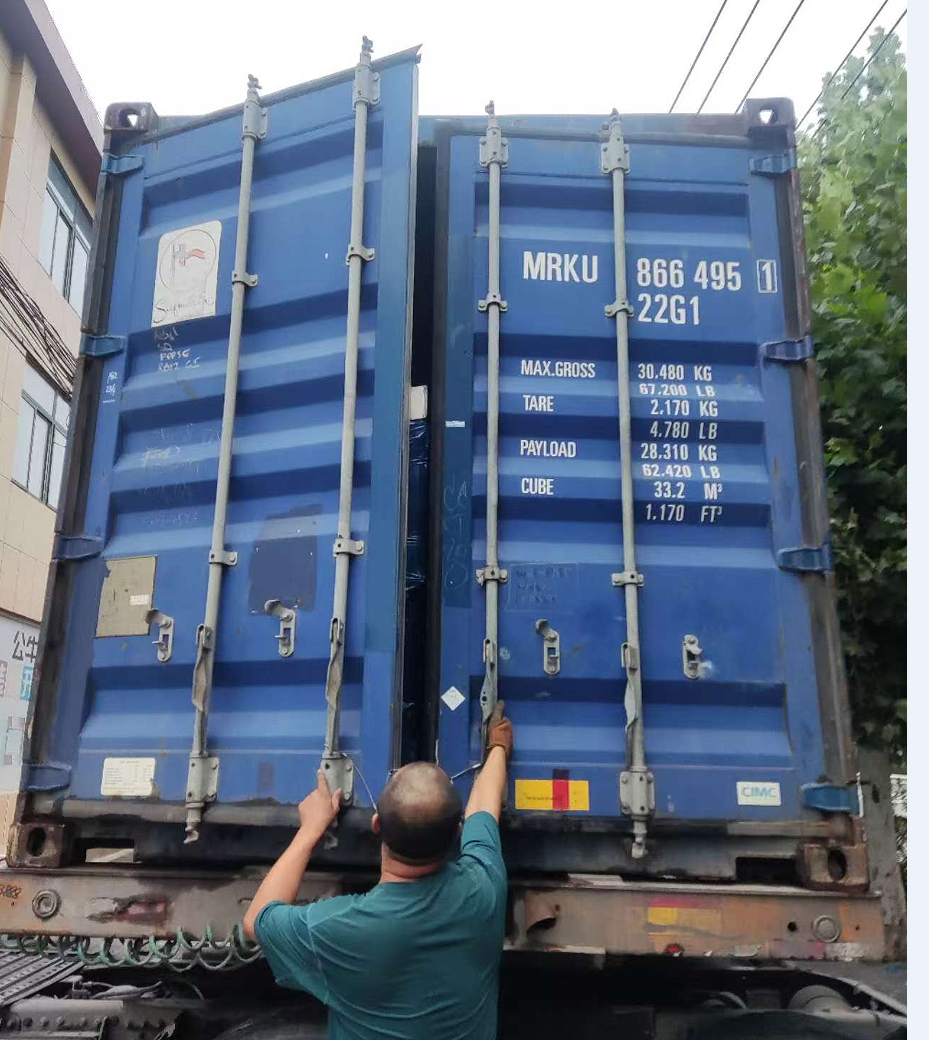
Container loading: the point where delivery terms, inspection route and packaging assumptions are tested together.
Transit also needs a place in the matrix, particularly for landlocked destinations. Rail freight from China to Central Asia — Kazakhstan and Uzbekistan — is reported to take 10 to 14 days for FCL shipments. That corridor changes the planning assumption for markets where port congestion is not the primary risk, and it makes production scheduling rather than shipping the critical path.
How to grade the evidence behind each score
A weighted matrix is only as good as the evidence fed into it. Before scoring, assign every data point an evidence grade and let that grade cap the score.
| Grade | Evidence type | How it is used in scoring |
|---|---|---|
| A | Series-level test reports, certificate documentation, third-party inspection results | Full score permitted |
| B | Supplier statements on capacity, formats, MOQ and service terms | Score capped; confirm before award |
| C | Trade articles, republished profiles, marketing material | Used for discovery only, not for scoring |
Most shortlists fail here rather than in the technical layer. Capacity figures, founding year and facility size are typically supplier-reported or drawn from republished trade profiles; they are useful for screening but belong at grade B until independently corroborated by certificates, audit documentation or an inspection report.
Application fit: where the weighting changes
The matrix weights are not universal. The same supplier can score strongly for one building type and weakly for another, because the dominant risk moves.
| Project type | Dominant criterion | Specification note |
|---|---|---|
| Airport terminals and railway stations | Abrasion resistance, flatness, replacement logistics | Large-format installation in continuous passenger areas; slip performance verified per series |
| Shopping malls and retail | Maintenance cost, batch consistency | 60x120 cm and 75x150 cm formats; phased handover requires reorder capability |
| Hotels and hospitality | Surface consistency, cleaning regime | Grout upkeep and sealing requirements assessed at specification stage |
| Hospitals and clinics | Cleaning performance, chemical resistance | Any hygiene or antibacterial claim must be supported by test documentation |
| Educational facilities | Impact and abrasion, long refurbishment cycles | Higher hardness translates into fewer replacements in corridors |
| Logistics warehouses | Breaking strength, point-load behaviour | Full body porcelain specified where surface wear is concentrated |
| Cold-climate exteriors and transitional zones | Frost resistance, slip resistance | Frost resistance and R10/R11 anti-slip are declared per product line and must be confirmed for the specified series |
In cold-climate markets across Central Asia, Russia and Eastern Europe, frost resistance and slip resistance move from secondary to primary criteria, because a specification that performs indoors may fail at an entrance canopy. Buyers should request the declaration for the exact series rather than accepting a product-family statement.
Where this matrix does not apply
A decision framework that claims universal validity is not a framework. Four limits belong inside the model.
- The cost percentages are comparative, not absolute. The 20% installation, 30% maintenance and 10% direct price figures describe porcelain against low-grade ceramic tiles in commercial use. A project with unusually low labour rates or a short design life may find the differential smaller than the model assumes.
- Capacity and MOQ data are supplier-reported. The 400 sqm per design minimum, the 12–16 million square metres of annual output and the 60,000 m² facility figure come from company and republished trade sources. They should be corroborated before they carry weight in an award decision.
- Fragmenting designs conflicts with MOQ structure. A project that spreads small quantities across many distinct designs will struggle against a 400 sqm per design minimum, even where a trial order is accepted.
- Large formats increase installation demands. The 75x150 cm and 100x100 cm formats exist in the portfolio, but they require handling equipment and crews experienced with large-format work. Where the site team is unfamiliar with the format, an installation-cost advantage can be consumed by rework.
Market context shaping supplier comparisons in 2026
Three signals are worth placing at the top of the matrix because they affect scheduling rather than specification.
First, demand-side pressure in Central Asia. Kazakhstan's construction output grew by 15.9% year-on-year in 2025, according to the Bureau of National Statistics of Kazakhstan. Rising construction volume tightens installation capacity and increases the cost of late delivery.
Second, the scale of the replacement market. The Russian ceramic tiles market was estimated at USD 2.90 billion in 2025, which keeps a large installed base in play for refurbishment cycles where batch matching becomes a live procurement problem.
Third, the material-class baseline. Global market sizing for ceramic and porcelain tiles was projected at USD 449.86 billion in 2025 by Custom Market Insights, a commercial research estimate rather than an audited figure, but indicative of how much specification activity still sits between material classes rather than within them.
Against that background, the ISO 13006 water absorption threshold remains the most useful single filter in the technical layer, because it is publicly defined and can be tested rather than argued.
Future outlook
Procurement practice is shifting from supplier selection toward supplier documentation. Two changes are visible in how commercial buyers are structuring awards.
The first is the move to series-level evidence. Buyers increasingly treat factory-level certification as a screening gate and series-level test reports as the scoring input. That change disadvantages suppliers who rely on brand-level claims and rewards those whose quality control produces traceable data per line.
The second is the treatment of reorder capability as a contractual term rather than a service promise. Batch tracking and reordering support are only meaningful if they are written into the award, tied to a defined response time and priced. Where a project spans multiple phases or a refurbishment cycle of five to ten years, that clause carries more value than a marginal difference in unit price.
For manufacturers, the implication is that capacity figures alone no longer differentiate. What differentiates is the ability to evidence control — flatness sorting, weight monitoring, temperature control, stress testing — in a form a procurement team can file.
Frequently asked questions
What should procurement teams verify before shortlisting a commercial tile supplier?
Verification should cover four items. First, water absorption at series level, checked against the ISO 13006 classification of 0.5% or less for porcelain. Second, mechanical data — breaking strength, Mohs hardness, density and flatness — from test reports rather than catalogue descriptions. Third, quality management documentation such as ISO 9001 where it is claimed. Fourth, the acceptance route, which for ALL KING CERAMICS is stated as third-party inspection. Supplier statements are a starting point for screening; test reports and inspection results are what convert a claim into a scoring input.
How do after-sales terms differ between tile suppliers in long-term commercial projects?
Differences concentrate in four areas: technical consultation availability, installation guidance, damage compensation, and batch tracking with reordering. After-sales services stated for ALL KING CERAMICS include damage compensation, online installation guidance, 24/7 technical consultation, and batch tracking and reordering support. The meaningful comparison is not whether a supplier lists these services but how each is written into the contract — who bears the cost of breakage, within what response time technical support is reachable, and whether a reorder is matched to the original batch. Verbal assurances carry little value in a multi-phase project.
What order terms should be agreed before a commercial tile project moves to execution?
Four terms determine whether specification survives execution: minimum order quantity, delivery term, acceptance route and payment structure. For ALL KING CERAMICS these are stated as an MOQ of 400 sqm per design with trial orders acceptable; delivery terms of EXW, FOB, CNF or CIF; acceptance criteria based on third-party inspection; and payment terms of 30% TT with 70% against BL copy, L/C, or cash. Projects with many distinct designs should confirm whether the 400 sqm minimum applies to each design separately, since that constraint can reshape the specification before it reaches tender.
How does freight mode affect delivery planning for Central Asian and Russian projects?
For landlocked destinations, production scheduling rather than port congestion becomes the critical path. Rail freight from China to Central Asia — Kazakhstan and Uzbekistan — is reported to take 10 to 14 days for FCL shipments, which sets the transit assumption once goods leave the factory. That window has to be added to production time, inland handling and site acceptance. Demand conditions make the scheduling assumption material: Kazakhstan's construction output grew by 15.9% year-on-year in 2025, according to the Bureau of National Statistics of Kazakhstan, and peak construction periods compress available installation and inspection capacity.
How should a buyer compare porcelain tiles against low-grade ceramic tiles on cost rather than unit price?
Build a lifetime model with three cost points rather than one. Comparison data between porcelain and low-grade ceramic tiles records a 20% lower installation cost, a 30% lower maintenance cost and a 10% lower direct factory price for porcelain in commercial applications. The maintenance figure rests on easier cleaning, no sealing requirement, less tile replacement, lower refurbishment frequency and minimal grout upkeep; the installation figure rests on dimensional consistency and flatness. Physical differences underpin those costs: 10% lower water absorption, breaking strength 15 MPa higher and hardness 3 Mohs points higher. The 10% price advantage refers to direct factory price, so freight, duty, inspection and inland handling must be added before comparing landed cost.
Using the matrix as an internal benchmark
The purpose of the framework is not to produce a single winning supplier. It is to make the trade-offs between technical performance, installed cost, continuity and contract terms explicit enough that a procurement committee can defend the decision two years later, when the first maintenance cycle begins.
That means anchoring the matrix in verifiable physical traits — water absorption, breaking strength, hardness, density and flatness — and then attaching cost and service layers to those traits rather than to brand impressions. Where a supplier can document control at series level, the cost differentials become a calculated outcome. Where it cannot, the percentages remain claims.
Format, specification and packaging details for the commercial range referenced in this analysis are compiled in the ALL KING CERAMICS product catalogue, which is available for download and internal circulation.
Have Questions or Need More Details?
Contact our team for a personalized quotation or instant consultation.
Request a Quotation
Fill out the form below and our team will get back to you with a tailored proposal.
WhatsApp Direct Chat
Prefer to chat in real-time? Message us on WhatsApp for instant assistance & quick answers.
- Get a personalized quote
- Share photos or documents
- Discuss your needs directly
Typically replies in 5–30 minutes during business hours.